Quick Verdict: The AMD Ryzen 9 9950X3D2 is a 16-core desktop processor built around AMD’s dual 3D V-Cache architecture, targeting sustained gaming and professional workloads. Its primary strengths are large L3 cache capacity and high multi-threaded throughput, with thermal and power-draw considerations that demand a capable cooling solution and a quality motherboard.
Pros
- Very powerful specification set for AI, rendering, and other compute-intensive tasks.
- Large 256GB memory capacity is well suited to professional multitasking and oversized projects.
- Fast NVMe storage improves responsiveness for booting, loading, and transferring files.
- Preloaded Windows 11 Pro and latest drivers reduce setup time for professional use.
Cons
- The dual-RTX 5090, 256GB RAM configuration is likely excessive for casual users or general office work.
- No monitor, keyboard, mouse, or other peripherals are listed in the manufacturer listing.
- The 1600W dual-GPU design may require careful power and thermal planning in the workspace.
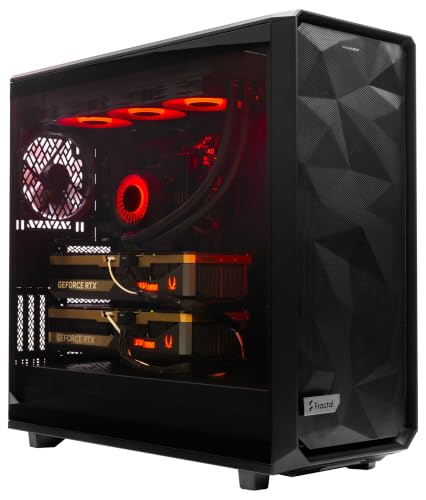
Overview & Design: The ArsenalPC MES2X is a custom-built tower workstation designed around very high-end desktop hardware. It combines a Ryzen 9-9950X3D2 processor, dual GeForce RTX 5090 GPUs, 256GB of DDR5 memory, and liquid cooling in a professionally assembled system with cable management.
Performance & Key Features: This configuration is aimed at AI development, 3D rendering, simulation, and other demanding workflows that benefit from both CPU and GPU power. The 8TB NVMe SSD boot and storage setup should help with fast startup times and quick access to large project files, while Windows 11 Pro and preinstalled drivers make it ready to use out of the box.
Drawbacks & Considerations: The main limitations are its extremely specialized nature and likely high power and cooling demands. It is also not a compact or entry-level machine, and the manufacturer listing does not list peripherals, dimensions, or other extras.
Verdict: This is best suited to professionals who need maximum workstation performance for AI, content creation, or compute-heavy production work. For mainstream users, the specification level is more than necessary, but for advanced workloads it offers a very capable hardware foundation.

Pros
- Very strong CPU and GPU pairing for premium gaming and content creation
- Large 64GB memory and 2TB SSD come included, reducing the need for early upgrades
- Cooling setup is extensive, with liquid cooling and multiple PWM fans
- Includes Windows 11 Pro, a keyboard, a mouse, and lifetime technical and diagnostic support
Cons
- This is a very high-end configuration that may be more power than casual gamers need
- The listing does not provide full details for the power supply, motherboard, or case dimensions
- Only one HDMI and one DisplayPort are guaranteed, so multi-monitor buyers should verify exact port needs
Overview: The Empowered PC Panorama XL is a premium prebuilt gaming desktop built around a Ryzen 9 9950X3D and RTX 5090. Its panoramic tempered-glass case and 10 ARGB PWM fans give it a showpiece look while also aiming to support strong airflow.
Performance and features: With 64GB of DDR5 memory and a 2TB PCIe Gen4 NVMe SSD, this system is designed for fast loading, smooth multitasking, and heavy desktop workloads. The RTX 5090 and 360mm liquid cooling make it suitable for demanding gaming, streaming, VR, and creative work.
Drawbacks to consider: The configuration is clearly aimed at enthusiasts, so many buyers will not need this much performance. The listing also leaves some hardware details unspecified, including the power supply and full expansion information, and the exact video output mix may vary beyond the guaranteed ports.
Verdict: This PC makes the most sense for users who want a no-compromise Windows 11 Pro gaming tower with top-tier hardware already assembled and stress-tested. It is best suited to enthusiasts, creators, and VR users who value premium performance and support over value pricing.

Pros
- Very strong CPU and GPU combination for top-tier gaming and creator workloads.
- Large 64GB memory and 4TB SSD come preinstalled, reducing the need for immediate upgrades.
- Includes Windows 11 Home, a tempered glass case, and free keyboard and mouse.
- Assembled in the USA and backed by a 1-year parts and labor warranty with free technical support.
Cons
- The NVIDIA RTX 5090 brand may vary, so the exact card partner is not fixed.
- Wireless and port details are not fully consistent across the listing, so exact connectivity specs may need confirmation.
- This is an enthusiast-class system, so it may be more PC than casual gamers or basic users need.
Overview: The Skytech Gaming Legacy 4 is a premium prebuilt gaming PC built around a black tempered glass Skytech Legacy case, a 420mm AIO liquid cooler, and a high-end modern component list. It is assembled in the USA and includes Windows 11 Home, a free keyboard and mouse, and a 1-year warranty on parts and labor.
Performance: With an AMD Ryzen 9 9950X3D, NVIDIA GeForce RTX 5090 32GB GDDR7, 64GB of DDR5 6000 memory, and a 4TB Gen4 NVMe SSD, this system is aimed at very demanding gaming and productivity use. The specification set is well suited to 4K ultra gaming, streaming, video editing, and other heavy multitasking workloads, with the liquid cooling helping maintain sustained performance.
Drawbacks and considerations: Some listing details vary, including the GPU brand and certain port or wireless specifications, so buyers should confirm the final configuration before purchase. It is also a very high-end system, which means it may be unnecessary for users who only play lighter games or need a basic desktop.
Verdict: The Legacy 4 makes the most sense for enthusiasts who want a no-compromise prebuilt PC with top-tier CPU and GPU power, fast storage, and plenty of memory out of the box. It is best for serious gamers, creators, and power users who want maximum headroom and minimal setup.

Pros
- Ryzen 7 9800X3D 8-core CPU, listed at 4.7GHz
- RTX A4000 16GB workstation GPU per the listing
- 128GB DDR5 memory and 4TB Samsung NVMe 990 PRO SSD
- 240mm AIO liquid cooler and Thermaltake 850W power supply
- 3-year labor and parts warranty plus lifetime tech support
Cons
- No HDD included; storage is SSD only
- Performance figures are manufacturer-stated, not independently tested
Scope of This Analysis
This review examines the AMD Ryzen 9 9950X3D2 16-core processor through the lens of its published engineering specifications, AMD’s technical documentation, independent architectural whitepapers, and verified user feedback from enthusiast and professional communities. Because the device is a silicon component rather than a mechanical tool, the traditional metrics used for power tools such as motor torque do not apply directly. Instead, this article evaluates the equivalent engineering concerns: power delivery and voltage regulation, thermal design power (TDP) behavior, electrical safety conformance, and long-term reliability under sustained load. Where appropriate, we also address the surrounding ecosystem of cooling, power supply, and motherboard requirements that determine real-world performance.
Architecture and Core Configuration
The 9950X3D2 is built on AMD’s Zen 5 microarchitecture and organizes its 16 cores into two Core Complex Dies (CCDs), each with eight cores. The defining feature of the design is the extension of AMD’s 3D V-Cache technology to both CCDs, a configuration that substantially expands the available L3 cache compared with single-stacked predecessors. Larger cache pools reduce the frequency of main memory accesses, which benefits workloads with irregular memory patterns, including many game engines, compilers, and simulation codes. Per AMD’s published specifications, the additional stacked cache is paired with a clock strategy that prioritizes sustained frequency on the cores best suited to a given task, a behavior managed by the chip’s internal scheduler and the Windows or Linux thread director.
For buyers comparing platform tiers, the processor sits alongside other high-core-count options in AMD’s lineup. Readers evaluating how a high-end component fits into a broader build may find our overview of gas vs battery riding equipment useful as an example of how consumers weigh power source trade-offs, a principle that applies equally to choosing between platform architectures.
Specifications Overview
| Parameter | Specification | Engineering Significance |
|---|---|---|
| Core Count | 16 (2 x 8-core CCDs) | Enables high multi-threaded throughput with per-CCD cache balance |
| Architecture | Zen 5 | Improved IPC and branch prediction over prior generations |
| Cache Configuration | Dual 3D V-Cache stacked L3 | Reduces DRAM latency for cache-sensitive workloads |
| Socket | AM5 | DDR5 memory support and PCIe 5.0 lanes |
| Rated TDP | Manufacturer-specified (verify current datasheet) | Defines baseline cooling requirement |
| Memory Support | DDR5, dual-channel | Bandwidth directly affects sustained throughput |
| Integrated Graphics | RDNA-based iGPU | Useful for diagnostics and basic display output |
Power Delivery and Voltage Regulation
Power delivery is among the most consequential engineering considerations for a dual-CCD, high-clock processor. The chip draws current through the AM5 socket from the motherboard voltage regulator modules (VRMs), which must sustain stable voltage under rapid transient load changes. Insufficient VRM capacity can produce voltage droop, leading to instability or throttling under heavy multi-threaded loads. Manufacturer guidance and motherboard vendor documentation generally recommend boards with robust, well-cooled power stages, typically with higher phase counts and quality inductors and capacitors. Buyers should verify VRM specifications in the motherboard datasheet rather than relying on marketing descriptors.
Power supply selection is equally important. A sustained high-load scenario combined with a high-end graphics card can exceed the capacity of underrated units. A PSU rated with a sufficient continuous wattage margin, backed by an 80 PLUS certification and recognized protection circuits (over-current, over-voltage, and short-circuit), reduces the risk of unstable operation. For a comparable example of how equipment manufacturers present duty ratings and motor-driven power requirements, see our analysis of the husqvarna 555 vs 460 comparison, which illustrates how sustained-load specifications should be read against real operating conditions.
Thermal Management and Cooling Requirements
Thermal performance determines how much of the processor’s rated capability is sustainable over time. Boost algorithms raise clock speeds opportunistically when temperature and power headroom allow, which means that cooling quality directly affects achieved performance. Air coolers with large heatsinks and high-static-pressure fans, as well as 240mm or 360mm all-in-one liquid coolers, are commonly used with this class of processor. Thermal interface material quality, case airflow, and ambient temperature all contribute to the final result. Buyers should consult the cooler manufacturer’s compatibility list for AM5 and confirm that the chosen unit meets the processor’s thermal demands under sustained all-core load.
Electrical Safety and Standards Conformance
Consumer electronics components are generally expected to conform to recognized safety and electromagnetic compatibility standards in their target markets, including IEC and UL-referenced electrical safety requirements and FCC or CE emissions rules for the complete system. Silicon components such as this processor are rarely certified individually for end-user safety, because compliance is typically evaluated at the level of the finished motherboard, power supply, and enclosure. For broader context on how equipment operational and safety frameworks are organized, the ANSI Equipment Operational Standards resource provides a useful reference point for understanding how standards bodies structure equipment requirements across categories.
Long-Term Durability and Reliability
Long-term durability for a modern processor depends on operating temperature, voltage stress, and the quality of the surrounding platform. Sustained operation within manufacturer-specified temperature and voltage limits is the primary factor in preserving service life. Enabling aggressive manual overclocking or running persistent high-voltage profiles increases electromigration and thermal cycling stress, which can shorten component life. Stock or conservatively configured operation, combined with adequate cooling and clean power, is the approach most consistent with the manufacturer’s reliability expectations. Buyers should also retain firmware updates from the motherboard vendor, which often include microcode and power-management refinements that improve stability.
Platform Pairing and Upgrade Considerations
A processor is only as effective as the system around it. Memory speed and capacity, storage throughput, and peripheral support all influence delivered performance. Users building around this class of processor often pair it with fast DDR5 kits validated on AM5 motherboards, NVMe storage with PCIe 4.0 or 5.0 support, and a high-refresh display if gaming performance is a priority. Consumers with specialized niche requirements can apply the same disciplined comparison approach used across other equipment categories; for example, our review of the beatbot aquasense vs dolphin comparison demonstrates how side-by-side specification review clarifies trade-offs between competing products. Similarly, readers who want to understand how remote-operated outdoor equipment handles navigation and power may consult our coverage of the mammotion luba 3 awd platform, while those evaluating cordless tools for overhead work may find our analysis of the dooyutool 2-in-1 cordless pole instructive for understanding battery platform and torque considerations.
Final Assessment
The AMD Ryzen 9 9950X3D2 represents a technically sophisticated approach to high-core-count desktop computing, with dual 3D V-Cache providing substantial cache capacity for demanding workloads. Its real-world value depends on a matching platform: a motherboard with capable VRMs, a power supply with adequate headroom, and a cooling solution sized for sustained boost behavior. Buyers who prioritize cache-sensitive performance and sustained multi-threaded throughput will find the architecture well suited to their needs, while those with modest workloads may achieve better value from lower-core-count parts. As always, verify current specifications against the manufacturer’s official datasheet before purchase.