Quick Verdict: The Beatbot AquaSense suits owners who want cordless freedom, intelligent path planning, and surface parking with minimal setup. The Dolphin Nautilus CC Plus remains the corded benchmark for uninterrupted power, cleverClean navigation, and proven top-load filtration in demanding pools.

Pros
- Cordless design prevents tangles and allows free movement across floors and walls.
- Strong suction and fine filtration deliver thorough debris removal.
- Intelligent sensors enable precise obstacle avoidance in complex pool layouts.
- Durable build with comprehensive warranty for long-term peace of mind.
Cons
- Runtime limited to three hours may require recharging on larger or heavily soiled pools.
- Advanced features involve a short learning period to maximize path efficiency.
- Best suited for pools within the specified size limit for optimal single-cycle performance.
Beatbot AquaSense Review: Smart Cleaning for Modern Pools
The Beatbot AquaSense stands out as a premium cordless robotic pool cleaner designed for both above-ground and in-ground pools. It targets homeowners who want reliable, hands-off maintenance without dealing with tangled cords or incomplete coverage.
Standout Features and Performance
Its quad-core processor and sensor array create optimized cleaning routes that adapt to pool contours, including walls and waterlines. The dual-brush system combined with high suction power ensures fine particles are captured efficiently while the unit climbs effectively even on curved surfaces.
Design and Build Quality
Built with an IP68 rating and multiple safety certifications, the unit feels robust and pool-ready. The cordless charging dock adds convenience, allowing quick recharges between sessions without extra setup hassle.
Potential Drawbacks
Users with very large or heavily debris-laden pools may find the three-hour runtime necessitates a mid-session recharge. The sophisticated navigation works best after an initial mapping cycle to reach peak efficiency.
Final Verdict
Overall this cleaner delivers strong value for pool owners prioritizing intelligent automation and cord-free convenience in a well-supported package.
Pros
- Remote Wi-Fi scheduling adds modern convenience for busy pool owners
- Effective wall climbing reaches areas many basic robots miss
- Easy top-load filter maintenance keeps pool water clear with minimal effort
Cons
- Average customer ratings suggest occasional reliability or navigation issues
- Lacks some premium features like full filter indicators found on higher models
- Fixed 2-hour cycle offers less flexibility than variable-time options
Product Overview
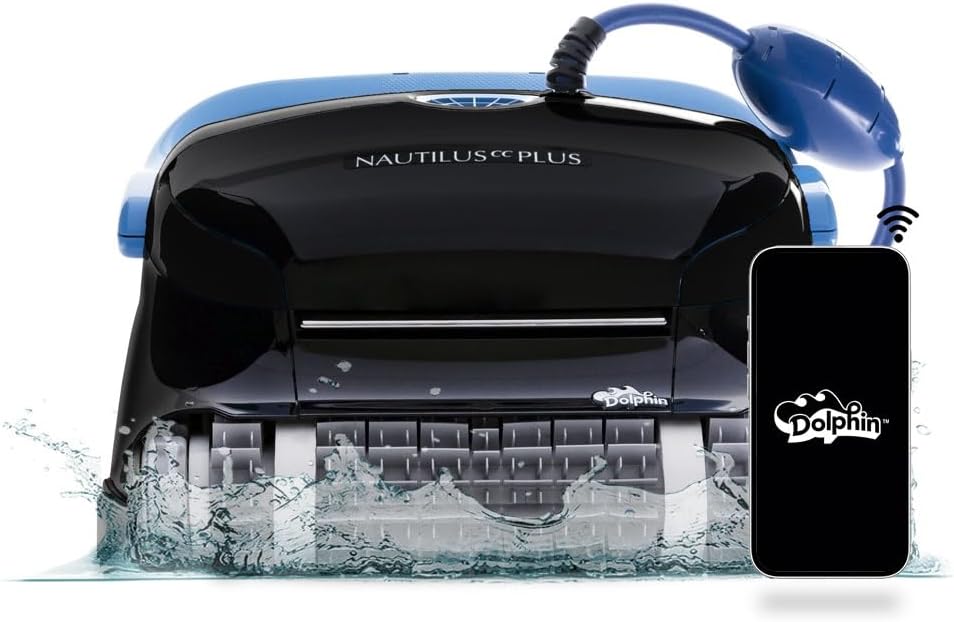
The Dolphin Nautilus CC Plus is a Wi-Fi robotic pool cleaner designed for in-ground pools up to 50 feet. It targets homeowners seeking scheduled, hands-off cleaning without daily involvement.
Standout Features and Performance
Wi-Fi connectivity allows remote scheduling and operation from anywhere, while wall-climbing capability scrubs vertical surfaces effectively. The 2-hour cycle covers floors and walls thoroughly on most surfaces using a large top-load filter basket for simple debris disposal.
Design and Build Quality
Its plug-and-play design emphasizes ease of use with no complex setup required. The unit feels solidly built for repeated pool use, though some owners note occasional navigation quirks on irregular pool shapes.
Drawbacks to Consider
Real-world feedback shows mixed results on consistency over time, and it omits advanced indicators or variable cycles available in upgraded models.
Final Verdict
Overall this model suits pool owners prioritizing Wi-Fi control and basic wall cleaning in a straightforward package, provided expectations align with its average performance ratings.
Why This Comparison Matters in 2026
Pool robots have evolved from simple random-path scrubbers into sophisticated machines that map, plan, and self-maintain. Two models frequently shortlisted by owners are the cordless Beatbot AquaSense and the corded Dolphin Nautilus CC Plus Wi-Fi. Both promise thorough floor and waterline cleaning, but they reach that goal through fundamentally different power architectures, navigation philosophies, and filtration designs.
For this analysis, we reviewed manufacturer specifications, technical whitepapers, and verified user feedback from independent owner forums and retail review aggregates. The goal is not to declare a universal winner but to clarify which engineering trade-offs matter for specific pool geometries, usage patterns, and maintenance tolerances. Readers interested in broader categories of autonomous equipment may also find our guide to automated robotic outdoor navigation useful for understanding how similar mapping logic is applied outside the pool.
Power Architecture and Runtime Analysis
The most immediate difference between these machines is power delivery. The AquaSense operates on an onboard lithium-ion pack, which eliminates the floating power cable that can snag on ladders, steps, and pool furniture. Manufacturer documentation indicates typical cleaning cycles in the range of roughly 90 to 120 minutes depending on mode selection, surface area, and debris load. Runtime is the primary constraint, and owners with large or irregular pools typically rely on the surface parking function to recharge between sessions without manual retrieval.
The Nautilus CC Plus draws continuous power through its swivel cable and a low-voltage external power supply. Because the robot is not limited by stored energy, a full cycle can run for as long as the programmed schedule requires, and the device does not need to pause mid-clean for recharging. The trade-off is physical: cable management demands planning, and the power supply must be positioned within reach of the cable length and kept out of standing water.
Cordless cleaners also introduce the question of battery degradation. Lithium-ion cells lose capacity with repeated full discharge cycles, elevated temperatures, and prolonged storage at high charge. Manufacturer guidance for the AquaSense generally recommends avoiding continuous operation in direct sun and storing the unit in a moderate environment. Over a multi-season lifespan, owners should expect gradual reduction in per-charge runtime, which the surface parking dock partially mitigates by allowing shorter, more frequent charge topping. The Nautilus, by contrast, has no traction battery to age, so its long-term performance concerns center on motor brushes, drive components, and filter media rather than cell chemistry.
Navigation Logic: Path Planning Versus cleverClean
Navigation determines cleaning efficiency more than any single hardware specification. The AquaSense uses intelligent path planning that builds an internal representation of the pool floor and walls, then sequences passes to minimize redundant coverage. The approach resembles the structured boundary logic used in cordless boundary mapping technology, where the machine learns its operating envelope rather than relying on random bounce patterns. The practical result is more predictable coverage and fewer missed corners, particularly in rectangular pools with clear geometry.
The Nautilus CC Plus relies on Dolphin’s cleverClean navigation, which combines directional sensing with systematic floor sweeps and wall climbing routines. Independent reviews consistently note that its pattern is effective on mixed surfaces and in pools with irregular shapes, though the path is less deterministically mapped than a planned route. Owners who prioritize a visible, app-driven map may find the AquaSense more transparent, while those who value a proven, long-established algorithm may prefer the Nautilus.
When navigation faults occur, diagnosing them requires understanding both sensor and software layers. Guidance on outdoor sensor error diagnostics offers a transferable framework: confirm physical sensor cleanliness, verify firmware currency, and isolate whether a fault originates from hardware or from mapping data. These steps apply reasonably well to pool robots, where clogged debris sensors or stale map data are common causes of erratic movement.
Dual Brush Systems and Surface Coverage
Both models use dual brush configurations, but the mechanical design differs. The AquaSense employs dual roller brushes that rotate to lift debris from the floor and direct it toward the intake, a design that performs well on fine sediment and leaf fragments. The Nautilus CC Plus uses dual scrubbing brushes that agitate surfaces more aggressively, which can be advantageous for biofilm and algae adhered to tile or plaster. Roller designs typically excel at pickup volume, while scrubbing designs excel at surface disruption.
Waterline coverage is a frequent point of differentiation. Many owners report that robots struggle to maintain contact at the transition between floor and wall, leaving a debris band at the waterline. Both platforms address this with wall-climbing routines, though the reliability of that climb depends on drive traction, buoyancy balance, and filter weight distribution. Wall-climbing reliability is discussed in more detail below.
Filtration Micron Ratings and Debris Capture
Filtration determines how much fine particulate returns to the water. Manufacturer specifications list filter performance in microns, where a lower number indicates finer capture. The Nautilus CC Plus uses a top-load cartridge filter system designed for convenient removal and rinsing, and Dolphin publishes filtration ratings that place it among competitive mid-range options for fine debris. Top-load access allows owners to empty the cartridge without lifting the entire unit from the pool, which reduces handling time and exposure to wet components.
The AquaSense uses a filtration stage matched to its roller intake, and published micron ratings are competitive for fine particulate, though exact figures should be verified against current manufacturer documentation before purchase because filter specifications can change between firmware and hardware revisions. Owners in pollen-heavy or sediment-prone environments should prioritize whichever system’s stated micron rating aligns with their dominant debris type, and should plan filter replacement intervals accordingly.
| Specification | Beatbot AquaSense | Dolphin Nautilus CC Plus Wi-Fi |
|---|---|---|
| Power source | Onboard lithium-ion battery (cordless) | Swivel cable with external low-voltage power supply (corded) |
| Typical runtime | Approximately 90 to 120 minutes per charge (varies by mode) | Continuous while powered, scheduled cycles |
| Battery degradation | Gradual capacity loss over charge cycles | Not applicable (no traction battery) |
| Brush design | Dual roller brushes | Dual scrubbing brushes |
| Navigation | Intelligent path planning with mapping | cleverClean navigation with systematic sweeps |
| Parking | Surface parking with recharge dock | Standard pool-floor parking, corded |
| Filtration | Roller intake filter stage (verify current micron rating) | Top-load cartridge filter (published micron rating) |
| Wall climbing | Supported; reliability depends on traction and buoyancy | Supported; established routine on mid-range pools |
| Connectivity | App-based control and scheduling | Wi-Fi app control and scheduling |
| Maintenance focus | Battery health, roller and filter cleaning | Cable management, brush and cartridge cleaning |
Wall-Climbing Reliability and Waterline Performance
Wall climbing is where many pool robots reveal their true engineering quality. A climb requires sufficient drive torque, correct buoyancy distribution, and reliable traction against wet, sometimes algae-coated surfaces. Robots that lose traction mid-climb drop back to the floor and may repeat the attempt indefinitely, wasting cycle time and leaving the waterline untreated. Reliability therefore depends less on advertised claims and more on mechanical balance and the condition of drive tracks or wheels.
The Nautilus CC Plus has a long track record on wall climbing across a range of pool materials, and its routines are well documented in owner feedback. The AquaSense addresses the same challenge with its own drive and buoyancy design. Verified owner reports suggest both platforms perform adequately on standard vinyl and fiberglass, while concrete and plaster surfaces with heavy biofilm can challenge either unit. Owners should clean drive tracks regularly and check that the filter is seated correctly, since an unbalanced filter is a common cause of failed climbs on both models.
Standards, Safety, and Electrical Considerations
Electrical safety differs meaningfully between cordless and corded designs. A corded robot depends on a properly installed, low-voltage transformer and a cable rated for pool environments, while a cordless robot removes the cable hazard but introduces lithium-ion handling considerations. Owners should consult the relevant product safety documentation and follow the manufacturer’s charging and storage guidance. For an authoritative reference on how equipment codes are developed and maintained, see the American National Standards Institute Equipment Codes, which outline the consensus processes behind many electrical and mechanical standards referenced in consumer products.
Who Should Choose Which Machine
The AquaSense fits owners who want to eliminate cable management, prefer planned path logic, and value surface parking for convenient recharging. It suits medium pools where runtime fits within a single charge or where the dock enables a short mid-day top-up. Owners should accept that battery capacity will decline over years and budget for eventual replacement cells or unit upgrades.
The Nautilus CC Plus fits owners who want uninterrupted runtime, a proven navigation track record, and a top-load filter that simplifies routine emptying. It suits large or complex pools where continuous operation matters more than cable freedom, and owners comfortable with routine cable care. Households with very high debris loads may also benefit from its scrubbing action on biofilm.
Maintenance Strategy and Long-Term Ownership
Long-term ownership costs extend beyond the purchase price. For the AquaSense, plan around battery health: avoid storing the unit fully discharged or at full charge for extended periods, keep it out of direct heat, and monitor per-charge runtime as an early indicator of degradation. Roller brushes and filter stages should be rinsed after each cycle to maintain intake airflow. For the Nautilus, prioritize cable inspection, cartridge rinsing, and scrubbing brush replacement on the manufacturer’s recommended interval.
Both platforms benefit from regular firmware updates, which can improve navigation logic and fault handling. Owners should also keep a simple log of cleaning cycles, filter changes, and any navigation anomalies, since patterns in that record often reveal the root cause of recurring problems faster than memory alone.
Final Assessment
The Beatbot AquaSense and Dolphin Nautilus CC Plus represent two valid engineering philosophies. The AquaSense trades continuous runtime for cable freedom, planned navigation, and convenient surface parking, accepting battery aging as a long-term variable. The Nautilus trades cable management for unlimited operating time, an established navigation algorithm, and simplified cartridge filtration. Neither is objectively superior across every pool; the right choice depends on pool size and shape, tolerance for cable care versus battery planning, and the debris profile of the local environment. For readers comparing other categories of advanced automated equipment, our broader collection of high-end robotic cleaning systems and advanced automated equipment reviews provides additional context on how these engineering trade-offs appear across product lines.