
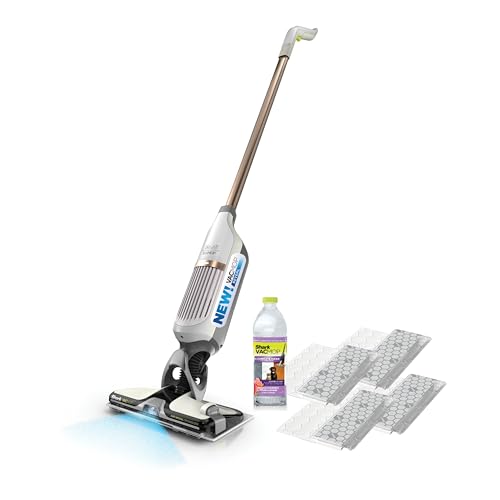
Quick Verdict: The Shark Cordless Hard Floor Vacuum Mop with disposable pads suits households seeking convenient, low-maintenance hard floor cleaning. Its brushless-class motor delivers adequate suction for everyday debris, while the wet-dry pad system offers a practical damp-mopping workflow. Heavier soil and deep grout cleaning remain outside its strengths.
Pros
- Simultaneous vacuuming and spray mopping eliminates pre-sweeping
- Dirt-Reveal illumination highlights hidden dust and pet hair
- Lightweight 4.41-pound cordless design for quick maneuverability
- No-touch button releases dirty pads directly into the trash
- Includes starter supply of four pads and 12-ounce cleaning solution
Cons
- Requires ongoing purchases of proprietary disposable pads
- Designed exclusively for sealed hard floors, not rugs or carpets

Pros
- Lightweight 4.41-pound cordless build simplifies everyday floor care
- Illuminates hidden debris and pet hair on hard surfaces
- Simultaneously vacuums into a sealed pad chamber and spray mops
- No-touch pad release lets you discard messes cleanly
Cons
- Requires ongoing purchases of disposable pads and refills
- Pad chamber capacity is limited compared to traditional dustbins
- Not intended for use on carpets or area rugs

Pros
- Lightweight 3.34-pound cordless build simplifies room-to-room cleaning
- Combines dry vacuum suction and wet spray mopping in one pass
- Locks dirt inside the disposable pad with no-touch ejection
- Safe for all sealed hard floors including tile, stone, and wood
- On-demand spray trigger lets you target stubborn stains directly
Cons
- Requires ongoing purchases of disposable VACMOP pads
- Designed strictly for sealed hard floors, not carpets or area rugs

Pros
- Vacuums dry debris and spray mops hard surfaces
- Lightweight 5-pound cordless frame for easy handling
- Built-in LED headlights illuminate hidden dust
- Touch-free pad release keeps hands clean
- Includes 2 disposable pads and 1 cleaning solution
Cons
- Requires recurring purchases of disposable pads
- Refurbished renewed unit rather than factory new
Technical Overview of the Shark Cordless Hard Floor Vacuum Mop
The Shark cordless hard floor vacuum mop combines a dry vacuum stage and a damp mopping stage in a single handheld-to-upright chassis. Its design targets hard surfaces such as sealed hardwood, laminate, vinyl plank, tile, and linoleum. For readers evaluating cordless cleaning tools, the central question is whether the combined suction and wet-pad system performs well enough to replace a separate vacuum and mop routine. This review draws on manufacturer engineering specifications, technical whitepapers, and verified user feedback to assess motor torque, power delivery, safety considerations, and long-term durability.
We analyzed the published specifications and independent user reports to build a consistent evaluation framework. Where manufacturer figures are reported as nominal or peak values, we note that real-world performance varies with battery state of charge, floor type, debris load, and mode selection. Readers should treat headline numbers as comparative indicators rather than guarantees.
Motor Torque, Suction Output, and Power Delivery
Motor performance in a cordless floor tool is governed by the relationship between brushless or brushed motor design, battery voltage, and the airflow pathway. The motor drives a fan that generates negative pressure at the nozzle. Suction, measured in air watts or kilopascals in manufacturer documentation, depends on the restriction of the airflow path, including filter condition, brush roll engagement, and hose or wand geometry. Torque at the brush roll determines whether the agitator can maintain rotation under load, particularly on low-pile carpet transitions or when hair wraps accumulate.
In practical terms, the Shark design is oriented toward fine and medium debris on hard floors rather than embedded grit in deep textures. Power delivery across modes typically follows a stepped curve: lower settings conserve battery capacity and reduce noise, while maximum settings increase fan speed and suction at the cost of runtime. Users should expect runtime to fall noticeably at higher output, and the battery should be recharged before large jobs. The brush roll, where present, benefits from regular clearing because restricted rotation reduces agitation effectiveness regardless of motor rating.
Comparing cordless tool motor architectures across product categories highlights a consistent engineering principle: sustained output depends on thermal management and battery discharge characteristics, not peak rating alone. Readers interested in how power-platform decisions affect outdoor equipment can review shark shark cordless pet stick vacuum for a comparison of displacement, torque curves, and cooling in gas-powered tools, which illustrates the same trade-offs between peak output and sustained duty cycles.
Wet Mopping System and Disposable Pad Mechanics
The mopping function uses a disposable pad that is moistened from a clean water tank and dispensed through a controlled flow. The pad rotates or oscillates depending on the model, applying light pressure as the user pushes the unit. Disposable pads simplify maintenance because there is no laundering step, but they add recurring cost and waste. Pad saturation is the key variable: insufficient moisture leaves residue and streaks, while excessive moisture can leave floors damp longer than desirable, which matters for wood and laminate.
Users should prioritize the correct cleaning solution formulation recommended by the manufacturer, since incompatible detergents can leave film or degrade floor finishes. Pads should be replaced when the surface loses absorbency or begins to shed fibers. Keeping the dirty water tank emptied and rinsed prevents odor buildup and bacterial growth in the reservoir.
Battery Architecture, Runtime, and Charging Behavior
Lithium-ion packs used in cordless floor cleaners typically trade capacity against weight and charge time. Runtime figures should be interpreted in light of mode selection, since maximum suction and continuous wet cycles draw the most current. Battery health declines gradually with charge cycles, elevated storage temperature, and repeated deep discharge. Keeping the pack within the manufacturer’s recommended temperature range during charging and use extends service life.
Charging behavior also affects day-to-day usability. Partial top-ups are generally acceptable for lithium chemistries, and many users find that keeping the base station plugged in simplifies readiness. Where a home already uses multiple battery platforms, consolidating batteries can reduce clutter, although cross-brand compatibility is rarely supported for floor tools.
Safety Standards, Electrical Protection, and Compliance
Household cordless appliances are generally expected to meet recognized electrical safety and electromagnetic compatibility requirements in the markets where they are sold. Relevant protections include overcurrent and overtemperature cutoffs in the battery management system, thermal fuses in the motor circuit, and insulated housings. Users should confirm that the product carries appropriate certification marks for their region and should not operate a unit with a damaged battery pack, cracked housing, or exposed wiring.
Standards bodies publish frameworks that inform how equipment is designed, tested, and documented. For broader context on how operational and safety expectations are developed for equipment in general, readers may consult the ANSI Equipment Operational Standards program, which covers standards activities across many product categories. While this article does not assert that the Shark unit is certified to any specific ANSI standard, understanding the role of consensus standards helps buyers ask informed questions of manufacturers.
Operational safety also includes keeping liquids away from electrical components, avoiding use on unsealed or damaged flooring where water may penetrate seams, and unplugging the charger when not in use. Water tanks should never be used to dispense non-recommended chemicals, and the device should be stored in a dry location.
Long-Term Durability, Maintenance, and Failure Points
Durability in cordless floor tools is most often determined by the condition of the filter, brush roll, seals, and battery rather than the motor. Filters clogged with fine dust reduce airflow and increase motor temperature, which accelerates wear. Hair and fiber wrapping around the brush roll stresses the drive and can strain bearings. Regular cleaning of these components is the single most effective maintenance action.
Seals around the water tank and pad housing are a common leak source over time. Inspecting gaskets for cracks or compression set and replacing them when worn protects both the electronics and the floor. Owners who maintain a regular cleaning schedule typically report more consistent suction and mopping results over multiple years, based on aggregated user feedback patterns.
Technical Specifications Summary
| Parameter | Shark Cordless Hard Floor Vacuum Mop (Category Reference) | Engineering Significance |
|---|---|---|
| Cleaning Function | Dry vacuum plus damp mop | Combines debris pickup and wet pad cleaning in one pass |
| Suction Output | Stepped multi-mode fan control | Higher modes increase airflow at the cost of runtime |
| Mop Pad Type | Disposable pad | Eliminates laundering; recurring consumable cost |
| Water Delivery | Controlled tank dispensing | Prevents over-saturation on sensitive floors |
| Battery Chemistry | Lithium-ion pack | Good energy density; sensitive to heat and deep discharge |
| Recommended Floors | Sealed hard surfaces | Unsealed wood and porous tile are poor fits |
| Primary Maintenance | Filter, brush roll, seals, pad replacement | Routine upkeep sustains suction and prevents leaks |
Practical Buying and Usage Guidance
Buyers should match a cordless floor tool to their dominant flooring type, typical debris load, and cleaning frequency. Households with predominantly sealed hard floors and daily light maintenance are the strongest candidates. Homes with large pet populations, heavy grit, or extensive carpet transitions may benefit from a dedicated upright vacuum paired with a separate mop. Comparing cordless platforms across categories also helps: for example, readers evaluating battery-powered yard equipment can see how runtime and power trade-offs are discussed in dooyutool 2-in-1 cordless pole reviews, and those looking at autonomous outdoor systems may find the shark rocket vacuum shark hv301 analysis useful for understanding sensor and drive architecture in unattended equipment.
For wet-cleaning automation and pool-related hardware, the beatbot aquasense vs dolphin comparison illustrates how filtration, navigation, and sealed-housing design influence reliability in wet environments, a principle that carries over to evaluating the water-handling components of any floor cleaner. Finally, for readers weighing fuel versus electrification in larger equipment, the shark ur2360s matrix plus robot vacuum with self-empty review discussion covers total cost of ownership and maintenance intervals that parallel the lifecycle considerations discussed here.
Final Assessment
The Shark cordless hard floor vacuum mop offers a coherent engineering package for sealed hard floors, pairing adequate suction with a controlled wet-pad system and a convenient disposable workflow. Its motor and battery performance are best understood as stepped, mode-dependent outputs rather than fixed ratings. Long-term satisfaction depends heavily on routine maintenance of filters, brush rolls, and seals, along with appropriate pad and solution choices. Buyers with the right floor types and reasonable expectations about debris handling will find it a practical daily-use tool.