Quick Answer: Choosing the Best Affordable Robot Vacuum
Critical factors for choosing an affordable robot vacuum in 2026 center on suction power ranging from 2300Pa to 10000Pa for effective debris and pet hair removal, navigation systems using gyroscope or LiDAR for systematic coverage instead of random patterns, and runtime of 100-200 minutes to handle spaces up to 1290 square feet. Prioritize tangle-free suction ports, app or voice…

Pros
- AutoEmpty dock holds debris for up to 75 days
- ClearView LiDAR provides precise mapping and navigation
- Automatically detects and avoids rugs while mopping
- Customizable suction levels and mopping liquid flow
- SmartScrub mode provides deeper floor scrubbing
Cons
- Requires a 2.4 GHz Wi-Fi network for operation
- Stands over 4 inches tall, which may limit low-clearance reach

Pros
- Self-emptying dock holds debris in a 3L sealed dust bag
- LiDAR navigation stores up to 5 multi-floor maps
- Boosts suction up to a claimed 6,000Pa on carpets
- Up to 150-minute runtime in gentle mode with auto-resume
- Supports both 2.4 GHz and 5 GHz Wi-Fi connections
Cons
- Requires manual removal of mop holder or no-mop zones on rugs
- Max runtime is rated under the lowest suction setting

Pros
- 3L self-emptying base minimizes manual dustbin disposal
- Four suction levels up to 6000Pa adjust for different floor types
- LiDAR system scans layouts to create multi-room maps and no-go zones
- Three electronic water flow settings prevent over-wetting hard floors
Cons
- App integration and Alexa commands depend solely on 2.4GHz Wi-Fi
- Mopping requires setting no-go zones to prevent contact with rugs

Pros
- Strong suction and sonic mopping handle pet hair and stuck-on messes effectively in one cycle.
- LiDAR navigation creates accurate maps for methodical cleaning even in low light.
- Self-emptying base reduces frequent interventions for busy households.
- Edge and corner detection improves perimeter cleaning performance.
Cons
- Average 3.5 rating suggests occasional navigation or reliability inconsistencies.
- Reusable mop pads require regular washing to maintain effectiveness.
- App features may need updates for smoother multi-room scheduling.
The Shark Matrix Plus Review highlights a capable 2-in-1 robot vacuum and mop designed for carpets and hard floors in homes with pets. It combines powerful suction with sonic mopping to deliver efficient whole-home cleaning while the self-empty base minimizes upkeep.
Standout Features and Performance
Matrix Clean technology drives the robot in a grid pattern for multiple passes that improve dirt removal. Sonic mopping scrubs at 100 times per minute, and CleanEdge Detect blasts air to pull debris from edges. Users gain reliable pet hair pickup thanks to the self-cleaning brushroll that avoids wraps.
Design and Build Quality
The unit uses 360-degree LiDAR for precise mapping and obstacle avoidance day or night. The bagless XL base features true HEPA filtration to contain allergens effectively after each cycle.
Drawbacks to Consider
Some owners report mixed long-term durability and occasional app connectivity issues that can interrupt scheduled cleans. Reusable pads add a small maintenance step compared to disposable options.
Final Verdict
This model suits pet owners seeking automated floor care with minimal intervention. It balances suction power, mopping action, and self-maintenance well for most households despite average user ratings.

Pros
- Self-emptying dock holds up to 90 days of debris
- Simultaneous vacuuming and mopping with 15,000Pa suction
- LiDAR navigation enables precise row cleaning and obstacle avoidance
- Anti-hair-wrap brushes reduce tangles from pet fur
- Customizable cleaning with No Mop Zones and SmartScrub settings
Cons
- 900 sq ft per charge limit may require recharges for large homes
- Requires a 2.4 GHz Wi-Fi network for setup

Pros
- AutoEmpty dock holds up to 75 days of debris in a sealed bag
- Simultaneous vacuuming and active micro-pump mopping saves time
- LiDAR mapping navigates efficiently in neat rows day or night
- Automatically avoids mopping over carpets and rugs
- Customizable suction, water flow, and no-go zones via app
Cons
- At 4.1 inches tall, it may not fit under low-profile furniture
- Requires a 2.4 GHz Wi-Fi network for setup and operation

Pros
- SLAM navigation with 12 sensors plans cleaning paths (manufacturer-stated)
- Scheduled cleaning lets the robot run while you are away
- Real-time view of the cleaning path and progress
- 5200 mAh battery with manufacturer-stated multi-protection design
Cons
- Rated runtime of about 2.5 hours per charge (manufacturer-stated)
- Listing details are incomplete, with no customer reviews or full description

Pros
- 5000 Pa suction with manufacturer-stated carpet auto-boost
- Tangle-free design aims to reduce hand-removal of pet hair
- Returns to its dock automatically when the battery runs low
- Five cleaning modes: Auto, Manual, Edge, Spot, and Room
- 2.87-inch profile for under beds and low furniture
Cons
- Small 250 mL dustbin and 200 mL water tank for large areas
- Runtime and coverage figures are manufacturer-stated

Pros
- Separate 300ml dustbin and 300ml water tank for vacuuming or mopping
- Five cleaning modes: Auto, Spot, Edge, Max, and Scheduled
- Remote, ILIFE Home app, and Alexa or Google Assistant voice control
- App shows cleaning routes and adjusts suction and water output
- Manufacturer rates up to 110 minutes of runtime per charge
Cons
- Vacuuming and mopping cannot run simultaneously
- App works only on 2.4GHz Wi-Fi, not 5GHz networks
- Requires about 5 hours of full charging before first use
Essential Engineering Checklist for Affordable Robot Vacuum
Suction Power and Pet Hair Management
Suction power forms the foundation of cleaning effectiveness for any affordable robot vacuum. Models delivering 2300Pa to 6500Pa handle everyday dust, crumbs, and light pet hair on hard floors, while units reaching 10000Pa excel at extracting embedded debris from low-pile carpets via auto-boost features. Brushless or tangle-free suction ports outperform traditional rollers for pet owners by preventing hair wrap, reducing the need for manual detangling after each session. Select based on household needs: 4000Pa minimum for multi-pet homes ensures thorough lift without repeated passes, and pair with dual side brushes for edge efficiency. Practical guideline: match suction modes (eco for quiet daily runs, max for weekly deep cleans) to floor types to optimize battery use. To evaluate matched hardware tolerances, consult our detailed overview of why robot vacuum keeps getting lost lidar fix.
Navigation Technology and Coverage Efficiency
Navigation determines whether the unit completes rooms systematically or wastes energy on random bounce patterns. Gyroscope and inertial systems provide orderly zigzag paths suitable for most homes under 1290 square feet, reducing missed areas compared to basic infrared. Advanced dToF or LiDAR options enable multi-floor mapping, no-go zones, and precise obstacle avoidance via PSD sensors that detect cords or furniture at millimeter accuracy. For budget-conscious buyers, gyroscope models with 15-degree climbing ability cover thresholds reliably. When evaluating, prioritize units that auto-return for recharge and resume, ensuring full-home completion. Homes with complex layouts benefit from reviewing robot vacuum with self-empty integrations for reduced upkeep alongside strong path planning.
Battery Runtime and Area Coverage
Battery capacity directly impacts practical usability, with 2500-2600mAh packs delivering 100-200 minutes depending on suction mode. Eco settings often yield 200 minutes for light maintenance across large open areas, while max suction drops to 70-100 minutes for intensive pet hair sessions. Target coverage of at least 1290 square feet per charge to handle average main floors without mid-clean docking. Auto-recharge and resume functions extend utility for multi-story homes. Calculate needs by measuring primary living space and adding 20 percent buffer for edges and furniture underpasses. Units with side power switches further protect battery longevity during storage.
Smart Controls, App Integration, and Noise Levels
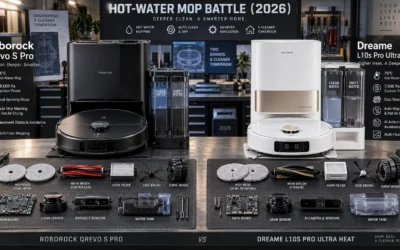
App and voice connectivity via 2.4GHz Wi-Fi, Alexa, or Google Assistant enable scheduling, mode switches, and remote starts even when away. Prefer dual-band support where available for faster response, and features like cleaning history logs or water level adjustment for mop combos. Noise stays critical for daytime use: look for 55-65dB operation quieter than conversation levels to run during work calls or naps. Remote controls serve as reliable backups for non-Wi-Fi models. Integration simplicity reduces setup friction, making daily automation seamless for families. When planning workspace deployment, consider the engineering criteria outlined in our roborock qrevo s pro vs dreame l10s pro ultra heat guide.
Design Profile, Mopping, and Maintenance Ease
Slim designs measuring 2.8-2.99 inches tall access under beds and sofas for 98 percent floor coverage, outperforming bulkier units. 2-in-1 vacuum-mop combos with 200-230ml water tanks and washable pads handle hard floors efficiently, but require manual mop removal on carpets to avoid wetting. Carpet detection with auto-boost adds versatility. Maintenance focuses on emptyable 300-450ml dustbins, HEPA filters cleaned bi-weekly, and tangle-free ports that cut pet hair care time. For compact spaces, consider how the smallest robot vacuum designs improve maneuverability in tight rooms. Warranty coverage of 12 months minimum plus responsive app support enhances long-term reliability.
Our team applied a data-driven process to assess top-rated affordable robot vacuum models by aggregating manufacturer specifications for suction, battery capacity, height, navigation type, and dustbin volume. We cross-referenced these against user-reported metrics on coverage consistency, pet hair handling reliability, and app responsiveness where available, while factoring warranty duration and brand support quality. Evaluation weighted performance balance against the entry-level to premium, excluding units lacking self-charging or basic obstacle sensors. This approach prioritizes objective technical utility and long-term value over marketing claims, ensuring recommendations align with diverse home layouts and cleaning frequencies in 2026.
Brand reliability from leading manufacturers further informed selections, emphasizing models with verifiable features like tangle-free designs and multi-mode cleaning for practical daily use. For additional operational safety benchmarks, see our published testing notes on why is my robot vacuum not dispensing water.
Final Verdict: Choosing the Right Affordable Robot Vacuum
After analyzing the full set of specifications, clear leaders emerge based on buyer priorities. The ILIFE A30s Robot Vacuum stands as the Best Overall Affordable Robot Vacuum due to its 10000Pa max suction, LiDAR navigation with multi-floor mapping and no-go zones, dual anti-tangle brushes for pet hair, 150-minute runtime, and full app plus voice control. These specs deliver comprehensive coverage and deep cleaning on hard floors and carpets, justifying its position for most households seeking efficiency without premium cost.
For Best Value / Budget Choice, the XIEBro Robot Vacuum and Mop Combo with 6500Pa suction, gyroscope navigation, 200-minute runtime, and 2-in-1 mopping capability provides exceptional cost-to-performance. Its four suction modes, app/voice control, and large dustbin handle mixed floors and pet debris effectively within tight budgets. Best for Pet Hair and Slim Access goes to the Lefant LiDAR Robot Vacuum and Mop M330 Pro, featuring tangle-free suction, carpet detection with auto boost, dToF mapping, 95mm ultra-slim body, and dual-band Wi-Fi for precise avoidance and wide coverage under furniture.
Quiet self-charging options like the eufy Robot Vacuum 11S MAX suit noise-sensitive environments with 55dB operation and BoostIQ adaptive suction. Overall, prioritize LiDAR for complex homes or high-suction gyro models for open layouts. Explore complementary high-end mapping insights via our guide to the Ecovacs Deebot T20 Omni robot vacuum and mop when scaling up features later. These selections ensure reliable floor care tailored to 2026 needs.
Common Questions on Affordable Robot Vacuum Answered
Is it worth buying an affordable robot vacuum in 2026?
Yes, entry-level models now deliver 2300Pa-10000Pa suction, systematic navigation, and smart scheduling at accessible prices within entry-level to premium. Technological improvements make them efficient for daily pet hair and dust control compared to older random-path units, providing clear time savings for most homes.
How often should I empty the dustbin and clean sensors on my robot vacuum?
Empty the dustbin after every cleaning cycle for optimal suction, especially in pet households, and wipe sensors with a dry cloth every two weeks. This prevents navigation errors and maintains consistent performance over months of use.
Can an affordable robot vacuum handle multiple floor types including carpets?
Most models transition between hard floors and low- to medium-pile carpets via adjustable suction or auto-boost features. Confirm carpet detection and 15-degree climb ability for seamless movement, then refer to our vacuum cleaner category page for specialized flooring advice.
What suction power is needed for effective pet hair removal?
Target 4000Pa or higher combined with a tangle-free brushless port for reliable pet hair pickup from floors and carpets. Lower 2300Pa units work for light shedding but may require more frequent passes on heavy deposits.
Do budget models support app control and voice assistants?
Yes, the majority of current affordable robot vacuum options include 2.4GHz Wi-Fi app scheduling plus Alexa or Google Assistant compatibility. Confirm dual-band support for better connectivity reliability in denser networks.
Getting Value From a Lower Cost Model
A lower price often means fewer sensors or a smaller battery, so read the specifications closely. Consider your floor type and home size first, then compare the features that fit those needs. For general electrical safety principles that apply to any charger, the International Electrotechnical Commission (IEC) is a reasonable place to look.