Quick Answer: Battery Powered Cordless Pressure Washer Overview
Brushless motors replace carbon contact brushes with electronic commutation. The practical result: 10 to 15% more energy reaches the pump rather than dissipating as heat and friction. For a cordless pressure washer running on a fixed battery capacity, that efficiency gain translates directly into longer run time per charge and a motor that lasts 3 to 5× longer than a brushed equivalent. Always prioritize “brushless” in the spec sheet over raw PSI claims when comparing cordless models.
Voltage vs. Amp-Hours: Which Matters More?
Voltage sets the motor’s power ceiling. Amp-hours (Ah) set how long you can run at that ceiling. Think of voltage as water pressure in a pipe and amp-hours as the tank size. A 40V 4.0 Ah battery stores 160 watt-hours (Wh) of energy. A 20V 4.0 Ah battery stores 80 Wh, half the energy at the same Ah rating. For any given task, a higher-voltage platform finishes faster and with more force, so it may consume less total energy even though the motor draws more watts per minute.
Run Time Per Amp-Hour Battery: Realistic Expectations
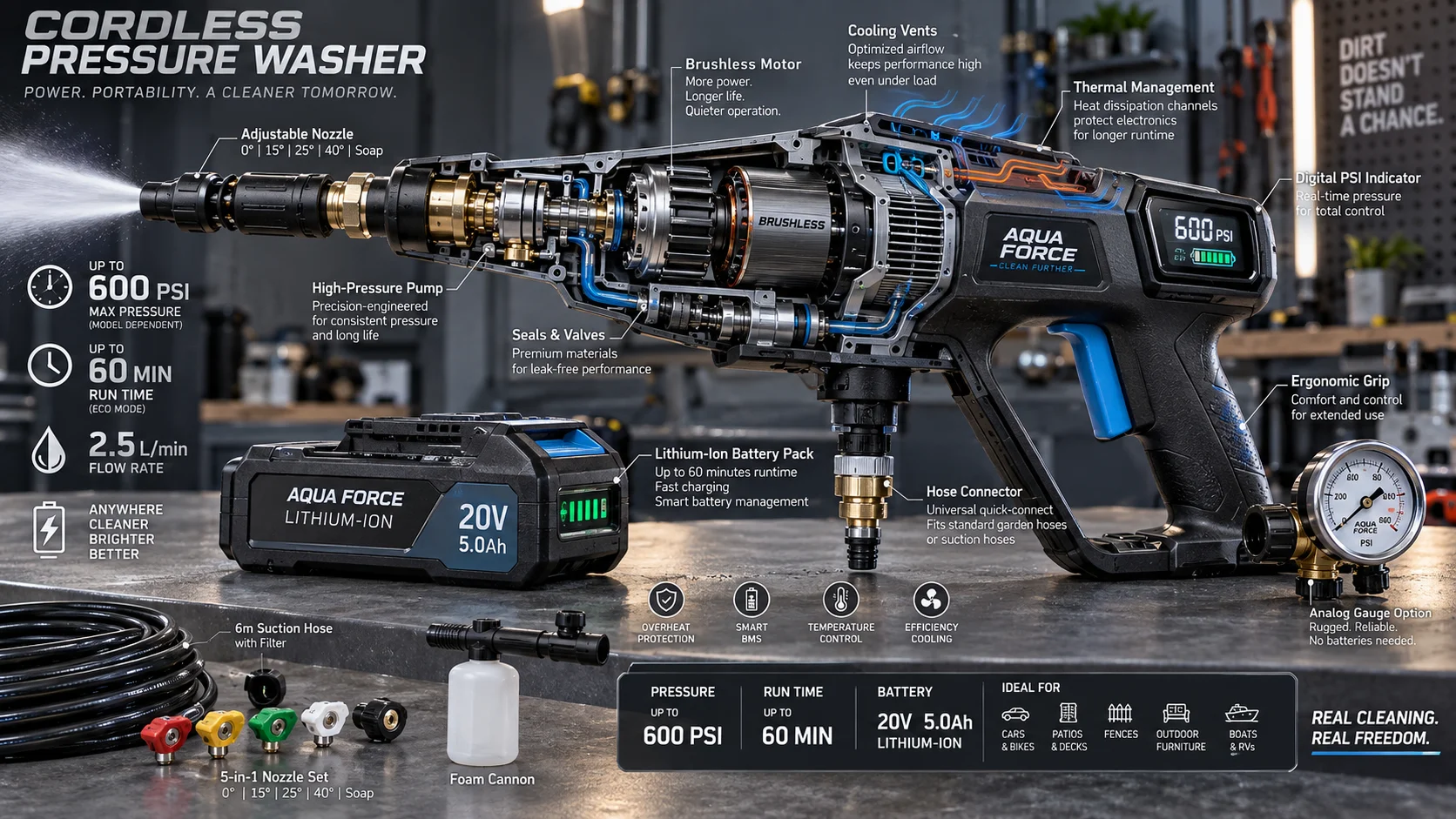
Manufacturers quote run time at partial-load conditions. Real-world run time depends on trigger duty cycle (how often you hold the trigger), nozzle type, and water inlet pressure. Use these benchmarks as planning baselines:
| Battery Spec | Energy (Wh) | Continuous Run (High Pressure) | Intermittent Run (Trigger Cycling) |
|---|---|---|---|
| 20V / 2.0 Ah | 40 Wh | 8 to 12 min | 15 to 20 min |
| 20V / 4.0 Ah | 80 Wh | 15 to 22 min | 25 to 40 min |
| 20V / 5.0 Ah | 100 Wh | 18 to 28 min | 30 to 50 min |
| 40V / 4.0 Ah | 160 Wh | 20 to 35 min | 40 to 60 min |
| 40V / 6.0 Ah | 240 Wh | 30 to 50 min | 55 to 80 min |
The practical takeaway: buy the highest Ah battery your budget allows, and always keep a second charged battery on hand for jobs longer than 30 minutes. Most brand ecosystems (EGO, Ryobi, Greenworks, Worx) share batteries across tools, so the upgrade has zero waste.
Water Source Options: Hose, Tap, or Bucket
Drawing Water from a Garden Hose or Outdoor Tap
The default and lowest-effort setup. Connect the unit’s inlet to a standard ¾-inch garden hose. The incoming tap pressure (typically 40 to 80 PSI at residential supply) feeds the onboard pump, which then amplifies output to the rated PSI. Requirements: minimum 1.0 GPM supply flow (virtually all residential taps meet this), a standard hose bib fitting, and no kinks in the supply hose.
Drawing Water from a Bucket (Self-Priming Mode)
Many cordless pressure washers, including the most popular units on major platforms, include a self-priming inlet hose (typically a thin siphon tube, 3 to 6 feet long) that attaches to the pump’s inlet port. To use bucket-draw mode correctly:
- Fill a bucket with at least 5 gallons of clean water (add a filter sock if the water contains sediment).
- Submerge the inlet siphon tube fully, keeping the pickup end near the bucket bottom.
- Position the washer no higher than 3 feet above the bucket surface, self-priming lift is limited.
- Trigger the gun briefly to prime the line before applying pressure to a surface.
- Refill the bucket before it drops below 1 gallon to prevent dry-running the pump.
Bucket mode is ideal for locations without a hose bib: rooftops, boats, campsites, and apartment balconies. Output PSI is identical to tap-fed mode once primed, because the pump, not the inlet pressure, generates the output force.
Patio and Car Rinse Capabilities: Surface-by-Surface Analysis
Car Washing and Vehicle Rinse
400 to 800 PSI is the sweet spot for vehicle exteriors. It removes road grime, bird droppings, and pollen without lifting door seals, stripping wax, or etching clearcoat, risks that exist above 1,500 PSI. Use a 25° or 40° wide-angle nozzle and hold the wand 12 to 18 inches from the panel. A foam cannon attachment (compatible with most M22 or quick-connect fittings) lets you apply soap with a cordless unit, making a full two-bucket wash feasible on a single 4.0 Ah charge.
Patio Furniture, Decking, and Fences
Patio furniture (plastic, aluminum, wicker) cleans at 300, 600 PSI. Wooden decking requires more caution: use 600, 1,000 PSI with a 40° nozzle and keep the wand moving parallel to the wood grain to avoid raising fibers. For composite decking, 600 PSI maximum prevents surface hazing. Vinyl and aluminum fences respond well to 800, 1,000 PSI with a 25° nozzle at 8, 12 inches. Concrete patios are where most battery units reach their limit , 1,000, 1,200 PSI removes surface dirt but won’t strip deep oil stains or algae embedded in porous concrete the way a 2,500 PSI gas unit does. For broader ecosystem context, read through our operational guide on how to replace string trimmer head.
Tasks That Exceed Cordless Limits
Set realistic expectations before buying. Battery-powered pressure washers are the wrong tool for: removing paint from masonry, blasting caked mud from ATV undercarriages, cleaning deeply stained concrete driveways, or stripping old deck stain before refinishing. For these jobs, rent or hire a 2,500+ PSI gas unit.
Nozzle Selection and Pressure Adjustment
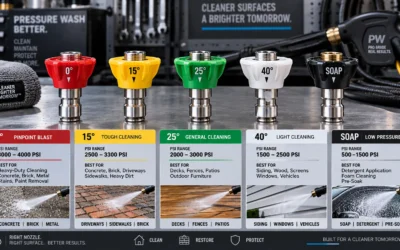
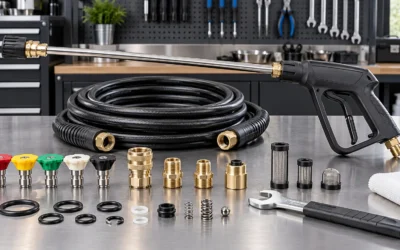
Nozzle angle directly controls effective PSI at the surface, a narrower angle concentrates the same output into a smaller contact area, increasing impact force but reducing coverage width. Standard color-coded nozzles included with most units:
| Nozzle Color | Spray Angle | Effective Use | Warning |
|---|---|---|---|
| Red | 0° | Pinpoint stain removal, concrete joints | Never use on cars, wood, or skin |
| Yellow | 15° | Concrete, brick, heavy grime | Avoid on painted or soft surfaces |
| Green | 25° | Fences, siding, vehicles (safe distance) | Standard general-purpose nozzle |
| White | 40° | Furniture, windows, gentle rinse | None at rated PSI |
| Black | 65° | Soap/detergent application (low pressure) | Incompatible with pressure cleaning |
Buying Checklist: Five Specs That Matter
- Motor type: Brushless over brushed, always.
- Voltage platform: Match to your existing battery ecosystem if possible (Ryobi 18V, EGO 56V, Greenworks 40V, etc.).
- Inlet flexibility: Confirm self-priming bucket-draw support if you lack outdoor hose access.
- Included nozzle set: Minimum four interchangeable nozzles (15°, 25°, 40°, soap) plus a turbo/rotary nozzle if patio cleaning is a priority.
- Hose length: 20+ feet of high-pressure hose for vehicle reach without repositioning the unit.
Recommended Hardware & Essential Equipment
The two units below represent the strongest verified value across the 20V brushless and 40V brushless segments. Both support bucket-draw mode, ship with multi-nozzle sets, and are backed by battery platforms with broad tool compatibility , critical so the battery investment extends beyond the pressure washer itself. Neither overstates PSI claims in lab-comparable published specs, and both have documented real-world run times consistent with the amp-hour benchmarks in this guide. For troubleshooting and reliability insights, consult our in-depth pressure washer nozzle color guide report.

Pros
- Cordless, portable design listed in the product name
- Manufacturer lists a 1500 PSI rating

Pros
- Battery-powered cordless design listed in the title
- Described as a portable pressure washer

Pros
- 1200 PSI rating listed by the manufacturer
- Portable handheld cordless design listed in the title
Common Questions on Battery Powered Cordless Pressure Washer Answered
What PSI does a battery-powered cordless pressure washer produce?
Most cordless pressure washers produce 300 to 1,200 PSI depending on voltage and motor type. Entry-level 18V-20V brushed models land at 300 to 500 PSI. Mid-range 20V-24V brushless units reach 500 to 800 PSI. Top-tier 40V brushless models hit 800 to 1,200 PSI. These figures are sufficient for car washing, bike cleaning, patio furniture, and light deck rinsing but fall short of the 2,000+ PSI required for concrete stripping or paint removal.
Can a cordless pressure washer draw water from a bucket?
Yes , most quality cordless pressure washers include a self-priming inlet siphon hose that draws water from any open container. Submerge the pickup end in at least 5 gallons of clean water, keep the unit within 3 vertical feet of the bucket surface, and prime the line before pressurizing. Output PSI is the same as tap-fed mode. Always refill before the bucket drops below 1 gallon to avoid pump damage from dry-running. Readers comparing setup options can review our technical analysis on cleaning a wood deck with a pressure washer.
How long does a cordless pressure washer run on one battery charge?
Run time per amp-hour battery varies by voltage and trigger duty cycle. On a 20V 4.0 Ah battery, expect 15 to 22 minutes continuous or 25 to 40 minutes with normal trigger cycling. A 40V 4.0 Ah battery (which stores twice the energy) yields 20 to 35 minutes continuous or 40 to 60 minutes with cycling. Always budget for a spare battery on jobs over 30 minutes. Brushless motors extend run time 10 to 15% compared to brushed designs at the same battery spec.
Is a battery-powered pressure washer strong enough to clean a patio or driveway?
Patio furniture and composite or wood decking: yes, comfortably. Light algae and surface dirt on concrete patios: yes, with a 40V unit at 1,000+ PSI. Deep oil stains, embedded grime in porous concrete, or heavy moss on flagstone: no, a corded or gas unit at 2,500+ PSI is required. For regular maintenance cleaning of a patio, a 40V cordless unit with a rotating turbo nozzle handles the job efficiently.
Is a brushless motor worth the extra cost in a cordless pressure washer?
Yes, for three reasons. First, brushless motors convert 10 to 15% more battery energy into pump work, extending run time on every charge. Second, they generate less heat, which reduces pump wear and extends the unit’s service life by years. Third, they maintain consistent pressure output as the battery depletes, whereas brushed motors lose PSI noticeably as voltage drops. The price premium over brushed models is typically $20-$50, recoverable within the first season of use through battery savings and avoided replacements.
Final Verdict: Choosing the Right Battery Powered Cordless Pressure Washer
Battery-powered cordless pressure washers are the right tool for car care, outdoor furniture, bikes, light patio maintenance, RV rinsing, and any location without a hose bib. Select a brushless motor, match the voltage to your existing battery platform, confirm bucket-draw support, and buy the highest Ah battery pack your budget allows. For tasks requiring sustained 2,000+ PSI, concrete driveways, paint stripping, heavy moss removal, a corded or gas unit remains the correct choice. Use the PSI-vs-CU table and run time benchmarks in this guide to match the unit’s spec to your actual workload before purchase, not after.
Cordless Washer Safety Background
Battery pressure washers pair high pressure with lithium packs, so keep water away from the battery and charger. Those comparing other cordless gear may find the cordless stick vacuum buyer guide useful, and general safety information for outdoor power tools is at American National Standards Institute (ANSI).