

Choosing Best Mini ITX Motherboards is primarily a compatibility decision, not a simple ranking exercise. A Mini-ITX board can have strong networking, storage, and expansion specifications yet still be unsuitable if its CPU socket does not match your processor, its memory standard conflicts with your RAM, or its connectors do not support the case and peripherals you plan to use. Compact systems also leave less room to correct purchasing mistakes because a Mini-ITX board normally provides fewer expansion slots and internal headers than larger form factors. For this August 2026 review, we analyzed 3 options spanning AMD AM4, AMD AM5, and Intel LGA1700 platforms. The comparison focuses on chipset and processor compatibility, DDR generation, PCIe and M.2 support, wired and wireless networking, display connectivity, power delivery, builder-friendly features, warranty information, and relative price position. Readers planning an entire small-form-factor computer should also review the broader desktop PC hardware category to evaluate how the board fits with the processor, graphics card, case, cooling system, storage, and power supply.
The best Mini ITX Motherboards in August 2026 should match the processor socket first, the required DDR generation second, and the intended storage, networking, display, and expansion configuration third. Buyers should then compare platform age, upgrade potential, BIOS convenience, power delivery, warranty coverage, and total cost within $89.99 – $289.99, because paying for PCIe 5.0, DDR5, Wi-Fi 7, or 2.5GbE is useful only when the rest of the system can benefit from those capabilities.
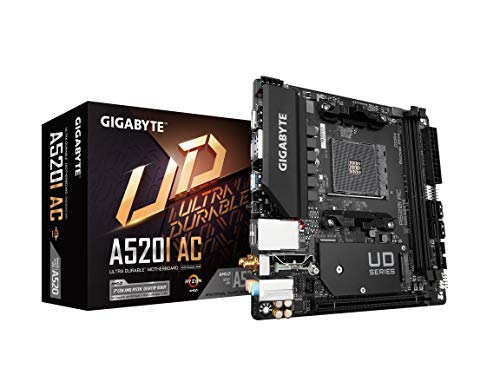
Pros
- Built-in WiFi and Bluetooth reduce the need for extra adapter cards.
- Mini-ITX size is ideal for small-form-factor cases and compact systems.
- VRM cooling and 55A DrMOS support are useful for stable Ryzen operation.
- Q-Flash Plus can simplify BIOS updating on compatible setups.
- Multiple rear display outputs increase flexibility for office or media use.
Cons
- The Mini-ITX layout limits expansion compared with larger motherboard sizes.
- Only 2 DIMM slots are available, so memory expandability is more limited than on ATX boards.
- Connectivity is based on PCIe 3.0 and 1GbE LAN, so it lacks newer high-bandwidth standards found on more advanced boards.
Overview & Design: The GIGABYTE A520I AC is a Mini-ITX AM4 motherboard built for compact AMD Ryzen systems. Its feature set is focused on core essentials, including integrated wireless connectivity, a single full-length PCIe slot, and support for dual-channel DDR4 memory.
Performance & Key Features: For small PC builds, the board offers a solid foundation with Direct 6 Phases Digital PWM, 55A DrMOS, and an optimized VRM heatsink. It also includes a PCIe 3.0 x4 M.2 slot for NVMe storage, 1GbE LAN, Intel Dual Band AC WiFi, Bluetooth, and rear DisplayPort plus dual HDMI outputs.
Drawbacks & Considerations: The Mini-ITX form factor naturally limits expansion, and the board only provides 2 DIMM slots. It is also restricted to PCIe 3.0 and 1GbE wired networking based on the listed specifications, so users seeking newer high-bandwidth features may want to compare alternatives.
Verdict: This motherboard is best suited to buyers who want a compact Ryzen AM4 platform with built-in wireless features and straightforward storage support. It makes the most sense for small gaming PCs, home office systems, or media builds where space efficiency matters more than maximum expandability.
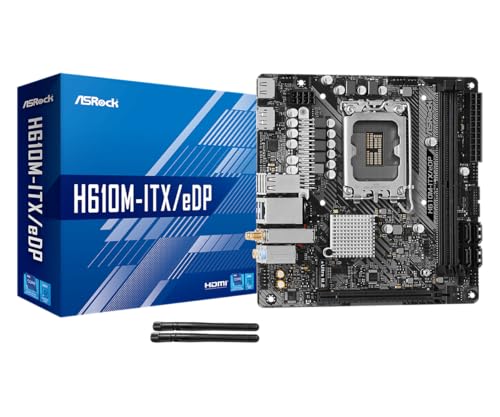
Pros
- Supports a wide range of Intel LGA1700 CPUs, including 14th Gen models.
- Compact Mini-ITX layout is well suited to small cases and embedded builds.
- Includes eDP, HDMI, and DisplayPort for versatile display configurations.
- Uses DDR4 memory, which is generally more affordable than DDR5.
Cons
- Mini-ITX size limits expansion compared with larger motherboard formats.
- Wireless networking is Wi-Fi 5 rather than newer Wi-Fi 6 or Wi-Fi 6E.
- eDP functionality is only useful for compatible panel-based applications and supported processor graphics.
Overview: The ASRock H610M-ITX/eDP is a Mini-ITX motherboard built around Intel's LGA1700 platform. It is designed for compact systems, with a clean feature set and ASRock Super Alloy components that aim to support long-term reliability in small enclosures.
Performance and features: This board supports 14th, 13th, and 12th Gen Intel Core processors, DDR4 memory up to 3200MHz, and a PCIe 4.0 x16 slot for a graphics card. Storage flexibility is good for the size, with one Ultra M.2 slot and four SATA3 ports. Display connectivity is also a highlight, thanks to HDMI 2.1, DisplayPort 1.4, and a dedicated eDP connector for compatible panel applications.
Drawbacks and considerations: The Mini-ITX form factor naturally limits expansion, so users needing multiple add-in cards or more room for upgrades may want a larger board. Wi-Fi 5 is adequate for many builds, but it is not the newest wireless standard. The eDP output is also specialized, so not every user will need or fully use that feature.
Verdict: This motherboard makes the most sense for users building a compact Intel-based PC, SFF workstation, embedded system, or display-focused project. If you want a small board with broad CPU support, DDR4 compatibility, and useful display options, it is a well-rounded choice.

Pros
- Mini-ITX layout is ideal for compact, high-performance small-form-factor PCs.
- Dual M.2 support and PCIe 5.0 deliver modern expansion capability for storage and graphics.
- WiFi 7 plus 2.5GbE LAN provide strong next-gen connectivity options.
- AM5 and DDR5 support keep it aligned with the latest AMD platform requirements.
Cons
- Mini-ITX boards have fewer expansion options than larger ATX or Micro-ATX motherboards.
- Only 2 DIMM slots limit memory expansion compared with larger platforms.
- The feature set is geared toward premium builds, so it may be more than some basic users need.
Overview: The GIGABYTE X870I AORUS PRO ICE is a Mini-ITX motherboard built for AMD AM5 systems. It targets compact PC builders who want a modern feature set without moving up to a larger board format.
Performance and features: With support for Ryzen 9000, 8000, and 7000 Series processors, DDR5 memory with AMD EXPO, PCIe 5.0, and two M.2 slots, it is designed for fast storage and strong platform longevity. Front and rear USB-C, WiFi 7, and 2.5GbE LAN make it well suited for gaming, productivity, and connected home setups.
Drawbacks and considerations: The Mini-ITX design naturally limits expandability, and the 2-DIMM layout offers less memory flexibility than larger motherboards. Buyers should also expect a more specialized board that is aimed at compact premium builds rather than budget-focused systems.
Verdict: This motherboard makes the most sense for users building a high-end small-form-factor Ryzen PC who want modern connectivity, fast storage support, and easier installation features in a compact footprint.
Best Mini ITX Motherboards Buying Guide
The right board is the model that supports every required component without forcing unnecessary platform changes. Use the following criteria to eliminate incompatible options before comparing secondary features or price.
CPU socket, chipset, and processor compatibility
Socket compatibility is the first non-negotiable requirement. The GIGABYTE A520I AC uses AMD’s AM4 socket and A520 platform, the ASRock H610M-ITX/eDP uses Intel’s LGA1700 socket and supports compatible Intel Core processors from the specified generations, and the GIGABYTE X870I AORUS PRO ICE uses AMD’s AM5 socket. These platforms are not interchangeable, so select the processor before purchasing the motherboard unless you are building an entirely new system.
Chipset positioning also affects platform scope. The A520I AC is a practical AM4 option for a compact build that does not require the newest memory and connectivity standards. The H610M-ITX/eDP provides an entry-oriented LGA1700 route with DDR4, while the X870I AORUS PRO ICE targets newer AM5 systems with DDR5 and PCIe 5.0. For more board-focused comparisons, consult the site’s motherboard reviews and buying resources.
DDR4 versus DDR5 memory
Memory generation must match the motherboard because DDR4 and DDR5 modules have different electrical designs and key positions. The ASRock H610M-ITX/eDP explicitly supports DDR4, while the GIGABYTE X870I AORUS PRO ICE specifies DDR5. The supplied data does not state the memory generation for the A520I AC, so buyers should verify the supported module type and capacity in the current manufacturer documentation before ordering RAM.
For an existing build, reusing compatible memory can reduce the platform’s total replacement cost. For a new performance-oriented system, DDR5 provides access to a newer memory ecosystem, but the motherboard price is only part of the calculation. Use this formula when comparing platforms: total platform cost equals motherboard cost plus CPU cost plus compatible memory cost plus any cooling hardware that must be replaced. This prevents a seemingly inexpensive board from becoming the more expensive option after required component changes.
PCIe expansion and M.2 storage
Mini-ITX systems have limited physical expansion, making each slot and storage connector important. The A520I AC lists an NVMe PCIe 3.0 x4 M.2 connection, the H610M-ITX/eDP lists PCIe 4.0 support, and the X870I AORUS PRO ICE lists PCIe 5.0 plus two M.2 connections. PCIe generations provide progressively higher theoretical bandwidth, but real-world gains depend on the installed graphics card or SSD and the workload.
Count the storage devices you expect to install over the system’s service life rather than only at launch. If the plan requires multiple M.2 drives, the X870I’s two specified M.2 connectors offer clearer flexibility than a board listing one M.2 interface. Also verify whether installing a drive changes the bandwidth or availability of another connector, as lane-sharing details are not included in the supplied product data.
Networking and external connectivity
Networking specifications influence file-transfer speeds, latency, and whether the build needs separate adapters. The A520I AC includes Gaming Gigabit Ethernet plus Intel Wi-Fi and Bluetooth, although the supplied name does not identify the Wi-Fi generation. The H610M-ITX/eDP specifies Intel Gigabit LAN and Wi-Fi 5. The X870I AORUS PRO ICE provides the strongest listed network package with Wi-Fi 7 and 2.5GbE LAN.
A 2.5GbE connection has a nominal link rate that is two and a half times that of Gigabit Ethernet, but the router, switch, cabling, and receiving device must also support the faster standard. Wi-Fi 7 is similarly most relevant when paired with a compatible access point and client environment. Check USB needs as well: the X870I explicitly lists USB-C, while the precise USB port counts and speeds for the other models are not specified in the provided data.
Display outputs, power delivery, and build convenience
Display outputs matter when using a processor with integrated graphics. The A520I AC lists three display interfaces, while the H610M-ITX/eDP specifies eDP, HDMI, and DisplayPort. The X870I data does not provide a complete display-output list, so buyers planning a graphics-card-free system should confirm its rear-panel video connections and verify that the selected processor includes integrated graphics.
Power delivery and setup tools become more important in a confined case. The A520I AC specifies a direct six-phase digital PWM design with 55A DrMOS and includes Q-Flash Plus, which can simplify supported BIOS update procedures. The H610M-ITX/eDP also lists Dr.MOS. The X870I includes EZ-Latch hardware intended to make component installation or removal more convenient, but detailed power-stage specifications are not included in the raw data. Compare additional compact-build guidance through the desktop PC component review hub before finalizing the complete parts list.
Core product specification comparison
| Model | CPU platform | Memory | Storage and PCIe | Networking | Relative price |
|---|---|---|---|---|---|
| GIGABYTE A520I AC | AMD AM4, A520 | Not specified in supplied data | NVMe PCIe 3.0 x4 M.2 | Gigabit Ethernet, Intel Wi-Fi, Bluetooth | Mid-range within $89.99 – $289.99 |
| ASRock H610M-ITX/eDP | Intel LGA1700, H610 | DDR4 | PCIe 4.0 listed | Intel Gigabit LAN, Wi-Fi 5 | Lowest listed at $89.99 |
| GIGABYTE X870I AORUS PRO ICE | AMD AM5, X870 | DDR5 | PCIe 5.0, two M.2 connections | 2.5GbE LAN, Wi-Fi 7 | Highest listed at $289.99 |
Testing and Selection Methodology
We compared 3 models using the supplied technical specifications rather than claiming hands-on testing. The evaluation prioritized processor and socket compatibility, chipset generation, memory standard, PCIe and M.2 capabilities, network interfaces, display connectivity, power-delivery information, BIOS or installation conveniences, relative price, and the practical role each product can fill in a compact system. Where a specification was absent, we treated it as not specified rather than estimating or borrowing details from a similar model.
Warranty information, user satisfaction, and brand reliability were also considered where usable data was available. The X870I AORUS PRO ICE explicitly includes a five-year warranty, while warranty terms for the other boards were not provided. The raw product set reports no usable review scores or customer-review evidence, so ratings were not used to rank the boards. This prevents an unsupported satisfaction claim from outweighing verifiable platform features. Brand recognition was treated as supporting context only, not proof that every model will provide the same firmware support, durability, or after-sales experience.
Best Picks and Final Verdict
Best Overall Best Mini ITX Motherboards: GIGABYTE X870I AORUS PRO ICE. This is the strongest overall specification package in the comparison for a new AMD AM5 build. Its DDR5 support, PCIe 5.0, two M.2 connections, Wi-Fi 7, 2.5GbE LAN, USB-C, EZ-Latch feature, and stated five-year warranty provide the broadest combination of current connectivity and upgrade-oriented features. It is also the highest-priced selection at $289.99, so its value depends on whether the build can use those standards.
Best Value / Budget Choice: ASRock H610M-ITX/eDP. This model is the lowest-priced option at $89.99 and provides a practical route to a compact Intel LGA1700 system using DDR4. PCIe 4.0, HDMI, DisplayPort, eDP, Intel Gigabit LAN, Wi-Fi 5, and Dr.MOS cover a useful set of baseline requirements. It is best suited to buyers prioritizing initial platform cost over newer DDR5, Wi-Fi 7, or 2.5GbE features. Additional alternatives can be evaluated in the Motherboards category.
Best for an Existing AM4 Compact Build: GIGABYTE A520I AC. The A520I AC is the targeted choice for users who already own a compatible AMD AM4 processor or want an AM4-based small-form-factor system. Its direct six-phase digital PWM design with 55A DrMOS, PCIe 3.0 x4 M.2 interface, Gigabit Ethernet, Intel wireless connectivity, Bluetooth, three display interfaces, and Q-Flash Plus create a balanced feature set. It is less appropriate for buyers specifically seeking an AM5 and DDR5 upgrade path, but it may avoid the additional cost of replacing a compatible AM4 processor and related components.
Frequently Asked Questions
What should I check first when buying Best Mini ITX Motherboards?
Check the CPU socket and processor support first. After confirming compatibility, verify the memory generation, case form factor, cooler clearance, storage connectors, graphics expansion, power connections, display outputs, networking, and internal headers required by the build.
Is Mini-ITX slower than a larger motherboard?
No, the form factor alone does not make a motherboard slower. Performance depends on the chipset, processor support, memory configuration, power delivery, firmware, cooling, and expansion interface, although a smaller board usually provides fewer slots and connectors than a larger alternative.
Should I choose AM4, AM5, or LGA1700?
Choose the platform that matches your processor or intended upgrade plan. AM4 can make sense when reusing compatible AMD hardware, AM5 supports a newer AMD and DDR5 platform in this comparison, and LGA1700 is appropriate for the Intel processor generations identified for the ASRock H610M-ITX/eDP.
How many M.2 slots do I need in a compact PC?
One M.2 connection is sufficient for a build using a single NVMe drive, while two connections provide more convenient storage expansion without adding cables. Review the board manual for supported drive sizes, PCIe generations, and lane-sharing behavior because those details are not fully stated in the supplied product data.
How long should a Mini-ITX motherboard last?
A motherboard can remain useful for several upgrade cycles when it receives adequate cooling, stable power, compatible components, and appropriate firmware support, but no universal lifespan is guaranteed. Warranty length offers one useful comparison point: the X870I AORUS PRO ICE lists a five-year warranty, while terms for the other products should be confirmed before purchase through the manufacturer or retailer. The desktop PC reviews section can also help with selecting supporting components that fit the board’s platform.


