Quick Answer: How Much Does A Chainsaw Chain Cost?
Most replacement chainsaw chains cost $10 to $50, with the majority of consumer-grade options landing between $15 and $30. Professional or specialty chains can run higher. The price is driven by chain specifications, brand, and whether you buy from a dealer, big-box store, or online retailer.

Pros
- Built as a genuine ECHO replacement chain for the listed CS-series saws.
- Includes low-vibration and low-kickback features for a more controlled cutting experience.
- Chamfer chisel cutters with twin cutting corners are a practical design for efficient cutting.
- Compatible with specific ECHO bar part numbers for easier fit verification.
Cons
- Compatibility is limited to the listed ECHO models and bars, so it is not a universal replacement chain.
- The raw product data does not provide full technical details such as pitch, gauge, or drive link count.
- Buyers must verify fit carefully before purchase if they are unsure of their saw or bar part number.
Overview: The ECHO 91PX57CQ is a 16-inch chainsaw chain made as a replacement option for select ECHO gas saws. Its chamfer chisel cutters with twin cutting corners give it a practical, work-ready design for owners who need a compatible chain rather than a universal aftermarket option.
Performance: According to the product data, this chain is built with low vibration and low kickback characteristics. In real-world use, those features can help improve comfort and control, while the cutter style is intended to support efficient cutting on the saw models and bars it is designed to fit.
Considerations: The main limitation is fit. This chain is only listed for specific ECHO CS-series models and compatible with 12A0CD3745C and 12A0ED3745C bars, so buyers need to confirm compatibility before ordering. The listing also does not provide every technical specification, such as pitch, gauge, or drive link count.
Verdict: For ECHO owners who need a direct replacement chain for the supported models, the 91PX57CQ is a sensible, specification-driven choice. It should appeal most to users who value a confirmed fit, low-kickback design, and a straightforward replacement part from the same brand.

Pros
- Matches a common 18-inch .325/.050/72DL setup for many saw models
- Full chisel design supports fast cutting performance in clean conditions
- Low-kickback certification claims add an important safety-oriented spec
- Centri-Lube oiling system is designed to improve lubrication and chain longevity
Cons
- Full chisel chains typically perform best in clean wood and can be less forgiving in dirty or abrasive cutting conditions
- Fitment must be verified carefully by pitch, gauge, and drive link count before ordering
- It is an aftermarket replacement chain, not an original branded OEM chain
Overview: The Trilink 18" Chainsaw Chain is a replacement loop built to .325" pitch, .050" gauge, and 72 drive links. It is designed for compatible saws from brands such as Craftsman, Echo, Dolmar, Homelite, and others, making it a practical fit-focused option for users replacing a worn chain.
Performance: This chain uses a full chisel cutter profile, which is intended to cut faster and more aggressively in clean wood. The Centri-Lube oil distribution system is another useful feature, since better lubrication can help reduce wear and support longer chain life during regular use.
Drawbacks: The main limitation is that full chisel chains are not usually the best choice for dirty, rocky, or heavily abrasive cutting jobs. Fitment also matters here, so buyers should confirm pitch, gauge, and drive link count before purchasing to avoid compatibility issues.
Verdict: This is a solid aftermarket replacement for users who need an 18-inch chain with common OEM-style specifications and fast cutting performance. It is best suited to homeowners and maintenance users who cut clean wood and want a straightforward replacement chain with broad compatibility.

Pros
- Includes four replacement chains in one pack.
- Exact fit specs are clearly listed: 3/8 LP pitch, .050 gauge, and 56 drive links.
- Low-kickback design supports more controlled operation.
- Hardened build is intended for durability and wear resistance.
Cons
- Not universal for all 16-inch chainsaws, so pitch, gauge, and drive links must match exactly.
- No guide bar compatibility list or saw model chart is provided in the product data.
- Buyers need to verify fit manually using the guide bar stamp or owner’s manual.
Overview: GSSHBR's 4 Pack 16 Inch Chainsaw Chain is a replacement chain set with 3/8 LP pitch, .050 gauge, and 56 drive links. It is built for users who need multiple spares for a compatible 16-inch bar.
Performance: The chain is described as deeply hardened for smooth, fast cutting with high wear resistance and low kickback. That makes it a practical option for routine trimming and general yard work when the bar specifications match.
Considerations: Fit is the main thing to confirm. This chain is not universal, so buyers should check the pitch, gauge, and drive links on the guide bar stamp or in the owner’s manual before ordering.
Verdict: If you want a multi-pack replacement chain for a compatible 16-inch saw, this GSSHBR set offers convenient backups and clear sizing. Users who are unsure about compatibility should verify the fit first.
Key Factors That Affect Chain Price
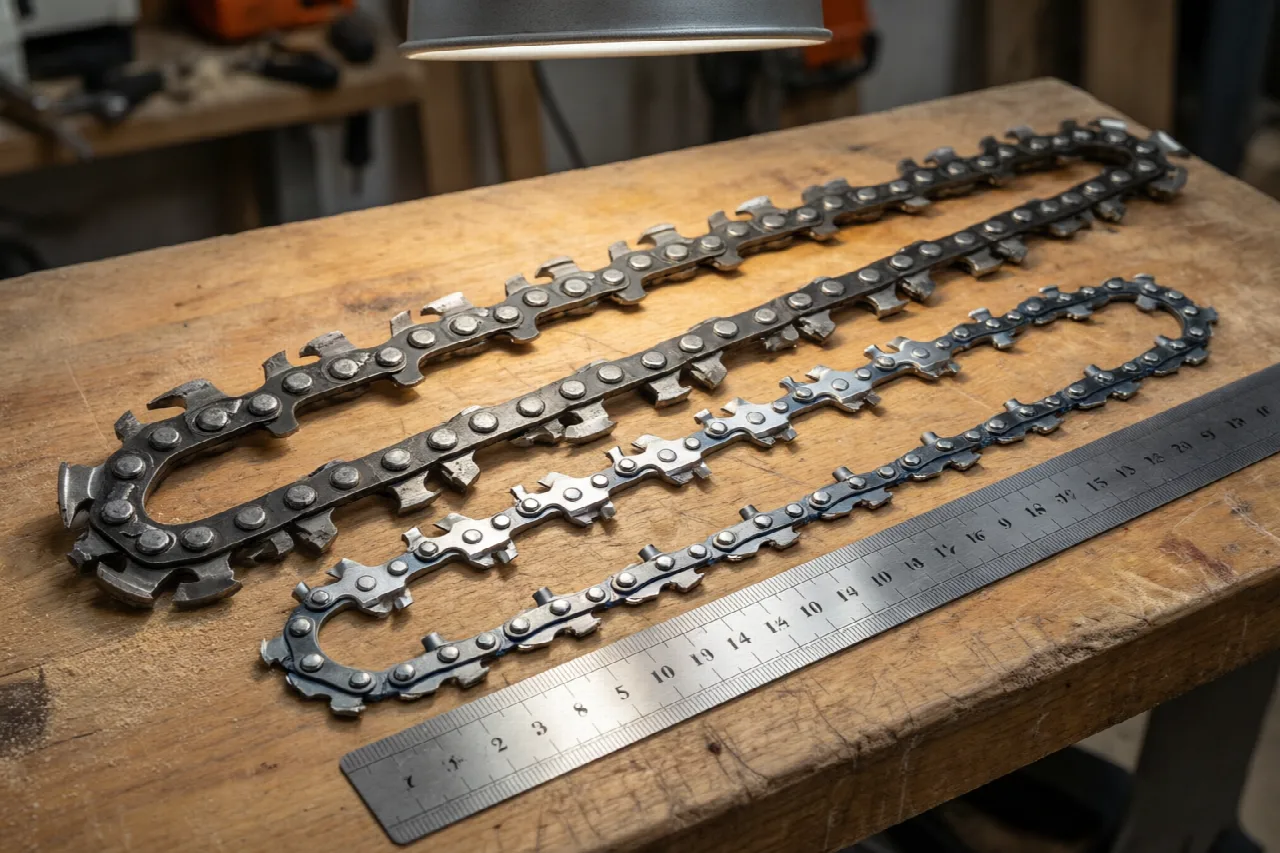
Several core specifications determine how much you’ll pay for a chainsaw chain. Chain length, expressed as drive link count, is one of the most direct cost factors. A 12-inch chain requires less material and costs less than an 18-inch chain; longer chains command proportionally higher prices across all quality tiers.
Pitch, the distance between consecutive drive links, is equally important. Common pitches include .325 inch (smallest, typically cheapest), 3/8 inch, and .404 inch (largest, typically most expensive). Smaller pitches are standard on homeowner saws, while larger pitches appear on professional and high-displacement models. Standard operational and maintenance protocols can be consulted via U.S. Consumer Product Safety Commission (CPSC) lawn mower guidelines.
Gauge, the thickness of the drive links, affects both compatibility and cost. Standard gauge chains cost less than full-complement or full-skip variants designed for heavy-duty or professional use. Gauge options vary by manufacturer and pitch, so availability can limit your choices and influence pricing.
Tooth design also plays a role. Semi-chisel chains with rounded cutting teeth are gentler on equipment and typically occupy the lower to mid-price range. Full chisel chains with square-cornered teeth cut faster and more aggressively but are generally more expensive and require more skill to maintain properly.
Typical Cost by Saw Size and Use
For a 16-inch homeowner chainsaw, replacement chains typically cost $15-$25. This is the most common bar length for residential use, and high manufacturing volumes keep prices competitive in this segment.
A 20-inch chain for a larger or semi-professional saw generally ranges from $20, $35. The additional length and often heavier-duty construction account for the higher price compared to 16-inch options. For complementary field maintenance guidelines, examine our breakdown of z890 vs x870e motherboard.
Smaller chains for 12-inch bars often cost $10-$18, making them affordable entry points for budget-conscious buyers or second-saw owners. Conversely, 24-inch or longer chains for large commercial or forestry saws typically exceed $35 and may approach or surpass $50 depending on specifications and brand.
Casual homeowners replacing a chain once every few years can expect to spend in the $15, $25 range. Regular users or professionals who maintain multiple saws should budget $25, $50 per chain, with some specialty options costing even more. To evaluate matched hardware tolerances, consult our detailed overview of marshall stanmore iii vs harman kardon onyx studio 8.
OEM Versus Aftermarket Chains
Original Equipment Manufacturer (OEM) chains are sold directly by the saw maker and typically cost 10 to 25 percent more than comparable aftermarket options. The premium reflects brand assurance, warranty coverage, and the guarantee that the chain is engineered specifically for your saw model.
Aftermarket chains from third-party manufacturers meet the same pitch and gauge specifications as OEM chains and often perform comparably. Reputable aftermarket brands offer similar durability at lower prices, making them a practical choice for budget-conscious users who prioritize cost over brand loyalty. When planning workspace deployment, consider the engineering criteria outlined in our dyson v8 cyclone vs bissell featherweight stick guide.
No universal standard determines whether OEM or aftermarket chains last longer. Durability depends more on proper maintenance, regular sharpening, adequate lubrication, and correct tension, than on brand alone. Both OEM and quality aftermarket chains can deliver years of service if maintained properly.
Some users prefer OEM chains for peace of mind and easier warranty claims, while others find aftermarket chains offer equal performance at better value. Your choice depends on your budget, risk tolerance, and the specific brands available in your region. For additional operational safety benchmarks, see our published testing notes on bissell crosswave hydrosteam vs shark stainforce.
Where to Shop and How to Compare Prices
Local independent chainsaw dealers often stock multiple brands and can offer expert advice on fit and performance. However, their prices are typically higher than big-box retailers or online sellers due to lower sales volumes and overhead costs.
Big-box hardware and home improvement stores usually offer competitive pricing on popular chain sizes and brands. They benefit from high inventory turnover, which allows them to discount prices. Availability of niche pitches or gauge options may be limited, however.
Online retailers frequently undercut local and big-box prices by 10 to 20 percent for the same specifications. Shipping costs can offset some savings, and delivery times vary. Online purchases require confidence in your own ability to identify correct specifications, since you cannot verify fit in person.
To compare prices effectively, write down the exact pitch, gauge, drive link count, and any brand preferences before shopping. Identical specifications from different retailers may vary in price by $5-$15, so shopping around is worthwhile for larger purchases or bulk orders.
Buyer FAQs: How Much Is A Chainsaw Chain Solved
Do I need to buy a matching sprocket or bar when I replace the chain? Not necessarily. Chains and bars wear at different rates; a chain replacement does not require a new bar or sprocket unless they are visibly damaged or excessively worn. Check your saw’s manual or consult a dealer if you are unsure.
How often should I budget for a new chain? This depends on usage frequency and cutting conditions. Casual homeowners may replace a chain once every 2 to 3 years, while frequent users may need replacement annually or more often. Regular sharpening extends chain life; a chain that becomes difficult to sharpen is a candidate for replacement.
Related Maintenance and Operating Guides
To keep your equipment running at peak operating efficiency, explore our related technical walkthroughs and maintenance tutorials:
- Consult our detailed breakdown on residential zero-turn lawn mower guide.
Buying Chains Safely
Chain prices depend on pitch, gauge, and length, and a mismatched chain can be dangerous even when it looks like a bargain. Background reading on chainsaw safety is available from American National Standards Institute (ANSI).