
A standard recommendation for lawn mower oil changes is every 50 hours of use or at least once per season—whichever comes first. However, always consult your owner’s manual for the specific interval for your engine model. Two‑stroke and four‑stroke engines have different oil requirements, and usage patterns can affect how often you need to change the oil. Regular oil changes are essential for engine longevity and performance.
Why Regular Oil Changes Matter
Engine oil lubricates moving parts, reduces friction, and helps dissipate heat. Over time, oil breaks down, becomes contaminated with dirt, metal particles, and combustion by‑products, and loses its viscosity. When oil is old or dirty, it cannot adequately protect the engine, leading to increased wear, overheating, and eventually engine failure. For a lawn mower, which often operates in dusty, grassy conditions, oil contamination happens faster than in a car engine. Regular oil changes remove these contaminants and replenish the protective additives, ensuring your mower starts easily, runs smoothly, and lasts for many years.
Neglecting oil changes can have serious consequences. Sludge builds up, clogging oil passages and starving critical components of lubrication. The engine may overheat, warp parts, or seize altogether. Even if you only use your mower for a few months each year, the oil can degrade from moisture and acids that accumulate during storage. Thus, changing oil at recommended intervals is one of the simplest and most cost‑effective maintenance tasks you can perform.
Standard Oil Change Intervals
The most widely cited guideline is to change the oil every 50 hours of engine operation. For a typical residential mower used on a half‑acre lot, that often translates to about once per mowing season. Many manufacturers recommend an annual oil change regardless of hours, especially if you store the mower over winter. If you have a larger property or use a riding mower, you might accumulate 50 hours well before the season ends, so you should change oil more frequently.
Some newer mowers have oil‑change indicators that alert you when it’s time. If not, keep a log of your mowing hours. As a rule of thumb, change the oil at the start of each season, and again mid‑season if you mow more than an hour per week over several months. For push mowers with small engines, the 50‑hour mark is a safe average. However, always treat your owner’s manual as the definitive source, as some engines have specific intervals (e.g., every 25 hours for heavy‑duty use or 100 hours for synthetic oils).
Variations by Engine Type
Two‑stroke (2‑stroke) engines do not have a separate oil reservoir; oil is mixed directly with the fuel. For these engines, you do not change oil in the same sense—you simply ensure the correct fuel‑to‑oil ratio (typically 50:1 or 40:1) and use high‑quality 2‑stroke oil. However, you should still periodically clean or replace the fuel filter and spark plug, and drain the fuel system before storage.
Four‑stroke (4‑stroke) engines have a separate oil sump and require regular oil changes. The interval for these is the 50‑hour or annual rule discussed above. Additionally, four‑stroke engines often have an oil filter that should be replaced at every other oil change or per manufacturer instructions. Some small four‑stroke mowers do not have a filter, making the oil change even more straightforward. The key difference is that two‑stroke engines consume oil with the fuel, so you never drain and refill oil; four‑stroke engines need periodic draining and refilling with fresh oil of the correct viscosity.
Checking Your Owner’s Manual
Your mower’s owner’s manual is the most authoritative guide for oil change intervals. It will specify the recommended oil type (e.g., SAE 30, 10W‑30, or synthetic), the capacity, and the exact service schedule. If you have lost the manual, you can often find it online using the model number. Following the manual ensures you maintain the warranty and avoid voiding it due to neglect.
If the manual’s recommendation differs from general advice—for example, if it suggests 25 hours instead of 50—always follow the manual. Manufacturers design engines with specific tolerances and conditions. Some commercial mowers used daily may require more frequent changes. Conversely, some modern engines with advanced oil formulations may allow longer intervals. The manual also provides guidance for extreme conditions, such as dusty environments or heavy loads, which might require shorter intervals. Trust the manufacturer’s engineers over generic rules.
Signs Your Oil Needs Changing
Visually, fresh oil is amber and translucent. When it turns dark brown or black, and especially if it appears gritty or has a burnt smell, it is time to change it. You might also notice sludge on the dipstick or at the bottom of the oil fill port. Performance‑wise, if the engine runs rougher than usual, produces excessive smoke, or has difficulty starting, old oil could be the culprit. Additionally, if the oil level drops more quickly than normal, it might indicate oil consumption due to worn rings or seals, which also signals a need for fresh oil and possibly a mechanical check.
Even if the oil looks clean, if you have reached the hour or time interval, change it anyway. Oil degrades from heat and chemical breakdown even without visible contamination. Regular inspection—checking the dipstick before each use—lets you catch issues early. If you notice metal particles on the dipstick, that is a warning sign of internal wear; changing oil alone won’t fix it, but fresh oil may help slow further damage until you can service the engine.
Step‑by‑Step Oil Change Basics
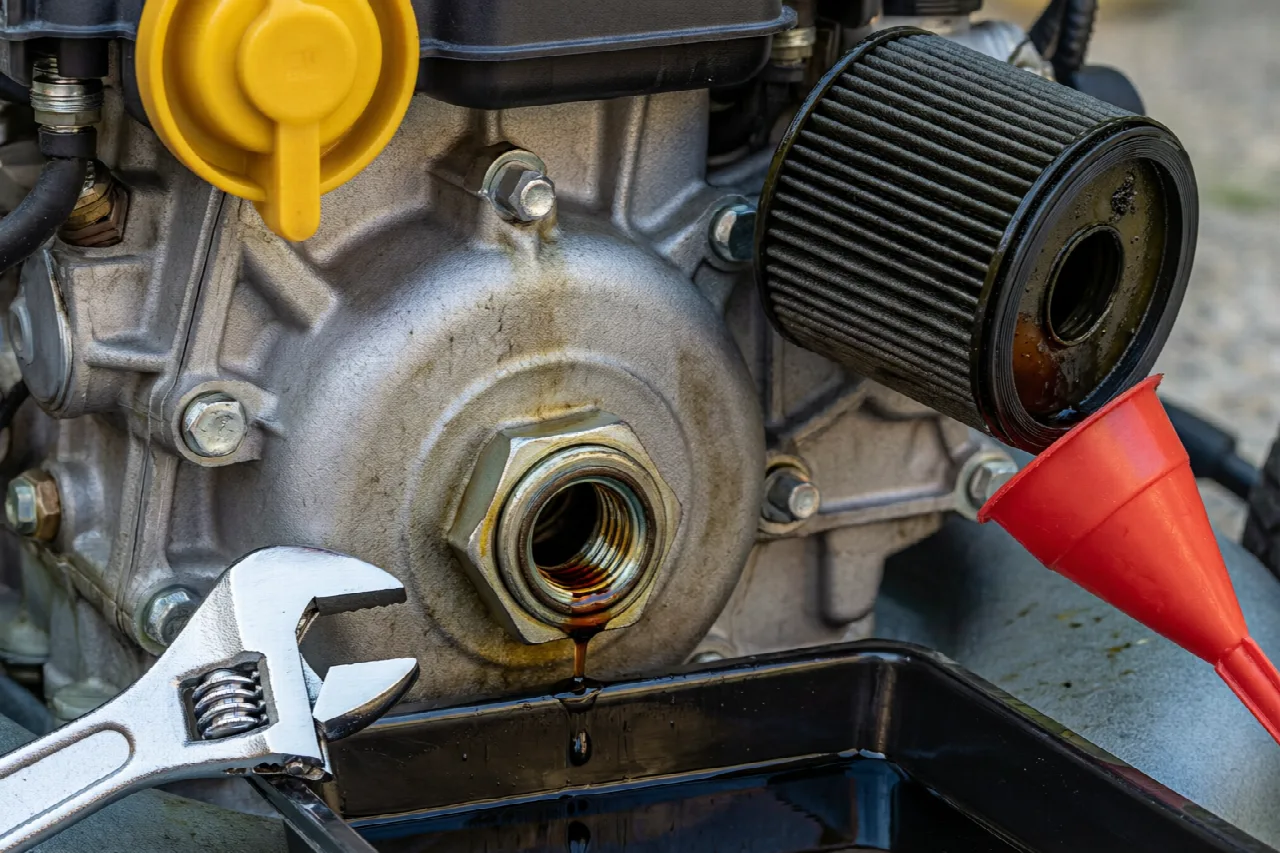
To change the oil, you’ll need a wrench or socket to remove the drain plug (or a suction pump if your mower has a dipstick tube), an oil catch pan, a funnel, and the correct oil type and quantity. Run the engine for a few minutes to warm the oil (so it flows more easily), then turn it off and disconnect the spark plug for safety. Place the catch pan under the drain plug, remove the plug, and let the oil drain completely. Replace the plug, then add new oil through the fill port, using the dipstick to check the level. Never overfill.
Dispose of used oil responsibly—take it to a recycling center, auto parts store, or hazardous waste facility. Never pour it down drains or on the ground. Also, if your mower has an oil filter, replace it according to the manual’s instructions. After refilling, run the engine briefly to circulate the oil, then re‑check the level and top off if needed. Keeping a record of the date and hours will help you stay on track for the next change.
For more hands-on benchmarks and buying recommendations, consult our guides on heavy-duty chainsaw buyer guide, as well as high-CFM commercial leaf blower guide, as well as automated robotic lawn mower guide.