Change the oil in a lawn mower every 50 hours of running time or at least once a year, whichever comes first. Many manufacturers also recommend the first oil change after the initial 5 hours of use. Always verify the specific schedule in your owner’s manual, as some engines may call for 25-hour or 100-hour intervals.
Standard Oil Change Frequency for Lawn Mowers
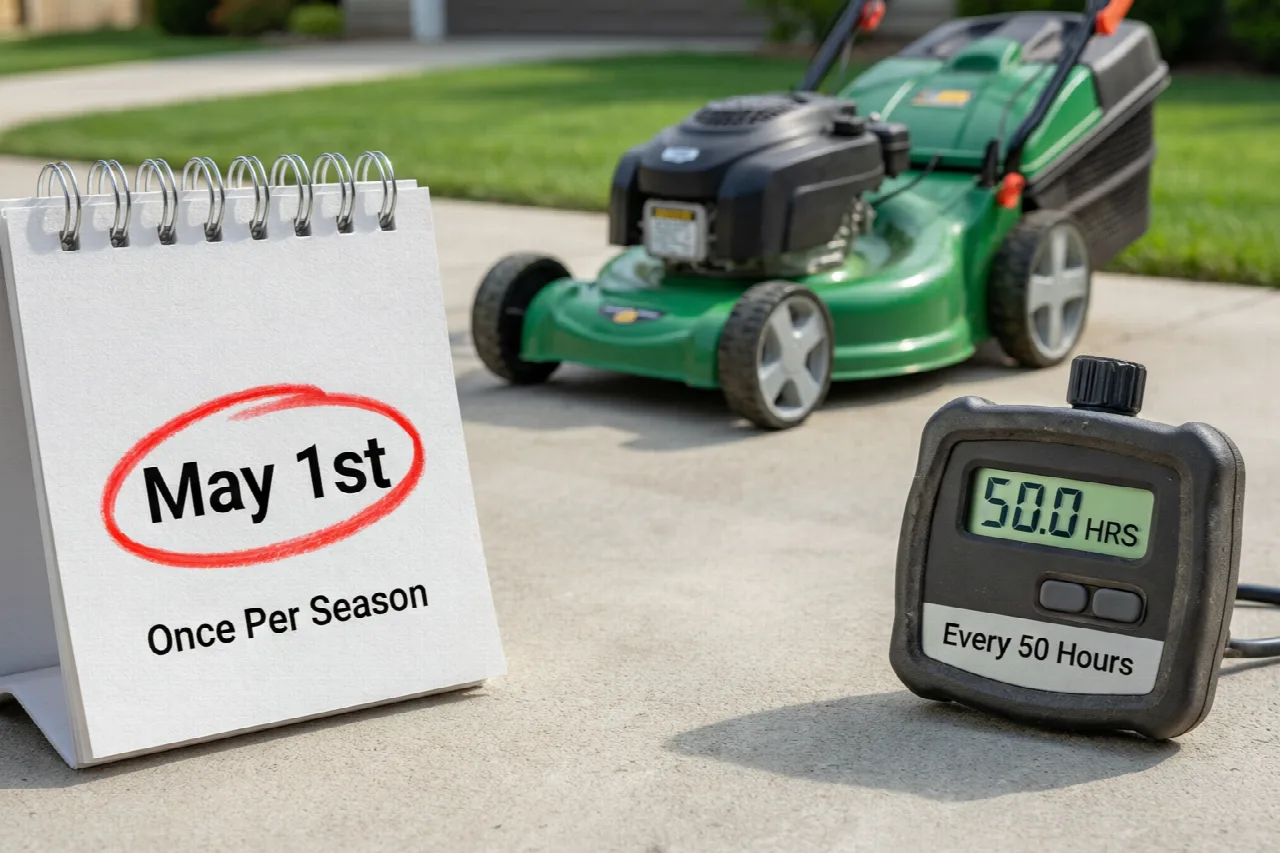
The most widely accepted rule for how often to change oil in a lawn mower is every 50 hours of operation. For most homeowners, that translates to roughly once per mowing season, since a typical lawn takes one to two hours to mow each week. If you mow a larger property or run your mower for commercial purposes, you may hit the 50-hour mark well before the season ends.
Because most residential mowers see between 20 and 40 hours of use per season, the calendar-based recommendation of at least once a year is a practical safeguard. Even if you mow less than 50 hours in a season, the oil still degrades over time. Heat cycles, moisture, and contaminants accumulate even during short runs, so an annual oil change keeps the engine protected regardless of your total hours.
When you are unsure whether your mower has reached the 50-hour threshold, check the owner’s manual. Most manuals list the recommended interval on the maintenance page, and many also include a simple log to help you track hours. If you no longer have the manual, most manufacturers publish PDF copies online for free.
First Oil Change: The Break-In Rule
New lawn mower engines require an earlier first oil change than the standard 50-hour interval. Most manufacturers recommend changing the oil after the first 5 hours of running time. This break-in period allows metal particles and debris from the manufacturing and initial running process to settle into the oil, and removing that oil early protects the engine from premature wear.
The break-in oil change is important because new engines shed small amounts of metal as the piston rings seat against the cylinder walls. If you leave that contaminated oil in the crankcase for the full 50 hours, those abrasive particles can accelerate wear on bearings and other moving parts. Changing the oil at 5 hours flushes those particles out while the engine is still fresh.
Some manufacturers recommend an even earlier first change, such as after 2 hours, while others extend it to 10 hours. Always follow the specific break-in schedule printed in your owner’s manual. After that first change, you can return to the normal 50-hour or annual interval.
Hour-Based vs. Calendar-Based Scheduling
The question of whether to follow hours of use or time of year depends on how often you mow. If you mow regularly throughout the growing season, hour-based tracking is the most accurate method. If you mow infrequently or have a small yard, calendar-based scheduling is simpler and ensures the oil never sits too long.
For mowers without an hour meter, you can estimate hours by tracking your mowing sessions. Keep a small notebook in your garage or shed, or use a phone app to log each mow. Multiply the number of sessions by your average mowing time to get a rough total. This method is not perfectly precise, but it is good enough for maintenance purposes.
If you prefer a hands-off approach, simply change the oil at the start of every mowing season. This guarantees fresh oil for the busiest months and avoids the risk of forgetting. For most homeowners, a seasonal change is sufficient, provided the mower does not accumulate more than 50 hours in a single season.
Variations by Engine Manufacturer and Mower Type
Not all lawn mower engines follow the same oil change schedule. While 50 hours is the common default, some manufacturers specify different intervals. For example, Briggs & Stratton engines typically recommend an oil change every 50 hours or once per season, whichever comes first. Honda engines often follow a similar 50-hour guideline, though some models call for changes every 25 hours under heavy use.
Kohler engines, commonly found on riding mowers and commercial equipment, may recommend intervals ranging from 50 to 100 hours depending on the model and operating conditions. Always consult the specific manual for your engine, as the recommended interval can vary even within the same brand across different models.
Electric mowers do not require oil changes at all. Because they have no internal combustion engine, there is no crankcase oil to replace. If you own an electric mower, your maintenance routine focuses on the battery, blade, and deck instead. For gas mowers, the oil change interval is the key maintenance task to keep the engine running smoothly.
How to Know When Oil Needs Changing (Beyond the Schedule)
Even if you have not tracked hours, you can often judge whether the oil needs changing by inspecting it. Fresh oil is amber or light brown and translucent. As it ages, it darkens and becomes more opaque. If the oil on the dipstick looks black or gritty, it is time for a change, regardless of the hour count.
You can also check the oil’s consistency. Healthy oil feels smooth and slippery between your fingers. Oil that feels thick, gritty, or watery has broken down or become contaminated. A milky or frothy appearance indicates water contamination, which can happen if the mower is stored outdoors or run in wet conditions.
While clean-looking oil can sometimes tempt you to extend the interval, do not rely on appearance alone. Oil loses its lubricating properties over time even when it still looks clear. The additives that protect against corrosion and wear deplete with use, so following the schedule is safer than waiting for visible signs of degradation.
Consequences of Skipping Oil Changes
Skipping oil changes can cause serious damage to your lawn mower engine. Old oil loses its ability to lubricate moving parts, leading to increased friction and heat. Over time, this can cause the engine to overheat, seize, or suffer catastrophic failure that requires a full replacement.
Contaminated oil also allows dirt and debris to circulate through the engine. These abrasive particles wear down the piston rings, cylinder walls, and bearings, reducing compression and power. An engine running on old oil may become harder to start, run roughly, or produce excessive smoke.
Beyond performance issues, neglected oil changes shorten the overall lifespan of the mower. A well-maintained engine can last many years, while an engine that never receives fresh oil may fail within a few seasons. The cost of an oil change is minimal compared to the expense of a new engine or mower, making regular maintenance a clear financial win.
Finally, old oil can cause problems during storage. If you put the mower away for the winter with dirty oil, the contaminants can settle and cause corrosion while the engine sits idle. Changing the oil before storage, or at the start of the season, protects the engine during the months it is not in use.
For more hands-on benchmarks and buying recommendations, consult our guides on heavy-duty chainsaw buyer guide, as well as high-CFM commercial leaf blower guide, as well as automated robotic lawn mower guide.