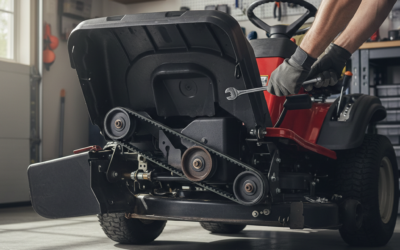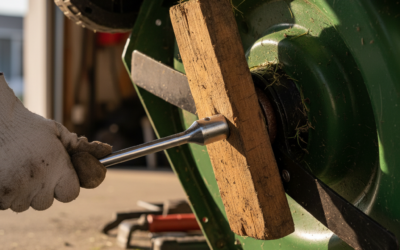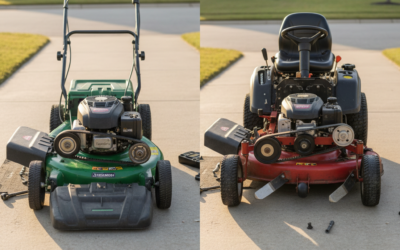
On a typical walk-behind gasoline lawn mower, carburetor adjustment usually means setting idle with the idle-speed screw and, if present, making small idle or high-speed mixture changes so the engine idles smoothly and picks up cleanly. Many newer mowers are fixed-jet and have little or no mixture adjustment. Work outdoors, treat the blade as live, follow the engine maker’s procedure, and stop if the carburetor is dirty, leaking, or damaged.
What carburetor adjustment is meant to change
A lawn-mower carburetor meters air and gasoline so a small gasoline engine can idle, accelerate, and keep running when the blade is cutting grass. Adjustment is not a rebuild and it is not a cure-all. On a simple walk-behind mower it is meant to change how the engine behaves at rest and, only when the hardware allows it, how rich or lean the fuel mixture is in a limited range of throttle openings.
Three controls get talked about as if every mower has all of them. They do not.
- The idle speed screw usually changes how far the throttle plate stays open when you release the control. It is a stop, not a fuel valve.
- An idle mixture screw, when one exists and is meant to be turned, changes how much fuel is added at idle and just off idle.
- A high-speed mixture screw, when one exists and is documented for user adjustment, changes fuel delivery at larger throttle openings. Many walk-behind mowers have no such screw, or the screw is capped so you cannot treat it as a free-tuning control.
Idle quality, a clean pickup when you open the throttle, and a stable note under a light load are the reasonable goals. A no-start engine, a flooded smell after one pull, sudden power loss in tall grass, or an engine that only runs on choke often point somewhere else: stale fuel, a clogged air filter, a stuck choke, an air leak, weak spark, or low compression. Turning mixture screws will not invent fuel that is not reaching the engine, and it will not seal a cracked fuel bowl or a torn gasket.
Many late-model walk-behind mowers use a fixed-jet carburetor. The jet sizes are chosen at the factory, sometimes with limiter caps on any remaining screws, so there is little or no user mixture adjustment. That design is common on emissions-controlled small engines. If you only find an idle-speed screw, that is often the entire intended tune. Exact layouts still vary by engine family and year, so the owner’s manual or a matching engine service guide should override any generic map of screws.
Safety before you work around fuel and a running engine
Carburetor work sits next to gasoline, a hot exhaust, and a cutting blade that can start turning as soon as the engine fires. Treat those hazards as real even for a “quick” idle tweak.
Position the mower and treat the blade as live
Work on level ground outdoors. Chock the wheels so the walk-behind mower cannot roll. Keep children, pets, and bystanders away. Keep hands, feet, clothing, and tools out of the discharge opening and the blade path. If the engine can start, or is running, the blade area is live. Do not reach under the deck to hold the machine still. Do not remove guards to “see the blade better” while you adjust idle. After you finish, refit any covers you moved and restore the spark-plug lead so the machine is not left in an unsafe state.
Fire, burns, and carbon monoxide
Gasoline is flammable. Spills and vapors are a fire hazard. Keep flames, sparks, cigarettes, and hot work away from the fuel tank, fuel lines, and carburetor. If you spill fuel, wipe it up and let vapors clear before you pull the starter or reconnect the spark-plug lead. Do not smoke over an open fuel bowl.
A running engine produces carbon monoxide. Do not run the mower in a closed garage, a shed, or another enclosed space even “for a minute.” A partly open door is not a safe substitute for outdoor air. Mufflers and nearby engine parts can cause burns. Give a recently run engine a cautious pause to cool before you put bare skin against the carburetor, tank, or exhaust. This article does not give medical treatment advice; if fuel or exhaust exposure is more than a brief outdoor nuisance, get away from the vapor and seek appropriate help.
When the spark-plug lead should be off, and when the engine must run
Disconnect the spark-plug lead and keep it away from the plug whenever you are inspecting linkages, wiping spills, checking the air filter, or doing anything that puts your hands near the blade path or fuel fittings. You need the engine running only for the short periods when you are actually judging idle and throttle response. Start it in a clear outdoor area, keep a firm stance away from the discharge, and shut it down before you change tools, chase a dropped screw, or walk away. Follow the machine’s own starting and stopping controls rather than improvising a bypass of the handle bail or other interlocks.
Identify the carburetor and the screws you actually have
On most walk-behind gasoline mowers the carburetor sits on the side of the engine, with the air filter housing on the inlet side and the intake manifold toward the cylinder. Throttle and choke levers or cables usually meet the carburetor at a small linkage cluster. The fuel bowl hangs under many common designs. Look first; do not start turning every pointed screw you see.
Idle-speed screw versus mixture screws versus linkage
An idle speed screw often bears on a throttle stop, a governor arm, or another piece of linkage. Turning it changes rest throttle opening. Mixture screws, when present, are usually finer pointed screws threaded into the carburetor body rather than into a lever. An idle mixture screw meters fuel at closed or nearly closed throttle. A high-speed mixture screw, on the minority of walk-behind carbs that still have a user-facing one, meters fuel at larger openings. Choke and throttle plates are moved by levers and springs, not by those pointed needles. Do not use a left-versus-right or clock-face rule; brands do not share one map.
If labels are missing or the hardware is unfamiliar, stop and match the engine model, type, and code on the blower housing to the owner’s manual or a matching service guide. Guessing which needle is idle mixture is how people lean an engine out or damage a seat.
Fixed jets, limiter caps, and screws that should not be forced
A complete lack of mixture screws usually means a fixed-jet carburetor. Limiter caps or tamper-resistant plugs on remaining screws usually mean the manufacturer does not want open-ended mixture tuning. Do not pry, drill, grind, or otherwise defeat those devices. Forcing a seized mixture screw can break the needle or ruin the seat, after which adjustment is no longer possible even if it once was.
Check air, fuel, and choke before any screw moves
A dirty air filter starves the engine of air and can make a healthy carburetor look rich. Stale gasoline, water in the tank, or debris in the fuel bowl can make it look lean or make idle hunt no matter where the screws sit. A choke left partly on after warmup does the same. Confirm that the filter is serviceable, the fuel is fresh enough to use, lines are intact, and the choke is fully off once the engine is warm. Only then is a screw change informative.
What this article is not assuming
Two-stroke equipment that needs oil mixed in the gasoline, riding mowers with more complex governors and decks, generators, and pressure washers can share the same basic carburetor idea without sharing the same linkages or loads. This article is general guidance for typical walk-behind gasoline lawn mowers. It is not a shop manual, not small-engine certification, and not a procedure for every outdoor power product that happens to have a bowl and a jet.
A conservative general adjustment sequence
Use this only as a cautious starting map when you do not yet have the engine maker’s steps in front of you. Exact settings, screw counts, and whether mixture is adjustable vary. The matching official procedure wins. Never treat a universal “turns out from seated” number or a single idle speed as if it applied to every walk-behind mower. Seating a mixture screw hard can damage the needle and seat; do not use a mixture screw as a clamp.
Prepare the engine, then work warm
- Confirm fresh fuel, a serviceable air filter, intact fuel line, and a choke that can open fully.
- Disconnect the spark-plug lead while you inspect. Reconnect it only when you are ready to start outdoors, clear of the blade path.
- Start the engine using the mower’s normal controls. Use choke only as needed for a cold start, then move the choke fully off as soon as the engine will run without it.
- Let the engine reach a fully warm, choke-off condition before you judge idle. A cold engine and a warm engine do not idle the same, and mixture impressions taken on choke are misleading.
Set idle speed first
On many walk-behind mowers the only user control is the idle speed screw. Turn it in small increments so the engine stays running when you release the throttle control, without racing. You want a stable idle that does not stall the moment the plate closes, and you do not want an idle so high that the machine feels eager to take off. This general walk-behind guidance is not about setting a blade clutch or belt on a rider. If idle will not stabilize after small stop changes, the problem is probably not the screw.
Touch mixture only if the carburetor is built for it
If there is no idle mixture screw, or a limiter cap makes further travel impossible, stop after idle speed. Do not force the hardware.
If an idle mixture screw exists and the documentation for that engine treats it as user-adjustable, make very small turns one way, wait for the engine to settle, then listen. Try the other direction the same way. You are listening for a smoother idle and a clean response when you open the throttle, not for a peak scream or a claimed fuel-economy gain. Leave a high-speed mixture screw alone unless the manufacturer documents a user procedure for that engine. High-speed mixture on a mower that must also survive heat and load is easy to get wrong, and an overly lean mixture can raise the risk of overheating and damage.
After each small change, pause. Needles and passages do not update the running mixture in an instant, and a hurried series of turns erases any sense of which change helped. If a screw will not move, stop. If you lose track of where you started, do not keep turning in hope of finding a factory home position that this article cannot honestly give you. Look up the exact engine procedure instead.
When to abandon the generic sequence
Stop turning screws and consult the official steps, or a qualified small-engine shop, if the carburetor is wet with leaking fuel, the linkage is broken or missing a spring, idle collapses after every small change, the engine only runs with the choke partly on, or you cannot identify the screws with certainty. Continuing past those points is how a light tune becomes a damaged needle or an unsafe runner.
How to judge idle quality and throttle response
Without a model-specific idle specification in hand, judge the engine by behavior, not by a number you do not have. A reasonably healthy idle on a walk-behind mower is steady. It should not constantly hunt up and down, and it should not die the instant the throttle closes. When you open the throttle, the engine should pick up cleanly rather than stumble, go silent for a beat, or blow a cloud of unburned-fuel smell.
Possible clues of a rich mixture include sooty exhaust smoke, a dull or lazy response, and a strong raw-fuel odor. Possible clues of a lean mixture include surging, a thin irritable idle, popping, or an engine that seems to clean up only when you close the choke slightly. Treat those as clues, not as a diagnosis and not as a color chart. Plug appearance and smoke shade are easy to misread on a mower that has been sitting on old fuel.
“As lean as it will run” is a poor goal on equipment that must also survive heat and cutting load. A mixture that sounds crisp in the driveway can be too lean once grass load and a hot deck raise demand. Stop at smooth, reliable running. Do not chase maximum rpm or a promised economy gain. This article does not claim that adjustment will add power, extend engine life, or cut fuel use by a stated amount, because those outcomes are not something a generic screw sequence can honestly guarantee.
When turning screws will not fix the problem
A dirty, varnished, leaking, or mechanically damaged carburetor often will not respond to screw changes. Forcing an adjustment in that state wastes time and can make running worse.
Problems that mimic a bad mixture
Stale fuel, water, tank debris, a clogged air filter, a stuck choke, a cracked fuel line, a leaking bowl gasket, and gummed jets all imitate mixture trouble. Ethanol-blended gasoline left in the fuel bowl can leave varnish that narrows passages and sticks needles. The engine may surge, stall at idle, or refuse to off-idle even though every screw is still in a plausible place. Wrong fuel, including gasoline that has sat for a long off-season, is often the first thing to correct.
Visible reasons to stop adjusting
- Fuel wetness on the bowl, gasket, or surrounding engine case
- Cracked plastic, a warped bowl, or a missing bowl fastener
- Broken throttle or choke linkage, or a missing return spring
- A mixture screw that spins without changing running, or that is seized
- An idle that will not hold after small, careful changes
Those signs point to cleaning, gasket service, or replacement rather than another eighth-turn. Next steps that stay within general owner maintenance include draining old fuel, fitting a clean air filter, inspecting lines, and deciding whether a matching complete carburetor or professional cleaning is more realistic than fighting varnish in tiny passages. This is not a promise that any particular cleaner, additive, or rebuild kit will restore a given carburetor, and it is not a DIY rebuild procedure. Do not drill jets or remove required limiter devices.
If adjustment makes no difference or the engine runs worse, return the screws toward the positions you started from if you still know them, shut the machine down, and move to fuel, air, and hardware inspection. A qualified shop is the safer path when the engine is unsafe, badly worn, or leaking fuel.
Model differences and when to use the official procedure
Two mowers with the same cutting width can use completely different engines and carburetors. Screw count, limiter design, idle specification, float and jet details, and emissions hardware vary by engine family and year. Some walk-behind units still have an accessible idle mixture screw. Others are fixed-jet with only an idle speed screw. A few older or specialty carbs still show a high-speed mixture screw. None of those patterns is universal, and no brand always uses the same layout.
The owner’s manual or a matching engine service guide is where idle specifications, any authorized mixture procedure, cable routing, and choke setup belong. Those documents can also tell you whether a screw you found is even intended for field adjustment. Read the model, type, and code on the blower housing and match that identity rather than the color of the deck or the width of the cut.
Do not stretch walk-behind lawn-mower assumptions onto riding mowers, generators, two-stroke trimmers, or pressure washers. They can share a bowl and a throttle plate and still differ in governors, loads, oiling, and legal hardware. This article is general informational guidance for typical walk-behind gasoline mowers. It is not a model-specific shop manual and not a substitute for professional service when the machine is leaking, damaged, or unsafe to run.
Quick recap
- Adjustment changes idle stop position and, only if the carburetor is built for it, a limited range of fuel mixture.
- Many newer walk-behind mowers are fixed-jet or limiter-capped; the idle speed screw may be the only user control.
- Work outdoors, keep gasoline vapors away from ignition sources, never run the engine in an enclosed space, and treat the blade path as live.
- Warm the engine, choke off, set a stable idle first, then make only small mixture changes if a documented idle mixture screw exists.
- Stop at smooth idle and clean throttle response. Do not lean the engine to the ragged edge.
- Dirt, varnish, leaks, stale fuel, and damaged parts will not be fixed by more turns. Clean, repair, or replace instead, and let the matching official procedure override this general sequence.