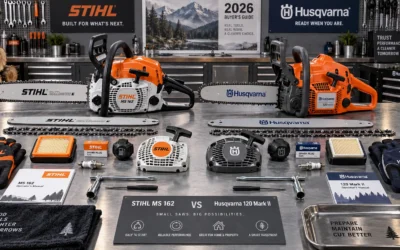
Quick Answer
To start a Husqvarna chainsaw, set the choke, use the primer bulb if fitted, and engage the chain brake. Brace the saw on the ground, then pull the starter cord with a firm, steady stroke. Move the choke off once the engine starts so it runs smoothly.

Pros
- Powerful 59.8-cc, 4.16-HP X-Torq engine built for heavy-duty cutting
- AutoTune system automatically adjusts engine settings for environment
- Smart Start feature designed for easier pull-cord startup
- Durable magnesium crankcase withstands demanding use
- Side-mounted chain tensioning provides quick access for adjustments
Cons
- 13-pound dry weight can cause fatigue during all-day operation
- Requires ongoing gas-and-oil fuel mixing and standard engine upkeep

Pros
- Professional 50.1cc gas engine with 3.6 HP output for serious cutting applications.
- AutoTune and Smart Start add convenience for users who need reliable performance and easier startup.
- Air Injection and enhanced cooling are designed to support durability in dusty, high-demand cutting environments.
- Inertia-activated chain brake adds an important safety feature for reducing kickback-related injury risk.
- Slimmed-down design is intended to improve handling for forestry and tree care crews.
Cons
- Gas-powered operation requires fuel mixing, engine maintenance, and proper storage compared with electric chainsaws.
- Professional-grade power may be more than casual homeowners need for occasional light trimming.
- Product data does not specify included accessories, weight, or exact package contents, so buyers should verify what comes in the box.
Overview and design: The Husqvarna 545 Mark II is a professional gas-powered chainsaw built for forestry crews, tree care professionals, and serious outdoor users. It uses a slimmed-down design and is recommended for bar lengths from 13 inches to 20 inches, with this listing centered on a 20-inch setup for larger cutting work.
Performance and key features: Its 50.1cc, 3.6 HP X-Torq engine is designed for strong cutting capacity in felling, limbing, and demanding woodcutting tasks. Smart Start helps reduce startup effort, while AutoTune automatically adjusts engine settings to maintain performance without manual tuning. The Air Injection system helps remove larger dust and debris before they reach the air filter, and the cooling system is built to support extended engine life.
Drawbacks and considerations: This is a gas chainsaw, so it requires fuel handling, routine engine maintenance, and proper storage. It may be more tool than needed for casual users who only cut small branches occasionally. The manufacturer listing does not list weight, dimensions, or all included accessories, so buyers should confirm package contents before purchase.
Verdict: The Husqvarna 545 Mark II is best suited for professional tree care, forestry, farm, and property maintenance users who want a powerful 20-inch gas chainsaw with automatic engine adjustment, improved filtration, cooling support, and vibration reduction. It is a strong fit for demanding outdoor cutting rather than light-duty occasional trimming.

Pros
- Powerful 3.6-HP X-Torq engine delivers high cutting performance
- Ergonomic LowVib design reduces vibrations for easier handling
- Smart Start and combined choke/stop control simplify reliable startups
- Air filtration system supports longer engine durability
- Built-in inertia chain brake enhances user safety
Cons
- 2-cycle gas engine requires fuel-oil mixing and ongoing maintenance
- Limited to recommended bar lengths of 13 to 24 inches only
- Gas-powered design produces typical noise and emissions of combustion tools
The Husqvarna 460 Rancher is a robust gas powered chainsaw with a 24 inch bar built for wood cutting, tree trimming and land clearing. It combines exceptional ergonomic features for easier handling and mobility with the superior power of a gas chainsaw, creating a solid immediate impression as a durable outdoor tool.
Performance comes from the 60.3-cc 3.6-HP X-Torq engine that maximizes power even at low RPMs. Standout features include Smart Start for effortless quick startups, Air Injection Technology that expels larger dust and debris particles before they reach the air filter, an automatic adjustable oil pump, LowVib technology, a 7 degree offset front handle with improved grip, and an inertia-activated chain brake to reduce kickback risks. Combined choke/stop control further eases starting and lowers flooding risk.
Drawbacks and considerations include the need for regular 2-cycle fuel mixing and maintenance typical of gas engines. It is recommended strictly for bar lengths between 13 inches minimum and 24 inches maximum, which may limit versatility on bigger jobs. Users should also account for the noise and emissions common to this power type.
The Husqvarna 460 Rancher delivers the most value to experienced users handling demanding land clearing or heavy wood cutting tasks who prioritize raw power, safety features and ergonomic handling in a reliable gas chainsaw.
The critical factors to evaluate when choosing How To Start Husqvarna Chainsaw in 2026 center on Smart Start technology that cuts pull force, precise compatibility of recoil starters and primer bulbs with models like the 445 and 450 series, engine displacement for reliable low-RPM power, and inclusion of air filters plus spark plugs in tune-up kits to sustain clean combustion. Our review of top-rated options from leading manufacturers prioritizes these elements for consistent cold and warm starts across ergonomic designs, as covered in our expert reviews of leading chainsaw models.
Selecting the right products for How To Start Husqvarna Chainsaw requires focusing on components and full units that address ignition reliability while matching specific Husqvarna model requirements for bars from 13 to 24 inches. Key criteria include starter design, engine efficiency, upkeep parts, fuel delivery systems, handling features, and supporting tools, each evaluated against real-world needs for pruning, cleanups, and clearing.
Smart Start Technology and Recoil Starter Compatibility
Smart Start systems on Husqvarna gas chainsaws reduce the force required to engage the engine, enabling faster ignition with fewer pulls even in cooler weather or after storage periods. Full models like the 450 Rancher incorporate this with an inertia-activated chain brake that limits kickback risks during initial acceleration. For repairs, the AILEETE 544071604 Recoil Starter Assembly serves as a direct replacement for 445, 450, 445e, and 450e units, matching original dimensions to restore smooth cord retraction without binding or premature wear.
Compatibility checks prevent mismatches that leave saws inoperable, so verify part numbers against the specific engine series before installation. High-quality aftermarket or OEM starters extend service life by using robust springs and housings that withstand repeated tension cycles common in frequent firewood cutting sessions. Pairing a reliable starter with proper technique, such as firm ground placement and sequential choke engagement, minimizes flooding and ensures the first or second pull succeeds consistently.
Engine Displacement, Power Output, and Efficiency Features
Engine size directly influences starting ease and sustained performance, with larger displacements providing stronger compression and quicker response once running. The Husqvarna 450 Rancher uses a 50.2-cc 3.2-HP X-Torq 2-cycle engine that balances power for 13- to 20-inch bars while optimizing fuel use at varying RPMs. The 455 Rancher steps up to a 55-cc or 56-cc 3.5-HP configuration for heavier 13- to 24-inch applications, delivering torque even at lower speeds to avoid bogging during dense wood cuts.
X-Torq technology maximizes output while reducing emissions and consumption, which supports longer run times between refuels and cleaner spark plug conditions that aid restarts. Air Injection centrifugal cleaning expels dust before it reaches the filter, preserving airflow for reliable combustion and fewer mid-task stalls. When assessing How To Start Husqvarna Chainsaw options, match engine specs to workload intensity so lighter 50-cc class units suit residential pruning while higher-output variants handle professional land clearing without excessive pull resistance on the starter.
Maintenance Kits and Tune-Up Components for Consistent Ignition
Regular replacement of air filters, fuel filters, and spark plugs prevents hard starts caused by restricted flow or weak sparks. The Husqvarna 599333401 Maintenance Kit targets 135, 435, and 440 series with easy-to-install parts that restore factory-level breathing and ignition reliability in a single package. These kits address common degradation after dust exposure or ethanol-blended fuel use, restoring compression response so the engine fires promptly on the first solid pull.
Schedule kit installation every 25 to 50 hours of operation depending on conditions, calculating intervals based on daily runtime logs for heavy users. Combining a fresh filter set with correct 50:1 fuel mix ratios keeps carburetors clear and avoids the repeated choke cycling that floods engines. This proactive approach, detailed further across our chainsaws category resources, ensures accessories support the core starting process rather than creating secondary failures.
Fuel Lines, Primer Bulbs, and Delivery Systems
Primer bulbs and fuel lines enable precise carburetor charging before the first pull, eliminating dry starts that demand excessive cord force. The Hipa Fuel Line with Primer Bulb fits a wide range of Husqvarna chainsaws including 235, 236, 240, 340, 345, 350, 353, 440, 445, 450, and 460 models as well as select trimmers and blowers under part reference 503936601. Flexible, ethanol-resistant materials resist cracking and leaks that otherwise introduce air pockets and prevent proper priming.
Installation involves routing the line without kinks and securing the bulb for easy thumb pressure that draws fuel visibly. Users should replace these components at the first sign of hardness or discoloration to maintain consistent fuel volume delivery. Reliable primers reduce the number of pulls needed from five or more down to one or two, particularly valuable for intermittent residential use where saws sit unused between sessions.
Ergonomics, Vibration Control, and Safety Mechanisms
Comfortable handles and LowVib dampeners reduce operator fatigue so starting pulls remain controlled and accurate rather than jerky. The 450 and 455 Rancher models feature soft inlays, ergonomic triggers, asymmetrical or 7-degree offset front handles, and vibration isolation that keeps hands steady during the critical first ignition sequence. These designs support recommended bar lengths while the inertia-activated chain brake engages automatically on kickback forces. For additional operational safety benchmarks, see our published testing notes on echo cs 355t vs makita xcu06z.
Proper grip positioning allows full body weight transfer into the pull without twisting the saw, improving success rates and lowering injury risk. When choosing among options for How To Start Husqvarna Chainsaw, prioritize units that combine these handling traits with automatic oilers that lubricate the chain immediately upon running to prevent binding that could affect subsequent restarts.
Essential Multipurpose Tools and Fastener Replacements
A dedicated scrench and quality fasteners simplify assembly, tensioning, and starter housing reattachment after service. The Husqvarna Chainsaw Scrench functions as a combined screwdriver and wrench measuring approximately 1.5 inches by 3.2 inches by 11.5 inches for removing, tightening, or loosening bar nuts, plugs, and covers. Complement this with the Recoil Starter Screws Replacement 10-pack sized for 340, 345, 350, 435, 440, 445, 450, 455 Rancher, 455 Rancher II, 460, and 461 models under reference 503217321. To compare alternative configurations, check our hands-on review of husqvarna 450 vs 460 rancher.
Secure fasteners prevent housing vibration that loosens over time and causes starter misalignment. Keeping these tools on hand allows quick field adjustments without searching for improvised solutions that risk stripping threads. They complete a full kit for both new saw setup and ongoing How To Start Husqvarna Chainsaw maintenance.
| Product | Engine / Type | Key Starting Feature | Primary Compatibility |
|---|---|---|---|
| Husqvarna 450 Rancher | 50.2-cc 3.2-HP X-Torq | Smart Start + Inertia Brake | 13-20 inch bars, pruning and firewood |
| Husqvarna 455 Rancher | 55-cc 3.5-HP X-Torq | Smart Start + LowVib | 13-24 inch bars, land clearing |
| AILEETE Recoil Starter | Replacement Assembly | Direct pull-start restore | 445 / 450 / 445e / 450e series |
Starting Features Worth Comparing
Starting features differ from item to item, so the table lines up engine or type, key starting feature and primary compatibility for each entry. Those fields come from manufacturer specifications and listed Amazon details. Compatibility deserves a check before any purchase, because a starting aid suited to a given platform may not suit another. Readers wanting to compare a different battery platform can look at greenworks 40v 18 vs ego cs1800.
Buyer FAQs: How To Start Husqvarna Chainsaw Solved
How do you properly start a Husqvarna chainsaw?
To properly start a Husqvarna chainsaw, place it on firm ground, engage the chain brake, set the choke fully for cold starts, press the primer bulb several times if equipped until fuel appears, then pull the starter cord firmly and evenly until the engine fires before moving the choke to half or run position. Fresh 50:1 mixed fuel and a functional spark plug are required for reliable ignition on the first or second pull. Models with Smart Start further reduce the force needed during this sequence.
What are the most common reasons a Husqvarna chainsaw will not start?
The most common reasons a Husqvarna chainsaw will not start include a flooded engine from excess choking, clogged air or fuel filters restricting flow, a worn or broken recoil starter assembly, stale fuel that has degraded, or a fouled spark plug. Checking and replacing these components with kits or parts designed for the exact model series usually restores function quickly. Consistent maintenance intervals prevent most of these issues from developing during regular use.
How often should the recoil starter be replaced on a Husqvarna chainsaw?
The recoil starter on a Husqvarna chainsaw should be replaced when the cord frays, the spring loses tension, or the housing cracks, typically after several seasons of heavy use or sooner under dusty conditions that accelerate wear. High-quality replacements such as those matching 445 and 450 series restore original pull ease and prevent incomplete rewinds that strand the cord. Inspecting the assembly during every filter change helps catch problems early.
Can aftermarket primer bulbs and fuel lines be used safely on Husqvarna chainsaws?
Aftermarket primer bulbs and fuel lines can be used safely on Husqvarna chainsaws when they match the exact model fitment list and employ ethanol-resistant materials that avoid swelling or cracking. Products covering ranges from the 235 through 460 series provide reliable fuel delivery equivalent to original parts for consistent priming. Always confirm routing paths and secure clamps during installation to eliminate air leaks that hinder starting.
What tools are needed for basic Husqvarna chainsaw starter maintenance?
Basic Husqvarna chainsaw starter maintenance requires a multipurpose scrench for bar nuts and plugs plus the correct replacement screws for the starter housing to ensure secure reassembly after inspection. These tools allow filter access, tension adjustments, and housing reattachment without specialized equipment. Keeping them with a full maintenance kit supports rapid troubleshooting as noted in our chainsaws category guides.
Pull Start Safety Notes
Pull starting can strain the body if done carelessly, so a steady stance and relaxed grip help. Background on safe power tool use can be found at American National Standards Institute (ANSI).