Quick Answer: What Does a Circular Saw Do?
A circular saw is a high-speed handheld power tool that uses a round toothed blade spinning around an arbor to make precise straight cuts. It excels at rip cuts (cutting with wood grain), crosscuts (cutting across grain), and bevel cuts through lumber, plywood sheet goods, and plastic composites.
How a Circular Saw Works
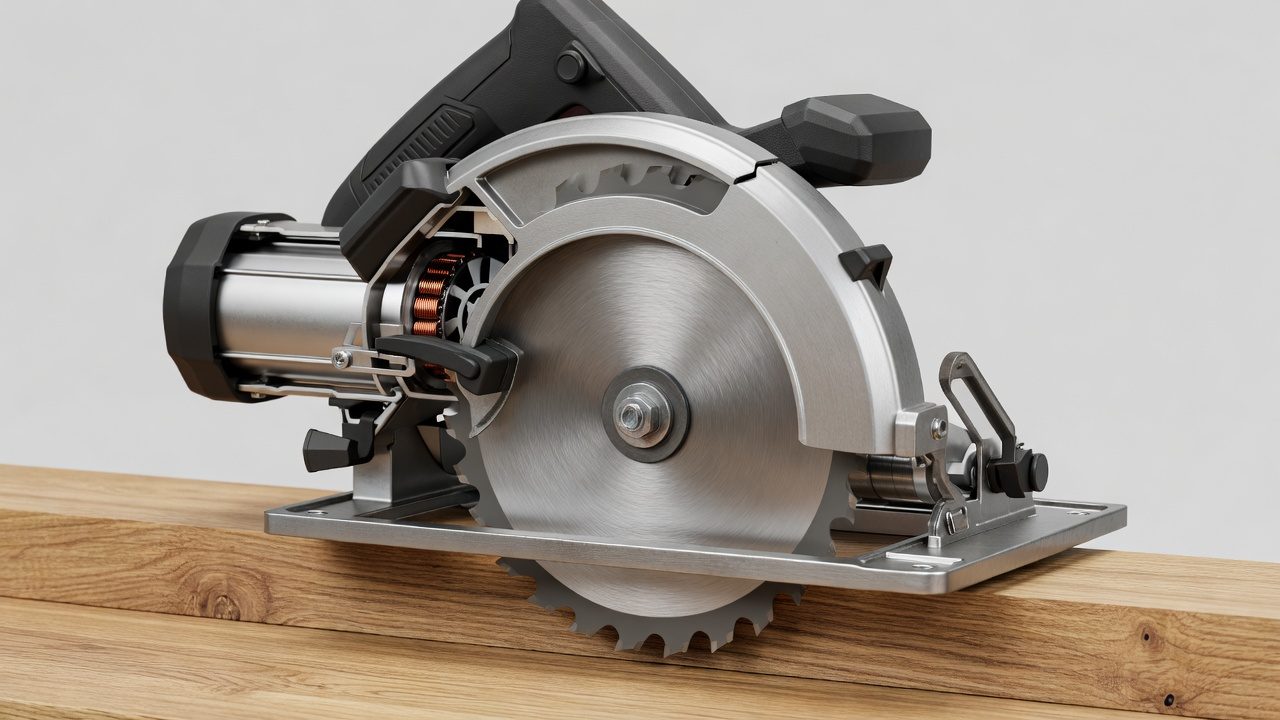
A circular saw operates through a straightforward mechanical principle: an electric motor (powered by a cord or rechargeable battery) spins a circular blade with sharp, hardened teeth around a central arbor. The spinning blade cuts as it moves forward through the material, with the blade guard automatically retracting as the saw contacts the workpiece and returning to cover the blade when the cut is complete.
The flat metal base plate, sometimes called the shoe, rests flat against the top of the workpiece. This base plate serves two purposes: it provides a stable platform that keeps the blade perpendicular to the material, and it allows the user to adjust the cutting depth by raising or lowering the blade in relation to the workpiece. Most circular saws allow depth adjustment from fully retracted (where only the teeth protrude slightly below the base) to fully extended, letting you cut through materials of varying thickness.
Unlike a manual saw, which requires physical sawing motions, a circular saw does the cutting work for you, you simply guide it along your marked line and let the blade’s speed and sharpness do the work. This makes it faster and less physically demanding for repetitive or long cuts.
Primary Cuts: Rip Cuts and Crosscuts
A circular saw is designed to make two fundamental types of straight cuts: rip cuts and crosscuts.
Rip cuts run parallel to the grain of the wood, from one end of a board to the other along its length. Crosscuts go perpendicular to the grain, across the width of the board. Both are straight cuts that a circular saw handles well, though the technique and setup differ slightly. To evaluate matched hardware tolerances, consult our detailed overview of z890 vs x870e motherboard.
For a rip cut, you typically align the blade with the edge of the board or use a straightedge guide to keep the saw tracking parallel to the grain. For a crosscut, you mark your line and guide the saw across the width of the board. Many users employ a speed square or layout square clamped to the workpiece as a reference to help maintain a perpendicular cut.
While a circular saw can make both types of cuts, it is not designed for precision rip cuts on narrow boards the way a table saw is, where the material is pushed through a stationary blade. Instead, a handheld circular saw excels at crosscutting large sheets and making rip cuts when portability and ease of setup matter more than bench-top precision. When planning workspace deployment, consider the engineering criteria outlined in our marshall stanmore iii vs harman kardon onyx studio 8 guide.
Materials a Circular Saw Can Cut
Circular saws are primarily designed for wood and wood-based sheet goods. Common materials include:
- Solid lumber (hardwood and softwood)
- Plywood
- Oriented strand board (OSB)
- Medium-density fiberboard (MDF)
- Particle board
With the right blade, a circular saw can also cut beyond wood. Diamond-tipped blades are used for masonry, tile, and concrete; fine-toothed or carbide-tipped blades can cut non-ferrous metals like aluminum and copper; and abrasive blades are available for specialty materials. However, cutting non-wood materials typically requires slower feed rates and may produce dust or debris that demands appropriate respiratory protection and ventilation. For additional operational safety benchmarks, see our published testing notes on dyson v8 cyclone vs bissell featherweight stick.
Blade selection is critical. Using the wrong blade, for instance, a wood blade on metal or masonry, dulls the teeth quickly, produces poor cuts, generates excessive heat, and increases safety hazards. Always verify that your blade is appropriate for both the material and the depth of cut you intend to make.
Handheld vs. Table-Mounted Circular Saws
The term “circular saw” most commonly refers to the handheld model, a portable tool you grip and guide by hand. This version is compact, lightweight, and ideal for job sites, on-location cuts, and situations where you need to bring the tool to the work. To compare alternative configurations, check our hands-on review of bissell crosswave hydrosteam vs shark stainforce.
A table-mounted circular saw, often called a table saw, is the stationary counterpart. The blade protrudes upward through a flat table surface, and the user pushes the material through the stationary blade. Table saws are better for precision, repeatability, and high-volume ripping, but they are fixed installations that require shop space.
Each has trade-offs. Handheld saws offer portability and speed for cross-cutting and general construction work. Table saws provide superior precision and control for fine woodworking and long rip cuts. Many workshops have both, using each for the tasks where it performs best.
Common Tasks and Typical Uses
A circular saw is the go-to tool for a wide range of cutting tasks:
- Framing and rough carpentry: Cutting wall studs, joists, and beams to length
- Deck building: Crosscutting deck boards and structural lumber
- Sheathing and subflooring: Cutting plywood and OSB sheets to size and fitting them around obstacles
- Sheet goods: Breaking down large sheets of plywood, drywall, or composite materials into smaller, more manageable pieces
- Angle cuts: With the base plate tilted, making beveled or chamfered cuts
- On-site trimming: Cutting lumber and trim to final length during installation
A circular saw is the appropriate choice when you need speed, portability, and straightforward cuts. It is less suitable for curved cuts, which require a jigsaw; for precise angled crosscuts, a miter saw is often superior; and for rip cuts requiring fine precision, a table saw is the better tool. However, for general construction, framing, and site work, a circular saw remains the most versatile handheld option.
How You Operate a Circular Saw
Basic operation involves a few key steps. First, you mark your cut line on the workpiece with a pencil or chalk. Next, you clamp or support the workpiece securely so it cannot move or rotate, unstable workpieces are a common source of accidents. You then position the circular saw so the blade aligns with your cut line, with the base plate flat against the workpiece surface.
Before starting, you verify that the blade depth is set appropriately: typically, the lowest teeth of the blade should protrude just slightly below the bottom surface of the workpiece. A deeper setting wastes energy and increases kickback risk. Once everything is in position, you start the motor and allow the blade to reach full speed before engaging the material. Then you guide the saw forward along the cut line at a steady, even pace, letting the blade do the work without forcing it.
The blade guard covers the blade when not in use and retracts automatically during the cut, then returns to cover the blade when you release the trigger. Never attempt to manually raise or hold back the blade guard while cutting, the guard is a critical safety feature.
Safety Considerations
Circular saws are powerful tools, and safe use requires respect for the hazards they pose.
Kickback is the most serious hazard. If the blade binds in the material, often because the wood closes around the blade or the material twists, the saw can be suddenly jerked back toward the user with considerable force. Proper workpiece support, a sharp blade, and correct blade depth reduce kickback risk, but it remains a recognized hazard of the tool.
Contact with the spinning blade causes severe lacerations and can sever fingers or hands. The blade guard protects against accidental contact when not cutting, but carelessness or removing the guard significantly increases injury risk.
Standard protective equipment for circular saw use includes safety glasses or a face shield to protect against flying dust and debris, and hearing protection, as the tool produces noise above levels considered safe for extended exposure. Many users also wear a dust mask, particularly when cutting materials like MDF that generate fine particles.
Proper technique also matters: keeping both hands on the tool (or positioned safely away from the blade path), ensuring the workpiece is clamped or held firmly, setting appropriate blade depth, using sharp blades, and never reaching under the saw or toward the blade while it is running are fundamental safety practices. Always consult the manufacturer’s safety instructions and guidance specific to your saw, and consider professional instruction if you are new to power tools.
Choosing the Right Saw for Your Project
A circular saw is ideal when you need a portable tool for general straight cuts in wood and sheet materials. If your project involves curved cuts, precision angled crosscuts, or high-volume rip cutting, a different saw may be more efficient. Evaluate your specific tasks, the materials you’ll cut, your workspace, and whether portability or shop precision matters more, the answer often points to whether a handheld circular saw or a more specialized tool is the better fit.
Related Maintenance and Operating Guides
To keep your equipment running at peak operating efficiency, explore our related technical walkthroughs and maintenance tutorials:
- Consult our detailed breakdown on how to refill a string trimmer.
- Consult our detailed breakdown on how to remove a STIHL trimmer head.
- Consult our detailed breakdown on what size file for a 3/8 chain.
- Consult our detailed breakdown on leaf blower CFM meaning.
- Consult our detailed breakdown on what a Sawzall is used for.
Technical Standards and Safety Guidelines
Equipment design tolerances, operational vibration thresholds, and protective gear guidelines comply with published safety standards from the American National Standards Institute (ANSI) under ANSI B71.1 and B175 safety specifications for outdoor machinery.