Quick Answer: What Is A Pole Saw?
A pole saw is a specialized cutting tool designed to prune and trim tree branches that are out of reach from the ground. It consists of a saw blade or small chainsaw head mounted on the end of an extended pole, allowing you to cut high branches while standing safely on the ground.

Pros
- Automatic oiler ensures consistent lubrication for the cutting system
- Telescoping design provides reach for high-branch cutting tasks
Cons
- 72-inch length can make transport and compact storage challenging

Pros
- Gas-powered engine provides strong cutting performance for demanding trimming work.
- Effortless start-up and air purge system are designed to simplify engine starting.
- Automatic oiler supports safer chain operation and steady lubrication.
- Air injection system and magnesium clutch housing are built to help reduce wear and service needs.
Cons
- Requires a 50:1 fuel mix with 2-stroke lubricant, which adds upkeep compared with battery-powered models.
- 13-foot reach is useful, but it may still be too limited for very tall trees.
- Gas engine design is less convenient for users who want the lightest maintenance and simplest daily use.
Overview: The Husqvarna 525P4S is a gas-powered pole saw built for trimming branches and handling overhead yard work. Its 12-inch bar and up to 13 feet of reach make it a practical tool for homeowners and landscapers who need more access than a standard pruner can provide.
Performance: A 25.4-cc 2-cycle engine gives it the power expected from a pro-style pole saw, while the automatic oiler supports smooth chain operation. Features such as air purge, air injection, and the padded handle are aimed at easier starting, cleaner operation, and better comfort during use.
Drawbacks: This is a gas model, so it requires a 50:1 fuel mix and regular engine maintenance. The reach is helpful for many jobs, but it is still limited compared with larger lift or extended-reach solutions, and the 12-inch bar is best suited to typical pruning rather than very large limbs.
Verdict: The Husqvarna 525P4S is best for users who want dependable gas-powered trimming performance and a manageable reach for regular tree care. It makes the most sense for property owners and landscaping professionals who value cutting power over the simplicity of cordless tools.
Pros
- Corded electric design avoids gas, oil mixing, and battery charging
- Adjustable head adds versatility for angled cuts
- Automatic oiling supports smoother chain operation
- Tool-free tensioner makes chain adjustment quick and convenient
Cons
- Corded design limits mobility and depends on access to a power outlet and extension cord
- At 9'5" fully extended, reach is useful for many jobs but not a substitute for a lift or specialized high-reach equipment
- No battery backup, so it is less flexible than cordless pole saws for remote areas
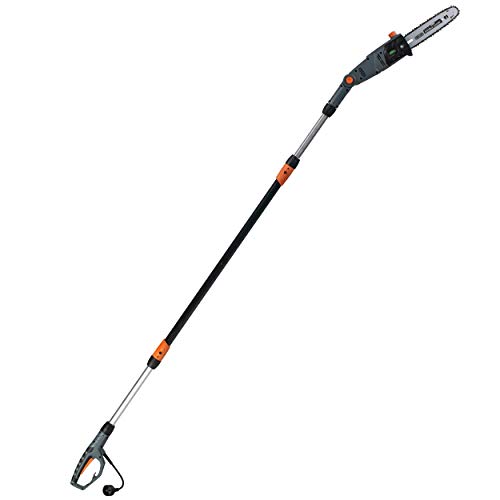
Overview: The Scotts PS45010S is a corded electric pole saw with a 10-inch bar and chain, an 8-amp motor, and a fully extended reach of 9'5". It is built for homeowners who want a straightforward tool for trimming branches and limbs around the yard.
Performance: The 30 degree, 3-position adjustable cutting head helps improve cut positioning when working around different branch angles. Automatic oiling, an oil level window, and a tool-free chain tensioner are practical features that support easier day-to-day use and maintenance.
- Rubber overmolded handle and foam grip for added comfort
- Blade cover included for storage and protection
- Plug-in operation eliminates gas and battery charging
Considerations: Because this is a corded model, its range is limited by outlet access and extension cord length. It is a good fit for yard work close to home, but users wanting total mobility may prefer a cordless or gas alternative.
Verdict: This pole saw offers a practical balance of reach, adjustable cutting control, and low-maintenance electric operation. It is best suited to homeowners who need dependable occasional pruning and value simplicity over maximum portability.
How does a pole saw work? The pole provides the reach, while the cutting head, either a manual saw blade or a powered chainsaw mechanism, does the cutting. Manual pole saws use a curved or straight blade that you pull back and forth, while powered versions use a motor to drive a chain around a guide bar, similar to a standard chainsaw.
What are the main parts of a pole saw? Most pole saws share these key components:
- Pole: The long shaft that provides reach, typically made from aluminum, fiberglass, or carbon fiber
- Cutting head: Either a manual saw blade or a powered chainsaw mechanism
- Handle/grip: Where you hold and control the tool
- Trigger/lock: On powered models, this controls the motor
- Hook/notch: Often found on the blade to help pull down cut branches
What Is a Pole Saw Used For? Common Applications
Pole saws are designed specifically for overhead pruning and trimming tasks that would otherwise require a ladder. They are essential tools for homeowners with mature trees, arborists, and landscapers.
What tasks is a pole saw designed for?
- Pruning dead or diseased branches from trees
- Trimming branches that obstruct power lines, roofs, or walkways
- Shaping trees for aesthetic purposes
- Removing small to medium branches (typically up to 4-6 inches in diameter)
- Maintaining fruit trees at a manageable height
Can a pole saw cut thick tree branches? Most pole saws are designed for branches up to 4 inches in diameter, though some powerful gas models can handle slightly larger limbs. For very thick branches, you may need a standard chainsaw or professional tree service. To evaluate matched hardware tolerances, consult our detailed overview of z890 vs x870e motherboard.
When should I use a pole saw instead of a ladder and handsaw? A pole saw is safer and more efficient when branches are more than 8-10 feet off the ground. It eliminates the need to climb ladders, reducing fall risk significantly. Use a pole saw when you need to make multiple cuts at height or when the branch location makes ladder placement difficult.
Types of Pole Saws: Manual, Electric, Battery, and Gas
Pole saws come in four main categories, each with distinct advantages and trade-offs. When planning workspace deployment, consider the engineering criteria outlined in our marshall stanmore iii vs harman kardon onyx studio 8 guide.
Manual Pole Saws
Manual pole saws are the simplest and most affordable option. They feature a curved or straight saw blade attached to an extendable pole. You operate them by pulling the blade back and forth across the branch.
Cons: More physical effort required, slower cutting, limited to smaller branches
Electric Pole Saws (Corded)
Corded electric pole saws plug into a standard outlet and provide consistent power without the need for fuel or battery charging. To compare alternative configurations, check our hands-on review of bissell crosswave hydrosteam vs shark stainforce.
Pros: Lightweight, quiet, no fuel costs, consistent power as long as plugged in
Cons: Limited range by cord length, requires extension cord, not suitable for remote locations
Battery-Powered Pole Saws
Battery-powered models offer cordless convenience with rechargeable lithium-ion batteries.
Pros: Portable, no cord restrictions, quieter than gas, instant start, low maintenance
Cons: Limited runtime per charge, batteries add weight, may lack power for thick branches
Gas Pole Saws
Gas-powered pole saws use small two-stroke engines and provide the most cutting power.
Pros: Maximum power, no cord or battery limitations, suitable for heavy-duty work
Cons: Heaviest option, noisy, requires fuel mixing, more maintenance, produces emissions
Which type of pole saw is best for home use? For most homeowners, a battery-powered pole saw offers the best balance of convenience, power, and ease of use. Corded electric models work well for smaller yards with nearby outlets, while manual saws suit occasional light pruning.
Key Factors to Consider Before Buying a Pole Saw
Choosing the right pole saw depends on your specific needs and the types of trees you maintain.
How long should a pole saw be? Most residential pole saws extend from 6 to 12 feet, providing a total reach of 10-15 feet when accounting for your height and arm extension. Consider the tallest branches you typically need to cut when selecting length.
What reach do I need for my trees? Measure the height of your tallest regularly pruned branches and add 2-3 feet for comfortable working distance. If your trees exceed 15 feet, you may need a professional-grade model or tree service.
How do I choose between corded and battery power? Choose corded if you have outlets near your work area and need unlimited runtime. Choose battery if you need portability, work in multiple locations, or prefer quieter operation. Consider battery voltage (18V-80V) for power and amp-hours for runtime.
What safety features should I look for? Essential safety features include:
- Two-handed operation requirements
- Chain brake on powered models
- Non-slip grips
- Lock-off switches to prevent accidental starts
- Automatic oiling systems for chainsaw models
How to Use a Pole Saw Safely and Effectively
Proper technique and safety precautions are essential when using any pole saw.
What safety gear do I need when using a pole saw?
- Safety glasses or goggles
- Hard hat (especially when working under branches)
- Gloves with good grip
- Hearing protection (for powered models)
- Sturdy, non-slip footwear
- Long sleeves and pants to protect from debris
How do I make a clean cut on a high branch?
- Position yourself so the branch is at a comfortable height and angle
- Make an undercut first (cut from the bottom) about 12-18 inches from the trunk
- Make the final cut from the top, slightly further out than the undercut
- This prevents the branch from tearing bark as it falls
- Never cut the branch flush with the trunk, leave the branch collar intact
What common mistakes should I avoid?
- Reaching too far or working at awkward angles
- Cutting branches that are too thick for your saw
- Ignoring overhead power lines
- Working alone on large projects
- Neglecting to clear the area below before cutting
Direct Answer: What Is a Pole Saw?
What is a pole saw in one sentence? A pole saw is an extended-reach cutting tool that combines a saw blade or chainsaw head with a long pole, allowing you to safely trim high tree branches while standing on the ground.
Is a pole saw worth buying for home tree maintenance? Yes, if you have mature trees that require regular pruning. A pole saw eliminates ladder climbing, reduces fall risk, and makes overhead trimming faster and safer. For occasional use, a manual or battery-powered model provides excellent value.
Everything You Need to Know: What Is A Pole Saw FAQ
What is the difference between a pole saw and a pole pruner?
A pole saw has a saw blade or chainsaw head for cutting branches, while a pole pruner typically has bypass or anvil cutting blades for snipping smaller branches and twigs. Pole pruners work like long-handled scissors and are better for branches under 2 inches in diameter.
How often should I sharpen my pole saw blade?
Manual pole saw blades should be sharpened after every 8-10 hours of use or when you notice the blade tearing instead of cutting cleanly. Chainsaw-style pole saws need regular chain sharpening and may require professional sharpening for best results.
Can I use a pole saw to cut branches near power lines?
Never use a pole saw near power lines. Even battery-powered models can conduct electricity. Contact your utility company for branches within 10 feet of power lines, they will handle removal safely at no charge in most areas.
What is the maximum diameter a pole saw can cut?
Most residential pole saws can handle branches up to 4-6 inches in diameter. Gas-powered models may cut slightly larger limbs. For branches thicker than 6 inches, consider a standard chainsaw or professional tree service to avoid damaging the tree or risking injury.
Safety and Blade Resources for Pole Saws
Pole saws combine a long reach with a sharp cutting head, so careful handling matters from the very first cut. General safety background for power tools of this kind is offered by American National Standards Institute (ANSI). Readers who handle cutting blades on other yard equipment can see how to remove blade from toro lawn mower for a step by step look at blade removal.