What Is a Snow Blower? Direct Answer
A snow blower is a motorized machine designed to remove snow from driveways, sidewalks, and other surfaces by collecting snow and forcefully projecting it away from the cleared area. It uses an engine to power an impeller or auger that scoops up snow and channels it through a discharge chute, allowing homeowners and businesses to clear snow efficiently during winter storms. The term “snow blow” is a colloquial variation of “snow blower” and refers to the same equipment.
What Does a Snow Blower Do?
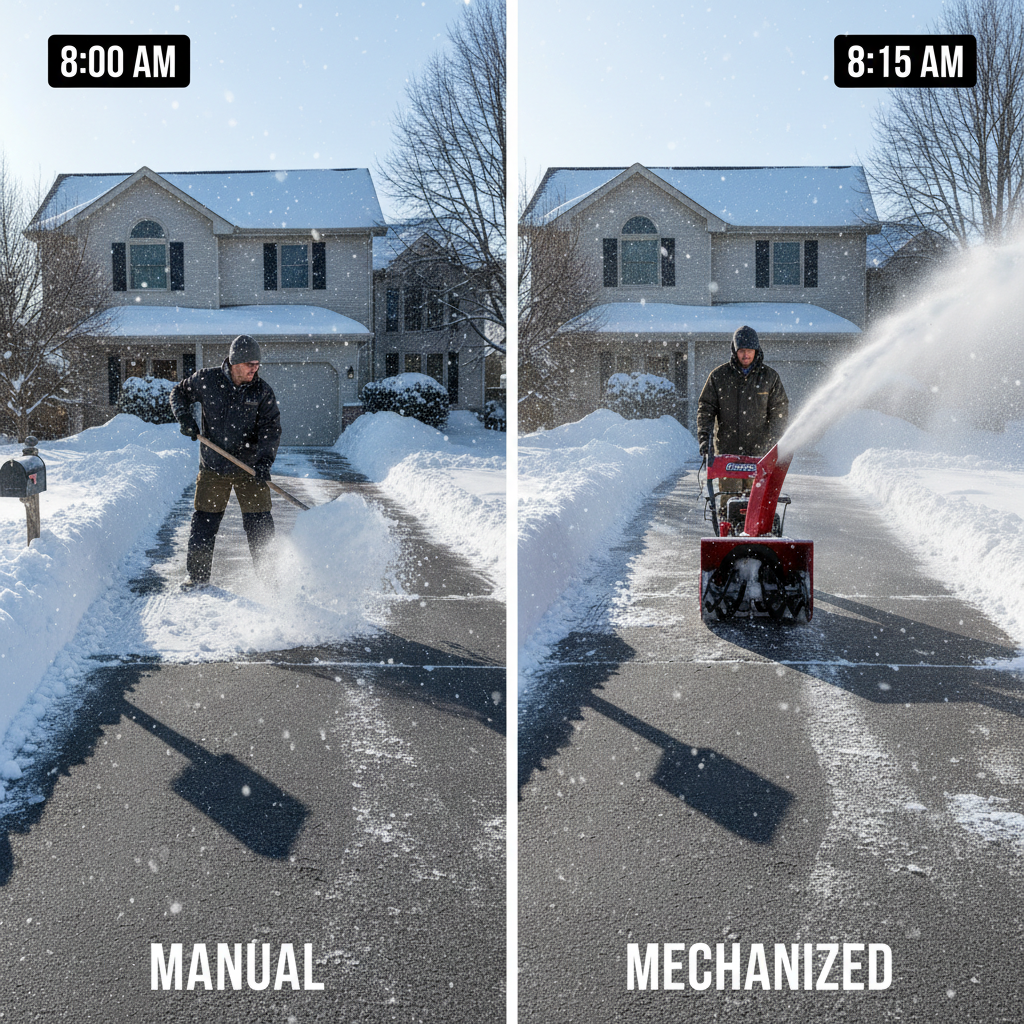
A snow blower serves a single primary purpose: to clear accumulated snow from outdoor surfaces quickly and with minimal physical effort. Unlike shoveling, which requires manual labor and can take hours for large areas, a snow blower mechanizes the snow removal process.
Snow blowers are commonly used to clear:
- Residential driveways
- Sidewalks and walkways
- Parking lots and commercial spaces
- Decks and patios
- Small roads and rural properties
The primary advantage over shoveling is speed and reduced physical strain. A snow blower can clear a typical residential driveway in minutes rather than the 30-60 minutes manual shoveling might require. This efficiency becomes increasingly valuable in regions that receive frequent or heavy snowfall, where multiple clearing sessions per season are necessary.
How Do Snow Blowers Work?
Understanding the mechanics of a snow blower helps explain why different models suit different snow conditions.
Key Components
A snow blower consists of several essential parts working in coordination:
- Engine: Typically a small gasoline or electric motor that powers the entire machine
- Auger or Impeller: A rotating screw or fan-like mechanism that scoops up snow from the ground
- Discharge Chute: A funnel-shaped channel that directs snow away from the cleared area, often with an adjustable angle for control
- Wheels or Tracks: Provide traction and allow the operator to push or ride the machine across snowy surfaces
- Shear Pin: A safety mechanism that breaks if the auger encounters an obstacle, preventing damage to the engine
How the Process Works
When you start the engine, the auger or impeller begins rotating at high speed. As you push the snow blower forward, the rotating auger scoops up snow from ground level and feeds it into an internal chamber. A second rotating mechanism (called an impeller in two-stage models) then forces this collected snow up and out through the discharge chute at high velocity. The chute can typically be adjusted left, right, or straight ahead, giving the operator control over where the snow lands.
Types of Snow Blowers: Single-Stage vs. Two-Stage vs. Three-Stage
Snow blowers come in three primary configurations, each designed for different snow conditions and clearing needs.
Single-Stage Snow Blowers
Single-stage models use one rotating auger that both collects and expels snow. They are the lightest and most compact option, typically weighing between 50-100 pounds.
Best for:
- Light to moderate snowfall (up to 6 inches)
- Small residential driveways and walkways
- Wet, heavy snow that doesn’t accumulate deeply
- Flat terrain without gravel or debris
Limitations: Single-stage models cannot handle deep snow accumulation and may struggle with dense, packed snow. They also cannot clear onto gravel surfaces, as they pick up small stones along with snow.
Two-Stage Snow Blowers
Two-stage models separate the collection and expulsion functions. An auger collects snow and feeds it into an internal chamber, where a separate impeller mechanism propels it out through the chute. Two-stage models are heavier (typically 200-600 pounds) but significantly more powerful.
Best for:
- Moderate to heavy snowfall (6-20 inches)
- Larger driveways and commercial applications
- Wet, compacted, or icy snow
- Longer clearing distances, as two-stage models can project snow 40-50 feet
Advantages: Two-stage models offer significantly greater snow-throwing distance, better handling of dense snow, and the ability to clear gravel driveways without picking up excessive stones.
Three-Stage Snow Blowers
Three-stage models add an additional accelerator stage that further compresses and accelerates snow before expulsion. These are the largest and most powerful option, often mounted on wheeled frames or tracked bases.
Best for:
- Very heavy or frequent snowfall (20+ inches)
- Commercial snow removal operations
- Large properties, parking lots, and rural areas
- Extreme snow density and ice conditions
Advantages: Three-stage models can handle the most challenging snow conditions and offer the greatest clearing capacity, but they require significant storage space and typically cost substantially more than single or two-stage models.
When Do You Need a Snow Blower?
Not every homeowner needs a snow blower. Consider these factors to determine whether one is practical for your situation.
Climate and Snowfall Patterns
Snow blowers become increasingly practical as annual snowfall increases and snow events become more frequent. In regions receiving 40+ inches of snow annually or frequent storms that drop 4+ inches, a snow blower typically offers better value than hand shoveling. In areas with infrequent light snowfall, shoveling or hiring occasional clearing services may be more economical.
Property Size and Terrain
A snow blower is most worthwhile for properties with driveways or parking areas larger than 500 square feet. Flat terrain is ideal; steep slopes can be challenging and unsafe with a motorized snow blower. Very small urban properties or apartment dwellings may lack adequate storage space for a snow blower.
Physical Capability
Snow blowers are particularly valuable for older adults or individuals with physical limitations who cannot safely shovel for extended periods. For younger, physically capable individuals in light-snow climates, shoveling may remain practical.
Cost-Benefit Analysis
Entry-level single-stage snow blowers cost $200-$500, while quality two-stage models range from $800-$2,500. A season of professional snow removal services can cost $1,500-$3,000 or more. If you plan to use a snow blower for 5+ years and receive regular snowfall, ownership typically provides better long-term value than hiring professional clearing.
Key Factors to Consider Before Buying
Engine Type and Fuel
Most snow blowers use small gasoline engines (3-16 horsepower) that operate reliably in cold weather. Electric models are quieter and require no fuel storage, but offer limited runtime and power, making them suitable only for small areas with light snow. Two-stage and larger single-stage models typically require gasoline.
Clearing Width
Clearing width—the width of snow the machine can handle in a single pass—ranges from 18 inches on compact models to 30+ inches on larger two-stage machines. A wider clearing path means faster snow removal but requires more storage space. For most residential driveways, 20-24 inches provides a good balance.
Chute Control and Distance
Look for adjustable discharge chutes that can be rotated or angled. Some models offer remote chute control from the operator position, which is convenient for adjusting throw direction without stopping the machine. Snow throw distance varies from 15-30 feet on single-stage models to 40-60 feet on powerful two-stage machines.
Drive System
Single-stage models are typically push-only, requiring you to propel them forward manually. Two-stage models often feature power-driven wheels or tracks that pull the machine forward at a steady pace, reducing operator fatigue on longer driveways. Tracked systems provide superior traction on icy or sloped surfaces compared to wheeled models.
Maintenance Requirements
Snow blowers require seasonal maintenance: pre-season engine service, regular fuel system checks, and post-season storage procedures. Gasoline engines require fuel stabilization when stored over summer months to prevent carburetor damage. Expect to spend 2-4 hours annually on basic maintenance.
Snow Blower vs. Snow Thrower: Is There a Difference?
In practical terms, “snow blower” and “snow thrower” refer to the same equipment. Both terms describe a motorized machine that removes snow by collecting it and projecting it away.
Regional terminology varies primarily by geography. In North America, “snow blower” is the standard term, while “snow thrower” is used somewhat interchangeably but less commonly. Some manufacturers market their products as “snow throwers,” emphasizing the throwing action. Internationally, terms vary: in parts of Canada, “snow blower” is standard; in the UK, “snow blower” is used but less common since significant snow is rarer.
The term “snow blow” (as in your search) is simply a colloquial shortening of “snow blower” used in casual conversation—functionally identical to the full term.
Frequently Asked Questions
Can a snow blower handle icy or packed snow?
Single-stage snow blowers struggle with dense, icy snow because their auger lacks the power to break up hard-packed accumulation. Two-stage and three-stage models handle icy conditions much better due to their greater mechanical force. If your region experiences frequent freeze-thaw cycles creating ice, a two-stage model is significantly more practical than a single-stage.
What’s the difference between gas and electric snow blowers?
Electric snow blowers are quieter, produce no emissions, and require minimal maintenance. However, they offer limited runtime (typically 30-60 minutes per charge for cordless models), less power for heavy snow, and struggle in very cold temperatures where batteries perform poorly. Gas models are more powerful and reliable in extreme cold but generate noise and require fuel storage and seasonal maintenance. For small residential areas with light snow, electric may suffice; for larger properties or heavy snow, gas is more practical.
How do I store a snow blower during off-season?
Proper off-season storage extends snow blower life significantly. Drain the fuel tank or add fuel stabilizer and run the engine to circulate treated fuel through the carburetor. Store the machine in a dry location, ideally on blocks to keep wheels off the ground. Cover it to prevent dust accumulation. In spring, verify all moving parts operate freely and check spark plugs before storage ends.
Can you use a snow blower on gravel or unpaved driveways?
Single-stage snow blowers cannot safely clear gravel driveways because they pick up small stones along with snow and eject them as projectiles. Two-stage and three-stage models have higher ground clearance and more selective collection, allowing them to clear unpaved surfaces with minimal stone pickup. If you have a gravel driveway, a two-stage model is essential for snow removal.