
Quick Answer: How Much Horsepower Does A Push Mower Have?
A typical consumer gas push mower uses a small single-cylinder engine, and sellers may still mention horsepower, but many models are now described by engine displacement instead. Electric and battery walk-behind mowers are usually not sold by horsepower at all; they are rated in volts, watts, or battery capacity. Advertised power is only a starting point: deck size, grass conditions,…

Pros
- Fuel-efficient 4-cycle OHV engine provides low noise and extended runtime compared to 2-stroke designs
- Wide 20-inch deck reduces overall mowing time on yards and gardens
- Versatile 5 height settings adapt easily to different grass conditions
- Durable steel construction supports long-term use on varied terrain
Cons
- Push-only operation demands more physical effort and is less ideal for very large properties
- No rear bagging option limits collection of clippings to mulch or side discharge only
- Maximum 3.75-inch cut height may require multiple passes on heavily overgrown areas
The SENIX 20 inch gas push lawn mower is a walk-behind unit built around a heavy-duty steel deck and 144cc 4-cycle OHV engine. Its straightforward design with matching 7-inch front and rear wheels creates a solid first impression for residential lawn, yard, and garden use while offering good ground clearance.
Performance & Key Features shine through the engine that delivers consistent power, low noise, and 20 to 30 percent better fuel efficiency with reduced emissions versus 2-stroke models. The 20-inch cutting width needs fewer passes, the 5-position height settings range from 1.25 to 3.75 inches for flexible grass control, and the 2-in-1 mulch and discharge system handles clippings effectively on slopes up to 15 degrees. Accessible blade and air filter components keep upkeep simple.
Drawbacks and considerations include the pure push design that requires more user effort on expansive or frequently mowed areas, plus the absence of a bagging option so clippings stay limited to mulching or side discharge. The height range may also feel restrictive for extremely tall growth without preparatory cuts.
This mower delivers the most value to homeowners managing medium yards who want a durable, fuel-efficient push model with straightforward maintenance and a 2-year limited warranty rather than premium self-propelled features.
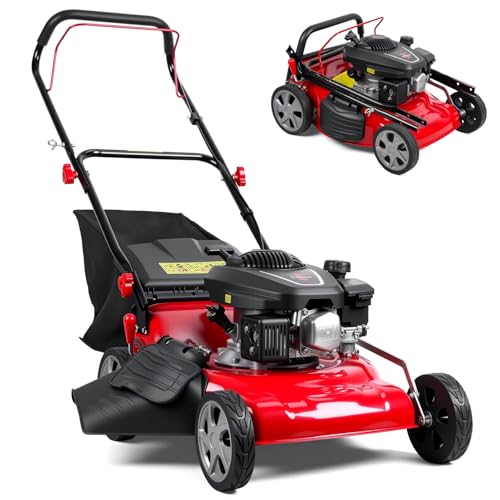
Pros
- Versatile 3-in-1 mulching, bagging and side-discharge modes for flexible lawn care
- Generous 50L grass collection capacity with easy-empty design
- Fuel-efficient 131cc 4-cycle engine with low-noise operation
- Lightweight construction and large wheels improve maneuverability
- Cutting height adjustment and easy-start features suit various users
Cons
- Gas engine requires ongoing fuel, oil and basic maintenance unlike electric models
- Exact cutting width and detailed height settings are not specified in available data
- Push-focused design may still demand physical effort on large or rough properties
The YOXIER 131cc 4-Cycle Gas Lawn Mower is a walk-behind model aimed at residential lawns, yards and gardens. It features a lightweight frame, large wheels and a 50L grass tank that create a practical first impression for everyday home use.
In performance the durable blade handles thick weeds and overgrowth while the 3-in-1 system supports mulching, side discharge or rear bagging. The 131cc engine is described as fuel-efficient and low-noise, with position cutting height adjustment and push-button start adding convenience. Rear-wheel drive is claimed to help on slopes and uneven terrain.
Drawbacks include the need for regular gas and oil maintenance. Precise cutting width and full height range details are missing from the specifications, so buyers should verify fit for larger or very dense areas. Physical pushing effort may remain depending on the terrain despite self-propelled mentions.
Overall this mower delivers solid value for homeowners with medium-sized yards who want a budget-friendly gas option with multi-mode clipping control and simple operation. It suits users comfortable with basic gas mower upkeep rather than those seeking fully electric convenience.
What horsepower means on a push mower
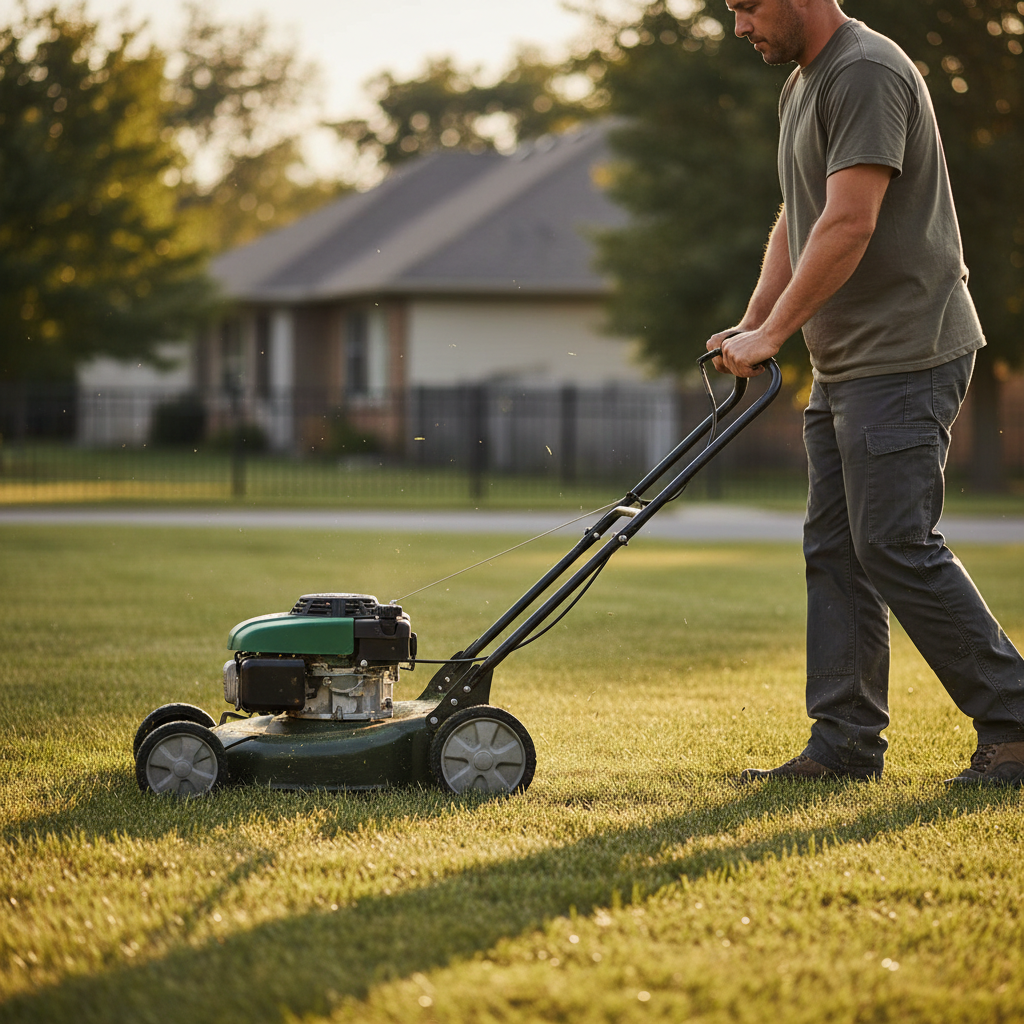
Horsepower is a unit of power. It describes how quickly an engine or motor can do work, not how wide the deck is, how clean the lawn will look, or how long the machine will last. On a consumer walk-behind mower, the number you see on a carton or spec sheet almost always refers to the power plant itself. It is not a lab score for the finished cut.
That distinction matters because a rotary mower does more than spin a blade. The engine or motor has to overcome friction, drive any belts or gears, move air through the deck, and, on some machines, also push the mower forward. Advertised engine horsepower is therefore not the same as power delivered at the blade after those losses. Two mowers with similar nameplate figures can feel different in tall grass if one wastes more energy in the drivetrain or deck.
Everyday language also blurs the machine type. People say “push mower” for almost any consumer walk-behind rotary mower. That usually includes hand-push models you walk behind and self-propelled models that drive their own wheels. Both sit in the same product class. They are not riding mowers, and they are not commercial walk-behinds built for all-day crew use. Self-propelled drive is still relevant to power, though: some of the engine or motor output goes into moving the machine instead of cutting. A hand-push model sends more of its available power to the blade, but you supply the travel force with your legs.
There is no single horsepower figure that describes every push mower. Gas, corded electric, and battery models are not labeled the same way. Even among gas engines, makers have used different rating practices over time. Older advertising sometimes leaned on “gross” style figures that described an engine under favorable test conditions. Later marketing more often used “net” style figures that tried to account for accessories such as an air cleaner, muffler, or cooling fan. Those practices have varied by manufacturer and era. Treat any number as that maker’s claim for that engine, not as a universal measurement of cutting performance.
Manual reel mowers sit outside this discussion. They have no engine horsepower rating because you supply the work. Powered reel units exist, but they are a different category from the common rotary walk-behind mower most people mean by “push mower.” For broader ecosystem context, read through our operational guide on z890 vs x870e motherboard.
How gas push mowers are commonly rated
A consumer gas lawn mower in this class typically uses a small single-cylinder four-stroke engine mounted on a stamped or fabricated deck. Sellers may list horsepower, engine displacement, or both. Displacement is the swept volume of the cylinder, usually shown in cubic centimeters (cc) and sometimes in cubic inches. It describes how large the engine is, not how much torque it makes, how efficiently it breathes, or how the blade feels in wet turf.
Marketing has shifted toward displacement in part because horsepower claims were easy to misunderstand and hard to compare. One brand’s advertised horsepower might have been measured differently from another’s. Accessories, test temperature, fuel, and whether the figure was a peak or a more conservative rating all change the printed number. Two engines that look similar on a showroom floor can therefore carry different advertised figures without one being twice as capable in the yard.
Displacement should not be treated as a substitute for horsepower. A larger cylinder can support more output, but output also depends on compression, valve timing, carburetion or fuel injection, exhaust, governor settings, and the condition of the engine. A worn engine with the same displacement as a new one will not deliver the same power. Altitude, hot weather, stale fuel, a dirty air filter, and a restricted muffler all reduce what you actually get compared with a clean-sheet rating. For troubleshooting and reliability insights, consult our in-depth marshall stanmore iii vs harman kardon onyx studio 8 report.
Published figures also vary because the engine is part of a system. A blade adapter, belt, or transmission absorbs some energy. A bagger adds back pressure and extra mass. Mulching keeps clippings in the deck longer, which can raise the load compared with an open side-discharge chute on the same lawn. None of those effects appear as a separate line on a horsepower sticker.
Because rating methods are not a single public yardstick that every walk-behind engine must use in the same way, you should not convert a displacement number into a homemade horsepower estimate and treat the result as fact. If a product page lists both cc and horsepower, read them as related but incomplete clues. If it lists only displacement, that tells you engine size, not a complete measure of cutting feel. Brand-specific horsepower or cubic-centimeter claims belong in the current owner literature for that model. They are not industry-wide constants, and they are not something this article can invent as a “typical” range. Readers comparing setup options can review our technical analysis on dyson v8 cyclone vs bissell featherweight stick.
Why similar-looking engines carry different numbers
Walk-behind engines in the same visual family can differ in governor springs, cam profiles, exhaust, and cooling. A maker may also rate one version as a bare engine and another as an installed lawn-mower engine. Installation matters: shrouds, blade load, and the mower’s own intake path change temperature and airflow. Wear matters too. An engine that has sat with old fuel, a fouled plug, or a nicked flywheel key will not match its original claim even if the displacement stamp is unchanged.
The honest use of a gas rating is modest. It tells you the manufacturer’s intended power class for that engine. It does not tell you whether the deck, blade, and wheels are well matched to your grass. It does not tell you how the mower will behave on a slope, in clover, or after a week of rain. Those questions depend on load, which is the next part of the story after the label.
How electric and battery push mowers are rated instead
Most corded and battery walk-behind mowers are not sold by horsepower. Retail listings usually lead with electrical units: a voltage class for the battery system, a wattage for the motor or charger, and a capacity for the pack in amp-hours or watt-hours. Those numbers answer different questions than a gas horsepower claim, so forcing them onto the same scale creates a false comparison.
Voltage class describes the electrical system the tool is built around. It is not a direct measure of cutting power. A higher voltage platform can support more power delivery and sometimes more efficient electronics, but the motor, controller, gearing, and blade still decide what happens in the grass. Two mowers in the same voltage class can cut very differently if one has a stronger motor or a better deck.
Watts describe electrical or mechanical power. Amp-hours describe how much charge a battery can theoretically hold at a given current. Watt-hours combine voltage and capacity into a closer estimate of stored energy. Runtime is not printed energy. Tall grass, wet turf, bagging, hills, and a dull blade all pull more current, so the same pack can feel generous one Saturday and short the next.
There is a defined conversion between mechanical horsepower and watts: one mechanical horsepower equals 746 watts. That identity is useful for unit math and almost useless as a shopping shortcut. Nameplate watts, peak motor watts, and sustained cutting power are not the same thing. A motor may tolerate a brief surge far above the power it can hold while you walk a full pass. Controllers may limit current to protect the pack. Heat soaks into the motor on a long job. A back-of-envelope conversion of a wattage sticker into “horsepower” therefore is not a fair gas-versus-electric comparison of cutting performance.
Some marketing uses phrases such as “boost,” “peak,” or “equivalent horsepower.” Unless the maker explains the test method, treat those phrases as advertising language rather than a measured result at the blade. Do not assume a converted number means the electric mower will behave like a particular gas engine. The torque curve, governor or electronic limiter, and the way each machine sheds clippings are different.
Corded models add another wrinkle. They can often sustain power as long as the circuit and cord can feed them, but the cord itself limits where you mow and can introduce voltage drop on a long run. Battery models trade that constraint for pack size, charge time, and heat management. Neither constraint appears in a horsepower figure because the products are not primarily labeled that way.
What actually determines how much power you need
Needed power is the work of cutting and moving grass, plus the work of moving the machine. A wider deck processes more grass per pass. That extra swath is convenient, but it also raises blade load if the turf is thick. A narrower deck asks less of the engine or motor on each pass and may keep blade speed more stable in heavy growth, at the cost of more walking.
Grass condition changes the job more than many spec sheets admit. Short, dry, regularly mowed turf is a light load. Tall, wet, or dense growth is a heavy load. Wet blades cling, pack under the deck, and take more energy to accelerate. Overgrown spring grass can stall a machine that felt effortless in midsummer. Clover, thatch, and leaves add mass that is not “lawn height” on a ruler but still has to go through the blade and deck.
Cutting height and walking speed are operator-controlled loads. Lowering the deck takes a thicker bite and can scalp uneven ground, both of which demand more power. Walking faster feeds grass into the blade more quickly. Slowing down in a heavy patch is one of the simplest ways to keep blade speed up without buying a different rating. Overlapping passes slightly also reduces the chance that one overloaded strip leaves a strip of uncut stems.
Blade condition is a power issue, not only a quality issue. A sharp blade slices. A dull or nicked blade tears and drags, which wastes energy and leaves a frayed surface that browns. Bent blades and missing balancers add vibration and can steal still more power. Sharpening and balancing on the schedule in the owner’s manual is often a larger performance change than a small difference on a horsepower or wattage label.
Discharge mode matters. Side-discharge on relatively flat, dry turf is often the lightest powered path for clippings. Mulching recuts pieces inside the deck, which can improve the finished look on a regularly mowed lawn but increases the work per pass. Bagging adds the weight of the bag and the airflow needed to lift clippings into it. Hills add travel load, especially on a self-propelled model that must climb while the blade is engaged. None of these effects can be reduced to a single horsepower or watt threshold for a given yard size, and this article will not invent those thresholds.
Terrain and obstacles change useful power in quieter ways. Soft soil, ruts, and thick edges around beds make the wheels work harder. Uneven ground causes the blade to take intermittent heavy bites. A mower that feels strong on a smooth suburban lawn can feel strained on a lumpy lot even if the advertised rating is unchanged.
Riding mowers, zero-turns, and commercial walk-behinds occupy a different power and duty class. They are built for larger areas, longer run times, or heavier daily use. Their ratings are not a guide to what a consumer push mower “should” have. If your property is large enough that you are comparing those machines, you have already left the scope of a typical walk-behind shopping question.
Does a higher rating always mean a better cut?
No. A higher advertised horsepower or wattage does not automatically mean a cleaner cut, better reliability, or an easier mow. Cutting quality depends on blade design and condition, deck shape and airflow, wheel and height setup, and how fast you walk. Extra power can help in thick or overgrown grass, on slopes, or when bagging, because the blade is less likely to bog. Extra power does not repair a dull blade, a packed deck, or a cutting height that is too low for the turf.
Two walk-behind mowers with different labels can finish a light lawn almost identically if both keep the blade at a useful speed and both discharge clippings cleanly. The higher-rated machine may only show an advantage when the load spikes. Conversely, a generously rated engine or motor paired with a poorly vented deck can leave clumps, while a more modest machine with good airflow and a sharp blade can leave a tidy surface.
Other specifications often matter as much as the power claim:
- Deck width, because it sets how much grass you ask the blade to process on each pass.
- Drive type, because a self-propelled system uses some output for travel and can change how steadily you feed grass into the blade.
- Cutting modes, because mulch, bag, and side-discharge change load and the appearance of clippings.
- Wheel size and height adjusters, because they affect how evenly the blade tracks the ground.
- Blade style, because high-lift, mulching, and low-lift designs move air and clippings differently.
- Weight and handle geometry, because fatigue changes walking speed and the line you hold along an edge.
Extra power is most useful when you regularly face a heavy load you cannot avoid: infrequent mowing, lush growth after rain, bagging for a very tidy finish, or mixed terrain that keeps the deck working hard. Extra power is wasted when the real limit is a dull blade, an overloaded bag, a clogged deck, or a walking pace that stuffs the housing. It is also wasted if you buy capacity you never use and then struggle with weight, storage, or, on battery models, more pack than the job needs.
Reliability and ease are separate from the rating. Starting method, handle vibration, wheel drive engagement, and how easy the deck is to clean affect whether you maintain the mower. A neglected air filter, a gummed carburetor, a tired battery, or a bent blade will erase any paper advantage. Power is only available if the machine is in the condition the rating assumed.
How to read a push-mower power claim without overtrusting it
Read the full rating label, not the largest number in the headline. For a gas walk-behind mower, note the engine type, any listed displacement, any listed horsepower, and whether the maker describes the figure as a maximum, a net-style rating, or something else. For an electric or battery mower, note voltage class, any wattage, and battery capacity in amp-hours or watt-hours, plus how many packs the machine is designed to use. Then look at the chassis: deck width, push versus self-propelled drive, and whether the mower mulches, bags, side-discharges, or does some combination.
Treat peak, burst, turbo, boost, or “HP equivalent” language as marketing unless the manufacturer explains how the number was produced. A peak can last a fraction of a second. An equivalent can be a conversion that ignores heat, governor behavior, and deck losses. If the product page does not say what was measured, you cannot treat the claim as cutting power in your yard.
Match the machine to typical grass height and terrain rather than chasing the largest printed figure. Ask how often the lawn gets long, whether you bag, whether the lot is flat, and whether you already struggle to keep a blade sharp. A modest rating on a well-kept, regularly cut lawn can be entirely adequate. A heavy, wet, infrequently cut lawn will expose limits that no sticker fully predicts. If you are between two similar walk-behind models, the better question is often which deck, drive, and cutting mode fit your habits, not which claim is larger.
Check the manufacturer’s current documentation for that exact model. Labels change. Mid-year engine substitutions happen. Battery packs are revised. A photo of last year’s carton is not a specification. The owner’s manual is also the right place for fuel type, oil, charging, blade torque, and storage steps. Those procedures are model-specific. This article will not invent them, and you should not guess at fuel, starting, blade, or electrical work from a general explainer.
Stay conservative with anything that involves energy storage or rotating blades. Gasoline, oil, hot mufflers, and battery packs all carry real hazards if mishandled. If a repair involves the blade, flywheel, fuel system, high-current battery connections, or a damaged deck, follow the applicable manual and labels. When the job is beyond routine cleaning and the checks the maker describes for owners, use a qualified service technician. Power ratings do not make unsafe improvisation safer.
A practical way to compare two listings
Put the power claims in one column and the job-related specs in another. If both mowers are gas walk-behinds, compare displacement and any horsepower language only after you have compared deck width, drive type, and discharge options. If one is gas and one is battery, do not convert watts to horsepower and stop there. Compare how each machine is meant to be used: continuous corded power versus pack swaps, bagging capability, and how you will handle a week when the grass gets ahead of you. The fair comparison is whether each mower can keep blade speed up in your typical conditions, not whether the numbers share a unit.
If a listing is vague, that is information. A page that only says “powerful” or “high torque” without electrical ratings, displacement, or a described test method is asking you to trust a mood, not a measurement. You can still buy on other grounds, such as service access or a deck style you already know, but you should not fill in a missing horsepower number yourself.
Limits of horsepower as a shopping number
One horsepower figure cannot describe every push mower because consumer walk-behind ratings are not standardized in a way that makes every number comparable. Gas horsepower, engine displacement, corded wattage, battery voltage, and pack capacity measure different things. They also sit on top of decades of marketing language that has not meant the same procedure from brand to brand. A number from an old advertisement and a number from a current product sheet may not even be trying to describe the same test.
Brand-specific horsepower, wattage, displacement, certification, and test-method claims need the current product literature. They can be time-sensitive. An engine family can keep a familiar outline while internal parts or the official rating change. A battery platform can keep a voltage name while capacity or discharge limits change. Anything presented as a legal requirement, a universal annual standard, or a certified output for a named model is outside what a general explainer can assert without that documentation.
This article’s scope is the consumer walk-behind rotary mower, including common self-propelled versions. It is not a review, a ranking, or a promise that any rating is “enough for most yards.” Riding mowers, zero-turns, and commercial walk-behinds are outside that scope except as a reminder that they are a different power class. Manual reel mowers are a different tool. Powered reel mowers are a different category.
The useful takeaway is modest and practical. Horsepower, when you see it, is a maker’s description of engine power, not a score for cut quality. Displacement describes engine size. Volts, watts, and amp-hours describe an electrical system and its stored energy. The work you ask of the mower, deck size, grass height and moisture, blade sharpness, cutting height, walking speed, hills, and bagging or mulching, decides how much of that advertised power you actually need. Read the whole label, treat peak and “equivalent” language with caution, and use the owner’s manual for anything that involves fuel, charging, blades, or repair.
Frequently Asked Questions About How Much Horsepower Does A Push Mower Have
Is advertised engine horsepower the same as power at the blade?
No. The advertised figure usually describes the engine or, on electric models, some aspect of the motor or electrical system. Belts, gears, blade adapters, deck airflow, baggers, and self-propelled drive all consume energy. Power at the blade is what remains after those losses, and it also depends on grass load and blade condition.
Should I treat cubic centimeters as horsepower?
No. Displacement tells you cylinder size. It is related to potential output, but it is not a complete measure of power, torque, or cutting performance. Condition, tune, altitude, and how the engine is installed on the mower all change the result.
Can I convert battery watts into a meaningful horsepower number?
You can convert units, because one mechanical horsepower equals 746 watts, but that math is not a fair real-world comparison. Nameplate watts, peak watts, and sustained cutting power differ. Heat, controllers, and deck load are not in the conversion. Use electrical ratings as electrical ratings.
Do self-propelled walk-behind mowers count as push mowers?
In everyday shopping language, yes. People use “push mower” for consumer walk-behind rotary mowers, including self-propelled models. The drive system uses some engine or motor output that a hand-push model would leave available for cutting, so the same advertised rating does not mean the same blade power.
If two mowers list different power, is the higher one better?
Not automatically. The higher rating may help when grass is thick, wet, or bagged, but cut quality still depends on the blade, deck, setup, and operator pace. A higher number does not fix a dull blade or guarantee an easier mow.
Technical Standards and Compliance
For practical maintenance advice and setup requirements, check our guide on riding lawn mower alternator.
Mechanical safety standards, operational tolerances, and protective gear guidelines align with benchmark specifications established by the American National Standards Institute (ANSI).