

Quick Answer
Unopened thermal paste typically lasts 3 to 8 years depending on compound chemistry; opened tubes degrade faster once air exposure begins. On-die, applied paste dries and cracks within 2 to 5 years under sustained heat cycling. Hardened, flaky, or oil-separated paste must be replaced immediately, it raises junction temperatures by 10 to 20 °C above baseline.
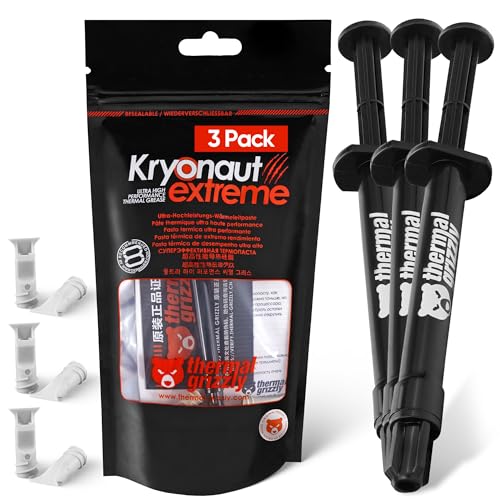
Pros
- Very high thermal conductivity rating for demanding cooling applications.
- Includes an applicator for easier and more controlled paste distribution.
- Built for long-term stability rather than short-term peak performance only.
- Multi-pack format is practical for builders, modders, and repeat installs.
Cons
- May be more than casual users need if the system is not running heavy workloads or overclocking.
- 2 gram syringes may feel limited for users who service many systems regularly.
- Real-world temperature improvements will vary by CPU, GPU, cooler, and application method.
Overview: Thermal Grizzly Kryonaut Extreme is a premium thermal paste designed for high-performance cooling on CPUs, GPUs, and supported consoles. The 3 pack of 2 gram syringes and included applicator give it a practical, user-friendly format for precise installation.
Performance: With a stated thermal conductivity of 14.2 W/(m·K), this paste is aimed at users who want strong heat transfer for demanding systems and overclocking setups. It is also described as remaining stable at temperatures up to 80°C, which supports long-term use in active builds.
Drawbacks and considerations: This is a specialized product, so casual users may not fully benefit from its higher-end positioning. The 2 gram size per syringe is useful for several installs, but users who maintain many systems may need more paste over time. Real-world results will also depend on how the paste is applied and on the cooling hardware used.
Verdict: Kryonaut Extreme makes the most sense for enthusiasts, builders, and overclockers who want a high-spec thermal compound with controlled application and long-term stability. If your priority is serious thermal performance rather than basic everyday use, it is a compelling choice.
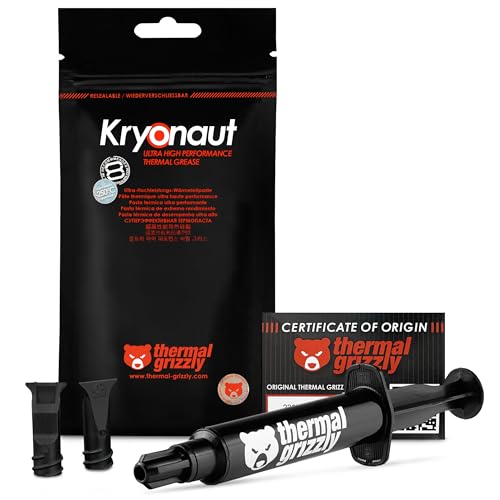
Pros
- Strong focus on thermal performance for demanding cooling scenarios.
- Easy-to-apply packaging with syringe and spatula included.
- Designed for long-lasting use rather than frequent reapplication.
- Compatible with CPUs, GPUs, and supported gaming consoles.
Cons
- Priced above basic thermal pastes, so it may be overkill for standard non-gaming systems.
- The 11.1 gram / 3 ml quantity may be limited if you are servicing many large builds.
- Performance gains depend on the quality of the cooler, mounting pressure, and overall system setup.
Thermal Grizzly Kryonaut is a premium thermal paste made for users who want high-end heat transfer on CPUs, GPUs, and compatible consoles. The 11.1 gram / 3 ml syringe format and included spatula give it a practical, user-friendly design for careful application.
Performance is the main selling point. Kryonaut is rated for exceptional thermal conductivity and is positioned for demanding systems, including overclocking builds and industrial-style cooling use cases. It is also designed to stay stable over time and not dry out at 80°C, which can help reduce the need for frequent maintenance.
There are a few tradeoffs to consider. This is a specialized paste, so casual users with stock cooling may not need this level of performance. The package size is also finite, which matters if you plan to service several systems or large heat spreaders.
Overall, Kryonaut is best suited for enthusiasts and performance-focused builders. If you want a premium thermal compound for demanding thermals and value easy, precise application, this is a strong choice. If you only need a basic paste for light everyday use, a lower-cost option may be enough.

Pros
- Developed by overclocking expert Vince "Kingpin" Lucido.
- Safe, non-conductive formula adds peace of mind for delicate components.
- Made for demanding thermal conditions rather than basic casual use.
- Included spatula supports more accurate application.
Cons
- Premium positioning may be more than some basic desktop builds need.
- Performance claims are strong, but the manufacturer listing does not include independent benchmark results.
- Package details are limited to the paste and spatula, with no additional accessories specified.
Kingpin Cooling KPx Ultimate Performance Thermal Paste is a 10g thermal compound designed for users who want a focused cooling solution for CPUs, GPUs, laptops, and gaming consoles. Its smooth consistency and included spatula suggest a product built for controlled, neat application.
Performance-wise, the formula is positioned for maximum heat transfer efficiency and lower thermal resistance under heavy workloads. The non-conductive, non-capacitive design is a practical advantage for builders and enthusiasts who want safer application on sensitive hardware, especially in overclocking or long-term performance setups.
On the downside, the manufacturer listing does not include independent test results, so real-world performance can only be assessed from the manufacturer details here. It is also a specialized premium thermal paste, which may be more than casual users need for standard systems.
Overall, KPx is best suited to PC builders, overclockers, and users maintaining high-heat devices who value precision application and a safety-focused formula. If your priority is a capable thermal paste for demanding hardware, this is a strong candidate to consider.

Pros
- High thermal conductivity rating of 11.25 W/mK.
- Non-conductive formula adds an extra layer of safety.
- Built-in applicator makes installation easier for beginners and experienced users.
- Broad compatibility across PCs and game consoles.
Cons
- 3.5g quantity may be limited for multiple full system applications.
- No detailed specs are provided for viscosity, cure time, or operating range.
- Compatibility is described broadly, but no device-specific fitment list is included.
Overview: The FUZEIce Thermal Paste is a high-performance silicon grease designed for CPUs, GPUs, and select game consoles. It comes in a 3.5g format and includes a built-in applicator/spreader, which gives it a practical, user-friendly feel for routine thermal maintenance.
Performance and features: With a thermal conductivity rating of 11.25 W/mK, this paste is positioned for efficient heat transfer between a chip and heatsink. The non-electrically conductive formula is a useful safety feature, especially for first-time builders or anyone working in tight component spaces. The brand also states that the formula is designed to last for years without drying out or corroding.
Drawbacks and considerations: The listing does not provide deeper technical details such as viscosity, cure time, or a device-by-device compatibility chart. The 3.5g size may be enough for a few installations, but users who service multiple systems may need more than one tube over time.
Verdict: FUZEIce is a solid option for users who want a thermal paste with strong conductivity, easy application, and a safer non-conductive formula. It makes the most sense for PC builders, upgraders, and console repair users who value convenience and broad compatibility.

Pros
- Focused on both thermal conductivity and long-term stability
- Can be applied in very thin layers for efficient contact
- Uses a mixed filler system with aluminum microparticles and zinc oxide nanoparticles
- Compact 6g format is convenient for PC maintenance and upgrades
Cons
- No benchmark thermal conductivity numbers are provided in the manufacturer listing
- Premium positioning may make it less appealing to budget-focused buyers
- The raw listing does not include application tools or detailed installation guidance
Overview: Thermal Grizzly Duronaut is a 6g thermal paste built for users who want a high-end thermal interface material with a focus on conductivity and stability. The formula uses specially engineered silicone oil blended with aluminum microparticles and zinc oxide nanoparticles.
Performance: The optimized particle shapes and sizes are designed to support very thin application layers, which can improve adhesion and help reduce thermal resistance. In practical terms, that makes it a strong choice for efficient heat transfer between a processor or other heat source and a cooler.
Drawbacks: The manufacturer listing does not include benchmark numbers, detailed application instructions, or included accessories. There are also no customer review details in the source, so real-world feedback is limited here.
Verdict: Duronaut is best suited to PC enthusiasts, system builders, and users who value a stable, premium thermal paste with a materials-focused design. If you want a straightforward high-end TIM for clean, thin application, it is a compelling option.

What Thermal Paste Actually Is, Chemistry Determines Shelf Life
Thermal interface material (TIM) is not a single substance. Every branded syringe contains a carrier matrix , typically silicone oil, hydrocarbon grease, or a phase-change wax , suspended with thermally conductive filler particles. Those fillers determine conductivity ratings (measured in W/mu00b7K), and the carrier chemistry determines how long the compound stays workable. The three dominant formulation families each age differently. For broader ecosystem context, read through our operational guide on custom cpu fan curve.
Silicone-Carrier Compounds
Silicone-based pastes, the overwhelming majority of budget and mid-range products, use polydimethylsiloxane (PDMS) as the carrier. PDMS is chemically stable across a wide temperature range but is susceptible to oil separation (syneresis) when stored at fluctuating temperatures. The filler particles, usually aluminum oxide or zinc oxide, settle toward the syringe tip under gravity over months. An undisturbed syringe stored upright for two or more years will show a clear or lightly tinted oil layer at the nozzle end and a stiffer, almost crumbly deposit further back. Once separation occurs, no amount of stirring or kneading the syringe restores the original homogenous dispersion reliably.
Metal-Particle and Liquid-Metal Compounds
High-end metal-particle pastes, those using silver, copper, or nickel flakes rather than ceramic oxides, carry a higher W/mu00b7K rating but introduce oxidation risk. Silver particles in particular develop a thin silver-sulfide or silver-oxide layer over extended storage, measurably increasing particle-to-particle contact resistance. Liquid-metal compounds (gallium-indium alloys) do not dry out in the conventional sense, but the gallium can migrate and oxidize at the exposed meniscus if the cap seal is compromised, forming a gel crust that prevents clean application. Liquid metal has essentially no shelf-life concern in a sealed, upright syringe, but an improperly capped tube stored for 18+ months can become partly unusable at the nozzle. For context on processors that run hot enough to make TIM choice genuinely consequential, the AMD Ryzen 5 9600X vs Intel Core Ultra 5 245K thermal comparison illustrates how much TIM quality influences sustained all-core frequency.
Phase-Change and Graphite-Pad Compounds
Phase-change materials are solid below approximately 45, 52 °C and liquefy under operating heat, self-spreading across the interface. In-tube shelf life is excellent , often 8+ years , because the compound is inert at room temperature and does not separate. Graphite pads are not pastes at all; they do not expire, though they can permanently deform if torqued improperly. These are the only TIM categories that storage conditions affect minimally. For troubleshooting and reliability insights, consult our in-depth how to choose cpu cooler report.
Manufacturer Shelf-Life Specifications and What They Actually Mean

Thermal compound manufacturers publish shelf-life figures that reflect controlled laboratory storage conditions, not a parts-drawer in a heated garage. Cooler Master specifies a two-year shelf life for its MasterGel lineup when stored cool, dry, and capped. Arctic rates its MX-4 and MX-6 compounds at 8 years under similar controlled conditions. Noctua claims 5 years for NT-H1 and 3 years for NT-H2. These numbers assume storage below 25 °C, away from direct UV exposure, and with the original cap creating an airtight seal.
Why Ambient Temperature Matters More Than Time
Every 10 °C rise in storage temperature roughly doubles the rate of polymer chain degradation in silicone carriers , a rule derived from Arrhenius kinetics applied to polymer chemistry. A tube stored in a workshop that regularly reaches 38 °C in summer effectively ages twice as fast as one kept at 18 °C in a climate-controlled server room. A paste rated for 5 years at 25 °C may functionally expire in under 3 years if stored warm. UV exposure photo-oxidizes silicone carrier chains, producing chain scission products that reduce viscosity uniformity. Keep tubes in opaque containers or inside their retail packaging away from windows. Readers comparing setup options can review our technical analysis on what is cpu ipc.
The Opened-Tube Acceleration Problem
Once you first push paste from the syringe, oxygen begins contacting the compound at the nozzle interface. Silicone carriers are not dramatically reactive with atmospheric oxygen at room temperature, but moisture absorption begins immediately, particularly in humid climates. Moisture disturbs the hydrophobic oil film that keeps filler particles in suspension. Cap threads often retain a small amount of dried compound that prevents an airtight seal on reseating. The practical rule: an opened tube degrades meaningfully within 12 to 24 months even under good storage, versus 3 to 8 years for an unopened tube of the same product. For board-level context on platforms that use sophisticated on-die TIM (solder) versus traditional TIM interfaces, the ASUS ROG Maximus Z890 Hero vs MSI MEG Z890 ACE platform breakdown explains how socket design influences thermal management choices.
On-Die Applied Paste: Degradation Timeline in a Running System
Applied paste faces a completely different threat profile than stored paste. Every power-on and power-off cycle thermally stresses the TIM layer. A desktop CPU cooler mount sees hundreds of thermal cycles per year, each cycle expanding the IHS and heatspreader base at different rates (copper vs. aluminum, copper vs. nickel) and micro-shearing the paste layer in between.
Mechanical Pump-Out and Voiding
Thermal pump-out describes the progressive lateral displacement of paste away from the high-pressure center contact zone toward the cooler edges. Repeated thermal cycling ratchets paste outward with each expansion-contraction event. After 2 to 4 years on a high-load desktop CPU, the center of the die, precisely where heat density peaks, can be nearly devoid of TIM, replaced by a microscopic air void. Air has a thermal conductivity of approximately 0.026 W/mu00b7K compared to 4 to 12 W/mu00b7K for typical paste. Even a 20-micron air gap at the die center produces a measurable Tjunction rise. Processors with integrated heat spreaders are partly protected; bare-die cooler configurations (common in older enthusiast mounts) experience pump-out most aggressively.
High-Temperature Curing and Hardening
Sustained high operating temperatures accelerate the cross-linking and outgassing that turn initially pliable paste into a rigid, cracked layer. A silicone-based compound repeatedly exposed to 90 °C+ junction temperatures, which translate to IHS surface temperatures of 60 to 75 °C, will harden significantly within 3 to 5 years. In extreme cases, especially in fanless or poorly cooled systems, the paste carbonizes partially and becomes a fine, chalky powder that provides almost no thermal contact. This exact failure mode is the primary reason legacy PlayStation 3 “fat” consoles required GPU and CPU re-pasting as a routine repair, the Cell processor and RSX GPU ran IHS surface temperatures that accelerated paste hardening far beyond the desktop norm, converting compound to powder within 5 to 7 years of regular use. For GPU thermal maintenance context, see our graphics card tests & GPU guides covering TIM replacement intervals for discrete cards.
Historical Benchmark Evidence
Igor Wallossek’s widely referenced test using decade-old Arctic Silver compound on a modern Intel Core i9-13900K demonstrated measurable but not catastrophic performance degradation from aged paste in controlled conditions, the paste was old but stored sealed and unused. The more significant finding was that once that same compound type was applied and then allowed to harden over years of use on an actual system, the degradation curves steepened sharply. Intel Architecture Technical Documentation specifies maximum continuous die temperatures for modern processors, and the margin between spec-limit and real-world thermal headroom narrows precisely when degraded TIM adds 10 to 20 °C to junction readings. For current-generation CPU thermal budget analysis, the desktop CPU benchmarks & reviews section covers per-platform TIM sensitivity across Intel Core Ultra and AMD Ryzen 9000 series processors.
Diagnostic Symptom Matrix, Identifying Expired or Failing TIM
| Symptom | Root Cause | Severity | Typical Tjunction Rise | Action Required |
|---|---|---|---|---|
| CPU temperature 10 to 15 °C above historical baseline | Partial pump-out or early hardening | Moderate | +10 to 15 °C | Re-paste within 30 days |
| CPU temperature 20 °C+ above baseline, throttling under load | Severe pump-out, central void, or cracked compound | Critical | +20 to 30 °C | Re-paste immediately |
| Paste is white/grey powder when cooler is removed | Full thermal carbonization/desiccation | Critical | +15 to 25 °C | Re-paste immediately; clean thoroughly |
| Oil ring visible around paste footprint, dry center | Oil/filler separation via pump-out | Moderate-High | +12 to 18 °C | Re-paste; inspect IHS for residue |
| Tube paste separated, clear oil at nozzle, stiff chunk inside | Silicone syneresis during storage | Tube Expired | N/A (application risk) | Discard tube; do not apply |
| Paste stringy, lumpy, or refuses to spread smoothly | Partial cure or moisture contamination | Moderate | Variable (+5 to 20 °C) | Discard tube; re-apply fresh compound |
| System-level thermal throttle, no fan/airflow fault | TIM failure as single differentiating variable | High | +10 to 25 °C | Re-paste; benchmark before and after |
Optimal Storage Protocol and Re-Application Intervals
Maximizing tube shelf life requires deliberate storage discipline, not passive hope. The following practices extend functional life of an opened tube to the upper bound of its rated window.
Storage Conditions That Preserve Compound Chemistry
Store tubes vertically, nozzle-up, to keep filler particles gravity-distributed away from the exit point rather than packed toward it. Keep ambient storage temperature between 10 °C and 22 °C, a cool drawer or a temperature-stable component storage box is ideal. Wrap the nozzle cap with a single layer of PTFE thread-seal tape before recapping to restore the airtight seal degraded by dried residue on the threads. Store tubes in their original opaque packaging or inside an anti-static bag to block UV. Avoid humid environments, a silica gel desiccant packet in the storage container costs nothing and meaningfully slows moisture ingress into a partially opened tube.
Re-Application Intervals by Use Case
Re-application frequency depends on thermal load and cooler mount design. A desktop gaming PC running a mid-range CPU at stock settings with a quality tower cooler realistically needs re-pasting every 3 to 5 years under normal use. A workstation running sustained all-core loads, video encoding, 3D rendering, compilation, cycles the TIM layer far more aggressively and warrants re-pasting every 2 to 3 years. Laptops, due to thin TIM layers and high operating temperatures in confined enclosures, need re-pasting every 1.5 to 3 years. Overclocked systems that regularly see IHS temperatures above 70 °C should be re-pasted annually as part of a maintenance schedule. When evaluating GPU card coolers, which use similar compound chemistry, check our Radeon RX 9060 XT 8GB vs 16GB comparison for a practical example of how GPU TIM thickness affects sustained boost clock stability.
Surface Preparation, The Step That Determines Re-Paste Success
No fresh paste compensates for contaminated or scratched contact surfaces. Remove all hardened residue from the IHS and heatspreader base using 99% isopropyl alcohol (IPA) and lint-free wipes. For carbonized or heavily hardened paste, apply IPA, allow 30 seconds of dwell time, then wipe with moderate pressure, do not scrape with metal tools. Inspect both contact surfaces under a bright light for micro-scratches from previous lapping or poor cleaning; deep scratches create air channels that degrade contact even with fresh paste applied. Apply fresh compound in your chosen method (center dot, cross, or manufacturer-specified spread) immediately after cleaning, do not allow cleaned surfaces to sit uncovered for more than 15 minutes in a dusty environment before mounting the cooler.
Final Diagnostic Verdict & Maintenance Checklist
Thermal paste is a consumable with a measurable service window, not a permanent installation. The chemistry of silicone carriers, the physics of thermal pump-out, and the cumulative effect of thousands of thermal cycles make TIM degradation inevitable, the variable is only speed. Stored paste: unopened and stored correctly, 3 to 8 years is a realistic expectation; once opened, treat 12 to 24 months as the practical window before performance consistency degrades. Applied paste: plan re-application every 2 to 5 years scaled to thermal load intensity.
The diagnostic consequences of ignoring this maintenance step are not subtle, a 15 to 25 °C junction temperature elevation from failed TIM eliminates thermal headroom, triggers sustained frequency throttling, and accelerates electromigration damage at the silicon level. Every degree above the processor’s thermal design point sustained over months of operation shortens operational lifespan and degrades performance stability in ways that no software tuning recovers.
- Check CPU maximum temperature readings against your documented baseline from initial build or last re-paste. A sustained 10 °C+ rise with unchanged ambient and workload is the primary TIM failure signal.
- Inspect tube paste before every application: discard if separated, hardened, stringy, or beyond its printed expiration date.
- Store tubes vertically, capped with PTFE thread tape, at 10 to 22 °C, in opaque packaging, away from humidity.
- Re-paste desktop gaming builds every 3 to 5 years; sustained-workload workstations every 2 to 3 years; laptops every 1.5 to 3 years; overclocked systems annually.
- Use 99% IPA only for cleaning, no acetone, no alcohol concentrations below 90%, no paper towels that leave lint on precision lapped surfaces.
- After re-pasting, run a standardized thermal benchmark immediately and log the result as the new baseline for future degradation comparison.
- If temperatures normalize after re-paste, the TIM was the thermal bottleneck, no cooler upgrade was necessary.
- If temperatures remain elevated after re-paste with quality compound and proper surface preparation, investigate mounting pressure, fan performance, and airflow path before assuming processor or cooler failure.
Storage Safety for Compounds
Thermal paste can thicken or dry out over time, and storage conditions such as heat and air exposure matter. General information on handling materials safely is worth a look at American National Standards Institute (ANSI) before you store any compound.









