

Quick Answer: What Is Ray Tracing vs Path Tracing?
Lo(x, u03c9o) = Le(x, u03c9o) + u222bu03a9 fr(x, u03c9i, u03c9o) Li(x, u03c9i) (u03c9i u00b7 n) du03c9i To evaluate matched hardware tolerances, consult our detailed overview of motherboard post codes q leds diagnostics.
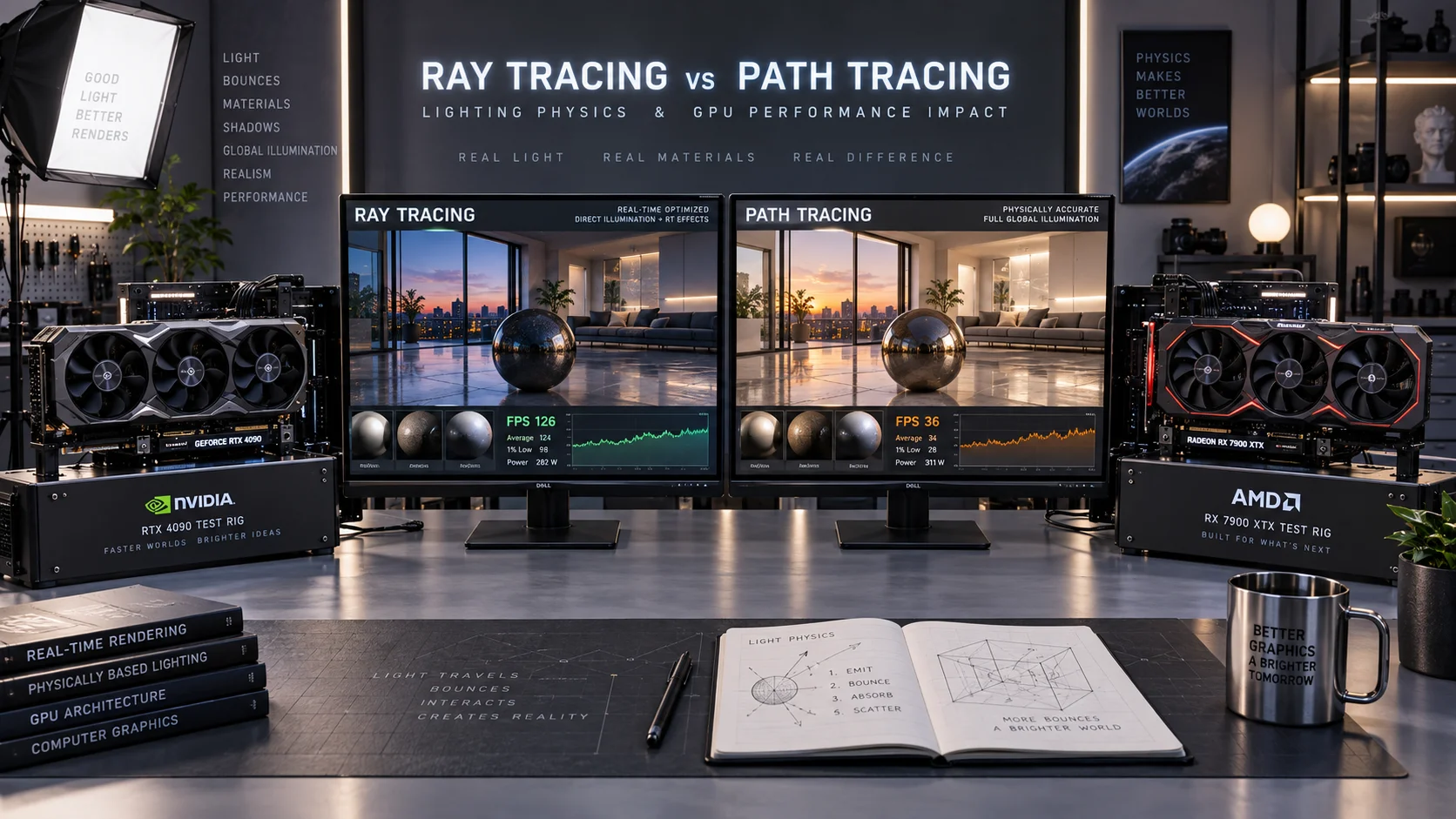
Ray Tracing vs Path Tracing: Lighting Physics & GPU Performance Impact
The shift from rasterization to physically based light simulation marks the most significant rendering paradigm change since programmable shaders. Both ray tracing and path tracing compute light by casting rays into a 3D scene, but the scope, cost, and output fidelity of each method differ fundamentally. Understanding those differences matters directly to GPU selection, thermal budgets, driver configuration, and the bandwidth characteristics of the PCIe bus carrying data between the CPU and GPU. This guide dissects the physics, the hardware pipeline, and the measurable performance consequences of both techniques at a level useful to enthusiasts, system builders, and developers.
The Physics of Light Transport: What Each Algorithm Actually Does
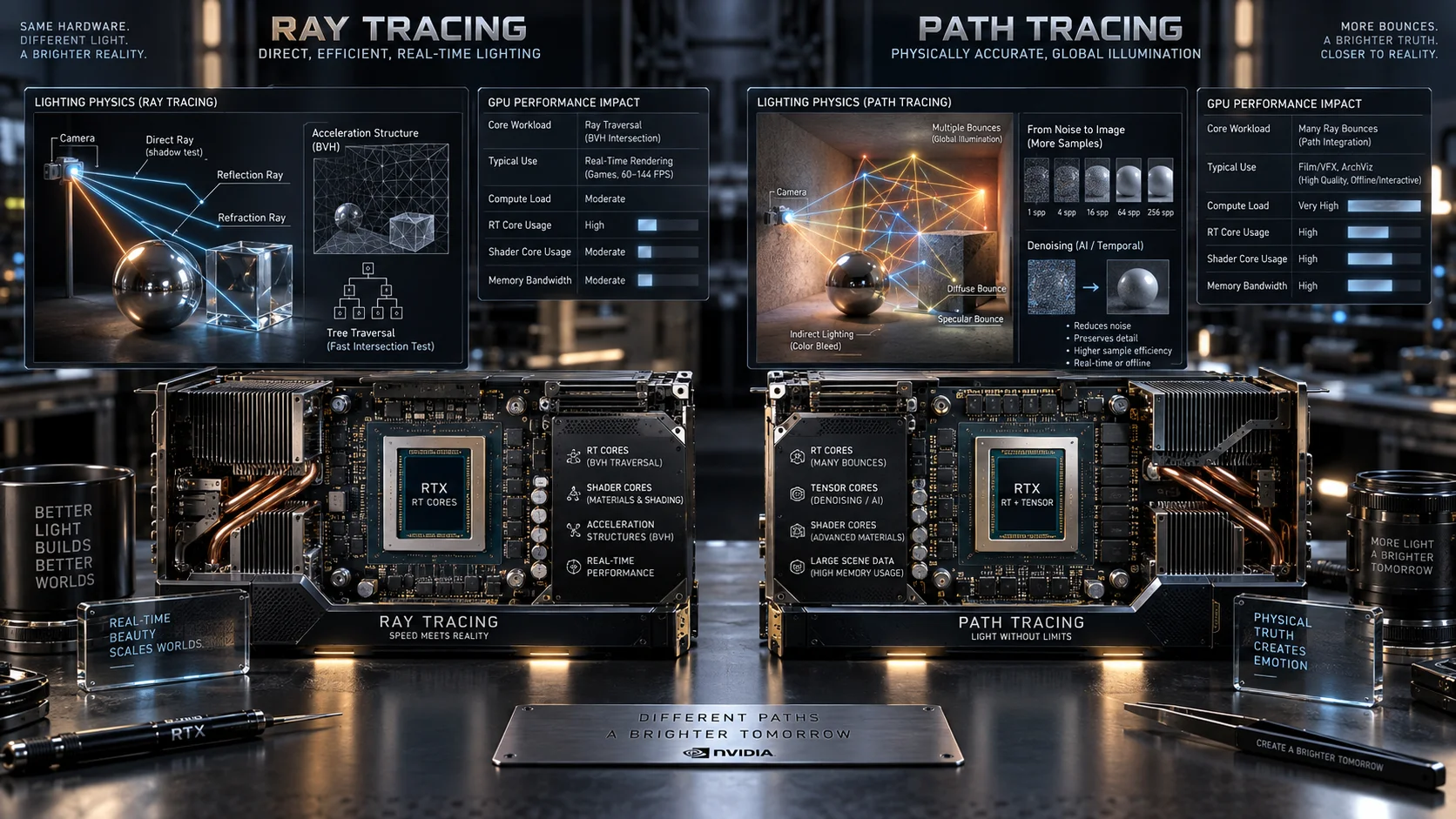
Light in the real world does not travel in straight lines from a source to your eye. It bounces, scatters, refracts, and diffracts across hundreds of interactions before reaching a sensor. Rendering algorithms are judged by how accurately they approximate this behavior within a finite compute budget.
Ray Tracing: Selective Ray Sampling
Real-time ray tracing, as implemented in DirectX Raytracing (DXR) and Vulkan Ray Tracing, casts a limited, deterministic set of rays per pixel per frame. A typical hybrid pipeline fires primary rays from the camera, intersects geometry, then spawns a small number of secondary rays , commonly one shadow ray per light source and one or two reflection rays per surface. The rasterizer handles the majority of opaque geometry; ray tracing fills in effects that rasterization cannot plausibly fake: sharp reflections, contact shadows, and accurate ambient occlusion. For troubleshooting and reliability insights, consult our in-depth what power supply wattage for gaming pc report.
The key constraint is ray budget. A 1440p frame at 60 fps has roughly 16 ms to complete. With tens of millions of pixels and multiple ray types, hardware must accelerate Bounding Volume Hierarchy (BVH) traversal, the spatial data structure that determines which triangle a ray intersects, in dedicated silicon. NVIDIA’s RT Cores (Turing onward) and AMD’s Ray Accelerators (RDNA 2 onward) offload BVH traversal from shader cores, allowing TFLOP capacity to remain available for shading work.
Noise is controlled by keeping secondary ray counts low and accepting that some effects are physically incomplete. Reflections may not reflect other reflections beyond one or two bounces. Area lights cast soft shadows only with specific noise-reduction passes. These are engineering trade-offs, not physical accuracy failures , the results are visually compelling within the constraints of 16, 33 ms frame budgets. Readers comparing setup options can review our technical analysis on how to fix intel arrow lake z890 bios voltage.
Path Tracing: Full Light Transport Simulation
Path tracing is the unbiased Monte Carlo solution to the rendering equation. Each pixel spawns one or more paths; each path recursively follows light interactions until it either reaches a light source or exceeds a maximum bounce depth, typically 8 to 32 bounces. Because no shortcuts are taken, path tracing naturally produces global illumination, caustics, subsurface scattering, participating media (volumetric fog), and inter-reflections between diffuse surfaces, effects that require separate, bespoke passes in hybrid ray tracing pipelines.
The cost is variance. A single path per pixel produces an extremely noisy image. Production renderers converge by averaging thousands of paths per pixel (samples per pixel, SPP). Real-time implementations such as Cyberpunk 2077’s Overdrive Mode and Alan Wake 2’s full path tracing mode use 1, 4 SPP and rely entirely on temporal accumulation and AI-driven reconstruction (DLSS 3.5 Ray Reconstruction, FSR 4) to denoise the result into a stable image. Without those denoising layers, a full path-traced frame at 1080p would be unusable at any real-time frame rate on current consumer hardware. For complementary field maintenance guidelines, examine our breakdown of how to safely connect 12v 2×6 gpu power cable.
The rendering equation path tracing solves is defined as:
Every term, emitted radiance, the BRDF, incoming radiance from all directions, and the cosine foreshortening factor, is evaluated stochastically across the hemisphere. This is why path tracing is considered physically ground-truth: it integrates the full hemisphere rather than selecting discrete rays to specific light sources.
Head-to-Head Comparison: Ray Tracing vs Path Tracing
| Attribute | Hybrid Ray Tracing | Full Path Tracing |
|---|---|---|
| Rendering equation coverage | Partial (selected effects) | Full (unbiased integral) |
| Global illumination | Approximated (SSGI, RTGI probes) | Native, physically accurate |
| Caustics | Rarely implemented; faked | Emergent, no extra cost |
| Noise / variance | Low (deterministic ray counts) | High without denoising |
| GPU VRAM demand (1440p) | +1 to 2 GB over raster | +3 to 6 GB over raster |
| Typical fps cost vs raster | 30 to 55% reduction | 70 to 90% reduction |
| Hardware RT core dependency | High (BVH traversal acceleration) | Critical (multiple BVH queries/path) |
| AI denoising requirement | Optional but beneficial | Mandatory for real-time playability |
| Minimum GPU tier (playable) | RTX 3070 / RX 6800 XT | RTX 4080 / RX 9070 XT |
| Typical use case | AAA gaming, real-time VFX | Showcase titles, offline rendering |
| PCIe bandwidth sensitivity | Moderate (BVH + texture streaming) | High (large BVH, denoise buffer transfers) |
GPU Hardware Architecture and the RT Acceleration Pipeline
Neither technique is feasible at real-time frame rates without dedicated hardware. The BVH , a tree of axis-aligned bounding boxes recursively enclosing scene geometry , must be traversed for every ray. On a shader core alone, this traversal consumes hundreds of ALU cycles per ray intersection test. RT Cores (NVIDIA) and Ray Accelerators (AMD) implement box-intersection and triangle-intersection tests in fixed-function hardware, delivering 10, 20u00d7 throughput improvement over pure shader-based traversal. When planning workspace deployment, consider the engineering criteria outlined in our how to update bios without cpu flashback guide.
For path tracing specifically, the shader occupancy model changes dramatically. Each path may diverge from neighboring paths after the first bounce, one ray hits a mirror, the adjacent ray hits a diffuse wall, producing warp divergence that wastes SIMD lanes. NVIDIA’s Ampere and Ada Lovelace architectures address this with shader execution reordering (SER), dynamically grouping similar shader types across wavefronts to maximize occupancy. AMD’s RDNA 3 introduces a comparable mechanism via its unified compute architecture. These microarchitectural features are not cosmetic: benchmarks show SER reducing path tracing shader stall cycles by up to 40% in titles like Portal with RTX.
VRAM capacity and bandwidth are equally limiting. A full path-traced scene at 1440p carries multiple G-buffers, the denoised color buffer, motion vectors, albedo, normals, and history buffers for temporal accumulation, often exceeding 12 GB in titles like Cyberpunk 2077 Overdrive at 4K. This is why cards with 16 to 24 GB VRAM, the RTX 4090, RTX 4080 Super, and RX 7900 XTX, dominate path-tracing benchmarks. Cards with 8 GB VRAM encounter buffer eviction to system RAM across the PCIe bus, which significantly impacts frame time consistency. Understanding PCIe 5.0 compatibility becomes relevant when large buffer transfers between CPU and GPU memory introduce latency under memory pressure scenarios.
Performance Impact: Benchmark Context and Real-World Frame Rates
Published benchmarks establish clear performance tiers. In Cyberpunk 2077 at 1440p with Ultra settings and no upscaling:
- Rasterization only: RTX 4080 Super averages ~145 fps
- Hybrid RT (Medium preset): RTX 4080 Super averages ~95 fps, a 34% reduction
- Full Path Tracing (Overdrive): RTX 4080 Super averages ~28 fps native, an 81% reduction
- Full Path Tracing + DLSS 3.5 Quality + Frame Generation: RTX 4080 Super returns to ~105 fps perceived
This data set illustrates why path tracing in consumer contexts is inseparable from upscaling and frame generation technology. DLSS 3.5 Ray Reconstruction replaces the traditional temporal denoiser with a neural network trained on path-traced reference frames, producing significantly cleaner results from 1 to 4 SPP input than hand-tuned denoising. AMD’s equivalent stack, FSR 4 with machine-learning upscaling on RDNA 4, closes the gap considerably on the RX 9070 XT in supported titles.
Sustained path tracing workloads also exert significant thermal pressure on the GPU die and VRM. Monitoring CPU temperature limits remains relevant because path tracing offloads BVH construction and scene update to the CPU each frame; a thermally throttled CPU delays BVH readiness and causes GPU starvation. Ensure thermal paste application on both CPU and GPU heatsinks is current, degraded compound on a GPU die directly limits the sustained boost clock available to RT and tensor cores.
The Role of AI Denoising and Upscaling in Modern Pipelines
Path tracing without denoising is an academic exercise on consumer hardware. The practical pipeline in 2024 to 2025 stacks multiple AI-accelerated stages:
- Upscaling (DLSS Super Resolution / FSR 4 / XeSS): Renders the path-traced frame at 50 to 67% of target resolution, reducing ray count quadratically.
- Ray Reconstruction / Neural Denoising: Replaces noisy 1 to 4 SPP path-traced input with a temporally stable image using a convolutional or transformer-based neural network running on Tensor Cores or AI accelerators.
- Frame Generation (DLSS 3 / FSR 3): Synthesizes interpolated frames from motion vectors to double perceived frame rate, masking the native low fps of full path tracing.
NVIDIA’s Tensor Core throughput, 1321 TOPS on RTX 4090 (FP8), handles all three stages in parallel with the path-tracing workload. AMD’s AI accelerators in RDNA 4 deliver competitive TOPS figures, narrowing the gap that historically made path tracing an NVIDIA-exclusive experience. Intel Arc’s Xe Matrix Extensions (XMX) similarly target this stack, documented in Intel’s Arc GPU architecture overview.
System memory speed also affects the CPU-side BVH construction throughput. Faster RAM speed and timings reduce the latency of scene data uploads and improve the responsiveness of the CPU’s BVH update pass, particularly in dynamic scenes with many moving objects, a common stress case in open-world path-traced titles.
Driver Configuration and Stability Considerations
Ray tracing and path tracing workloads expose driver bugs that rasterization workloads never trigger, shader compilation stalls, RT pipeline cache misses, and denoiser temporal artifacts are common on freshly installed or outdated drivers. Always perform a GPU driver clean install using DDU before switching GPU hardware or enabling path tracing for the first time. Stale driver remnants cause RT shader cache corruption that manifests as stuttering or visual artifacts indistinguishable from hardware defects.
In NVIDIA Control Panel, ensure “Shader Cache Size” is set to Unlimited for path-traced titles, the default 10 GB cap is insufficient for games like Alan Wake 2, which pre-compiles thousands of RT pipeline state objects. AMD users should verify that the HAGS (Hardware-Accelerated GPU Scheduling) setting is enabled in Windows; HAGS reduces CPU-GPU synchronization latency that otherwise manifests as frame time spikes during BVH reconstruction on dynamic scenes.
Which Technique Is Right for Your Use Case?
The decision between hybrid ray tracing and full path tracing maps directly to GPU tier, VRAM capacity, and the role of AI upscaling in your workflow:
- RTX 3060 Ti / RX 6700 XT class: Hybrid ray tracing at 1080p-1440p with DLSS/FSR Quality is the performance ceiling. Path tracing at any resolution is unplayable without extreme quality concessions.
- RTX 4070 Super / RX 7900 GRE class: Hybrid ray tracing at 1440p is comfortable. Path tracing at 1080p with DLSS Performance mode is feasible but frame times exceed 33 ms natively.
- RTX 4080 Super / RX 9070 XT class: Full path tracing at 1440p with upscaling and frame generation reaches playable perceived frame rates. Native path tracing remains impractical.
- RTX 4090 / RTX 5090 class: Path tracing at 4K with DLSS 3.5 Quality + Frame Generation delivers the full cinematic experience the technique was designed for.
For content creation and offline rendering, archviz, product visualization, VFX, path tracing is the unambiguous choice regardless of render time. Offline workflows absorb the per-sample cost across minutes or hours rather than milliseconds, eliminating the noise-versus-performance trade-off entirely. Tools such as Blender Cycles, Chaos V-Ray, and Autodesk Arnold are full unbiased path tracers operating in this regime.
Conclusion
Ray tracing and path tracing occupy distinct positions on the accuracy-performance spectrum. Hybrid ray tracing is an engineering solution, physically motivated, visually effective, and tuned to fit within real-time budgets by selectively applying ray casting where rasterization fails. Path tracing is a physics simulation, complete, unbiased, and currently dependent on AI denoising and upscaling to function at real-time frame rates on consumer hardware. The gap between them will narrow as tensor core throughput, RT core performance, and neural reconstruction quality improve generation over generation. For the 2024 to 2025 hardware cycle, the practical threshold for path tracing as a primary gaming mode sits at the RTX 4080 tier and above, with AMD’s RDNA 4 generation entering that bracket competitively for the first time. Choose the technique your GPU can sustain, not the one the marketing materials feature.

Pros
- 16GB of fast GDDR7 memory with a 256-bit memory interface.
- Broad NVIDIA feature support including DLSS, ray tracing, Reflex, and AV1 codecs.
- Large cooler design with triple 91 mm fans and six heat pipes.
- Modern connectivity with PCIe 5.0 x16 and multiple HDMI and DisplayPort outputs.
Cons
- Large 329 x 137 x 70 mm size and 1582 g weight may be difficult to fit in smaller cases.
- Uses a 16-pin power connector and calls for an ATX 3.0 750W or higher power supply.
- No SLI or NVLink support, so it is not intended for multi-GPU setups.
Overview & Design: The Yeston Sakura GeForce RTX 5070 Ti is a full-size desktop graphics card built around 16GB of GDDR7 memory and PCIe 5.0 x16 support. It uses a triple-fan cooler with a nickel-plated copper base, six heat pipes, and ARGB lighting, giving it a premium, bulky design that is clearly aimed at high-performance builds.
Performance & Key Features: With 8960 unified shaders, boost clocks up to 2482 MHz, and NVIDIA features such as DLSS, ray tracing, Reflex, NVENC, NVDEC, and AV1 encode and decode, this card is positioned for smooth modern gaming and streaming. The HDMI 2.1b and three DisplayPort 2.1b outputs also make it suitable for high-refresh monitors and multi-display setups.
Drawbacks & Considerations: Buyers should plan for its size and power needs. The card measures 329 x 137 x 70 mm, weighs 1582 g, uses a 16-pin power connector, and the recommended PSU is 750W or higher with ATX 3.0 support. It also does not support SLI or NVLink and is not available in a half-height design.
Verdict: This Yeston GPU is best for users who want a feature-rich RTX 5070 Ti with modern memory, strong cooling, and broad NVIDIA software support. It makes the most sense in a roomy case with a capable power supply, especially for gamers, VR users, and creators who value current-gen connectivity and codec support.

Pros
- Large 20GB GDDR6 memory capacity for demanding creative and engineering workloads.
- Ampere-based RTX architecture with ray tracing support for professional visualization tasks.
- Metal backplate adds a sturdier build feel.
- OEM workstation design is suited to integrated professional systems.
Cons
- OEM packaging may mean fewer retail extras or accessories than a standard consumer bundle.
- Key details such as display outputs, power connectors, and dimensions are not provided in the listing.
- The 1.32-pound weight may be a consideration for smaller or lighter workstation builds.
Overview: The PNY NVIDIA RTX A4500 20GB GDDR6 Ampere Ray Tracing Workstation OEM Graphic Card is a professional graphics solution designed for workstation use. It has a black finish and a metal backplate, giving it a practical and durable build profile.
Performance & Key Features: With 20GB of GDDR6 memory and NVIDIA Ampere ray tracing support, this card is aimed at demanding workflows such as CAD, 3D modeling, visualization, and content creation. The large memory capacity is especially useful when projects involve detailed assets or heavier datasets.
Drawbacks & Considerations: Because this is an OEM version, it may not include the extras often found in retail bundles. The listing also does not provide important details such as ports, power requirements, or dimensions, which can make planning a build harder.
Verdict: This card makes the most sense for professionals who need high VRAM and workstation-focused graphics capabilities. It is less compelling for casual users, but for creators, engineers, and system integrators, the RTX A4500 offers a strong pro-grade foundation.

Pros
- Strong RTX 3080-class feature set with ray tracing and DLSS support.
- 10GB GDDR6X memory is well-suited to high-demand gaming and content creation.
- TUF cooling design is focused on airflow, stability, and lower fan turbulence.
- Renewed and certified, which can offer better value than buying new if condition is acceptable.
Cons
- As a renewed product, cosmetic wear may be present even though it is tested to function like new.
- The 90-day warranty is shorter than typical new-product coverage.
- LHR designation may be a drawback for users who prioritize mining-focused performance.
Overview: The ASUS TUF Gaming GeForce RTX 3080 V2 is a renewed graphics card built around NVIDIA's Ampere architecture. It is positioned for users who want high-end gaming performance and TUF-series durability, and the renewed status means it has been tested, certified, and repackaged before sale.
Performance and features: With 10GB of GDDR6X memory, 2nd Gen RT Cores, and 3rd Gen Tensor Cores, this card is designed for demanding games, ray-traced visuals, and AI-assisted features like DLSS. The Axial-Tech cooling setup, reversed center fan design, and dual-ball fan bearings are aimed at keeping temperatures under control during longer sessions.
Drawbacks to consider: Because this is a renewed unit, cosmetic condition can vary and it is covered by a 90-day warranty rather than a longer new-product guarantee. The LHR designation may also matter to buyers looking beyond gaming and content creation. Product-specific details such as dimensions and bundled accessories are not provided in the raw data.
Verdict: This is a strong fit for gamers and creators who want RTX 3080-level features with TUF-focused cooling and durability, and who are comfortable buying renewed. It is less ideal for shoppers who want brand-new packaging or longer warranty coverage.

Pros
- Liquid-cooled design can help keep temperatures under control under load.
- High-end RTX 2080 performance with ray tracing support.
- 8GB GDDR6 memory and a 256-bit bus provide solid graphics bandwidth.
- Flexible output options include DisplayPort, HDMI, and USB Type-C.
Cons
- As an older-generation RTX card, it may not match the efficiency or feature set of newer GPUs.
- Liquid cooling can add installation and compatibility considerations compared with simpler air-cooled cards.
- The manufacturer listing does not list power requirements, dimensions, or bundled accessories, so fit should be verified separately.
Overview: The MSI GAMING GeForce RTX 2080 SEA HAWK X is a premium NVIDIA GeForce RTX 2080 graphics card with liquid cooling. It pairs 8GB of GDDR6 memory and a 256-bit interface with MSI's SEA HAWK X design for a high-end gaming build.
Performance: With core clocks up to 1860 MHz and ray tracing support from the Turing architecture, it is built for demanding games and graphics-heavy workloads. The liquid cooling setup is intended to help keep temperatures under control during sustained use.
Considerations: This is an older-generation flagship GPU, so buyers should weigh it against newer cards for efficiency and overall value. The manufacturer listing does not include power requirements, dimensions, or accessories, so system compatibility should be checked before purchase.
Verdict: The RTX 2080 SEA HAWK X is best for enthusiasts who want a liquid-cooled RTX card with solid memory bandwidth and flexible display outputs. It makes the most sense when thermal performance and NVIDIA features matter more than chasing the latest release.
Background on Light Simulation
Ray tracing follows light paths to produce shadows and reflections, while path tracing follows more light bounces for a fuller picture at higher cost. For general reading on how rendering technology is described, look at American National Standards Institute (ANSI).









