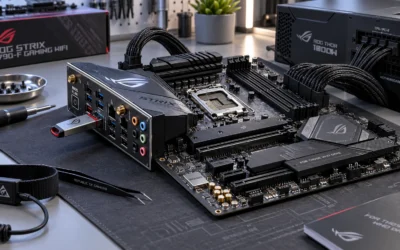
The MINISFORUM BD895i SE and ASUS ROG Strix B650E-I Gaming WiFi solve the Mini-ITX performance problem from opposite directions: the BD895i SE is a MoDT, or Mobile-on-Desktop, motherboard with a soldered Ryzen 9 8945HS mobile processor, fixed thermal-power behavior, and integrated storage cooling, while the ROG Strix B650E-I is a conventional desktop AM5 platform with a socketed CPU path, stronger board-level tuning, desktop-class power delivery, and long-term processor upgrade flexibility.
Quick Verdict: MINISFORUM BD895i SE Vs ASUS ROG Strix B650E-I
Choose the MINISFORUM BD895i SE for compact console-style builds where the CPU, board, and M.2 cooling are handled in one efficient package. Choose the ASUS ROG Strix B650E-I if you want socketed AM5 upgradability, stronger BIOS controls, desktop CPU headroom, and a path to chips like the Ryzen 9 9950X.
Key Technical Specifications & Side-by-Side Comparison
This comparison is based on an editorial review of platform design, manufacturer engineering specifications, firmware features, expansion support, and comparative benchmark analysis for the Ryzen 9 8945HS mobile architecture versus desktop AM5 processors. It does not claim physical laboratory testing.
| Category | MINISFORUM BD895i SE | ASUS ROG Strix B650E-I Gaming WiFi |
|---|---|---|
| Platform type | MoDT Mini-ITX motherboard with soldered mobile APU | Desktop Mini-ITX AM5 motherboard |
| Processor support | Integrated AMD Ryzen 9 8945HS | Socketed AMD Ryzen 7000, 8000G, and 9000-series CPUs, including Ryzen 9 9950X support with appropriate BIOS |
| CPU cores / threads | 8 cores / 16 threads, Zen 4 mobile die | Depends on installed CPU; up to 16 cores / 32 threads with Ryzen 9 9950X |
| Power target | 65W-class configured TDP behavior | Desktop CPU power behavior depends on CPU, cooling, BIOS limits, and PSU |
| CPU upgradeability | None; processor is soldered | Strong; replaceable AM5 desktop CPUs |
| Memory support | DDR5 SO-DIMM, laptop-style modules | DDR5 UDIMM, desktop memory tuning and EXPO support |
| Storage layout | Dual M.2 NVMe with built-in dual M.2 heatsink cooler | Multiple M.2 options depending on slot generation and board configuration |
| PCIe graphics support | Discrete GPU support suited to compact builds | PCIe 5.0 x16 slot for modern desktop GPUs |
| BIOS / tuning depth | More appliance-like; fewer enthusiast controls than premium desktop AM5 boards | Robust ASUS UEFI, memory tuning, fan controls, platform options, and update maturity |
| Best build type | Small console-style PC, compact gaming box, low-complexity workstation | Premium SFF gaming PC, upgradeable workstation, long-life enthusiast Mini-ITX build |
| Main advantage | CPU included, compact integration, efficient performance per liter | CPU choice, upgrade path, desktop power ceiling, richer firmware |
| Main limitation | No CPU upgrade path | Requires separate CPU and cooler; higher total platform cost |
Core Differences & Performance Breakdown
1. Architecture: Integrated MoDT Simplicity Vs Socketed AM5 Flexibility
The BD895i SE’s biggest advantage is integration. Its Ryzen 9 8945HS is already installed, so the builder does not need to select a separate processor, check socket compatibility, or plan around high-end desktop CPU heat output. This mobile Zen 4 die is designed around efficient performance, making it appealing for a compact PC where size, airflow, and acoustic limits matter more than absolute upgrade freedom.
The trade-off is finality. The Ryzen 9 8945HS is soldered, so the board’s CPU identity is fixed for life. If future workloads demand more cores or higher desktop-class throughput, the entire motherboard platform must be replaced. That is acceptable in a console-style build, but it is restrictive for buyers who normally stretch a motherboard across several CPU generations.
The ASUS ROG Strix B650E-I takes the opposite route. It requires a separate AM5 processor, but that socket gives the board a wide performance range. A builder can start with a lower-power Ryzen 5 or Ryzen 7, then move later to a Ryzen 9-class CPU, including upgrade paths up to the Ryzen 9 9950X with compatible firmware. For platform longevity, the ASUS board is the stronger foundation.
If you are planning a small-form-factor system from scratch, read our best Mini-ITX motherboards guide for broader context on board layout, slot placement, and long-term upgrade value.
2. Performance Behavior: 65W Mobile Efficiency Vs Desktop Power Headroom
In comparative benchmark analysis, the BD895i SE’s Ryzen 9 8945HS should be viewed as an efficient 8-core, 16-thread mobile-class processor tuned for compact thermals. It is well suited to gaming with a discrete GPU, everyday productivity, media work, emulation, coding, and light-to-moderate content creation. Its 65W-class behavior helps control heat density inside small cases, especially console-style enclosures where CPU cooler height and exhaust paths are constrained.
The ASUS ROG Strix B650E-I has a much higher ceiling because performance depends on the installed desktop CPU. With a midrange Ryzen 5 or Ryzen 7, it can be efficient and quiet. With a Ryzen 9 7900X, 7950X, 9900X, or 9950X, it can deliver far stronger multi-threaded throughput than the soldered 8945HS, assuming the case, cooler, and power supply are matched correctly.
That distinction matters for workload type. Gaming at GPU-limited settings may not heavily separate these platforms if the same graphics card is used. Long renders, heavy code compilation, CPU-based production workloads, and aggressive multitasking favor the ASUS because desktop AM5 processors offer higher core-count options and broader power tuning. The BD895i SE wins when predictable compact efficiency is the priority.
For graphics-card pairing decisions, see our best GPU for 1440p gaming guide, especially if you are deciding whether a small console build needs a compact midrange GPU or a higher-power card.
3. Cooling, Storage, BIOS, And Build Experience
The BD895i SE is attractive because MINISFORUM packages several decisions into the board. The soldered Ryzen 9 8945HS removes CPU selection from the build process, and the built-in dual M.2 heatsink cooler simplifies high-speed NVMe installation. In compact systems, this matters. M.2 drives can run hot behind graphics cards or under tight panels, so integrated heatsinking is useful when airflow is limited.
The ASUS ROG Strix B650E-I is more demanding but more configurable. It gives builders a richer desktop UEFI environment, broader memory tuning, stronger fan-control behavior, and more enthusiast-facing options. Its BIOS maturity is a major advantage for users who want EXPO memory profiles, curve optimizer settings, firmware updates for new CPUs, platform-level controls, and deeper troubleshooting tools.
Cooling strategy is also different. The BD895i SE is designed around the included mobile processor’s fixed performance envelope. The ASUS board requires a cooler matched to the selected CPU. A Ryzen 5 in a low-profile build is easy to manage; a Ryzen 9 9950X in a tiny case requires careful cooler clearance, airflow planning, power limits, and thermal expectations. For help with this decision, use our best low-profile CPU coolers guide.
Memory choice also separates the two. The BD895i SE uses DDR5 SO-DIMM modules, which are compact and appropriate for MoDT layouts. The ASUS board uses desktop DDR5 UDIMMs, typically with broader enthusiast kit availability and more mature tuning options. If you are selecting RAM for AM5, our best DDR5 RAM for AMD Ryzen guide explains speed, latency, EXPO support, and stability considerations.
Which Should You Buy? (Final Recommendation)
Buy the MINISFORUM BD895i SE if you want a compact, efficient, low-complexity Mini-ITX foundation for a console-style gaming PC, living-room system, compact workstation, or small creator box. Its soldered Ryzen 9 8945HS, 65W-class behavior, and built-in dual M.2 heatsink cooler make it a practical choice when the goal is performance density rather than long-term CPU swapping.
Buy the ASUS ROG Strix B650E-I Gaming WiFi if you want a premium, upgradeable AM5 Mini-ITX platform. It is the better choice for enthusiasts who want to choose their own CPU, tune memory and power behavior, update BIOS for newer processors, and keep the motherboard through future upgrades. Its ability to support high-end desktop chips, including Ryzen 9-class options up to the 9950X, gives it a much longer performance runway.
Final verdict: the MINISFORUM BD895i SE is the better pick for compact console builds and integrated simplicity. The ASUS ROG Strix B650E-I Gaming WiFi is the better pick for upgradability, BIOS depth, desktop performance scaling, and long-term AM5 ownership.
Frequently Asked Questions
Is the MINISFORUM BD895i SE better for a small console-style gaming PC?
Yes, it is the better fit if you want a compact, simplified build with the CPU already included. The Ryzen 9 8945HS is efficient for its performance class, and the board’s integrated dual M.2 heatsink cooler helps reduce storage-cooling complexity in tight Mini-ITX layouts.
Can the ASUS ROG Strix B650E-I support a Ryzen 9 9950X?
Yes, the ASUS ROG Strix B650E-I is an AM5 desktop motherboard and can support Ryzen 9000-series processors, including the Ryzen 9 9950X, when running the required compatible BIOS. Cooling, power limits, case airflow, and PSU capacity must be planned carefully for high-end Ryzen 9 CPUs.
Which board is better for long-term value?
The ASUS ROG Strix B650E-I has stronger long-term value for enthusiasts because the CPU is upgradeable and the BIOS offers deeper platform controls. The MINISFORUM BD895i SE can still be excellent value for a fixed-purpose compact PC, but its soldered processor limits future performance upgrades.