

Quick Answer: Dlss 4 vs Fsr 4 vs Xess Upscaling Overview
Rendering every frame at native 4K is increasingly impractical as ray tracing and path tracing workloads multiply. Temporal upscaling and AI-assisted frame generation have moved from novelty to essential infrastructure inside every major game engine. NVIDIA’s Deep Learning Super Sampling (DLSS), AMD’s FidelityFX Super Resolution (FSR), and Intel’s Xe Super Sampling (XeSS) represent three architecturally distinct answers to the same problem: extract maximum perceived resolution and frame rate from a finite GPU budget. This guide dissects each technology at the algorithm, hardware, and practical image-quality level so you can make an informed platform decision heading into 2026.
How Each Upscaling Technology Works
Understanding the underlying architecture matters because it directly explains quality differences, hardware lock-in, and latency behavior.
DLSS 3.5, Tensor-Core Neural Rendering
DLSS uses dedicated Tensor Cores present only on RTX-series GPUs (Turing and later). The upscaling stage (Super Resolution) feeds a convolutional neural network trained on high-resolution ground-truth images. The network accumulates motion-vector data across multiple low-resolution frames, reconstructs fine detail, and outputs a temporally stable high-resolution result. DLSS 3 added Frame Generation, which synthesizes entirely new intermediate frames using an Optical Flow Accelerator , a dedicated fixed-function block on RTX 40-series and above. DLSS 3.5 introduced Ray Reconstruction, replacing the denoiser in ray-traced pipelines with a second neural network trained on path-traced reference data, significantly reducing ghosting and noise in reflections and global illumination. To compare alternative configurations, check our hands-on review of what power supply wattage for gaming pc.
The trade-off is hard lock-in: Super Resolution requires RTX 20-series or newer; Frame Generation requires RTX 40-series or newer; Ray Reconstruction requires RTX 40-series. No other GPU family can run DLSS. Before enabling DLSS or any upscaling feature, verify GPU driver health with a GPU driver clean install to avoid rendering artifacts caused by stale shader caches.
FSR 4, AMD’s ML-Accelerated Open Standard
FSR 1 was a pure spatial upscaler with no temporal component, effective but visually limited. FSR 2 introduced temporal accumulation with motion vectors, closing the quality gap with DLSS Super Resolution substantially. FSR 3 added Frame Interpolation using optical flow running on shader cores, meaning any DirectX 11/12 or Vulkan GPU, including NVIDIA and Intel parts, could access frame generation without vendor-exclusive hardware.
FSR 4, shipping in 2025 and broadly adopted in 2026, moves upscaling to a machine-learning model running on AMD’s AI accelerators (RDNA 4 and later), producing significantly sharper results than the temporal algorithm while retaining the open-ecosystem commitment. On non-AMD hardware FSR 4 falls back to the FSR 2-class temporal path, preserving compatibility. The open-source GPUOpen codebase means engine developers can audit, fork, and optimize the implementation, a major enterprise adoption driver. FSR also has zero dependencies on proprietary fixed-function blocks, making it attractive on platforms where PCIe 5.0 compatibility and total-cost-of-ownership matter more than maximum single-vendor performance.
XeSS 2, Intel’s Hybrid Approach
XeSS uses a neural network upscaler that runs optimally on Intel’s XMX (Xe Matrix eXtensions) AI accelerator cores present on Arc Alchemist (A-series) and Battlemage (B-series) GPUs. On non-Intel hardware, XeSS falls back to a DP4a (dot-product) optimized path available on most modern discrete GPUs, or a generic compute path. XeSS 2 introduced its own Frame Generation implementation, competitive with DLSS 3 and FSR 3 in latency overhead and artifact frequency when running on Arc hardware. Users looking for related component recommendations can explore our how to fix intel arrow lake z890 bios voltage breakdown.
Intel’s biggest challenge has been software ecosystem breadth: game support lags DLSS and FSR by a meaningful margin, though the gap has narrowed as Intel has funded developer integrations aggressively. XeSS integrates directly with DirectX 12 Ultimate feature sets, aligning with the same bandwidth and latency considerations that affect RAM speed and timings in CPU-GPU communication pipelines.
Full Comparison: DLSS vs FSR vs XeSS (2026)
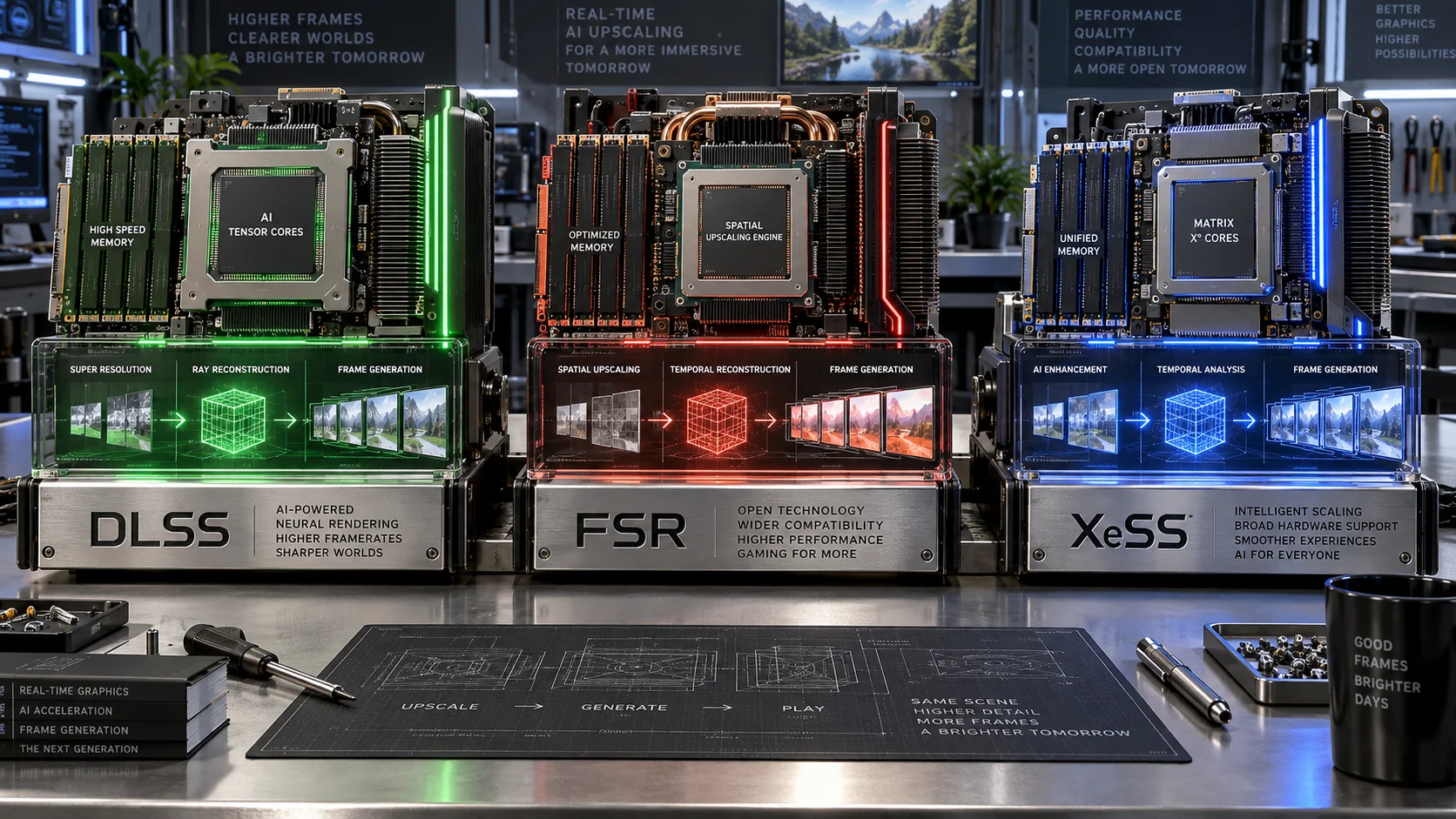
| Attribute | DLSS 3.5 (NVIDIA) | FSR 4 (AMD) | XeSS 2 (Intel) |
|---|---|---|---|
| Algorithm Type | Deep learning (CNN) + temporal | ML model (RDNA 4) / temporal fallback | Neural network (XMX) / DP4a fallback |
| Hardware Requirement | NVIDIA RTX only (Tensor Cores) | Any DX11/DX12/Vulkan GPU | Any modern GPU (best on Arc XMX) |
| Frame Generation | RTX 40-series+ (Optical Flow ASIC) | Any GPU (shader-based optical flow) | Arc Battlemage+ optimal; broader support |
| Ray Reconstruction | Yes (RTX 40-series+) | No | No |
| Image Quality (native render) | Excellent, best-in-class at Quality mode | Very Good (RDNA 4); Good (other HW) | Very Good (Arc); Adequate (other HW) |
| Ghosting / Trailing | Low (RR mitigates significantly) | Low-Medium (FSR 4 improved) | Low on Arc; Medium on fallback path |
| Latency Impact (Frame Gen) | +1 frame (mitigated by Reflex 2) | +1 to 2 frames (Anti-Lag+ recommended) | +1 frame (LatencyFlex integration) |
| Open Source | No | Yes (GPUOpen) | Partial (SDK open, model weights closed) |
| Game Support (2026) | 500+ titles | 400+ titles | 150+ titles |
| Console / Non-PC Support | No | Yes (PS5 FSR integration) | No |
| API Integration | NVAPI / Streamline | DX12 / Vulkan / GDK | DX12 / Vulkan / XeSS SDK |
Upscaling Quality Modes Explained
All three technologies share comparable quality presets, though the internal render resolution percentages differ slightly. Understanding these modes lets you balance visual fidelity against raw frame-rate gains.
- Native AA / Quality (67 to 77% render scale): Minimal artifact risk; recommended for 1440p or 4K displays where image stability matters more than frame count headroom.
- Balanced (58 to 67%): The practical sweet spot for most gaming scenarios. Temporal reconstruction is sufficiently reliable that fine detail is preserved in most game art styles.
- Performance (50%): Halves pixel count in each dimension; reconstruction artifacts become visible in high-frequency geometry (chain-link fences, foliage edges). Acceptable at 4K output, problematic at 1080p output.
- Ultra Performance (33%): Designed exclusively for 8K output or extreme frame-rate boosting. Ghosting and shimmer are significant at 4K and below. Pair only with Frame Generation to maintain perceived smoothness.
Thermal behavior deserves attention when running Frame Generation at Ultra Performance: synthesizing additional frames increases sustained GPU compute load. Monitor sustained GPU clock stability and ensure your cooling solution is sized correctly, consult CPU temperature limits as a reference baseline for acceptable silicon thermal margins, and verify your GPU compound hasn’t degraded (refreshing thermal paste application on older cards can recover 5 to 10°C under sustained upscaling load).
Frame Generation: Real Frames vs. Synthetic Frames
Frame Generation is the most commercially impactful, and most misunderstood, feature in this space. It does not render additional frames from the 3D scene; it interpolates a synthetic frame between two real rendered frames using optical flow analysis of pixel motion. The performance number displayed on-screen (e.g., “240 FPS”) reflects the output frame rate, not the native render rate. This distinction has direct gameplay implications.
Input latency is determined by the native render rate, not the output frame rate. A GPU rendering 60 native FPS with Frame Generation outputting 120 FPS has the latency profile of a 60 FPS scenario, not 120 FPS. NVIDIA partially offsets this with NVIDIA Reflex 2, which aggressively manages CPU-GPU pipelining to reduce the latency delta. AMD’s Anti-Lag+ serves the equivalent role in the FSR ecosystem. For competitive multiplayer, native frame rate optimization remains more important than Frame Generation-assisted totals.
Frame Generation delivers genuine value in single-player titles with heavy path tracing, Cyberpunk 2077 with full RT Overdrive, Alan Wake 2, and Indiana Jones and the Great Circle are representative examples where native render rates drop into the 40 to 55 FPS range on mid-tier hardware and Frame Generation restores perceptual smoothness without sacrificing ray-traced image quality.
Practical Decision Framework by GPU
NVIDIA RTX 40-Series and 50-Series Owners
Use DLSS as the default in every supported title. Ray Reconstruction should be enabled whenever the game exposes the option within a ray-traced or path-traced pipeline, the neural denoiser produces measurably fewer fireflies and more temporally stable reflections than FSR or XeSS can offer. Frame Generation on these cards uses a dedicated fixed-function optical flow block rather than shader cores, freeing compute resources and reducing frame generation overhead compared to software implementations.
AMD RDNA 3 and RDNA 4 Owners
FSR 4 is the primary choice on RDNA 4 hardware (RX 9000 series) where the ML upscaler runs natively on AI accelerators. On RDNA 3 (RX 7000 series), FSR 2-class temporal upscaling applies; the quality is competitive with DLSS Quality mode in most titles. FSR’s universal Frame Generation means no capability gaps regardless of game vendor. Enable AMD Anti-Lag+ in the AMD Software panel whenever Frame Generation is active to recover input latency. For detailed information on AMD’s hardware ecosystem design choices, refer to AMD’s official FSR technology page.
Intel Arc Battlemage Owners
XeSS 2 on Battlemage GPUs with XMX acceleration delivers image quality that benchmarks within 2 to 4% of DLSS Quality mode in direct pixel-level comparisons, a remarkable achievement for a second-generation implementation. The limiting factor remains software support: check XeSS game compatibility lists before purchasing a title expecting full feature parity. In unsupported titles, FSR (which runs on Arc hardware without penalty) is the correct fallback.
Mixed or Older Hardware
On GTX 16-series, RX 5000/6000, or integrated graphics, FSR 2’s temporal path is the only upscaling option that delivers temporal stability without vendor-specific acceleration. FSR 1 and XeSS DP4a fallback are viable spatial alternatives. Frame Generation on non-dedicated-block hardware consumes shader resources, reducing the net gain, benchmark before committing to Frame Generation at lower native resolutions where shader headroom is constrained.
Integration, Driver Management, and Known Issues
All three upscaling systems depend on accurate per-frame motion vectors supplied by the game engine. Poor motion vector implementation, a common source of artifacts in early or poorly optimized integrations, produces ghosting behind moving objects regardless of which upscaler is active. This is a game-side defect, not a technology defect. When evaluating upscaling quality in a new title, cross-reference community reports before attributing artifacts to the upscaling algorithm itself.
Driver-level upscaling wrappers (NVIDIA Image Scaling, AMD RSR) apply spatial upscaling outside the game pipeline. These are fundamentally inferior to in-engine temporal upscaling, they have no access to motion vectors or depth buffers, and should not be compared to DLSS Super Resolution, FSR 2+, or XeSS in quality discussions. Use them only when no in-engine integration exists.
Always perform a clean driver installation when switching GPU vendors or after major upscaling SDK updates, residual shader cache entries from a previous driver version can cause visual corruption with new upscaling features. The standard procedure is covered in the guide on GPU driver clean install.
Conclusion: Which Technology Wins in 2026?
There is no universal winner, the correct answer is hardware-dependent. DLSS 3.5 with Ray Reconstruction remains the highest absolute image quality option for RTX 40/50 users in supported titles, and its Tensor Core and Optical Flow ASIC architecture provides the most efficient Frame Generation implementation available. FSR 4 has closed the quality gap substantially on RDNA 4 hardware and retains its decisive advantage in ecosystem breadth, console reach, and vendor neutrality. XeSS 2 has matured into a genuinely competitive upscaler on Arc hardware, though its game library still needs continued growth to be a primary selection criterion for most buyers.
For most consumers purchasing a GPU in 2026, the upscaling technology follows the GPU choice, not the other way around. Evaluate raw rasterization performance, ray tracing efficiency, driver stability, and price-per-frame at your target resolution first. The upscaling ecosystem on whichever GPU you select is now mature enough that image quality differences within the same quality preset tier are marginal in the majority of shipping titles.

Pros
- Very large 32GB VRAM capacity for local LLM inference and heavyweight creator projects.
- Strong AI-focused hardware with 3352 AI TOPS and 5th Gen Tensor Cores.
- Advanced thermal design aimed at maintaining performance during sustained workloads.
- Wide connectivity options for modern multi-display setups, including DP 2.1b and HDMI 2.1b.
Cons
- Premium positioning makes it a poor value for users who only need a standard gaming GPU.
- The quad-fan design may be less practical for compact cases or minimalist builds.
- The manufacturer listing does not include dimensions or power requirements, so compatibility should be checked before purchase.
Overview: The ASUS ROG Astral GeForce RTX 5090 OC Edition is a flagship graphics card built around 32GB GDDR7 memory and a quad-fan cooling design. It is aimed at creators, AI enthusiasts, and high-end PC builders who need a premium, heavy-duty GPU.
Performance: With 3352 AI TOPS, 5th Gen Tensor Cores, 21760 CUDA cores, a 512-bit bus, and 28 Gbps memory, it is designed for demanding AI-assisted editing, local LLM inference, large asset handling, and GPU-accelerated workflows.
- 32GB VRAM supports larger models and heavier multitasking.
- Quad-fan cooling, a vapor chamber, and a phase-change thermal pad are built for sustained load management.
- DP 2.1b and HDMI 2.1b outputs make it suitable for multi-display setups.
Drawbacks: This is a very premium product, so it will not suit every budget or every gaming-only build. The quad-fan design may also be harder to accommodate in compact systems, and the manufacturer listing does not include full fitment details such as dimensions or power draw.
Verdict: Buyers who need strong AI acceleration, large VRAM capacity, and advanced cooling will get the most value from this card. If your use case is mostly standard gaming, a less specialized GPU may be more practical.
Pros
- Very large 32GB GDDR7 memory capacity for AI and creator workloads.
- Strong display connectivity with 3x DP 2.1b and HDMI 2.1b.
- Included GPU holder adds value for system stability.
- Triple-fan design suggests a cooling-focused build for a flagship card.
Cons
- Detailed dimensions, weight, power connector, and PSU requirements are not listed in the manufacturer listing.
- 8K and high-refresh output claims depend on DSC, compatible displays, and supported cables.
- Its feature set is geared toward specialized AI and premium gaming use, so it may be more than casual users need.
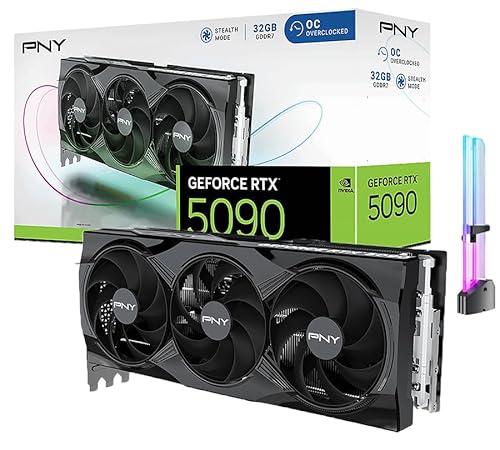
Overview: The CyberGeek GeForce RTX 5090 is a high-end triple-fan graphics card built for demanding gaming, AI creation, and workstation-style use. The inclusion of 32GB GDDR7 and a GPU holder makes it clear that this card is aimed at serious builds where stability and memory capacity matter.
Performance and features: With 3352 AI TOPS, 5th Gen Tensor Cores, DLSS 4, Reflex 2, and 4th Gen ray tracing cores, this card is positioned for modern AI-assisted workflows and supported games. The 28 Gbps memory speed, 512-bit bus, and 1792 GB/s bandwidth should be especially useful for large projects, local LLM inference, and GPU-heavy creative tasks.
Drawbacks and considerations: The manufacturer listing does not list dimensions, weight, power connector type, or PSU requirements, so buyers should verify compatibility before installation. Multi-display and 8K class output also depends on DSC support, compatible cables, and the connected monitor or monitors.
Verdict: This is best suited to creators, AI enthusiasts, and gamers who want maximum memory capacity and modern display support in one card. It is less compelling for everyday users, but it offers a strong specification set for workloads that can fully use its hardware.

Pros
- Very large 32GB VRAM pool for AI and creative workloads.
- Includes a GPU holder to help reduce sag and improve build stability.
- Wide range of modern display outputs for flexible workstation or gaming setups.
- Strong feature set for both gaming and content creation in one card.
Cons
- Its ultra-high-end specification makes it overkill for many mainstream gaming builds.
- The triple-fan design may be difficult to fit in compact cases.
- Advanced features such as AI acceleration and DLSS 4 depend on supported software and games.
Overview: The ASUS TUF Gaming GeForce RTX 5090 is a flagship-class graphics card built for users who need extreme GPU performance for gaming, AI work, and professional content creation. The triple-fan cooler and included GPU holder suggest a focus on physical support and long-term build stability.
Performance & Features: With 32GB of GDDR7 VRAM, 28 Gbps memory, 21760 CUDA cores, and 3352 AI TOPS, this card is designed for demanding workloads such as AI-assisted editing, local LLM inference, 8K assets, and heavy multitasking. It also supports DLSS 4, ray tracing, and up to four displays through DP 2.1b and HDMI 2.1b outputs.
Drawbacks & Considerations: This is an extremely specialized product, so many gamers and casual users will not need this much power or memory. The large triple-fan form factor may also be a challenge in smaller cases, and the most advanced features only matter in supported applications and titles.
Verdict: The RTX 5090 TUF is best suited to enthusiasts, AI developers, and creators who want maximum headroom for modern GPU workloads. If your projects or games can use its top-tier feature set, it offers a highly capable all-in-one solution.

Pros
- Built on NVIDIA Blackwell architecture for the latest RTX 50 Series feature set.
- Includes 16GB GDDR7 memory for a strong high-end VRAM configuration.
- Offers modern display connectivity with HDMI 2.1 and DisplayPort 2.1.
- Supports DLSS 4, Reflex 2, and RTX AI features for gaming and creator use.
Cons
- The 2.99-slot triple-fan design may be difficult to fit in smaller PC cases.
- This is a premium-tier graphics card, so it may be more than many casual gamers need.
- The manufacturer listing does not list full dimensions or power requirements, so system compatibility must be checked separately.
Overview: The PNY NVIDIA GeForce RTX 5080 Epic-X ARGB OC is a high-end triple-fan graphics card based on NVIDIA Blackwell architecture. Its 2.99-slot cooler and ARGB styling give it an enthusiast-focused design that should appeal to builders who want both performance and a premium look.
Performance: With 16GB of GDDR7 memory, a 2775 MHz boost clock, PCIe 5.0 support, and HDMI 2.1 plus DisplayPort 2.1 outputs, this card is aimed at demanding gaming and creator workloads. NVIDIA DLSS 4, Reflex 2, and RTX AI features add meaningful value for smoother gameplay, lower latency, and AI-accelerated tasks.
Drawbacks: The large triple-fan, 2.99-slot format may not be ideal for compact cases, and the card sits firmly in the premium segment rather than the value segment. The manufacturer listing also does not provide full dimensions or power details, so buyers should verify case and system compatibility before purchase.
Verdict: This model is best suited to enthusiasts who want a powerful RTX 50 Series GPU for modern gaming, content creation, and AI-enhanced workflows. If you have the space and want current-generation NVIDIA features, it is a strong high-end option.

Pros
- DLSS 3 and 4th-gen Tensor Cores deliver major performance gains in supported games
- Full ray tracing with 3rd-gen RT Cores for realistic lighting
- Large 16GB VRAM pool suited to 4K gaming and creative work
- Robust cooling and backplate design for longevity
Cons
- Listed 0.1-inch thickness is likely a specification error and should be verified
- No overclocked factory profile mentioned in the manufacturer listing
Reading on Upscaling Technologies
Upscaling tools render games at a lower internal resolution and rebuild the image, trading some sharpness for higher frame rates. If you want general background on how graphics and display technology is documented, American National Standards Institute (ANSI) offers a starting point.









