Quick Answer
Thunderbolt 4 guarantees 40 Gb/s bidirectional bandwidth, mandatory PCIe 3.0 u00d74 tunneling, certified daisy-chaining up to six devices, and Intel’s interoperability certification floor. USB4 Version 1 specifies 40 Gb/s maximum but certifies only 20 Gb/s minimum, omits mandatory PCIe tunneling, and lacks enforced daisy-chain topology, making Thunderbolt 4 the stricter, higher-assurance standard for professional workstation motherboard builds.
Protocol Architecture: How Each Standard Is Actually Defined
USB4 Is a Specification Envelope, Not a Single Speed
USB4 Version 1.0, ratified by the USB Implementers Forum in 2019, is architecturally a superset framework that tunnels three legacy protocols , USB 3.2, DisplayPort 1.4a, and PCIe , across a unified 40 Gb/s physical layer derived from Intel’s Thunderbolt 3 IP donation. The critical engineering nuance is that USB4 defines a capability ceiling, not a mandatory floor. A device bearing the USB4 logo legally operates at 20 Gb/s Gen 2u00d72 and satisfies the specification. PCIe tunneling over USB4 is optional at the silicon level, meaning a USB4 host controller may implement zero PCIe tunnel bandwidth and still carry full USB4 branding. USB4 Version 2.0, announced in 2022, extends the ceiling to 80 Gb/s using PAM-4 signaling on the same 40 Gb/s passive cables , but again, 80 Gb/s is the ceiling, not the floor, and Version 2.0 products are only beginning to appear on motherboards targeting pc hardware 2026 release cycles. For complementary field maintenance guidelines, examine our breakdown of mix nvme and sata ssd.
Thunderbolt 4 Is a Mandatory Minimum Contract
Thunderbolt 4, released by Intel in 2020 alongside Tiger Lake mobile silicon, operates on a fundamentally different philosophical premise: every certified port must deliver every specified capability simultaneously. Intel’s Thunderbolt 4 certification program mandates 40 Gb/s aggregate bandwidth (two 20 Gb/s lanes), tunneled PCIe 3.0 u00d74 at a guaranteed floor of 32 Gb/s, dual 4K display output or single 8K display, 100 W USB Power Delivery on host-side ports, and DMA protection via Intel VT-d. There is no “Thunderbolt 4 Lite.” This mandatory minimum is the single most significant structural difference when evaluating the thunderbolt 4 vs usb4 difference guide from an enterprise or prosumer motherboard specification perspective. The PCI-SIG PCIe Specification Standard underpins the PCIe tunneling layer both protocols rely on, and the divergence in how each standard mandates or omits that tunneling defines real-world NVMe enclosure performance.
Bandwidth Deep Dive: Theoretical Ceilings vs. Guaranteed Throughput

Raw Electrical Layer and Protocol Overhead
Both Thunderbolt 4 and USB4 Gen 3u00d72 operate at 20 Gbps per lane u00d7 2 lanes = 40 Gb/s gross electrical bandwidth, using 128b/132b encoding (approximately 97% line efficiency vs. USB 3.2’s 80% 8b/10b scheme). After encoding overhead and protocol framing, real-world sustained throughput ceiling for a single NVMe enclosure on either interface sits around 3,000 to 3,200 MB/s, effectively matching a PCIe 3.0 u00d74 NVMe SSD’s sequential ceiling. The difference emerges when multiple tunnels compete for the same 40 Gb/s pool. Thunderbolt 4 guarantees that PCIe tunnel allocation will not starve DisplayPort or USB 3.2 tunnels below their specified minima; USB4 leaves arbitration policy to individual silicon vendors, producing inconsistent real-world behavior across motherboard chipsets.
USB4 Version 2.0 and the 80 Gb/s Reality Check
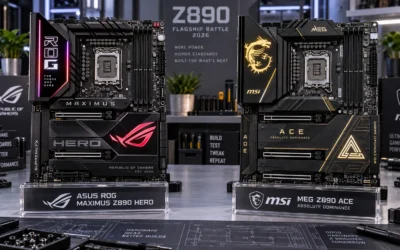
USB4 Version 2.0 doubles the physical layer to 80 Gb/s using PAM-4 modulation, which requires active cable assemblies beyond 0.8 m and more aggressive equalization in the host controller. Peak single-device throughput can reach approximately 6,400 MB/s, meaningful for next-generation NVMe RAID enclosures. However, motherboard implementations as of early 2026 vary significantly in whether the USB4 Version 2.0 controller implements the full PCIe tunnel bandwidth. When evaluating the ASUS ROG Maximus Z890 Hero vs MSI MEG Z890 ACE, for example, the distinction between which rear-panel USB-C ports are backed by Thunderbolt 4 controllers versus discrete USB4 controllers directly determines whether attached PCIe enclosures receive guaranteed u00d74 bandwidth or are subject to vendor-specific tunnel arbitration. Always cross-reference the motherboard’s block diagram, not just the port icon.
Daisy-Chaining Topology: The Feature That Separates Real Workflows
Thunderbolt 4 Star and Daisy-Chain Topologies
Thunderbolt 4 supports a true daisy-chain topology certified for up to six devices in a single chain, plus one host , seven nodes total on a single port. This is possible because Thunderbolt hubs implement an internal PCIe switch and DisplayPort Multi-Stream Transport (MST) hub, passing the full protocol stack downstream rather than merely repeating USB signals. Each downstream Thunderbolt 4 device participates in the same packet-switched fabric, meaning an NVMe enclosure at position three in the chain can negotiate PCIe bandwidth independently from a display at position two. The aggregate 40 Gb/s pool is shared, but arbitration is governed by a standardized protocol , not left to the end device’s firmware. To evaluate matched hardware tolerances, consult our detailed overview of pcie riser cable signal degradation.
USB4 Hub Behavior and Daisy-Chain Limitations
USB4 hubs exist, but they function differently from Thunderbolt 4 hubs. USB4 hubs are protocol converters that present downstream ports as USB 3.2 Gen 2 or USB 3.2 Gen 2u00d72, not as full USB4 fabric nodes. This means daisy-chaining two USB4 hubs does not propagate 40 Gb/s bandwidth through both; the second hub drops to USB 3.2 speeds. DisplayPort MST over USB4 is supported but requires the host and all intermediate hubs to implement Alt Mode correctly, a certification gap that produces real-world display detection failures on budget motherboards. For workflows involving multiple 4K displays plus high-speed external storage on a single-port chain, Thunderbolt 4 is architecturally the only currently certified path. Choosing the right CPU platform also matters here, see the AMD Ryzen 5 9600X vs Intel Core Ultra 5 245K breakdown for how each platform’s native I/O lanes affect Thunderbolt controller integration.
Compatibility, Certification, and Security Architecture
Backward and Cross-Compatibility Matrix
Thunderbolt 4 ports are fully backward-compatible with Thunderbolt 3, USB4, USB 3.2, USB 2.0, and DisplayPort Alt Mode devices, all over the same USB-C receptacle. USB4 ports are compatible with USB 3.2, USB 2.0, and DisplayPort Alt Mode but are not required to support Thunderbolt 3 or Thunderbolt 4 devices at full Thunderbolt bandwidth. A Thunderbolt 4 device plugged into a USB4 port falls back to USB4 Gen 3u00d72 (40 Gb/s), losing the Thunderbolt PCIe tunnel and daisy-chain fabric, the device works, but not as a Thunderbolt device. This asymmetry is the source of most consumer confusion and the reason the thunderbolt-4-vs-usb4-difference requires examining the host port, not just the cable or device.
Intel VT-d DMA Protection and Enterprise Security
Thunderbolt 4 mandates Intel VT-d (Virtualization Technology for Directed I/O) DMA protection at the host level, ensuring that newly attached Thunderbolt devices cannot directly read host memory before the OS or user authorizes them , a direct mitigation against DMA attack vectors such as those exploited by Thunderspy-class vulnerabilities. USB4 has no equivalent mandatory DMA protection requirement in its specification. Individual operating systems (Windows 11’s Kernel DMA Protection, Linux IOMMU) can layer protection over USB4 PCIe tunnels, but the guarantee is platform- and firmware-dependent rather than specification-mandated. For enterprise workstation deployments where PCI Express tunneling exposes host memory directly to external silicon, this gap is a non-trivial security architecture consideration. When planning workspace deployment, consider the engineering criteria outlined in our how to clear cmos guide.
Motherboard Implementation: What to Look for in 2026 Builds
Controller Silicon and Physical Integration
On Intel 700/800-series platforms, Thunderbolt 4 is typically implemented via Intel’s JHL8540 or JHL9480 retimer/controller attached to the PCH, consuming two PCIe 4.0 lanes per Thunderbolt 4 port pair. AMD platforms lack native Thunderbolt silicon in the CPU die and rely on discrete ASMedia ASM4242 or Intel JHL controllers attached to PCIe lanes from the chipset, introducing one additional PCIe hop versus Intel-native implementations. That hop adds approximately 1 to 3 u00b5s latency, irrelevant for storage but measurable in ultra-low-latency audio interfaces. AMD’s USB4 implementation via the USB4 Host Router block in Zen 4 and Zen 5 chipsets is native to the CPU die, giving AMD platforms a structural USB4 latency advantage over their Thunderbolt implementations. For GPU-centric builds where PCIe lane allocation is the binding constraint, reviewing the Radeon RX 9060 XT 8GB vs 16GB comparison alongside your motherboard block diagram reveals how many PCIe lanes remain after GPU + Thunderbolt controller allocation.
Port Labeling and Specification Sheet Interpretation
Motherboard manufacturers routinely label USB-C ports with both USB4 and Thunderbolt 4 icons when only one standard is actually implemented. The authoritative source is the motherboard’s chipset/controller block diagram in the technical manual or the Intel ARK database for the specific Thunderbolt controller part number. A port labeled “USB4 40G / TBT4” is genuinely dual-certified. A port labeled only “USB4 40G” should be assumed USB4-only until the controller silicon is confirmed. Flagship motherboards like those reviewed in desktop CPU benchmarks & reviews sections typically document controller-to-port mapping in teardown analysis, prioritize those sources over box art. Similarly, system-level GPU and display pipeline interaction is covered in graphics card tests & GPU guides that address DisplayPort Alt Mode bandwidth allocation under simultaneous GPU + Thunderbolt display load.
Comprehensive Specification Comparison Table
| Specification | Thunderbolt 4 | USB4 Version 1.0 | USB4 Version 2.0 |
|---|---|---|---|
| Max Aggregate Bandwidth | 40 Gb/s (mandatory) | 40 Gb/s (ceiling); 20 Gb/s minimum | 80 Gb/s (ceiling); 40 Gb/s minimum |
| PCIe Tunneling | PCIe 3.0 u00d74 mandatory (32 Gb/s floor) | Optional, vendor-dependent | Optional, vendor-dependent |
| DisplayPort Version | DP 1.4 (mandatory); dual 4K or single 8K | DP 1.4a (optional Alt Mode) | DP 2.1 (optional Alt Mode) |
| USB Power Delivery | 100 W mandatory on host; 15 W minimum downstream | 7.5 W minimum; 100 W optional | 7.5 W minimum; 240 W EPR optional |
| Daisy-Chain Depth | 6 devices (certified topology) | Not standardized; hub-limited | Not standardized; hub-limited |
| DMA Security | VT-d mandatory | OS/platform-dependent | OS/platform-dependent |
| TB3 Backward Compatibility | Full (hardware-level) | Functional fallback only | Functional fallback only |
| Certification Body | Intel mandatory program | USB-IF (voluntary logo program) | USB-IF (voluntary logo program) |
| Connector | USB-C (lightning bolt icon) | USB-C | USB-C |
| Typical Motherboard Implementation | Intel JHL8540 / JHL9480 (discrete controller) | Chipset-integrated or ASMedia ASM4242 | AMD USB4 Host Router (CPU die) or discrete |
Final Diagnostic Verdict & Selection Checklist
The thunderbolt 4 vs usb4 difference resolves to a single engineering principle: Thunderbolt 4 is a guaranteed capability contract; USB4 is a maximum capability envelope. For professional workflows, NVMe RAID arrays, multi-display daisy chains, PCIe eGPU enclosures, audio interface chains, Thunderbolt 4 ports on the motherboard are the only currently standardized path that eliminates per-device compatibility negotiation failures. USB4 Version 2.0 offers a higher bandwidth ceiling that will matter increasingly as 80 Gb/s NVMe enclosures reach the consumer market, but its implementation consistency in pc hardware 2026 products remains silicon- and firmware-dependent.
Pre-Purchase Checklist: Motherboard I/O Selection
- Identify every USB-C port’s controller silicon from the board’s block diagram or technical manual, not from the rear I/O silkscreen alone.
- Confirm Thunderbolt 4 certification via Intel’s Thunderbolt product database if daisy-chaining or PCIe tunneling is required.
- Count total PCIe lanes consumed by Thunderbolt controllers, each TBT4 port pair typically consumes two PCIe 4.0 lanes from the PCH lane budget.
- Verify USB Power Delivery output: 100 W host-side if powering bus-powered NVMe enclosures or docks without external PSU.
- Test DMA protection status in Windows 11 via
msinfo32u2192 “Kernel DMA Protection: On” before connecting untrusted Thunderbolt peripherals. - For AMD platforms: confirm whether the USB-C port routes through the CPU-native USB4 Host Router or a discrete Thunderbolt controller, latency and lane allocation differ.
- Cable-match the use case: passive 40 Gb/s cables (u22640.8 m) for Thunderbolt 4; active optical or active electrical cables required for USB4 Version 2.0 at 80 Gb/s beyond 0.8 m.
- Validate daisy-chain device count against the Thunderbolt 4 seven-node limit if building a multi-device hub chain.
Thunderbolt 4 remains the correct choice for any build where peripheral compatibility, daisy-chain reliability, and guaranteed PCIe tunnel bandwidth are non-negotiable. USB4 Version 2.0 becomes compelling only when the specific 80 Gb/s ceiling is required and the motherboard’s silicon has been independently confirmed to implement full PCIe tunnel bandwidth, a verification step that cannot be skipped in 2026’s fragmented USB4 implementation landscape.

Pros
- Strong all-in-one bundle with motherboard, memory, and SSD included.
- High-end connectivity options including USB4, Wi-Fi 7, and 2.5GbE LAN.
- Large 2TB PCIe Gen4 SSD and 32GB DDR5 memory reduce the need for immediate upgrades.
- Four M.2 slots improve long-term storage flexibility.
Cons
- AM5 and ATX sizing make it suitable only for compatible desktop builds, not older platforms.
- The listing does not provide full details such as VRM design, rear I/O count, or BIOS features.
- No customer review details are provided in the manufacturer listing, so real-world user feedback is limited here.
Overview: The Newegg X870E PRO AM5 ATX DDR5 combo is a parts bundle aimed at builders who want a newer AMD platform with storage and memory included. The package combines a feature-rich motherboard with 32GB of RGB DDR5 memory and a 2TB 990 PRO SSD, creating a strong starting point for a premium desktop build.
Performance and features: Based on the listed specifications, this bundle is built for speed and expansion. PCIe 5.0 support, 4x M.2 slots, USB4, Wi-Fi 7, and 2.5GbE LAN make it well suited for gaming, multitasking, and content creation. The included DDR5-6000 memory and 990 PRO SSD should help deliver fast boot times, quick application launches, and smooth everyday responsiveness.
Drawbacks and considerations: The main limitation is that the listing does not include full motherboard details such as VRM layout, rear port breakdown, or compatibility notes beyond AM5 and ATX DDR5 support. It is also a platform-specific bundle, so buyers must already be planning an AM5-based system. With no customer feedback shown in the manufacturer listing, long-term user experience is harder to judge.
Verdict: This combo makes the most sense for builders who want to simplify a high-performance PC purchase by getting the motherboard, RAM, and SSD together. It offers a practical mix of modern connectivity, fast storage, and generous memory capacity, especially for users assembling a capable Ryzen gaming or productivity system.

Pros
- Extremely strong expansion capacity for multi-GPU and high-end workstation builds
- Built-in remote management is valuable for labs, studios, and always-on systems
- High-speed connectivity includes USB4, USB 20Gbps Type-C, and dual 10Gb Ethernet
- Validated compatibility and QVL focus support more predictable deployment in professional environments
Cons
- Requires Intel Xeon 600 processors on the LGA 4710-2 platform, so it is not a mainstream desktop option
- EEB form factor and workstation-focused power setup require a compatible large case and advanced build planning
- Its feature set is specialized and may be unnecessary for users who only need a simple gaming or general-purpose motherboard
Overview: The ASUS Pro WS W890E-SAGE SE is a premium EEB workstation motherboard built around the Intel W890 platform and LGA 4710-2 socket. It is designed for professional systems that need serious expansion, dependable power delivery, and remote administration.
Performance and features: Key specifications include support for Intel Xeon 600 Processors for Workstation, ECC R-DIMM DDR5 memory, seven PCIe 5.0 x16 slots, four M.2 slots, MCIO, SlimSAS, dual 10Gb LAN, USB4, and USB 20Gbps Type-C. The board also adds server-grade IPMI management through an AST2600 BMC and ASUS Control Center Express.
Drawbacks and considerations: This is a highly specialized platform, so it is not the right choice for most mainstream desktops. Buyers should be prepared for the LGA 4710-2 Xeon ecosystem, the larger EEB size, and the complexity that comes with a board built for advanced workstation deployment.
Verdict: The strongest fit is for professionals building AI, rendering, data-heavy, or always-on workstation systems that need expansion, remote management, and strong networking. If you want a simpler or more cost-conscious motherboard, this model is likely more than you need.
Pros
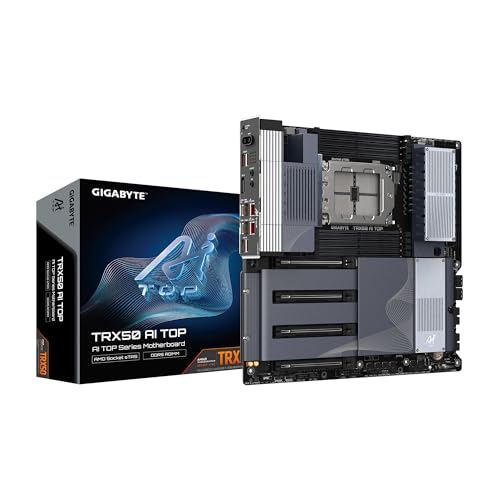
- sTR5 socket listed for Threadripper PRO 7000 and 7000 CPUs
- Eight memory slots, listed up to 2TB capacity
- Dual USB4 Type-C ports for connectivity
- Dual 10GbE LAN and Wi-Fi 7, per listing
- Quick-release, screwless M.2 and PCIe design, per listing
Cons
- Requires ECC R-DIMM memory, which limits memory options
- Listed at 16 x 15 x 4 inches; confirm case clearance

Pros
- Built for Intel Xeon 600 processors on the LGA 4710-2 platform.
- Strong expansion options with 7 PCIe 5.0 x16 slots and multiple storage interfaces.
- Dual 10Gb and 2.5Gb wired networking is well suited to demanding workstation environments.
- Power design and cooling are engineered for 24/7 reliability and heavy workloads.
Cons
- Requires Intel Xeon 600 Series support, so it is not a fit for standard consumer desktop CPUs.
- IPMI remote management depends on a separate ASUS expansion card rather than being fully built in.
- The CEB workstation format may require a compatible large chassis and a carefully planned power setup.
Overview: The ASUS Pro WS W890-SAGE is a high-end workstation motherboard built around the Intel W890 platform and LGA 4710-2 socket. It is aimed at professional systems that need strong compute, storage, and expansion capability, with a design that favors stability and long-term use.
Performance and features: Its standout strengths are the seven PCIe 5.0 x16 slots, four M.2 slots, two SlimSAS connectors, dual wired networking, and USB4 plus USB 20Gbps Type-C support. The board also includes 12+(2+2)+1+2 power stages and enhanced cooling coverage, which should help support demanding workloads and 24/7 operation.
Drawbacks and considerations: This is a very specialized motherboard, so it is not a practical choice for mainstream desktop users. It requires compatible Intel Xeon 600 processors and a workstation-ready chassis, and IPMI remote management is only available through a separate ASUS expansion card.
Verdict: The Pro WS W890-SAGE makes the most sense for AI-focused workstations, content creation rigs, and enterprise-style builds that need robust expansion and remote management. If your priority is maximum platform capability and reliability rather than broad consumer compatibility, it is a strong fit.
Background on Port Standards
Thunderbolt and USB ports can share a connector shape, yet their feature sets and speed rules differ, which makes board labels confusing. Those wanting a general look at how interface specifications are written can consult American National Standards Institute (ANSI).