Direct Answer: There Is No Single ‘Best’ Lawn Tractor
The ideal lawn tractor depends entirely on your property size, budget, terrain challenges, and maintenance priorities. For small to medium residential lawns (under 1 acre), a traditional riding tractor with 14 to 18 HP and a 42-inch deck offers excellent value. For larger properties (2+ acres), a zero-turn radius model with 18 to 25 HP and a 48 to 54 inch deck dramatically improves efficiency. The key is matching tractor specifications to your actual needs rather than buying the most feature-rich or expensive option available.
Why ‘Best’ Is Subjective: Understanding Your Needs First
Before evaluating any lawn tractor, identify your specific situation. The following questions help narrow the field:
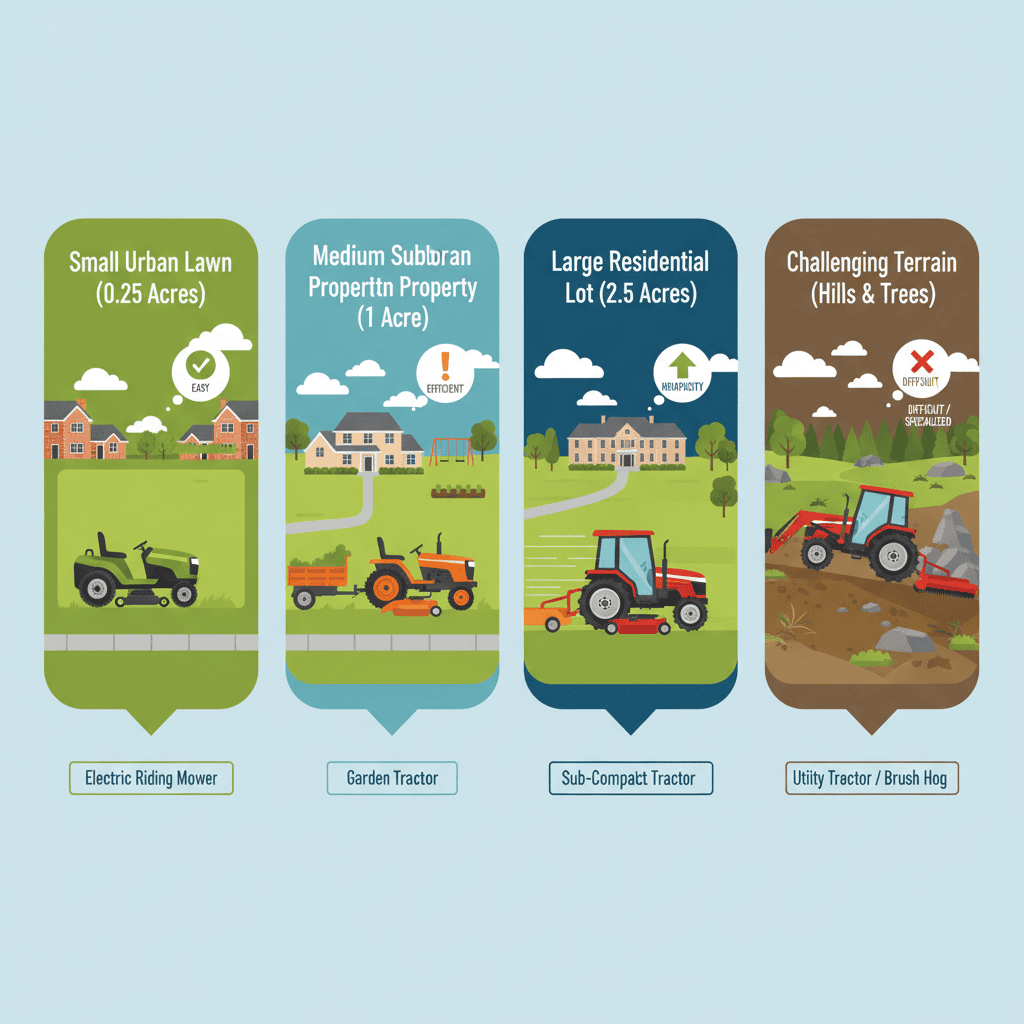
- What is your lawn size? Small yards (under 0.5 acres) may not justify a full tractor; medium lawns (0.5 to 1 acre) work well with entry-level riding tractors; large properties (2+ acres) benefit from zero-turn or commercial-grade models.
- What is your realistic budget? Entry-level tractors start around $3,000-$4,500; mid-range models range $5,000-$8,000; premium and commercial options exceed $10,000.
- What terrain challenges exist? Flat, manicured lawns require less ground clearance than uneven, hilly, or wooded properties.
- Which factor matters most: cutting quality, comfort, durability, or price? Your priority shapes brand and model selection.
- How frequently will you use it? Weekly mowing demands different durability standards than occasional use.
Key Lawn Tractor Specifications Explained
Understanding these specifications prevents overspending or under-buying:
Horsepower (HP)
Horsepower determines cutting power, mulching capability, and ability to handle attachments. Residential lawns typically require 14 to 25 HP. A 42-inch deck works efficiently with 16 to 18 HP; a 54-inch deck needs 20 to 25 HP. Oversized horsepower wastes fuel; undersized HP causes sluggish cutting and incomplete mulching.
Deck Size (Cutting Width)
Larger decks reduce mowing time but increase turning radius and storage requirements. Standard sizes are 42, 48, and 54 inches. For properties under 1 acre, a 42-inch deck is adequate; for 1 to 3 acres, 48 inches balances efficiency and maneuverability; for 3+ acres, 54 inches minimizes time spent mowing.
Transmission Type
Hydrostatic transmissions offer smooth, variable speed control and are easier to operate for long sessions. They cost more but reduce fatigue. Manual or gear-driven transmissions are cheaper, more durable, and easier to repair, but require more operator input and may feel jerky.
Zero-Turn Radius vs. Traditional Steering
Zero-turn radius models pivot on their rear axles, eliminating the need for three-point turns. This dramatically reduces mowing time on large, open lawns and around obstacles. However, they cost $1,500-$3,000 more than traditional models and may be overkill for small, simple properties.
Ground Clearance and Suspension
Properties with uneven terrain, rocks, roots, or light wooded sections benefit from higher ground clearance (8+ inches) and suspension systems. Low-clearance models may scalp grass or damage the deck on bumpy ground.
Lawn Tractor Categories and Appropriate Use Cases
Entry-Level Riding Tractors (14 to 18 HP, 42-inch deck)
Best for: Small to medium residential lawns (0.5, 1.5 acres), flat or gently rolling terrain, budget-conscious buyers, and occasional use. To compare alternative configurations, check our hands-on review of marshall stanmore iii vs harman kardon onyx studio 8.
Typical price range: $3,000-$5,000.
Pros: Affordable, simple to operate and maintain, adequate cutting performance, good dealer availability. Users looking for related component recommendations can explore our dyson v8 cyclone vs bissell featherweight stick breakdown.
Cons: Slower mowing pace, fewer attachment options, basic comfort features, limited terrain capability.
Mid-Range Riding Tractors (18 to 22 HP, 48-inch deck)
Best for: Moderate residential properties (1, 2 acres), mixed terrain, homeowners wanting better comfort and attachments, regular seasonal use. Before finalizing equipment decisions, refer to our comprehensive bissell crosswave hydrosteam vs shark stainforce comparison.
Typical price range: $5,000-$8,000.
Pros: Balanced performance, more comfort features, better mulching, decent attachment compatibility, good resale value.
Cons: Higher maintenance costs than entry models, still slower on very large lawns, more complex repairs.
Zero-Turn Radius Tractors (20 to 28 HP, 48 to 54 inch deck)
Best for: Large residential or light commercial properties (2+ acres), properties with many obstacles, frequent mowing schedules, operators who value speed and maneuverability.
Typical price range: $6,500-$12,000+.
Pros: Significantly faster mowing, superior maneuverability, excellent obstacle avoidance, premium comfort, strong resale value on quality models.
Cons: Substantial upfront cost, more complex hydraulic systems increase repair costs, overkill for small lawns, steeper learning curve for some operators.
Garden Tractors (Small Frame, Lightweight)
Best for: Very small properties (under 0.5 acres), landscaping professionals using multiple machines, properties requiring high precision near gardens or flower beds.
Typical price range: $2,500-$4,500.
Pros: Compact, excellent maneuverability, lower cost, suitable for precision work.
Cons: Very slow, exhausting for large areas, limited durability for heavy use, fewer attachment options.
Step-by-Step Lawn Tractor Selection Framework
Step 1: Measure Your Lawn Size Accurately
Use satellite images (Google Maps) or physical measurement to determine square footage. Divide total area by 43,560 to convert to acres. Properties under 0.5 acres rarely justify a full tractor; 0.5 to 2 acres suit mid-range models; 2+ acres benefit from zero-turn or commercial options.
Step 2: Assess Terrain and Obstacles
Walk your property and note: elevation changes, thick tree coverage, rocky patches, underground utilities, and permanent obstacles. Challenging terrain requires higher ground clearance, better suspension, and potentially higher horsepower. Flat, open lawns allow lower-cost models.
Step 3: Establish Your Budget, Including Hidden Costs
Don’t limit budget to purchase price. Include:
- Annual maintenance (oil changes, filter replacements, blade sharpening): $200-$500
- Fuel for typical seasonal use: $300-$800 per year
- Repairs and unexpected costs (average 5 to 10 years): $500-$1,500 annually on older models
- Storage space (shed or garage requirement)
- Delivery and setup fees: $200-$500
Step 4: Evaluate Brand Reliability and Dealer Support
Major brands include John Deere, Husqvarna, Kubota, Craftsman, Toro, and Cub Cadet. Research dealer density in your area, proximity matters for service and parts. Check warranty length (typically 2 to 3 years) and whether your local dealer honors manufacturer warranties.
Step 5: Test-Drive Candidates
Operate multiple models, even if you plan to buy new. Evaluate comfort (seat, armrests, controls), ease of controls, visibility, noise level, and smoothness. What feels good for 30 minutes might feel fatiguing over 2 to 3 hour sessions.
Major Lawn Tractor Brands: Market Positioning
| Brand | Market Position | Price Range | Typical Use Cases | Strengths |
|---|---|---|---|---|
| John Deere | Premium residential, commercial | $4,500-$15,000+ | All property sizes, all terrain types | Extensive dealer network, strong resale value, reputation for durability |
| Husqvarna | Mid to premium residential | $4,000-$10,000 | Medium to large residential lawns | Balanced performance, good attachment compatibility, European engineering |
| Kubota | Premium residential, light commercial | $5,500-$12,000 | Larger properties, mixed terrain | Exceptional durability, commercial-grade components, higher resale value |
| Craftsman | Budget to mid-range residential | $3,500-$6,500 | Small to medium lawns, value-conscious buyers | Affordable, good basic features, adequate for typical use |
| Toro | Mid to premium residential and commercial | $4,500-$12,000 | All property sizes and uses | Innovation in cutting technology, comfortable designs, good support network |
| Cub Cadet | Budget to mid-range residential | $3,500-$7,000 | Small to medium lawns, entry-level buyers | Affordable, simple operation, decent durability for the price |
Common Buying Mistakes to Avoid
Buying Too Large a Tractor
Oversized tractors waste fuel, are harder to maneuver in tight spaces, require excessive storage, and cost more to maintain. A 54-inch deck on a small 0.75-acre lot is inefficient and frustrating.
Ignoring Total Cost of Ownership
Cheap upfront prices often hide expensive maintenance. Brands with weak dealer networks or proprietary parts cost significantly more to service over 10+ years.
Overlooking Transmission Type
A cheap, manual transmission tractor may cost $1,000 less initially but cause significant fatigue and frustration. For properties requiring 2+ hours of mowing, hydrostatic transmissions are worth the premium.
Not Test-Driving Multiple Models
Comfort, visibility, and control feel differ dramatically between brands. A 15-minute dealer test drive often reveals deal-breakers.
Buying New When Used Makes Sense
Quality used tractors (3 to 5 years old) from major brands offer 40 to 50% savings with most operational life remaining. Inspect maintenance records and physical condition carefully.
Maintenance Expectations by Tractor Type
Budget for regular maintenance to protect your investment:
- Oil and filter changes: Every 50 operating hours or seasonally ($50-$100)
- Blade sharpening: 2 to 3 times per season ($30-$60 per sharpening)
- Air filter replacement: Annually ($20-$40)
- Spark plug replacement: Every 1 to 2 seasons ($10-$25)
- Fuel stabilization: Before winter storage ($10-$20)
- Battery maintenance: Check terminals, replace every 3 to 5 years ($50-$150)
Commercial or professional-grade tractors with zero-turn hydraulics require additional inspection of hydraulic hoses and fluid levels, adding $200-$400 annually.
New vs. Used: When to Buy Each
Buy New If:
- You want a full manufacturer warranty and peace of mind
- You plan to own the tractor for 10+ years
- You have budget available and prefer simplicity
- Local dealer inventory is strong
Buy Used If:
- Budget is limited and you’re comfortable with basic checks
- You’ve identified a specific model with proven reliability
- You can verify maintenance records and condition via inspection
- The tractor is 3 to 7 years old with under 500 operating hours
Everything You Need to Know: Best Lawn Tractor FAQ
Q: How much horsepower do I actually need for a residential lawn tractor?
A: Most residential properties (under 2 acres) perform well with 16 to 20 HP. Smaller decks (42 inches) work efficiently at 14 to 16 HP; larger decks (54 inches) benefit from 22 to 25 HP. More horsepower doesn’t necessarily cut faster or better, it mainly matters if you’re pulling heavy attachments (tiller, wagon, fertilizer spreader). For basic mowing, mid-range horsepower offers the best balance of cost, fuel efficiency, and performance.
Q: Is a zero-turn radius tractor worth the extra cost?
A: Yes, if your lawn exceeds 1.5 to 2 acres or has many obstacles. Zero-turn models reduce mowing time by 30 to 40% compared to traditional steering, which justifies the $2,000-$3,000 premium over long ownership. However, for small, simple lawns (under 1 acre), traditional models are more practical and economical. Zero-turn tractors also require more maintenance due to complex hydraulic systems.
Q: Should I buy the same brand as my previous tractor?
A: Not necessarily. While brand loyalty offers familiarity and potential parts compatibility, newer models from competing brands often deliver better features at similar prices. Evaluate your experience objectively: if you loved your previous machine and dealer support was excellent, loyalty makes sense. If you had issues, research alternatives thoroughly before repurchasing.
Q: What warranty should I expect, and does it matter?
A: Standard manufacturer warranties run 2 to 3 years on residential tractors. Some premium brands offer 4 to 5 years. Extended warranties (covering years 4 to 7) typically cost $500-$1,500 but are rarely necessary if you maintain the machine properly. What matters more is dealer proximity, a nearby dealer with good service support is worth more than a longer warranty at a distant location.
Final Recommendation: The Decision Process Matters More Than Perfection
The ‘best’ lawn tractor is the one that matches your property size, budget, terrain, and priorities. Rather than seeking a single perfect model, use this framework to identify 2 to 3 strong candidates, test-drive them, verify dealer support and warranty terms, and commit to regular maintenance. Most quality tractors from major brands deliver reliable performance for 10+ years if properly maintained. The difference between a $4,000 entry model and an $8,000 mid-range tractor often comes down to comfort, transmission smoothness, and attachment compatibility, not raw cutting capability.

Pros
- Brushless motor system delivers gas-equivalent power without emissions or excessive noise
- High-capacity battery kit enables cutting coverage of up to 4.4 acres per charge set
- Durable 10-gauge steel deck and constant high blade tip speed handle dense grass effectively
- Premium seating and lighting features support comfortable extended operation
- 4-year warranty provides strong protection for the investment
Cons
- Runtime tops out around 4.4 acres depending on conditions, requiring recharges for bigger properties
- Electric design depends on charging infrastructure and battery management rather than simple refueling
- Height adjustment is noted only basically without extensive position details in available specs
The Greenworks 60V MaximusZ Zero Turn Riding Lawn Mower is a commercial-grade electric machine built for large lawns. Its primary construction centers on a heavy-duty 60-inch 10-gauge fabricated steel deck that prioritizes durability and airflow, paired with premium comfort elements including an adjustable suspension seat with lumbar support and foldable armrests for a solid first impression of quality and user focus.
Performance shines through an intelligent brushless motor system offering power equivalent to a 31HP gas engine with zero emissions. Three high-torque brushless hub motors sustain a constant 17,900 FPM blade speed, while SmartCut Technology auto-adapts to prevent bogging in thick or wet grass. The complete kit supplies (2) 20.0Ah suitcase batteries plus (4) 8.0Ah batteries and a 1.5kW fast charger for up to 4.4 acres of cutting. Additional capabilities include a 4-in-1 deck for mulching, bagging, rear and side discharge, 300 lb towing capacity with front/rear hitch, dual LED headlights, and an LCD display.
Drawbacks and considerations include the practical need to recharge the battery set after maximum runtime, which can interrupt work on properties exceeding 4.4 acres. Being fully electric means reliance on power sources for recharging instead of fuel, and height adjustment is referenced only in basic terms without more granular position data in the specifications.
In verdict, the Greenworks 60V MaximusZ delivers the most value to homeowners and professionals managing medium-to-large properties who want quiet, emission-free commercial power, versatile cutting options, and the security of a 4-year warranty in a comfortable zero-turn package.

Pros
- Strong stated cutting capacity for large properties, with up to 4 acres per charge.
- Zero-turn design supports fast, precise mowing around obstacles.
- Uses battery power instead of gas, reducing maintenance-related chores and emissions.
- Includes six high-capacity batteries and a charger, so it is ready for use out of the box.
Cons
- Heavy at 720 pounds, which may make transport, storage, or maneuvering by hand difficult.
- Large dimensions require substantial garage or shed space.
- The high upfront cost may put it out of reach for buyers with smaller lawns or limited budgets.
Overview & Design: The EGO Power+ ZT5207L is a 52-inch electric riding lawn mower with a zero-turn radius, built for users who need efficient coverage on larger properties. Its black finish, substantial frame, and 720-pound weight reflect a serious, full-size riding mower designed for demanding residential mowing.
Performance & Key Features: EGO says Peak Power+ technology combines up to six 56V ARC Lithium batteries, and the mower is rated at a 25 HP-equivalent output. The 52-inch deck and zero-turn steering should help reduce mowing time and improve control around landscaping, while the included six 56V 12.0Ah batteries are stated to support up to 4 acres per charge.
Drawbacks & Considerations: This model is large and heavy, so it will not suit every storage space or every user. Its premium positioning also means buyers should be confident they need this much capacity, since smaller yards may not justify the size, weight, or cost.
Verdict: The ZT5207L is best for homeowners with expansive lawns who want battery-powered convenience and zero-turn efficiency in one machine. It is a compelling option if you value gas-like performance, broad deck coverage, and compatibility with EGO's 56V battery ecosystem.

Pros
- Offers quiet, emission-free electric operation with power matching traditional 22 HP gas mowers.
- Includes four high-capacity 56V 10.0Ah batteries for up to 2 acres of runtime right out of the box.
- Customizable LCD interface and multiple driving modes enhance user control and ride comfort.
- Versatile 10-position cutting height and 3-in-1 deck options provide flexible lawn finishing.
- Fast two-hour full recharge capability supports productive multi-session mowing days.
Cons
- Maximum single-charge coverage is limited to about 2 acres without purchasing additional batteries for bigger properties.
- Requires access to a power outlet for recharging, which may interrupt workflow on very large or remote lawns.
- Battery management and storage add extra steps compared to simple gas-powered alternatives.
The EGO Power+ ZT4204L is a premium electric zero-turn riding lawn mower built for homeowners seeking a clean alternative to gas models. It features a robust 42-inch stamped steel deck and includes four 56V 10.0Ah ARC Lithium batteries plus a charger, delivering an immediate impression of high-quality engineering focused on power and convenience.
In real-world use, this mower matches the performance of a 22 horsepower gas unit while reaching speeds up to 8 MPH. The zero-turn radius combined with three selectable driving modes via the LCD interface allows smooth navigation and efficient cutting of up to 2 acres per charge. Users can fine-tune the cut across 10 height positions from 1.5 to 4.5 inches and choose between mulching, bagging, or side discharge for complete lawn care flexibility. Full recharges take roughly two hours with the included Z6 charger.
Potential drawbacks include the 2-acre limit on the stock battery set, meaning larger properties will need extra batteries for uninterrupted operation. As a fully electric system, it also depends on regular charging access rather than quick refueling, and battery handling requires more attention than traditional gas mowers.
Overall, the EGO Power+ ZT4204L is an excellent choice for environmentally conscious homeowners with lawns up to a few acres who value quiet operation, low maintenance, and precise control. Those with extensive grounds should plan for additional battery capacity to maximize its benefits.
Related Maintenance and Operating Guides
To keep your equipment running at peak operating efficiency, explore our related technical walkthroughs and maintenance tutorials:
- Consult our detailed breakdown on residential zero-turn lawn mower guide.
Lawn Tractors for Larger Yards
Lawn tractors suit larger properties where a walk-behind mower would take most of a weekend. Attachments such as baggers and tillers extend what one machine can handle across the seasons. Anyone adding attachments should read the manufacturer’s manual and also browse general safety material from American National Standards Institute (ANSI).