Quick Answer: How To Sharpen Reel Lawn Mower Blades?
Sharpening reel lawn mower blades involves removing the cylinder and stationary blade, cleaning debris, using a metal file or honing stone to sharpen each blade at a 30-45 degree angle, checking blade alignment, and verifying balance before reinstallation. This process restores the scissor-like cutting action essential to reel mowers and typically takes 1-2 hours for DIY maintenance.

Pros
- Includes 80-grit and 120-grit compounds, a brush and gloves
- Separate grits for coarse edge restoration and fine finishing
- Premixed water-soluble gel that rinses off with water
- Two 100g jars, 200g total, per the listing
Cons
- Compatibility is stated only for two mower brands
- No customer reviews are listed to verify results

Pros
- Compound sharpening method for reel mower blades
- Listed fit with American Lawn Mower, Great States, and Earthwise
- Designed specifically for manual push reel mowers
Cons
- Kit contents are not itemized in the listing
- Listing offers little detail on results or technique

Pros
- Includes abrasive paste, sharpening crank, and application brush
- Lists specific compatible reel mower brands
- Simple process described: apply paste, turn drum by hand
- Compact listed dimensions of 1 x 1 x 1 inches
Cons
- Compatibility is limited to brands named in the listing
- Sharpening results and cost savings are not independently verified

Pros
- Water-soluble formula rinses off after sharpening
- Manufacturer says it leaves no oily film or residue
- Designed for metal roller mower components
- Includes long-handled application brush and gloves
Cons
- May separate during shipping; must be stirred before use

Pros
- Manufacturer lists fit with Great States, Earthwise and Scotts reel mowers
- Hand-operated design needs no power source
- Manufacturer states it suits most standard manual reel mowers
- Manufacturer describes it as built for repeated use
Cons
- No customer reviews are listed to confirm sharpening results
- Sharpening is manual and requires hands-on effort
Understanding Reel Mower Blade Systems
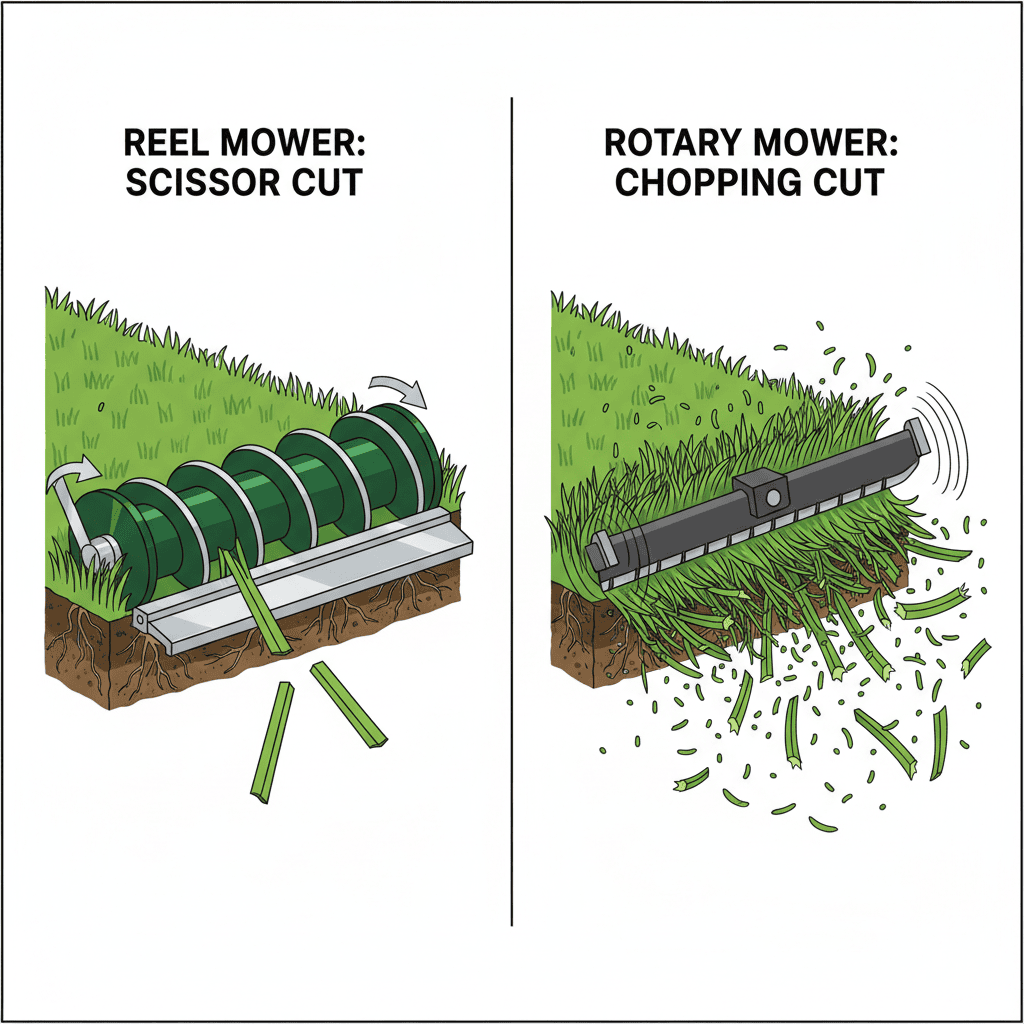
Reel mowers differ significantly from rotary mowers. While rotary blades spin horizontally to chop grass, reel mower blades rotate against a stationary bedknife, creating a scissor-like cutting action. This precision requires the rotating cylinder blades to be perfectly aligned with the stationary blade. If the alignment is off, the mower will tear the grass rather than cut it, leading to brown, ragged lawn tips.
Signs Your Reel Mower Blades Need Sharpening
If your mower leaves jagged, brown tips on the grass blades, or if it feels like the mower is pulling or skipping over patches of turf, your blades are likely dull. You can test sharpness by inserting a piece of paper between the reel blade and the stationary blade; if it doesn’t slice cleanly, maintenance is required.
Safety Precautions Before Starting
Always disconnect the spark plug wire (for gas models) or remove the battery (for electric models) before beginning. Wear heavy-duty leather gloves to protect your hands from the razor-sharp edges. When using a metal file or angle grinder, wear safety goggles to protect your eyes from metal shavings.
Step 1: Remove the Reel Cylinder and Blades
Consult your owner’s manual to safely detach the reel cylinder. Keep track of all bolts, nuts, and washers by placing them in labeled containers. Organizing parts during disassembly ensures a smooth reinstallation process.
Step 2: Clean the Blades and Cylinder
Use a wire brush to remove rust, dried grass, and debris from the blades. A clean surface is critical for accurate sharpening and ensures you aren’t grinding dirt into the metal edge.
Step 3: Sharpen Using a Metal File or Honing Stone
Using a metal file, sharpen each blade at a 30-45 degree angle. Apply light, consistent pressure, using the same number of strokes on each blade to maintain balance. For the stationary blade (bedknife), use a fine-grit honing stone to ensure a perfectly flat, clean edge.
Step 4: Check Blade Alignment and Balance
After sharpening, check the alignment by rotating the cylinder; it should make light, even contact with the stationary blade across the entire width. If the cylinder is unbalanced, it can cause excessive vibration, which may damage the mower bearings over time.
Step 5: Reinstall and Test
Reassemble the components in the reverse order of removal. Tighten all bolts according to the manufacturer’s recommended torque settings. Once reassembled, perform a test run on a small patch of grass to ensure the scissor-cut action is restored. To evaluate matched hardware tolerances, consult our detailed overview of marshall stanmore iii vs harman kardon onyx studio 8.
When to Seek Professional Blade Sharpening
If the blades have deep nicks, heavy pitting, or if the reel has become significantly warped, professional service is recommended. Specialized equipment, such as a reel grinder, can provide a level of precision that is difficult to achieve with hand tools.
Maintenance Tips to Extend Blade Life
Sharpen residential reel mower blades once per season, or more frequently if you mow over debris. Avoid mowing over twigs or stones, and store your mower in a dry, covered area to prevent rust. Proper lubrication of the reel bearings will also help maintain smooth operation. When planning workspace deployment, consider the engineering criteria outlined in our dyson v8 cyclone vs bissell featherweight stick guide.
Buyer FAQs: How To Sharpen Reel Lawn Mower Blades Solved
Can I use an angle grinder instead of a hand file?
Yes, but use caution. An angle grinder removes metal much faster and can easily overheat the steel, causing it to lose its temper (hardness). Use a light touch and keep the blade cool.
How often should I sharpen my reel mower blades?
For most residential lawns, an annual sharpening at the start of the season is sufficient. If you notice the grass blades are being shredded rather than cut, sharpen them immediately. For additional operational safety benchmarks, see our published testing notes on bissell crosswave hydrosteam vs shark stainforce.
What happens if the blades are misaligned?
Misaligned blades result in poor cutting performance and increased physical effort to push the mower. It can also cause uneven wear on the cylinder and stationary blade.
Related Maintenance and Operating Guides
To keep your equipment running at peak operating efficiency, explore our related technical walkthroughs and maintenance tutorials:
- Consult our detailed breakdown on residential zero-turn lawn mower guide.
- Consult our detailed breakdown on heavy-duty chainsaw buyer guide.
Reel Blade Edges Need Patience
Reel blades cut like scissors against a bedknife, so the two parts must be adjusted together. Sharpening the reel without checking contact against the bedknife can leave an uneven cut. Anyone working near these moving parts should look at general equipment safety information from American National Standards Institute (ANSI).