

Quick Answer: How to Replace Lawn Mower Tire
Preparing for the new tire: When planning workspace deployment, consider the engineering criteria outlined in our bissell crosswave hydrosteam vs shark stainforce guide.

Pros
- Arrives as a complete mounted assembly, which simplifies replacement.
- Compatible with turf and lawn surfaces thanks to the non-directional turf tread.
- Clear fitment specifications help buyers verify compatibility before ordering.
- Strong load rating for a tire in this size category.
Cons
- Fitment is specific, so buyers must confirm bolt pattern, pilot hole, and clearance before purchase.
- Not intended for highway use.
- Sold as a set of 2, which may not suit buyers needing a full four-wheel replacement.
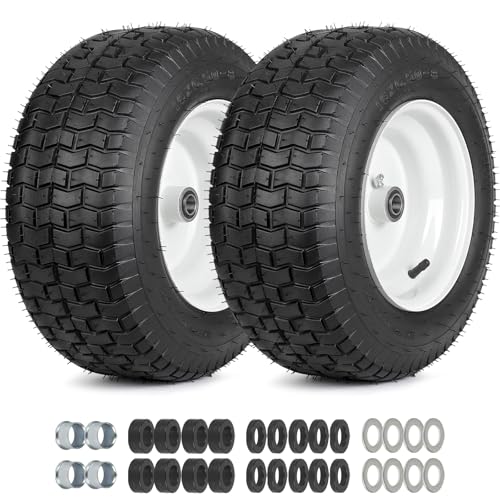
Overview: The Antego Tire & Wheel 18x8.50-8 assembly set is a pre-mounted replacement option for compatible golf carts, lawn mowers, and similar turf equipment. The white 8x7 steel wheel gives it a simple, utilitarian look, while the ready-to-install format is the main convenience advantage.
Performance & Key Features: This set uses an ATW-009 turf tread with a 4-ply tubeless construction and a non-directional pattern. That makes it a practical choice for grass, turf, and lawn surfaces where traction matters but aggressive off-road tread is not ideal. The published specs include a 17.72 inch outside diameter, 8.46 inch section width, and an 815 lb load capacity per tire at 22 PSI.
Drawbacks & Considerations: Fitment is the biggest thing to check carefully. Buyers need to confirm the 4 on 4 inch bolt pattern, 2.83 inch pilot hole, 0.590 inch bolt holes, offset, and available clearance before ordering. It is also not intended for highway use, and the set includes only two assemblies.
Verdict: For owners who need a straightforward turf tire replacement and have a compatible 4-lug setup, this Antego assembly set is a solid, specification-driven option. It offers convenience, clear sizing, and practical lawn-friendly performance without adding unnecessary complexity.
Pros
- Broad fitment support thanks to included bushings and spacers.
- Pre-assembled construction simplifies replacement work.
- Welded rim improves durability compared with weaker multi-piece wheel designs.
Cons
- Fit still depends on matching hub length, bore size, and axle dimensions, so compatibility must be checked carefully.
- The product is relatively specialized, so it may not suit all mower brands or wheel positions.
- No detailed traction or tread pattern information is provided in the raw data.
Overview & Design: The GICOOL 16x6.50-8 riding lawn mower tire and wheel set is a pre-assembled replacement option for garden tractors and lawnmowers. It features a centered hub, a 3/4" bore bushing, and a one-piece welded rim, giving it a solid and practical build for routine outdoor use.
Performance & Key Features: This set is designed for flexibility, with included adapters that support 5/8" bore applications and spacer options for different hub sizes. The tire uses an upgraded rubber compound intended to improve durability, while the 300 lb dynamic load capacity makes it suitable for many standard mower and tractor setups.
Drawbacks & Considerations: Compatibility is the main factor to verify before buying, since the correct fit depends on hub length, bore size, and axle measurements. The product also does not provide detailed tread performance data, so buyers should not expect information about traction in specific ground conditions.
Verdict: This is a useful replacement choice for owners who need a versatile 16x6.50-8 tire and wheel assembly with adapter hardware included. It offers the most value for users who want easier installation and broader fitment support, provided their mower dimensions match the specifications.

Pros
- One pair of zinc-plated two-link chains included
- Manufacturer lists 20 cross chains
- Listed for snow and mud use on turf tires
- Manufacturer lists 0.157 inch outside links
Cons
- Tires not included; confirm exact tire size first
- Listed for turf tires only, not other tread types

Pros
- No-flat design eliminates punctures and air-pressure maintenance.
- Includes bearing and spacer components for fit adjustment on compatible equipment.
- Load rating up to 400 lbs per tire supports demanding mower use.
- Steel rim and tread design add durability and traction.
Cons
- Not suitable for highway or high-speed use.
- Fitment depends on axle size and hub spacing, so compatibility should be checked carefully before purchase.
- At about 14.6 pounds, these tires may feel heavier than some pneumatic alternatives.
Overview & Design: The Iococee 11x6.00-5 flat free tire set is a two-pack replacement option for zero-turn mowers and other outdoor equipment. It uses PU material with a steel rim and precision bearings, giving it a practical, maintenance-light design for users who want to avoid air-filled tire problems.
Performance & Key Features: These tires are built to be puncture-resistant, tubeless, and heat resistant, with a tread pattern intended to improve traction and reduce sideslipping. The 11-inch diameter, 6-inch width, 5-inch rim size, and included spacers make them adaptable to a range of compatible machines, while the 400 lb load rating adds confidence for everyday mowing tasks.
Drawbacks & Considerations: This is not a universal replacement, so axle size, hub spacing, and bearing fit must be verified before ordering. The product is also not intended for highway or high-speed use, and its solid flat free design may be less forgiving than pneumatic tires on very rough terrain.
Verdict: For owners of compatible zero-turn mowers who want to avoid flats and reduce maintenance, this tire set offers a durable and straightforward solution. It is best suited to users who value reliability, traction, and convenience over the softer ride of air-filled tires.
When to Replace vs. Repair a Lawn Mower Tire
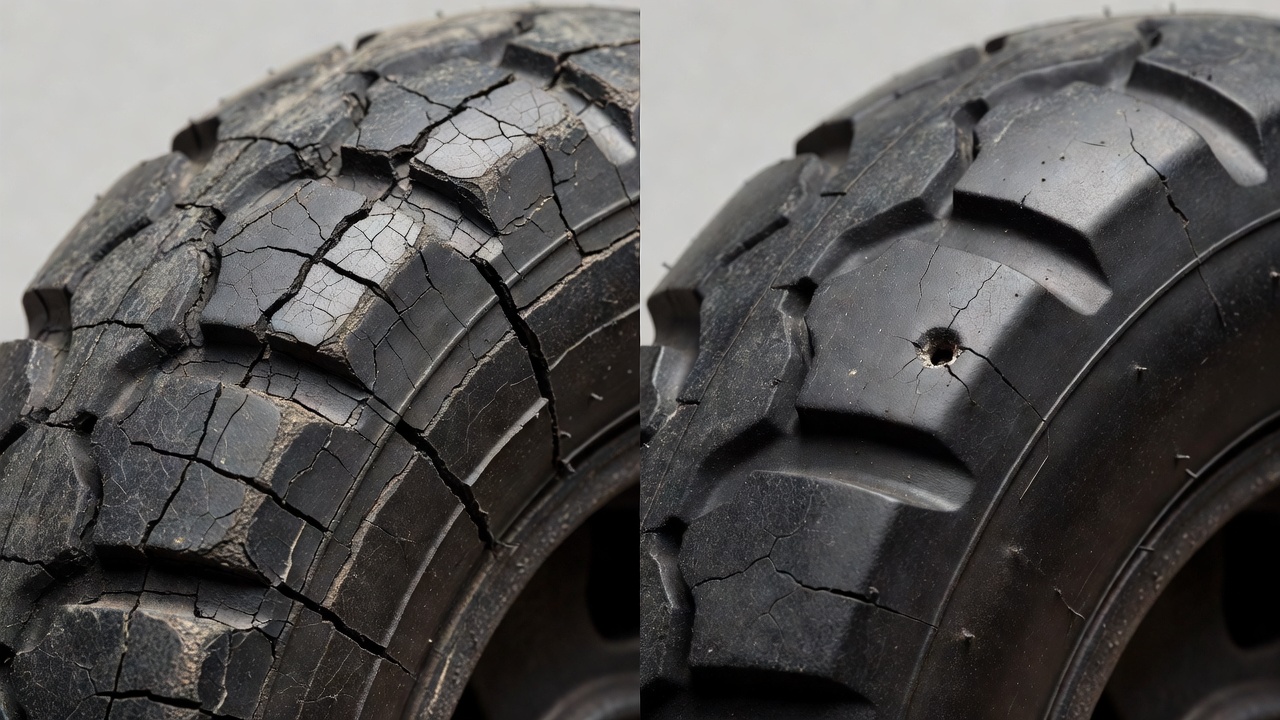
Before you start the replacement process, determine whether your tire can be patched or needs a full replacement. This saves time and money when damage is minor.
Replace the tire if:
- Sidewall damage or cracks are visible (cannot be safely patched)
- The puncture is larger than ¼ inch diameter
- The tire has multiple punctures in the same area
- Dry rot, splitting, or bulging appears on the sidewall
- Tread depth is worn below 4/32 inch
- The tire is over 5 to 7 years old, even if tread looks acceptable
- The puncture is in the tread area (not the sidewall)
- The hole is ¼ inch or smaller
- Only one puncture exists
- No signs of dry rot, cracking, or sidewall damage are present
Inspect the tire carefully for sidewall damage by running your fingers along the outer surface and looking for any visible cracks, bulges, or areas where the rubber appears deteriorated. Dry rot appears as a network of small cracks in the rubber and indicates the tire’s structural integrity is compromised.
Tools and Materials You’ll Need
Gather these items before starting to avoid delays:
- Socket wrench or adjustable wrench – sized to fit your mower’s lug nuts
- Tire levers (2 to 3) – specialized tools for removing tires from rims without damage
- Jack or mower lift – to safely raise the mower off the ground
- Blocks or jack stands – to support the mower while working
- Tire gauge – to verify inflation pressure
- Air pump or compressor – to inflate the new tire
- Replacement tire – matching your mower’s size and specifications
- Work gloves and safety glasses – for protection
For pneumatic (air-filled) tires, you may also need a new inner tube if the existing one is damaged. Solid or foam-filled tires do not require tubes.
Most homeowners can complete tire replacement manually using tire levers without a specialized tire mounting machine. Commercial tire shops have mounting machines that make the job faster, but they are not required for a DIY replacement.
How to Remove the Wheel Safely
Step 1: Prepare the work area
- Park the mower on level, firm ground
- Disconnect the spark plug wires to prevent accidental starting
- Allow the engine to cool completely
- Clear the area of obstacles
Step 2: Loosen the lug nuts For complementary field maintenance guidelines, examine our breakdown of marshall stanmore iii vs harman kardon onyx studio 8.
- Using your wrench, loosen (but do not remove) all lug nuts while the mower is still on the ground. This is easier than trying to loosen them after lifting
- Loosen them in a star or cross pattern if there are more than two lug nuts
Step 3: Lift the mower
- Position the jack under the mower’s frame (not the deck or plastic components)
- Slowly raise the mower until the wheel is 6 to 8 inches off the ground
- Place jack stands or wooden blocks under the frame as a safety backup
- Never rely solely on a jack; always use supports
Step 4: Remove the wheel To evaluate matched hardware tolerances, consult our detailed overview of dyson v8 cyclone vs bissell featherweight stick.
- Fully unscrew and remove all lug nuts
- Carefully pull the wheel straight toward you and off the axle
- Set it on a clean, flat surface to prevent damage
Removing the Old Tire and Installing the New One
Dismounting the old tire:
- Lay the wheel flat on the ground with the tire facing upward
- Insert a tire lever under the tire bead (edge) at a 45-degree angle
- Gently pry the tire bead away from the rim, working your way around the tire
- Once one side of the tire is free, remove the inner tube (if pneumatic)
- Flip the wheel over and repeat the process to remove the other side of the tire
- Take care not to damage the rim during this process
- Clean the rim of old rubber debris and dirt
- Inspect the rim for cracks, rust, or damage that could prevent a proper seal
- If installing a pneumatic tire, inspect the inner tube or install a new one if the old one is damaged or over 5 years old
Installing the new tire:
- If pneumatic, partially inflate the inner tube so it holds its shape (not fully inflated)
- Position the inner tube inside the tire (if applicable)
- Start the tire bead onto one side of the rim by hand, working your way around
- Use tire levers to work the second bead onto the rim, starting opposite the point where you began
- Take your time and work evenly to avoid pinching the inner tube
- Once fully seated, remove the tire levers
Avoid using excessive force or sharp tools that could pinch the inner tube. If the tube becomes trapped, gently work it free before continuing.
Selecting the Correct Replacement Tire
Finding your mower’s tire size:
- Check your mower’s operator manual (the definitive source)
- Look for a label or sticker on the mower frame or deck
- Inspect the existing tire sidewall for a size marking (example: 13×5.00-6, which indicates 13-inch diameter, 5-inch width, and 6-inch rim diameter)
Tire types:
- Pneumatic tires: Air-filled tires that provide a smoother ride and better traction on uneven terrain. They require an inner tube and periodic air pressure checks. Most common on push and riding mowers
- Solid or foam-filled tires: Non-pneumatic options that never go flat but provide a harder ride. They are maintenance-free but heavier and less forgiving on rough ground
Push mower vs. riding mower tires:
Push mower tires are typically 8 to 10 inches in diameter and handle lower torque loads. Riding mower tires are larger (12 to 15+ inches) and are designed to support the mower’s weight and engine power. Always match the exact size to your mower model to ensure proper fit and performance.
Reinstalling the Wheel and Inflating
Step 1: Mount the wheel
- Align the wheel’s center hole with the axle
- Slide the wheel onto the axle until it sits flush against the mounting surface
Step 2: Hand-thread and tighten lug nuts
- Start all lug nuts by hand to ensure they are aligned and threading correctly
- Using your wrench, tighten in a star or cross pattern (not in sequence around the wheel)
- This ensures even pressure and prevents the wheel from tilting
Step 3: Apply proper torque
- Push mowers: 35 to 50 ft-lbs
- Riding mowers: 90 to 120 ft-lbs
If you have a torque wrench, use it to achieve the manufacturer’s specification. If not, tighten until snug and firm, do not over-tighten, as this can strip threads or damage the rim.
Step 4: Lower the mower
- Carefully remove the jack stands or blocks
- Slowly lower the mower to the ground using the jack
- Remove the jack
Step 5: Inflate the tire
- Consult your mower manual or the sidewall label for the correct pressure (typically 10 to 20 psi for push mowers; 15 to 25 psi for riding mowers)
- Use an air pump or compressor to inflate to the specified pressure
- Use a tire gauge to verify the pressure is accurate
- Check pressure again after 5 to 10 minutes of mowing to ensure it remains stable
Step 6: Verify the installation
- Spin the wheel by hand to ensure it rotates freely without rubbing
- Reconnect the spark plug wires
- Start the mower and test the wheel under light load before resuming normal mowing
Push Mower vs. Riding Mower Tire Replacement Differences
Push mower tire replacement:
- Wheels are smaller and lighter, making manual removal easier
- Typically uses lug nuts on a single bolt or a simple axle pin
- Lower torque specifications (35 to 50 ft-lbs)
- Tire pressures are lower (10 to 20 psi)
- Can usually be completed with basic hand tools in 30 to 45 minutes
Riding mower tire replacement:
- Wheels are larger and heavier; you may need a stronger jack or lift
- Multiple lug nuts are common, requiring more careful removal
- Higher torque specifications (90 to 120 ft-lbs) to prevent wheel separation under load
- Tire pressures are higher (15 to 25 psi) to support the mower’s weight
- May require removal of wheel covers or decorative caps
- Job typically takes 60 to 90 minutes
If your riding mower has dual wheels on the rear axles, repeat the process for both wheels to maintain balanced weight distribution and handling.
Everything You Need to Know: How To Replace A Lawn Mower Tire FAQ
Can you repair a lawn mower tire instead of replacing it?
Yes, if the damage is minor. Punctures in the tread area that are ¼ inch or smaller can be patched using a tire repair kit. Sidewall damage, large punctures, or multiple holes in the same area require full replacement. If you’re uncertain, a tire professional can assess whether repair or replacement is appropriate.
How long do lawn mower tires typically last?
Pneumatic tires last 3 to 7 years depending on use, storage, and maintenance. Exposure to UV light, extreme temperatures, and prolonged underinflation accelerates dry rot and degradation. Solid or foam-filled tires last longer (7 to 10+ years) because they do not suffer from air loss or rubber deterioration as quickly. Check tires annually for signs of wear or damage, regardless of age.
What is the correct tire pressure for a lawn mower?
Check your mower’s operator manual or look for a pressure specification label on the mower frame. Push mowers typically require 10 to 20 psi, while riding mowers need 15 to 25 psi. Under-inflation causes poor handling and increases fuel consumption; over-inflation reduces traction and can damage the rim. Check pressure monthly during mowing season and before storage.
Do you need a torque wrench to install lawn mower wheel lug nuts?
A torque wrench is the best tool for ensuring lug nuts are tightened to the manufacturer’s specification without over-tightening. However, if you don’t have one, tighten lug nuts in a star or cross pattern until they are snug and firm. Avoid using excessive force. If you plan to perform maintenance regularly, a torque wrench is a worthwhile investment.
Mower Tire Replacement Notes
Replacing a flat mower tire means lifting the deck or the machine safely with stable supports. Match the bore size and tread pattern to the original so steering stays predictable.
A general overview of safe work on outdoor machines is available from American National Standards Institute (ANSI).









