Quick Answer: Can You Mow Lawn in Rain?
Mowing in rain or on wet grass creates a combination of problems that affect your safety, your lawn’s health, and your equipment’s longevity.
Wet Grass Clumps and Reduces Cut Quality
When grass is wet, the moisture weighs down the blades, making them bend and clump together. This prevents the mower blades from cutting cleanly, instead of slicing through each blade, the mower tends to push wet grass down or tear it unevenly. The result is ragged, uneven cuts that leave the lawn looking patchy and stressed. Torn grass edges also brown more easily, creating a shabby appearance for days after mowing.
Personal Safety Hazards
Wet grass and muddy ground significantly increase your risk of slipping or losing your footing while operating a mower, especially on slopes or uneven terrain. Loss of control can lead to falls, contact with spinning blades, or the mower rolling in an unexpected direction.
Electric mowers pose an additional electrical shock hazard. Wet grass, moisture, and conductive soil increase the risk of electrical hazards if the mower or its cord becomes damaged. Although modern electric mowers have safety features like ground-fault circuit interrupters (GFCIs), rain and standing water still create unnecessary risk.
Equipment Damage and Corrosion
Moisture is one of the fastest ways to degrade lawn mower components:
- Rust and corrosion: Water accelerates rust on metal parts, including the blade, deck, and engine components. This deterioration reduces blade sharpness and overall mower performance.
- Clumped grass buildup: Wet grass sticks to the mower deck in thick clumps, creating an environment where moisture gets trapped. This accelerates rust formation and makes cleaning difficult.
- Engine and electrical damage: Moisture can enter the carburetor (on gas mowers) or damage electrical components, leading to starting problems or component failure.
- Blade dulling: Wet, heavy grass puts extra strain on blades and causes them to dull faster than dry-grass cutting.
Key Factors That Determine If It’s Safe or Acceptable
Not all rain scenarios are equal. Several factors influence whether mowing in wet conditions is merely inadvisable or genuinely dangerous.
Rain Intensity: Light Drizzle vs. Heavy Rain
There’s a meaningful difference between light mist and a downpour. Light drizzle may be tolerable with gas-powered equipment, especially if the grass isn’t soaked. Heavy rain, thunderstorms, or mowing while standing water pools in your lawn should be off-limits.
Mower Type Matters
Electric mowers: Never operate in rain or wet conditions. Electricity and moisture are a dangerous combination, and wet grass stuck to the deck increases electrical hazards significantly.
Gas-powered mowers: Safer in light mist than electric models, but still at risk of rust, clumping, and equipment damage. Wet conditions still aren’t ideal. For additional operational safety benchmarks, see our published testing notes on marshall stanmore iii vs harman kardon onyx studio 8.
Reel/manual mowers: Have minimal electrical components, so they pose fewer electrical hazards, but they still struggle with wet grass clumping and produce poor cut quality.
Equipment Condition
A well-maintained mower with a sharp blade and sealed components can tolerate brief exposure to light moisture better than an older, neglected machine. If your mower already has rust or corrosion, wet mowing will accelerate those problems. To compare alternative configurations, check our hands-on review of dyson v8 cyclone vs bissell featherweight stick.
Your Experience Level
Wet conditions demand more caution and control. If you’re inexperienced with your mower or less confident on slippery surfaces, the risks increase significantly.
When You Might Mow in Rain (And When You Absolutely Shouldn’t)
Acceptable Scenarios (Proceed with Extra Caution)
- Light mist with a gas-powered mower: If it’s barely drizzling and you have a well-maintained gas mower, a quick mow may be acceptable, but only if the grass itself isn’t soaked.
- Urgency and short windows: If you’re facing a few days of consecutive rain and your grass is overdue for mowing, a single pass during light conditions beats letting it get severely overgrown (which stresses the lawn further).
- Well-draining soil: If your lawn drains quickly and doesn’t get muddy, the slipping hazard is lower, though equipment concerns remain.
When You Should Absolutely Not Mow
- During or immediately after heavy rain: Don’t mow while rain is actively falling or within 2-4 hours of heavy rain stopping. The grass will be too wet, and safety hazards are at their peak.
- During thunderstorms: Lightning risk makes outdoor equipment operation dangerous regardless of mower type.
- With an electric mower in any wet conditions: The electrical hazard isn’t worth the convenience.
- On slopes or uneven terrain: Slipping risks multiply, especially if mud is present.
- If standing water is visible: Pooled water indicates the ground is too saturated. Mowing will create ruts and damage your lawn’s soil structure.
How Long to Wait After Rain Before Mowing
As a general rule, wait at least 24-48 hours after rain stops before mowing, depending on conditions: Users looking for related component recommendations can explore our bissell crosswave hydrosteam vs shark stainforce breakdown.
- Light rain on well-draining soil: 24 hours may be sufficient.
- Heavy rain or clay-heavy soil: Wait 48 hours or more. Squeeze a handful of grass, if water drips out, it’s still too wet.
- Visual/tactile test: Walk through your lawn. If your shoes are getting muddy or grass is visibly dripping when you lift it, wait longer.
Practical Alternatives to Mowing in the Rain
Plan Around Weather Forecasts
Check the forecast before your planned mowing day. If heavy rain is expected, mow a day earlier. If rain just passed, wait before mowing rather than rushing into wet conditions.
Adjust Your Mowing Schedule for Rainy Seasons
In climates with frequent rain, mow every 5-7 days instead of 7-10 days. This keeps the lawn shorter and more manageable on the occasional dry day, reducing pressure to mow in marginal conditions.
Use Specialized Equipment for Wet Conditions
If you frequently face wet mowing situations:
- Rotary mowers with better drainage: Some commercial-grade gas mowers have superior moisture resistance and drainage compared to consumer models.
- Mulching mowers: These reduce clumping slightly by cutting grass into smaller pieces, though they still struggle with very wet grass.
- Professional lawn care services: For frequent rain scenarios, outsourcing during wet periods ensures quality cuts without personal risk.
Maintain Your Mower for Wet Exposure
If you occasionally must mow in damp conditions:
- Clean your mower deck immediately after use to prevent grass clumping and rust.
- Sharpen blades regularly, wet mowing dulls them faster.
- Apply a rust-preventative lubricant to metal parts after exposure to moisture.
- Store the mower in a dry location.
Caring for Your Lawn After Rain
If you do mow shortly after rain, prioritize lawn health:
- Never mow when the grass is soaked, wait until it’s merely damp.
- Set your mower to a slightly higher cutting height to reduce stress on the already-weakened wet grass.
- Make slow, deliberate passes to ensure even cutting despite poor conditions.
- Don’t collect clippings if they’re wet and clumped; let them dry and settle before cleanup.
Buyer FAQs: Can You Mow The Lawn In The Rain Solved
Is it safe to use an electric mower in the rain?
No. Electric mowers should never be used in rain or wet conditions. Water and electricity create a shock hazard, and wet grass clumped on the deck increases that risk. Wait for dry conditions or use a gas-powered mower if you must mow soon after rain.
Can mowing wet grass permanently damage my lawn?
A single mowing on damp (not soaked) grass won’t permanently damage your lawn. However, repeated mowing on very wet grass can cause turf stress, compaction, and rutting that weakens the grass long-term. Occasional damp-grass mowing is tolerable; chronic wet mowing is harmful.
What’s the difference between damp grass and wet grass?
Damp grass feels slightly moist but doesn’t drip or clump noticeably when handled. Wet grass drips water, clumps heavily, and leaves visible moisture on your shoes. Damp grass is marginally acceptable for a quick mow with a gas mower; wet grass should always be avoided.
Will mowing wet grass make my mower rust?
Yes, moisture significantly accelerates rust and corrosion, especially if the mower isn’t cleaned and dried afterward. Over time, repeated wet-grass mowing will dull blades, corrode metal components, and reduce your mower’s lifespan. Clean and dry your mower immediately after any wet-condition use.
Can I mow if there’s morning dew on the grass?
Light morning dew is usually acceptable, especially if it dries within an hour of sunrise. Give the grass time to dry if possible. If you must mow through dew, use a gas-powered mower, not electric, and expect slightly reduced cut quality and minor clumping.

Pros
- Powerful 80V brushless motor delivers 32HP gas-equivalent performance with quiet fume-free operation and no engine maintenance.
- Complete kit includes four 6.0Ah batteries and 600W charger for substantial runtime up to 1.5 acres.
- SmartCut technology and 42-inch heavy-duty steel deck ensure consistent cuts without bogging in tough conditions.
- Versatile towing up to 350 lbs and optional cargo hauling plus comfort features like high-back seat and LED lights.
- Strong 4-year limited warranty and full compatibility with the Greenworks 80V tool ecosystem.
Cons
- Rear utility cargo bed for 200 lb hauling is sold separately and not included in the kit.
- Runtime of up to 1.5 acres varies with conditions and may require recharging or battery swaps on larger properties.
- As a fully cordless model continuous operation depends on battery levels unlike gas engines with unlimited runtime.
The Greenworks 80V 42" CrossoverT Cordless Riding Lawn Tractor is a ready-to-mow zero-emission tractor designed for homeowners managing medium to large lawns. It features a reinforced 42-inch stamped steel deck of 12-gauge construction along with premium comfort elements such as a high-back padded seat with foldable armrests. The overall build emphasizes durability and user convenience right out of the box with the included battery and charger set.
Performance centers on the 80V TruBrushless motor that provides 32HP gas-equivalent power with instant torque and quiet fume-free operation. SmartCut technology senses grass conditions and automatically adjusts power to maintain a consistent cut even in tall thick or wet areas. The four 6.0Ah batteries support runtime for up to 1.5 acres depending on conditions while dual LED headlights and a 7-position deck height range from 1.5" to 4.5" add practicality. Front and rear attachments further allow towing up to 350 lbs for added yard utility.
Key considerations include that the rear utility storage bin capable of hauling 200 lbs is sold separately so full cargo functionality requires an extra purchase. Runtime remains condition-dependent and may fall short for properties significantly larger than 1.5 acres without using the 600W charger or swapping batteries. The cordless design prioritizes ease and low maintenance but trades off the continuous runtime of traditional gas models.
This tractor delivers strong value for eco-conscious owners of residential properties who want gas-like power without the emissions noise or upkeep. It suits those who already use or plan to expand into the Greenworks 80V family of tools and who appreciate the 4-year limited warranty. Users with exceptionally large or commercial-scale lawns should evaluate battery logistics carefully before purchase.

Pros
- Delivers strong 21 horsepower equivalent power comparable to gas riding mowers.
- Provides up to 1.5 acres of runtime on a full charge with the six included batteries.
- Features low-maintenance dual brushless motors without belts for greater durability.
- Offers versatile 12-position cutting height adjustment from 1.5 to 4.5 inches.
- Includes digital controls for blade settings, drive speeds, and cruise control.
Cons
- Limited to 1.5 acres of cutting per charge without purchasing additional batteries for bigger lawns.
- Requires recharging time for the six 56V batteries after each use session.
- Relies solely on battery power with no hybrid or gas backup option for extended operation.
The EGO Power+ TR4204 is a cordless electric riding lawn mower built as a modern tractor alternative for residential use. It features a robust 42-inch stamped steel deck and arrives ready to go with six 56V 6.0Ah batteries plus a charger, creating an immediate impression of convenience and solid construction free from gas engine complexity.
Performance shines through its equivalent 21 horsepower output and top speed of 6 MPH, allowing efficient coverage of up to 1.5 acres on a single charge. Dual brushless cutting motors operate without belts for added durability and less upkeep, while the digital display lets users select three blade settings, three drive speeds, and cruise control. The 12 adjustable heights ranging from 1.5 to 4.5 inches combined with anti-scalp wheels deliver precise results across varied terrain.
Drawbacks center on battery dependency, as larger properties beyond 1.5 acres require extra batteries and recharging intervals can interrupt workflow. The fully electric design eliminates fuel storage needs but demands access to power sources between sessions.
This mower suits homeowners with medium to large yards who value quiet, emission-free operation and reduced maintenance. Those seeking expandable battery capacity for bigger areas will find the EGO Power+ TR4204 a strong long-term investment in cordless lawn care.
Pros
- High-efficiency brushless motors maximize power output and durability over traditional motors
- Up to 2 acres runtime with three included 10.0 Ah batteries supports substantial mowing sessions
- Zero-emission operation with gas-equivalent 20 HP power for quieter environmentally friendly use
- Six-port auto-switchover battery system provides flexible extended runtime options
- Durable 42-inch steel deck plus included mulch and towing kits add immediate functionality
Cons
- Runtime is limited to approximately 70 minutes or 2 acres which may require recharging for larger properties
- Fully battery-dependent design means performance relies on charge levels and spare battery availability
- 42-inch deck size may require more passes on expansive lawns compared to wider commercial models
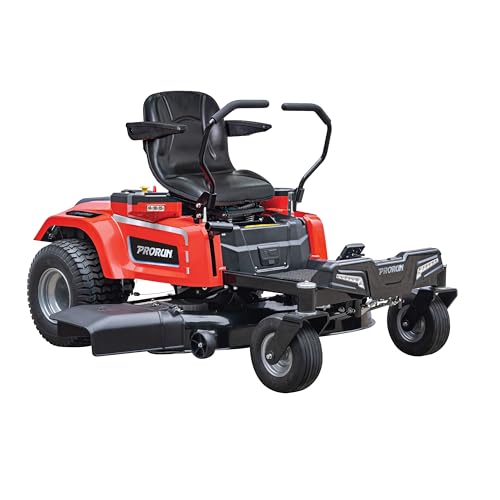
The PRORUN PZT60V42 is a fully electric 60V zero-turn riding lawn mower built for residential and light commercial use. Its primary design centers on a robust 42-inch 14-gauge stamped steel twin blade deck powered by direct-drive brushless motors, giving an immediate impression of solid construction and modern battery-focused engineering. The mower arrives complete with three 10.0 Ah batteries, a charger, mulch kit, and towing kit for ready-to-work versatility.
In performance terms, four high-efficiency brushless motors deliver power equivalent to a 20 HP gas engine while producing zero emissions. The system supports up to 2.0 acres or 70 minutes of runtime, and six battery ports with auto switchover intelligently manage all PRORUN 60V battery sizes for continuous operation. A washout port on the steel deck further simplifies post-mow maintenance during real-world sessions.
Potential drawbacks include the finite 70-minute runtime window which can limit coverage on larger properties without spare batteries or recharge breaks. As a fully electric model, it also depends entirely on battery charge levels rather than continuous fuel refills, and the 42-inch deck width may demand extra passes compared with wider traditional options.
Overall the PRORUN PZT60V42 offers strong value for homeowners and small-property managers who want gas-like cutting power without emissions or noise. Those with medium-sized lawns seeking quiet efficient zero-turn performance and included accessories will benefit most from this electric mower.

Pros
- Strong 24HP FR730 engine power for demanding cutting conditions
- Wide 54-inch FAB deck reduces total mowing time
- Zero turn design delivers excellent maneuverability
- Fabricated deck supports durable everyday operation
Cons
- Sparse details beyond engine and deck leave other features unspecified
- Gas-powered FR730 engine needs regular fuel and maintenance
- Large 54-inch deck size may feel oversized on compact properties
The Husqvarna Z254F is a zero turn mower from the established Husqvarna brand in the riding lawn mowers category. It centers on a solid build that pairs a 24HP 726cc FR730 engine with a 54-inch FAB deck for straightforward residential grass care.
Performance stems directly from the listed specifications. The FR730 engine delivers the horsepower needed for steady operation across typical lawns while the wide FAB deck completes passes efficiently. Zero turn handling improves control in real yard layouts based on the model design.
Considerations arise from the limited data available. Secondary elements such as comfort features fuel capacity or extras receive no mention and the gas engine format involves routine upkeep. The large deck suits open areas better than confined spaces.
The Husqvarna Z254F provides the most value for owners of medium or large properties who want reliable engine power and a broad cutting width. Users with smaller lots or those seeking extensive accessory options should weigh the core specs carefully before purchase.
Related Maintenance and Operating Guides
To keep your equipment running at peak operating efficiency, explore our related technical walkthroughs and maintenance tutorials:
- Consult our detailed breakdown on residential zero-turn lawn mower guide.
- Consult our detailed breakdown on heavy-duty chainsaw buyer guide.
Weather and Mowing Reading
Rain makes grass and walkways slick, and wet conditions near electrical equipment raise shock risks, so most owners wait for a dry day. General safety information about outdoor work can be consulted at American National Standards Institute (ANSI).