Direct Answer: Lawn Mower Battery Charging Time
Charging time depends on battery type and charger output: Lead-acid batteries usually take 8 to 12 hours to fully charge, while lithium-ion batteries typically charge in 1 to 2 hours. To estimate your specific charging duration, use this formula: (battery amp-hours ÷ charger amps) × 1.2. Always consult your owner’s manual for manufacturer-recommended charging procedures.
Charging Time by Battery Type
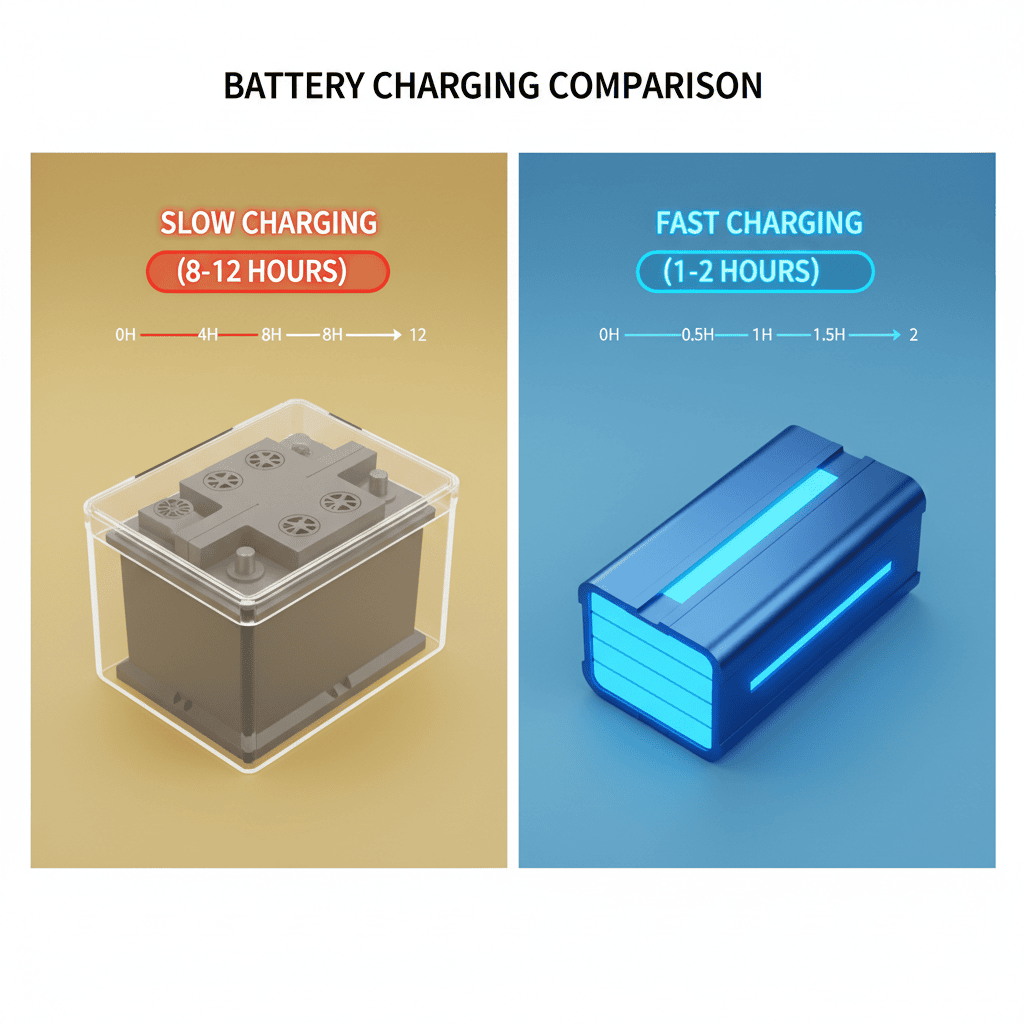
The primary factor determining how long your lawn mower battery takes to charge is its chemistry. Modern lawn mowers use two main battery types, each with vastly different charging characteristics.
Lead-Acid Batteries
Lead-acid batteries are common in older and budget-friendly lawn mowers. These batteries charge slowly and require careful monitoring to avoid overcharging.
- Typical charging time: 8 to 12 hours for a full charge
- Charger amperage: Usually 2 to 10 amps
- Best practice: Use a dedicated lead-acid charger with automatic shutoff to prevent damage
- Overcharging risk: High, lead-acid batteries can degrade quickly if left on a charger too long
Lithium-Ion Batteries
Lithium-ion batteries dominate newer lawn mower models. They charge significantly faster and include built-in protection circuits that prevent overcharging.
- Typical charging time: 1 to 2 hours for a full charge (some models: 30 to 60 minutes)
- Charger amperage: Usually 10 to 20 amps or higher
- Best practice: Use the manufacturer’s charger; most auto-shutoff when fully charged
- Overcharging risk: Low, modern lithium chargers have smart protection
How to Calculate Charging Time for Your Battery
If your mower’s manual doesn’t specify charging duration, you can estimate it using battery capacity and charger output.
The Charging Formula
The 1.2 multiplier accounts for charging efficiency losses and ensures the battery reaches a fuller state of charge.
Example Calculation
Scenario: You have a 5 Ah (amp-hour) lithium-ion battery and a 10-amp charger.
- 5 Ah ÷ 10 amps = 0.5 hours
- 0.5 × 1.2 = 0.6 hours (approximately 36 minutes)
Scenario: You have an 8 Ah lead-acid battery and a 5-amp charger.
- 8 Ah ÷ 5 amps = 1.6 hours
- 1.6 × 1.2 = 1.92 hours (approximately 2 hours)
Note: Lead-acid batteries often charge more slowly in practice due to internal resistance, so actual time may exceed the formula estimate. Readers comparing setup options can review our technical analysis on marshall stanmore iii vs harman kardon onyx studio 8.
Where to Find Battery and Charger Specifications
- Battery capacity (Ah): Printed on the battery label or in your owner’s manual
- Charger amperage: Marked on the charger unit or in the manual
- Owner’s manual: Always the most reliable source for your specific model
Factors That Affect Lawn Mower Battery Charging Time
Charger Amperage (Amps)
Higher-amperage chargers reduce total charging time proportionally. A 20-amp charger will charge a battery roughly twice as fast as a 10-amp charger, assuming the battery can safely handle the higher current.
- Low-amp chargers (2 to 5 amps): Slower but safer for delicate battery chemistry; common for lead-acid
- High-amp chargers (10 to 20+ amps): Faster charging; standard for lithium-ion systems
Battery Capacity (Amp-Hours)
Larger-capacity batteries store more energy and take longer to charge. A 10 Ah battery requires roughly twice the charging time of a 5 Ah battery (assuming the same charger). For complementary field maintenance guidelines, examine our breakdown of dyson v8 cyclone vs bissell featherweight stick.
Current Charge Level
A battery at 50% charge reaches full capacity faster than one completely drained. Routine top-ups may take only 30 to 60 minutes, while charging from empty takes the full duration.
Temperature
Cold temperatures slow chemical reactions inside the battery, extending charging time. Charging in temperatures below 50°F (10°C) can increase duration by 20, 30%. Conversely, heat can accelerate charging but may reduce battery lifespan if excessive. To evaluate matched hardware tolerances, consult our detailed overview of bissell crosswave hydrosteam vs shark stainforce.
Battery Age and Health
Older batteries with degraded internal chemistry charge more slowly than new ones. A worn battery may take 50% longer than a fresh unit.
Charger Quality
Budget or damaged chargers may deliver inconsistent amperage, slowing the charging process. Original manufacturer chargers optimize for your specific battery.
Charging Time for Push Mowers vs. Riding Mowers
Push Mower Batteries
Push mowers use smaller, lighter batteries suitable for handheld operation.
- Typical capacity: 2 to 5 Ah
- Lead-acid charging time: 4 to 8 hours
- Lithium-ion charging time: 30 to 90 minutes
- Common voltage: 18V, 20V, or 24V
Riding Mower Batteries
Riding mowers require larger batteries to power engines and electrical systems for extended periods.
- Typical capacity: 10 to 30 Ah
- Lead-acid charging time: 10 to 24 hours
- Lithium-ion charging time: 2 to 4 hours
- Common voltage: 12V or 24V (lead-acid); 36V or 48V (lithium-ion)
Riding mower batteries take significantly longer to charge due to higher capacity, though lithium-ion models still outpace lead-acid alternatives.
Safety Tips and Best Practices for Charging
Should I Remove the Battery Before Charging?
Check your owner’s manual. Most modern mowers allow on-board charging, but some recommend removal for safety. Removing the battery:
- Reduces fire risk in rare charger failure scenarios
- Allows better temperature monitoring
- Prevents accidental mower operation during charging
Avoiding Overcharging
Lead-acid batteries: Use a charger with automatic shutoff or manual timer. Overcharging causes water loss, internal corrosion, and shortened lifespan.
Lithium-ion batteries: Most modern chargers auto-shutoff at full charge. Leaving them plugged in after completion rarely causes damage, but disconnecting promptly extends lifespan.
Optimal Charging Frequency
- After each use: Ideal for lithium-ion; adds minimal stress
- When charge drops below 20%: Good practice for both types
- Before seasonal storage: Charge to 50 to 80% (not 100%) for long-term battery health
Temperature Considerations
- Charge in temperatures between 50 to 86°F (10 to 30°C) for optimal speed and safety
- Avoid charging in freezing conditions; wait until the battery warms
- Do not charge in direct sunlight or near heat sources
Charger Maintenance
- Inspect charger cables for damage before each use
- Keep charger vents clear of debris
- Store charger in a dry location
- Replace chargers showing signs of malfunction (sparking, burning smell, inconsistent output)
When to Expect Faster vs. Slower Charging
Faster Charging Scenarios
- Lithium-ion battery with 20-amp charger: 30 to 90 minutes
- Small-capacity battery (2 to 5 Ah) with high-amp charger: 15 to 45 minutes
- Partial charge (50% to 100%) rather than empty: 50% of full charge time
- Warm ambient temperature (70 to 80°F): Optimal chemical reaction speed
Slower Charging Scenarios
- Lead-acid battery with 5-amp charger: 8 to 12+ hours
- Large-capacity battery (20+ Ah) with low-amp charger: 15+ hours
- Cold weather (below 50°F): Add 20 to 30% to estimated time
- Aged or degraded battery: Add 30 to 50% to estimated time
Is Fast Charging Safe?
Fast charging (high-amp chargers) is safe for lithium-ion batteries designed to handle it, as they include built-in protection circuits. Lead-acid batteries should use moderate amperage (5 to 10 amps) to avoid internal damage. Always verify your charger matches the battery type and manufacturer specifications.
Buyer FAQs: How Long To Charge Lawn Mower Battery Solved
Q: Can I charge my lawn mower battery overnight?
A: Yes, but only if using a charger with automatic shutoff. Lead-acid batteries should not remain on a charger longer than 12 to 14 hours without shutoff, as overcharging degrades them. Lithium-ion batteries with smart chargers can safely remain plugged in overnight. Check your owner’s manual for specific guidance.
Q: What if my lawn mower battery won’t hold a charge?
A: This typically indicates battery failure. Lead-acid batteries degrade after 3 to 5 years; lithium-ion batteries last 5 to 10 years. If the battery won’t charge or discharges rapidly during use, replacement is usually necessary. Test with a multimeter to confirm the battery voltage; if it reads significantly below the rated voltage, the battery has failed.
Q: How do I know when my battery is fully charged?
A: Modern chargers have LED indicators (green light = fully charged). For manual chargers, consult the manual for estimated time. Some mowers display battery percentage on a dashboard. If uncertain, remove the battery after the estimated charge time and let it rest for 10 minutes before checking voltage with a multimeter.
Q: Can I use a car charger on my lawn mower battery?
A: No. Car chargers deliver too much amperage for small lawn mower batteries and may cause overheating or internal damage. Always use the manufacturer’s charger or a charger rated for your specific battery type and capacity. Using incompatible chargers voids warranties and risks battery failure.
Pros
- Precise EPOS positioning system ensures accurate navigation without boundary wires
- Handles slopes up to 45 percent and works rain or shine for year-round reliability
- Full app control for schedules, patterns, cutting height, and theft tracking
- Bundle includes ready-to-use cordless trimmer with dual-direction head and power boost
- Simple blade swaps and hose-down cleaning make ongoing upkeep quick and easy
Cons
- Maximum mowing capacity limited to 0.5 acres, unsuitable for larger properties
- Virtual mapping setup requires manually driving the mower to define boundaries, adding initial time investment
- Performance details such as exact battery runtime for the mower are not specified in available data
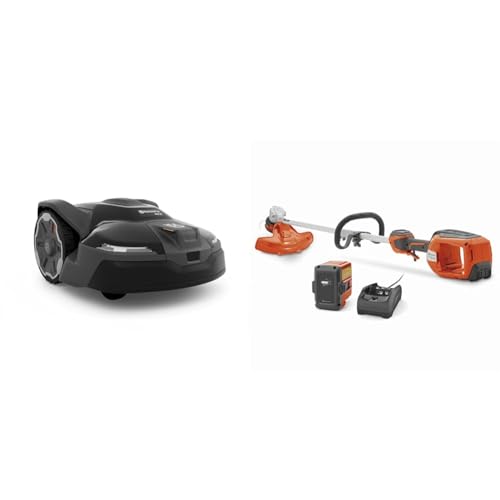
The Husqvarna 410iQ Automower Bundle combines the brand's robotic mower with the 320iL cordless string trimmer into a complete lawn care package. Built for American yards, the 410iQ features a rugged bumper, larger wheels, and solid construction that crosses paths and driveways smoothly while the included trimmer arrives with a 4 Ah battery and charger for immediate use. The overall design prioritizes wire-free convenience and ease of maintenance from the first unboxing.
In performance, the Exact Positioning Operating System uses satellite communication for centimeter-level accuracy, allowing the mower to handle slopes up to 45 percent and cut heights from 1 to 4 inches without tearing grass. App-guided virtual mapping replaces boundary wires, and the mower operates rain or shine with customizable schedules and patterns. The companion 320iL trimmer delivers a 16-inch cutting width, dual-direction head to keep clippings off beds, and a power boost mode offering 20 percent more power for heavy weeds, all while remaining 25 percent lighter with active cooling for consistent runtime.
Considerations include the 0.5-acre capacity limit, which may restrict use on bigger properties, and the initial virtual mapping process that requires driving the unit around the lawn. Available data also lacks specific battery life figures for the mower itself, so owners should plan for typical robotic charging cycles based on lawn conditions.
This bundle delivers excellent value for homeowners seeking automated mowing plus versatile cordless trimming on medium-sized properties. Those with complex landscaping who value app control, precision navigation, and a ready-to-go trimmer kit will benefit most from the Husqvarna 410iQ and 320iL combination.

Pros
- Heavy-duty AWD hub motors deliver consistent performance on 80% inclines and complex terrain
- Fully wire-free setup using 360° LiDAR and AI dual vision that works under tree cover or near walls
- 45-minute fast charge supports efficient coverage of lawns up to 0.5 acre
- EdgeMaster 2.0 precision trims to within 1.97 inches for a professional finish
- App control with 4G GPS anti-theft animal-friendly modes and custom mowing patterns
Cons
- Optional trimmer module is sold separately and required to shrink edge gaps below 1.18 inches
- Maximum recommended coverage is 0.5 acre so larger properties may need additional units or alternative solutions
- Exact battery runtime dimensions and full technical array are not detailed in the available specifications
The DREAME A3 AWD 2000 is an all-terrain wire-free robotic lawn mower engineered for homeowners managing complex yards up to 0.5 acre. Built around heavy-duty AWD hub motors and advanced sensing hardware it presents a robust professional-grade impression capable of handling multi-zone L-shaped or rolling landscapes without boundary wires.
Performance centers on OmniSense 3.0 navigation that combines 360° 3D LiDAR with binocular AI dual vision for rapid mapping and laser-precise operation even under heavy tree cover or beside tall walls. The unit climbs 80% slopes and clears 2.17 inch obstacles while avoiding over 300 items such as pets kids toys and hoses. A 5A adapter restores power in 45 minutes and EdgeMaster 2.0 achieves 1.97 inch edge results. Quiet night schedules plus Dreamehome App control with 4G GPS anti-theft real-time HDR monitoring and custom patterns further elevate daily usability.
Drawbacks and considerations include the need to purchase the optional trimmer module separately to reach under 1.18 inch edges and a hard coverage ceiling of 0.5 acre that may not suit expansive properties. Full battery runtime figures and physical dimensions remain unspecified which could affect planning for continuous heavy use.
The DREAME A3 AWD 2000 delivers the greatest value to owners of hilly multi-zone or wrap-around lawns who want to eliminate weekend labor and recurring service costs while gaining quiet smart app-managed results. Those with larger lots or who require included ultra-close trimming may need to evaluate supplementary options.

Pros
- Two-year warranty, per listing
- Eight cutting heights from 0.75 to 4 inches
- Mulching plug and 2.1-bushel grass bag included
- Nationwide parts and service network, manufacturer-stated
Cons
- Runtime of up to 45 minutes per charge is manufacturer-stated
- Second 12Ah battery is sold separately

Pros
- 30-inch cutting width enables significantly faster mowing sessions compared to standard decks
- Dual blade mulching system produces fine clippings that nourish the lawn without bagging
- Push-button start and battery power provide consistent, low-maintenance operation
- Dual LED headlights and Quick Stow handle add practical convenience for day-to-night use and storage
- Compatible with multiple 60V Max battery sizes for customizable power and runtime
Cons
- Battery and charger are not included, requiring an additional purchase of compatible 60V Max batteries
- Actual runtime and total operating cost depend entirely on the chosen battery capacity and number of packs
- Larger 30-inch deck and frame may feel bulkier for users with very compact storage or tight yard access
The Toro 60V MAX 30 in. eTimeMaster Personal Pace Lawn Mower is a cordless walk-behind model built for efficient yard maintenance. Its durable steel deck and cast aluminum frame create a sturdy impression right out of the box, while the Quick Stow handle offers two storage positions for compact placement in limited spaces. Battery and charger are sold separately, allowing users to select from recommended 60V Max 4.0Ah through 7.5Ah packs based on their needs.
In performance, the 30-inch deck is designed to save up to 40 percent of mowing time by covering more ground per pass. Dual Force Dual Blade Technology shreds grass into fine mulch for a clean finish and improved lawn health. Push-button start ensures reliable ignition every time, dual LED headlights support early or late sessions, and the Personal Pace system adjusts propulsion to match walking speed for reduced effort across medium and large properties.
Key considerations include the absence of a battery and charger in the package, so buyers must factor in extra cost and plan for adequate runtime capacity. The wider deck, while efficient, may require more maneuvering room in tight areas compared with narrower mowers. No customer reviews are yet available to confirm long-term durability under varied conditions.
Overall, this Toro eTimeMaster model delivers strong value for homeowners seeking faster coverage, quality mulching, and low-maintenance battery operation on larger lawns. Those prepared to add compatible 60V Max batteries will appreciate the time savings and convenience features most.
Related Maintenance and Operating Guides
To keep your equipment running at peak operating efficiency, explore our related technical walkthroughs and maintenance tutorials:
- Consult our detailed breakdown on heavy-duty chainsaw buyer guide.
Charging Safety for Mower Batteries
Charging times vary with battery size and charger output, so following the charger instructions protects both the battery and the user. Broad safety guidance on charging equipment can be found through American National Standards Institute (ANSI).