Direct Answer: How Do You Start a Mower?
To start a mower, first identify the type you own (gas push, riding, or electric), then complete the same pre-start checks: add fresh fuel if needed, verify the oil level, and clear the deck of debris. For the most common case, a gas push mower with a cold engine, open the fuel shut-off valve, press the primer bulb 3 to 5 times, set the choke to the closed/ON position, hold the handlebar safety lever (dead man’s switch), and pull the starter cord firmly until the engine fires, then move the choke to OFF once the engine is warm.

Pros
- Electric-start 10HP 302cc engine provides convenient power without pull-cord effort.
- High-traction tracks deliver excellent grip across soft terrain and slopes.
- Y-shaped flail blades protect the spindle by deflecting off hard obstacles.
- Tool-free handle and height adjustments allow personalized comfort and versatility.
- Multi-speed transmission including reverse enhances overall maneuverability.
Cons
- Petrol engine requires regular unleaded gasoline refills and 10W-30 oil maintenance.
- Walk-behind format, even when self-propelled, still involves physical effort on extensive areas.
- Best suited to rough terrain and heavy vegetation rather than fine manicured lawns.
The MechMaxx SFM27T is a robust 27-inch walk-behind flail mower engineered for demanding outdoor work. Its tracked self-propelled chassis and electric-start petrol engine give an immediate impression of solid, purpose-built quality aimed at landscaping and agricultural users.
Performance centers on the 10 HP 302cc single-cylinder 4-stroke air-cooled OHV engine with electric start, paired with a 3-forward 1-reverse transmission. High-traction tracks maintain grip on soft or uneven ground while 38 Y-shaped flail blades cut, mulch, and spread vegetation, safely deflecting off obstacles to protect the spindle. Tool-free handle adjustments and variable cutting height further improve real-world usability.
Considerations include the need for clean unleaded gasoline and regular 10W-30 oil changes typical of any petrol engine. The walk-behind layout, although self-propelled, can still produce operator fatigue over very large plots, and the design prioritizes rough-terrain work rather than precision residential lawns. Limited published dimensions leave buyers to assess storage needs independently.
The MechMaxx SFM27T delivers strongest value to landscapers, farmers, and property managers who regularly clear dense overgrowth or uneven sites and require a reliable tracked flail mower for efficient vegetation management.

Pros
- Completely wire-free setup using Vision AI for boundary recognition ideal for simple small yards
- Convenient one-click start combined with full app control for scheduling and preferences
- Quiet 55dB operation plus adjustable cutting height keeps lawns neat with minimal disruption
- Auto-recharge and return-to-base function reduces daily intervention
- Handles up to 42 percent slopes and provides Vision AI obstacle avoidance for safer navigation
Cons
- Limited to small simple yards up to 0.15 acre so not suitable for larger or complex properties
- Best performance requires daylight and a lawn free of small toys loose branches or heavy debris
- Magnetic strips may still be needed for open edges or flower beds lacking clear visual boundaries
The SUNSEEKER V3 is a compact wireless robot lawn mower built specifically for small yards measuring up to 0.15 acre or 6400 square feet. It focuses on simple properties with clear edges such as fences sidewalks patios driveways or garden borders and delivers a clean modern design that emphasizes easy setup without any buried perimeter wire. Immediate impression is of a lightweight practical tool aimed at busy homeowners who want consistent results with minimal fuss.
In real-world use the V3 relies on dual-camera Vision AI for obstacle detection and boundary recognition while an 8-inch cutting deck with heights adjustable between 1.6 and 3.2 inches keeps grass neat. One-click start plus full app control allow schedule setting and preference tweaks and the unit automatically returns to its charging station when finished or low on power. It operates at a quiet 55dB and manages slopes up to 42 percent making daily maintenance straightforward for suitable lawns.
Drawbacks include the strict size limit that excludes larger or highly irregular properties. Optimal Vision AI performance needs good daylight and a lawn cleared of toys branches or debris. Some open edges may still require magnetic strips for reliable definition.
Overall the SUNSEEKER V3 delivers strong value for owners of small simple yards who prioritize wire-free convenience app scheduling and quiet auto-recharging operation. It is an excellent fit for those ready to keep their lawn clear and mow mainly during daylight hours.

Pros
- Electric start technology simplifies operation by eliminating pull-cord starting.
- 6-speed CVT offers superior speed variability for comfortable self-propelled mowing.
- Integrated blower with 150 CFM and 130 MPH airflow adds multi-season utility.
- High-wheel RWD configuration enhances stability and control on varied terrain.
- Automatic choke system supports easy cold starts without extra steps.
Cons
- Gas-powered engine requires regular fueling, oil changes, and routine maintenance.
- High-wheel design may require more storage space than compact low-wheel models.
- Available data lacks specifics on weight, cutting height range, and bag capacity.
The YARDMAX 24 in. 201cc Electric Start Select PACE 6 Speed CVT High Wheel RWD 3-in-1 Gas Walk Behind Self Propelled Lawn Mower w/Blower is a feature-focused walk-behind mower aimed at residential users who want convenience and versatility. Its high-wheel self-propelled layout and rear-wheel drive give an immediate impression of stability and ease of use for medium to large yards.
Performance centers on the electric start and automatic choke for push-button, no-prime ignition, while the exclusive Select PACE CVT with 6-speed lever lets operators fine-tune speed to match their walking pace. The self-propelled RWD high wheels improve traction on uneven ground, and the advanced airflow blower delivers 150 CFM and up to 130 MPH for effective leaf and debris clearing alongside the 3-in-1 cutting system powered by the 201cc engine.
Considerations include the ongoing need for gasoline fuel and standard gas-engine maintenance such as oil and filter changes. The high-wheel configuration, while helpful for terrain, can make the unit bulkier to store or transport in tighter spaces. Specifics such as exact weight, cutting-height range, and bag capacity are not detailed in available information.
This YARDMAX model delivers the most value to homeowners who prioritize easy starting, variable self-propelled speeds, and multi-function capability including leaf blowing, especially those maintaining medium to large lawns who prefer gas power over battery alternatives.

Pros
- 3-in-1 bagging, mulching, and side discharge options
- 201cc 4-stroke OHV engine with 9.0 ft-lb torque, per listing
- Single lever adjusts all four wheels from 1.2 to 3.75 inches
- Foam-wrapped, angled handle listed to reduce hand fatigue
Cons
- Weighs 89.15 pounds, heavy to move and lift
- Single-speed drive limits speed adjustment
For a riding mower, sit in the seat, engage the parking brake, make sure the blades are disengaged, and turn the ignition key (using the choke for a cold start). For an electric mower, insert the safety key or battery, then press the start button or squeeze the start lever. In every case, confirm the blade is disengaged or the deck is clear before starting the engine.
Understanding the Question: Why Starting a Mower Is Not One-Size-Fits-All
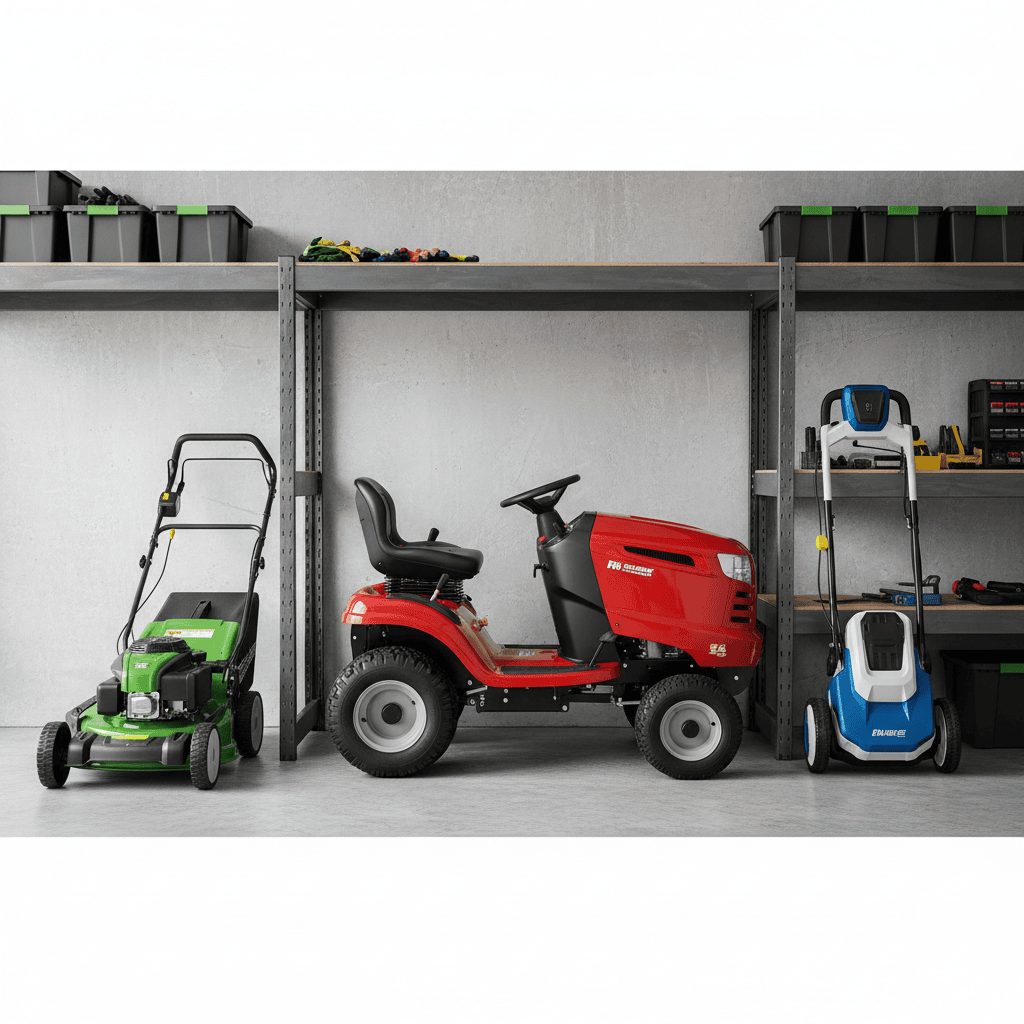
The question “how do I start my mower?” does not have a single universal answer, because the correct starting procedure depends on the type of mower you own and the design of its engine. The main categories are:
- Gas push mowers, started with a pull cord (recoil starter), and some models include an optional electric start button.
- Riding mowers and lawn tractors, started with an ignition key and protected by several safety interlocks that must be satisfied first.
- Corded electric mowers, started by plugging the unit into an outlet and pressing a start button or squeezing a lever.
- Battery (cordless) mowers, started by inserting the battery and a safety key, then pressing the start control.
Because the procedure varies so much, the first step is always to read the owner’s manual for your specific model. The manual tells you where the controls are located, whether your engine uses a primer bulb or an automatic choke, and which safety interlocks must be engaged before the starter will work. Skipping this check is one of the most common reasons people pull the cord for ten minutes without success, the machine simply will not start until a safety condition is met.
It also helps to understand the relationship between engine temperature and the choke or primer. A cold engine needs a richer fuel mixture to start, which is exactly what the choke (a plate that restricts air intake) and the primer bulb (which pushes raw fuel into the carburetor) provide. A warm engine, by contrast, needs less enrichment, so using the choke or primer on a hot restart can flood the engine with too much fuel and make it even harder to start.
Key Factors to Consider Before Starting
Before you touch the starter cord or turn the key, check the conditions that determine whether a mower will start reliably and safely. These factors are identical across gas push, riding, and most mower types, and checking them takes less than two minutes.
Fresh Fuel
Gasoline begins to degrade after roughly 30 days of storage, and stale fuel is the number one cause of hard starting. Old gas loses its volatility, leaves sticky varnish deposits in the carburetor, and makes the engine sputter, stall, or refuse to fire. If the fuel has been sitting in the tank since last season, drain it and refill with fresh gasoline (ethanol-free fuel is ideal where available). Adding a fuel stabilizer at the end of each season also keeps the gas fresh for months and prevents carburetor damage.
Oil Level
Check the engine oil level before every start, especially on a gas mower. Operating the engine with low or dirty oil can cause serious internal damage. Most push mowers have a dipstick or a fill cap with a mark showing the correct level; the mower should be on a flat surface and the engine cold when you check. If the oil is low, top it up with the viscosity grade listed in the owner’s manual, never overfill. Many modern engines also include a low-oil sensor that prevents the engine from starting or shuts it down automatically when the level is dangerously low.
Safety Interlocks and Controls
Lawn mowers are fitted with safety devices that physically prevent the engine from starting unless certain conditions are met. On a push mower, the dead man’s switch (the handlebar safety lever) must be held against the handle; when released, the blade and engine stop automatically within a few seconds. On a riding mower, the common interlocks include the seat switch (you must be sitting), the parking brake, and the blade engagement lever (the blades must be disengaged, or the PTO turned off). Learn which interlocks your model has, because a failed start is often just an interlock preventing the engine from cranking.
The Primer Bulb and the Choke
The primer bulb and the choke work together to help a cold gasoline engine start. Press the primer bulb 3, 5 times to draw fuel into the carburetor, but only when the engine is cold , and only if your model has one (many newer engines are self-priming). Set the choke to the ON or closed position for a cold start, then move it to OFF or run once the engine has warmed up. On a warm engine, skip the primer and leave the choke off; flooding the engine with extra fuel is the classic mistake that makes a hot mower refuse to start. To compare alternative configurations, check our hands-on review of marshall stanmore iii vs harman kardon onyx studio 8.
Step-by-Step Guide: How to Start a Gas Push Mower
The gas push mower is the most common type in North American garages and sheds, so this is the procedure most readers will follow. Work through these steps in order:
- Move the mower to a flat, dry surface. Ideally start on the lawn or a level driveway that is clear of stones and debris. Avoid starting on gravel, where the blade can pick up and throw pebbles.
- Inspect the lawn mower deck. Tip up or look underneath and clear away grass clippings, sticks, and built-up debris from the deck and around the blade. A clogged deck makes starting harder and stresses the engine.
- Check the fuel. Confirm there is fresh gasoline in the tank. If the fuel smells sour or has been stored for more than a month, drain and replace it before attempting to start.
- Check the oil. Verify the oil level on a level surface and top up if needed.
- Open the fuel shut-off valve. If your mower has a fuel valve on the fuel line or under the tank, turn it to the open position. Mowers with this valve are often left with it closed during storage to prevent carburetor flooding.
- Set the choke. For a cold engine, move the choke lever to the ON/closed position. For a warm restart, leave the choke OFF.
- Prime the engine (cold starts only). Press the primer bulb 3 to 5 times until you see fuel appear in the bulb. Do not prime a warm engine, and never prime more than five times or the engine may flood.
- Hold the safety lever. Grip the handlebar with one hand and press and hold the dead man’s switch (safety lever) against the handle. The engine will not crank unless this lever is held.
- Pull the starter cord. Grasp the pull cord handle with your other hand, pull it out in one smooth, firm motion, and let the cord rewind slowly rather than snapping back. Most engines start within 1 to 3 pulls.
- Adjust the choke after starting. Once the engine fires and runs steadily, move the choke to the OFF/run position. If your mower has a throttle, set it to a normal mowing speed.
- Disengage before mowing. Walk the mower to the mowing area, then engage the blade (usually with a second lever on the handlebar) only when you are ready to cut.
Two common pull-cord mistakes are worth avoiding. First, do not yank the cord at an angle; pull straight toward you so the handle moves in a line away from the engine, which reduces wear on the recoil starter. Second, do not pull with the safety lever released and then wonder why nothing happens , the dead man’s switch must be held the entire time you are pulling. Users looking for related component recommendations can explore our dyson v8 cyclone vs bissell featherweight stick breakdown.
If the engine starts and then immediately dies, the choke is usually still on, or the fuel shut-off valve was left closed. If you primed heavily and the engine will not fire, you have likely flooded it; see the troubleshooting section below.
Variations: How to Start a Riding Mower
Riding mowers and lawn tractors replace the pull cord with an ignition key and use multiple safety interlocks. The engine simply will not crank if any of the safety conditions are unmet, so follow this sequence: Before finalizing equipment decisions, refer to our comprehensive bissell crosswave hydrosteam vs shark stainforce comparison.
- Sit in the seat. The seat safety switch must be compressed or the starter is disabled, this prevents starting the mower from the ground.
- Engage the parking brake. Set the parking brake firmly. On most models, the engine will not start while the brake is released.
- Disengage the blades. Move the blade engagement lever (sometimes labeled PTO) to the off/disengaged position so the blades are not turning. Many tractors also require this before the starter will engage.
- Insert and turn the key. Turn the ignition key to start and release it once the engine catches. On a cold day, pull the choke knob or move the throttle to choke first, then return it to run once the engine warms up.
- Drive before engaging the blades. Release the parking brake, select your speed, and only engage the blades once you are in the mowing area with the deck clear.
If a riding mower’s starter will not turn over at all, work through the interlocks in order: confirm you are sitting in the seat, the parking brake is engaged, and the blade engagement lever is off. If those are all correct, the next suspects are a dead or weak battery (listen for a clicking solenoid), a blown fuse, or a corroded battery terminal. Clean the terminals and charge the battery before assuming a larger problem.
Some higher-end push mowers also offer electric start. With these, you skip the pull cord entirely: hold the safety lever and press the start button (or turn a key) instead. The pre-start checks, fuel, oil, choke, and primer, remain exactly the same.
Variations: How to Start an Electric Mower
Electric mowers eliminate fuel, oil, the choke, and the primer bulb entirely, which makes starting far simpler. There are two types:
Corded Electric Mowers
- Plug the mower in. Connect the power cord to a grounded outdoor outlet, preferably a GFCI-protected one, and route the cord away from the cutting path.
- Insert the safety key. Many corded mowers include a removable safety key or blade-brake key that must be inserted before the motor will run. Fitting this key is the electric equivalent of the dead man’s switch.
- Start the motor. Press the start button or squeeze the start lever, then continue holding the safety lever while you mow. Releasing the lever stops the blade automatically.
Battery (Cordless) Mowers
- Insert the battery. Push the charged battery into its slot until it clicks firmly into place. Check the charge indicator first, a nearly empty battery will start but die quickly.
- Insert the safety key. If your model uses one, push the safety key into the designated slot. This is often the start/stop key, and removing it prevents accidental starts.
- Start the motor. Press the start button or squeeze the start lever while holding the safety handle. The motor runs instantly with no warm-up and no choking.
The pre-start checks for electric mowers are about obstruction and power rather than fuel. Clear the lawn mower deck of debris, make sure the blade is free to spin, and keep the battery charged or the cord undamaged and firmly connected. Because there is no engine heat, an electric mower behaves identically whether it is cold or warm outside, but avoid mowing wet grass with a corded model, since water and extension cords are a bad combination.
Troubleshooting: What to Do When the Mower Won’t Start
When a mower refuses to start, work through the causes in order of likelihood. Most start failures come down to a handful of simple issues.
The Pull Cord Is Hard to Pull, or the Engine Won’t Turn
If the cord refuses to pull or pulls with heavy resistance, the blade is usually engaged, or something is jamming the blade and the crankshaft. Disengage the blade and inspect the deck for a lodged stick, rock, or heavy grass buildup. On rare occasions, a seized engine from running with no oil will also prevent the cord from moving, if the oil was empty, stop pulling and have the mower inspected.
The Engine Floods
A flooded engine smells strongly of gasoline and will sputter but never catch. It is caused by over-priming or starting a warm engine with the choke closed. The cure is to set the choke to OFF, open the throttle (if adjustable), and pull the cord repeatedly until the excess fuel clears. Be patient; it can take several pulls.
Old Fuel or a Clogged Carburetor
If the engine cranks but will not fire, suspect stale fuel first. Drain the tank and refill with fresh gasoline, then try again. If the mower has been sitting for months, the carburetor may need cleaning; fuel additives can help, but a thorough carburetor service is sometimes necessary.
The Spark Plug Is Dirty or Worn
The spark plug creates the spark that ignites the fuel. Remove it, inspect the electrode for carbon buildup or wear, and clean it with a wire brush or replace it (typically once per season). Check that the plug wire is pushed on firmly, a loose wire is an embarrassingly common cause of a no-start.
The Air Filter Is Clogged
A dirty air filter starves the engine of air, making it very hard to start. Inspect the foam or paper filter and clean or replace it if it is clogged with dirt and grass dust. This is a five-minute fix that solves many stubborn starting problems.
Safety Interlocks Are Preventing the Start
On riding mowers, recheck the seat switch, parking brake, and blade engagement lever. On push mowers, make sure the dead man’s switch is fully compressed. If a safety switch has failed, a new switch is an inexpensive repair, bypassing it is dangerous and should never be done.
If you have worked through fuel, oil, spark, air, and the safety interlocks and the mower still will not start, it is time to call a small-engine technician. Unusual noises, fuel leaks, smoke, or a cord that suddenly breaks are all signs to stop troubleshooting and seek professional help rather than risk injury or further engine damage.
Quick Recap: The Starting Checklists
Use these streamlined checklists as a fast reference next time you are standing in front of your mower.
| Mower Type | Minimal Safe Starting Sequence |
|---|---|
| Gas push mower | Check fresh fuel and oil → clear the deck → open the fuel shut-off valve → prime 3 to 5 times (cold only) → set choke ON (cold only) → hold the safety lever → pull the cord → move choke to OFF when warm. |
| Riding mower | Sit in the seat → engage the parking brake → disengage the blades (PTO off) → turn the key (use choke for cold starts) → release the brake and engage blades only when ready to mow. |
| Electric mower (corded or battery) | Clear the deck → plug in or insert a charged battery → insert the safety key if present → press the start button or squeeze the start lever while holding the safety handle. |
The common thread across all three types is safety: the blade must be disengaged or clear, the fuel and oil must be in good condition (for gas models), and the safety interlocks must be respected. If you remember nothing else, remember to hold the safety lever on a push mower, sit with the brake set and blades off on a riding mower, and insert the safety key on an electric mower, and the engine or motor will do the rest.
Everything You Need to Know: How To Start Mower FAQ
Do I need to press the primer bulb every time I start my mower?
No. Press the primer bulb 3 to 5 times only for a cold start. If the engine is warm, for example, if you just stopped for a minute to move a toy off the lawn, skip the primer and leave the choke off. Over-priming a warm engine floods the carburetor and makes the mower much harder to start.
Why does my mower start and then immediately die?
The most common causes are leaving the choke on after the engine warms up, forgetting to open the fuel shut-off valve, or running on stale fuel. Check those three things in that order. If the mower still dies, clean or replace the air filter and inspect the spark plug, since a clogged filter or weak spark will also cause the engine to stall.
How many times should I pull the starter cord before giving up?
If the mower does not start within 3 to 5 pulls, stop pulling and troubleshoot instead of tiring yourself out. A cold engine should catch within the first few pulls if the fuel, oil, choke, and primer are correct. Pulling the cord repeatedly on a flooded or choked engine just makes the problem worse.
Can I start a mower without the safety key?
No, and you should not try. The safety key on electric mowers and many push mowers is an interlock that prevents the blade from spinning accidentally. The engine or motor will not start without it, and bypassing the key is dangerous. If you lost the key, order a replacement from the manufacturer rather than rigging the mower.
Starting a Mower Safely
Starting a mower is simple, but a few checks first, such as clearing the path and keeping children indoors, prevent avoidable accidents. General safety information for lawn tools is available from American National Standards Institute (ANSI).