Direct Answer: Typical Charging Time
A lawn mower battery typically takes 8 to 12 hours to fully charge with a 2-amp charger. The exact duration depends on the battery’s capacity, measured in amp-hours (Ah), and its starting charge level. To estimate your specific time, divide the battery’s Ah rating by the charger’s 2-amp output.
Understanding the 2-Amp Charger and Battery Capacity
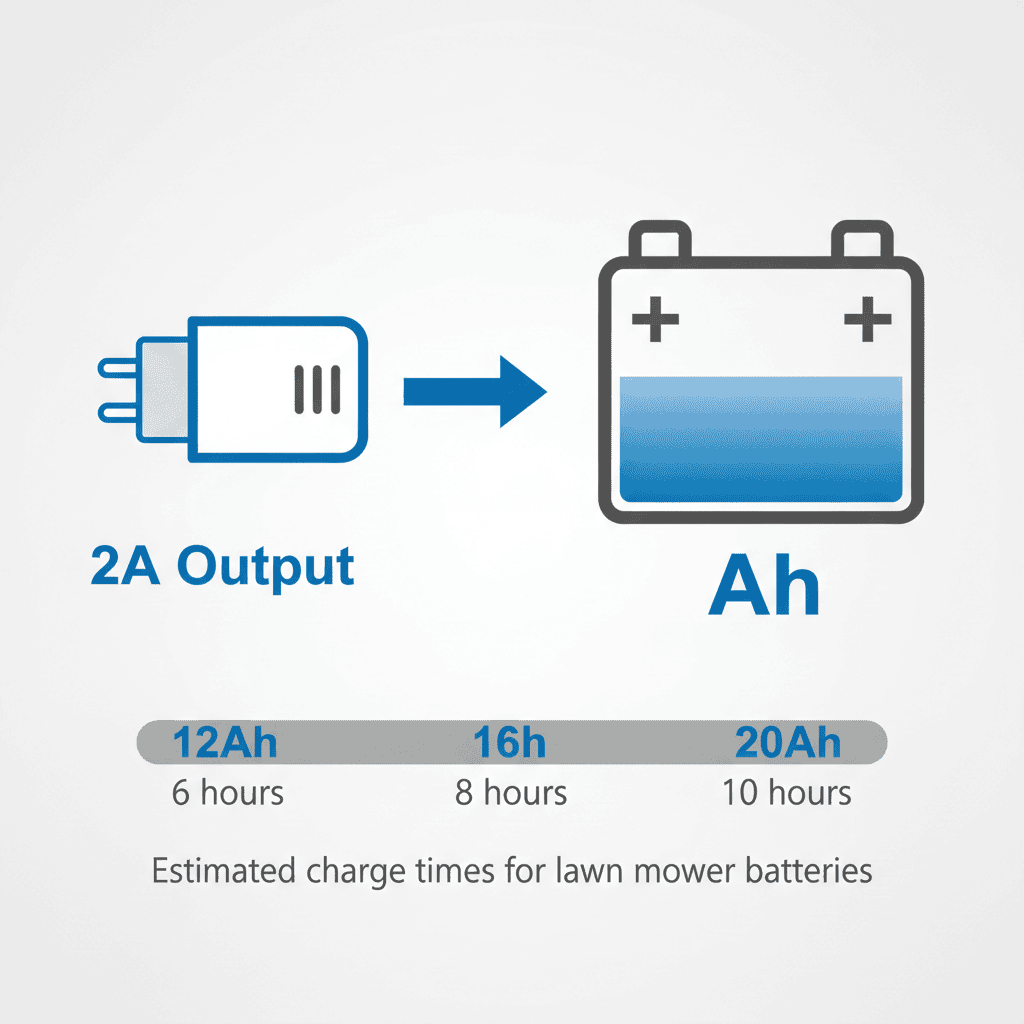
When we talk about a 2-amp charger, we’re referring to the charger’s output current. A 2-amp charger delivers a steady, low current of 2 amperes to the battery. This is considered a “trickle” or “maintenance” charge rate, which is gentle on the battery and ideal for periodic charging or maintaining a charge over long periods.
Battery capacity is measured in amp-hours (Ah). This rating tells you how much energy the battery can store. For example, a 12Ah battery can theoretically supply 12 amps for one hour, or 1 amp for 12 hours. Lawn mower batteries commonly range from 12Ah to 20Ah.
You can’t assume a fixed charging time for every battery because the time is directly proportional to the battery’s capacity. A larger capacity battery (like a 20Ah model) will naturally take longer to fill than a smaller one (like a 12Ah model) when using the same charger.
The Simple Formula for Estimating Charging Time
The basic calculation to estimate charging time is straightforward:
Charging Time (hours) ≈ Battery Capacity (Ah) ÷ Charger Amps
For a 2-amp charger, the formula simplifies to: Time ≈ Battery Ah ÷ 2.
However, this formula provides a theoretical minimum time. In reality, you should add extra time for two main reasons:
- Charging Efficiency: Not all energy from the charger is converted into stored battery energy. Some is lost as heat. Real-world charging is typically 20-30% less efficient than the theoretical calculation.
- Taper Charge Phase: As the battery approaches full charge, the charger (especially smart chargers) automatically reduces the current to top it off safely. This final “taper” phase can add several hours to the total time.
Example Charging Times for Common Lawn Mower Batteries
Here are estimates for common battery sizes, assuming a start from a fully discharged state. Remember, these are approximate and real-world times will be longer.
| Battery Capacity | Theoretical Time (Ah ÷ 2) | Estimated Real-World Time (with ~25% extra) |
|---|---|---|
| 12Ah Battery | 6 hours | ~7.5 to 8 hours |
| 16Ah Battery | 8 hours | ~10 hours |
| 20Ah Battery | 10 hours | ~12 to 13 hours |
If your battery is only half empty when you start charging, the time required will be roughly half of these estimates.
Key Factors That Affect Actual Charging Time
Several variables beyond simple capacity influence the real-world charging duration:
- Starting State of Charge: A completely dead battery will take the longest. A battery that’s only partially discharged will charge much faster.
- Battery Age and Condition: An older battery with reduced capacity or internal damage may not hold a charge well or may accept charge differently, potentially extending the time.
- Temperature: Charging in very cold or very hot environments can slow down the chemical process inside the battery, increasing charge time.
- Charger Type: A basic manual charger will deliver a constant 2 amps until disconnected. A smart charger will automatically taper the current and switch to a maintenance mode, which is more efficient and safer but can affect the total time to “full.”
Step-by-Step Guide to Charging Your Lawn Mower Battery Safely
- Preparation: Park the mower on a flat, dry surface in a well-ventilated area, away from open flames or sparks.
- Disconnect: Turn off the mower’s ignition. For safety and to prevent electrical issues, it’s recommended to disconnect the battery from the mower. Disconnect the negative (-) terminal first, then the positive (+).
- Connect Charger: Attach the charger’s red clamp to the positive (+) battery terminal and the black clamp to the negative (-) terminal. Ensure a firm connection.
- Power On: Plug in the charger and turn it on if it has a switch. The charging process will begin.
- Monitor: If using a smart charger, it will indicate when charging is complete. If using a manual charger, you may need to check periodically or use a multimeter.
How to Tell When the Battery Is Fully Charged
Recognizing a full charge is crucial to avoid overcharging.
- Smart Charger Indicators: Most smart chargers have LED lights or digital displays that change color (e.g., from red to green) or show a “full” or “maintenance” status when charging is complete.
- Multimeter Check: You can use a digital multimeter set to DC volts. A fully charged 12-volt lawn mower battery should read approximately 12.6 to 12.8 volts when measured at the terminals after the charger has been disconnected for a short while.
- Charger Behavior: On a manual charger, the amperage gauge may drop to near zero. On a smart charger, it will automatically switch to a low-current “float” or “maintenance” mode to keep the battery topped off without overcharging.
Frequently Asked Questions
Can I use a 2-amp charger on any lawn mower battery?
Yes, a 2-amp charger is generally safe and suitable for most 12-volt lead-acid lawn mower batteries. It’s a slow, gentle charge that is excellent for battery health. Always check your battery’s specifications and the charger’s compatibility, but a 2-amp rate is universally considered a safe maintenance charge.
Is it bad to charge a lawn mower battery with a 2-amp charger?
No, it’s not bad; in fact, it’s often recommended. Slower charging with a lower amperage like 2 amps generates less heat and reduces stress on the battery, which can help prolong its overall lifespan compared to fast charging with a high-amperage charger.
How often should I charge my lawn mower battery with a 2-amp charger?
During the mowing season, charge it as needed when it feels sluggish. During off-season storage, it’s best to connect it to a smart 2-amp charger with a maintenance mode every 30-60 days to prevent it from discharging completely, which can cause permanent damage.
What if my battery won’t hold a charge after using the 2-amp charger?
If the battery won’t hold a charge or won’t reach the proper voltage (12.6V+), it may be old, sulfated, or damaged. At this point, charging it further is unlikely to help, and the battery likely needs to be replaced.