
How to Start a John Deere Lawn Mower: Quick Answer
To start a John Deere lawn mower, first ensure the fuel tank is filled and the engine oil is at the proper level. Disengage the blade, engage the parking brake or seat switch (on riding mowers), set the choke to cold start, position the throttle to fast, insert the key and turn it to start, or pull the starter cord firmly on pull-start models. Once the engine catches, gradually move the choke to the run position as the engine warms up.
Safety Precautions Before Starting
Before you attempt to start any John Deere lawn mower, prioritize safety. These precautions protect you and prevent equipment damage:
- Disengage the blade: Always ensure the blade is not engaged before starting. On riding mowers, the blade should be in the off position. On walk-behind mowers, the blade control lever should be released.
- Engage the parking brake: For riding mowers, set the parking brake firmly. This prevents accidental movement while the engine starts.
- Check the seat switch: Riding mowers have a seat switch that prevents the engine from starting unless the operator is seated. Ensure you are seated properly before attempting ignition.
- Clear the mowing deck: Remove any debris, sticks, or grass clumps from the deck and under the mower. These can jam the blade or damage the engine.
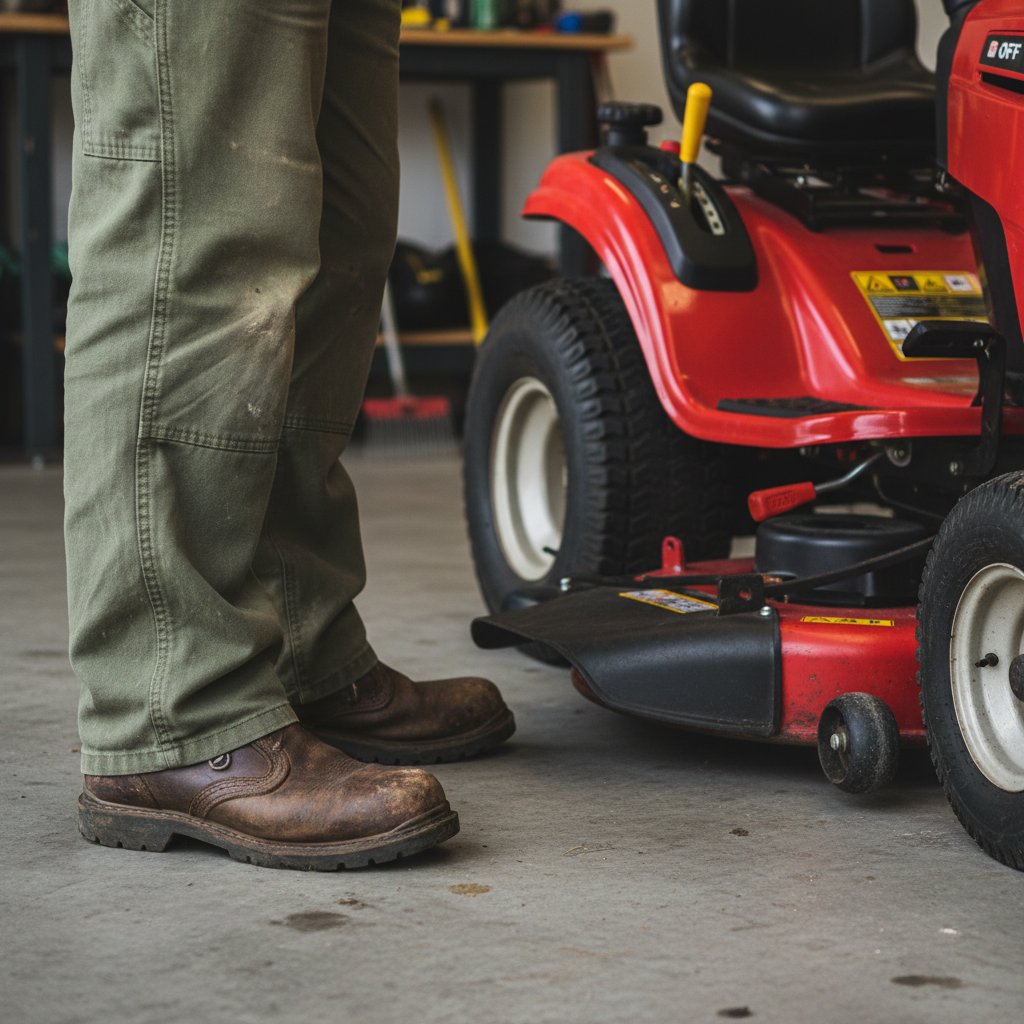
- Wear appropriate gear: Wear closed-toe shoes, long pants, and avoid loose clothing that could get caught in moving parts.
- Keep bystanders away: Ensure no children or pets are near the mower during startup.
Pre-Start Checklist: Fuel and Maintenance
A reliable start begins before you turn the key. Complete this checklist every time you mow:
Fuel Level Check
John Deere mowers typically use unleaded gasoline with an octane rating of 87 or higher. Check the fuel gauge or look through the translucent fuel tank (if your model has one) to ensure adequate fuel. Running on an empty or nearly empty tank can cause starting problems and engine damage. For best results, use fresh gasoline; fuel older than 30 days can become stale and inhibit ignition.
Engine Oil Level
Proper oil lubrication is essential for engine longevity and starting reliability. Check the oil level using the dipstick:
- Locate the dipstick on the side of the engine (position varies by model).
- Pull it out completely and wipe it clean with a cloth.
- Reinsert it fully, then remove it again to check the level.
- The oil should reach the full mark on the stick. If low, add the recommended oil type for your model (typically SAE 10W-30 for most residential mowers).
- Never overfill; excess oil can cause hard starting and smoking.
Air Filter Inspection
A clogged air filter restricts airflow to the engine, making it difficult to start. Inspect the air filter:
- Locate the air filter housing, typically a black plastic box on top of or beside the engine.
- Remove the filter cover and examine the pleated foam or paper element.
- If the filter appears heavily soiled or clogged with grass clippings, replace it or clean it according to your owner’s manual.
- For paper filters, tap gently to dislodge dust; foam filters can be rinsed with warm soapy water and dried completely.
Spark Plug Check
A fouled or worn spark plug is a common cause of starting failure. If your mower has been sitting for several weeks, inspect the spark plug:
- Disconnect the spark plug wire (pull the boot, not the wire itself).
- Unscrew the spark plug using a socket wrench.
- Examine the electrode gap and color. The center electrode should be light tan or gray.
- If the plug is black, wet, or has a large gap, replace it with a John Deere-approved replacement (typically Champion or Briggs & Stratton brand).
Starting Procedure for Gas-Powered Walk-Behind Mowers
Most residential John Deere walk-behind mowers follow this starting sequence:
Step 1: Position the Mower
Place the mower on a flat, level surface away from obstacles. Ensure the blade engagement lever is in the off position (not held in). The mower should not move when you release the handle.
Step 2: Set the Choke
The choke restricts airflow during cold starts, enriching the fuel mixture. Locate the choke lever or dial on the engine:
- For a cold start (first start of the day or after weeks of storage), move the choke to the full choke or cold position. This is typically indicated by a snowflake symbol or the word “Choke.”
- For a warm start (restarting shortly after shutdown), set the choke to the half or run position.
Step 3: Set the Throttle
Position the throttle lever to the fast or high setting. This ensures adequate fuel delivery during ignition. On most John Deere mowers, the throttle is a lever on the engine or a handle grip on the mower frame.
Step 4: Insert the Key and Turn to Start
If your mower has an electric starter:
- Insert the ignition key into the keyhole on the engine or control panel.
- Turn the key clockwise to the start position. Hold it there until the engine cranks and catches (typically 3-5 seconds).
- Release the key; it will return to the run position automatically once the engine starts.
- If the engine doesn’t start after 10 seconds, release the key and wait 30 seconds before trying again. Continuous cranking can drain the battery.
Step 5: Allow the Engine to Warm
Once the engine fires:
- The engine will run roughly at first, especially on a cold start.
- Gradually move the choke from cold to half choke, then to the run position as the engine smooths out.
- This typically takes 30-60 seconds on a cold morning.
- If the engine dies, return the choke to cold and restart.
Step 6: Verify Readiness
After the engine is running smoothly and the choke is in the run position:
- The blade engagement lever should still be off; the blade should not be spinning.
- Listen for a steady engine sound with no sputtering or hesitation.
- You are now ready to begin mowing.
Starting Procedure for Riding Mowers
Riding mowers have a more complex starting system due to their larger engines and safety features. Follow these steps:
Step 1: Mount the Mower and Engage the Brake
Sit on the operator seat and ensure your feet can reach the pedals comfortably. Firmly engage the parking brake or set the transmission to park (on hydrostatic models). The seat switch must sense your weight to allow starting.
Step 2: Position Blade and PTO Controls
The Power Take-Off (PTO) control engages the mowing deck. Ensure it is in the off position before starting. The blade should not engage.
Step 3: Set the Choke
Locate the choke control on the dashboard or engine:
- For cold starts, move the choke lever fully to the cold position.
- For warm restarts, set to run or half choke.
Step 4: Set Throttle to Fast
Move the throttle lever (or foot pedal on some models) to the high or fast position. This setting helps the engine catch during ignition.
Step 5: Turn the Key
Insert the ignition key and turn it clockwise to the start position. Hold until the engine cranks. Release the key once the engine starts; it will return to the run position automatically.
Step 6: Allow Warm-Up
Let the engine idle for 1-2 minutes, gradually moving the choke toward the run position as the engine stabilizes. Once the engine is running smoothly at idle, you can release the parking brake and begin mowing.
Pull-Start Mowers: Hand-Cord Starting Method
Older or smaller John Deere mowers may have manual pull-start systems instead of electric ignition. This method requires proper technique:
Proper Grip and Pull Technique
- Locate the starter cord handle on the side of the engine.
- Grip the handle firmly with one hand while stabilizing the mower frame with the other hand or with your leg.
- Pull the cord quickly and smoothly in a straight outward motion. Do not jerk or yank erratically.
- After each pull, allow the cord to retract slowly; do not let it snap back forcefully.
- Repeat pulling until the engine catches, typically within 3-8 pulls on a cold start.
Choke Positioning for Pull-Start Models
Set the choke to cold before your first pull. After 2-3 unsuccessful pulls, gradually move the choke toward the run position to avoid flooding the engine with excess fuel. Once the engine starts, continue adjusting the choke as described in the walk-behind section.
Throttle Adjustment
Most pull-start mowers have a throttle lever near the handle grip. Set it to fast before pulling the cord. After the engine starts, you can reduce throttle to a comfortable idle speed.
Warm Start Procedures and Choke Adjustment
Restarting a warm engine is faster and simpler than a cold start because the engine retains heat and fuel is already vaporized:
Key Differences from Cold Starts
- Choke position: Set to run or fully open. A warm engine does not need fuel enrichment.
- Throttle: You can set to medium rather than full fast; a warm engine requires less fuel to ignite.
- Cranking time: The engine should catch within 1-2 seconds of turning the key, compared to 3-5 seconds on a cold start.
Resume Mowing After Starting
Once the engine is running on a warm restart, you can begin mowing almost immediately. There is no need for an extended warm-up period. However, listen for any sputtering or hesitation; if the engine is not running smoothly, allow another 30 seconds of idling before engaging the blade.
Troubleshooting: Why Your John Deere Won’t Start
If your mower fails to start despite following the correct procedure, work through these common issues:
Engine Won’t Turn Over (No Cranking Sound)
Possible causes: Dead battery, loose battery connections, faulty ignition switch, or broken starter motor.
Solutions: Check that the battery terminals are clean and tight. If the battery is more than 3-4 years old, it may have lost charge overnight. Charge it fully using a 12V battery charger. If the engine still won’t crank, the starter motor or ignition system may need replacement.
Engine Cranks but Won’t Catch (No Ignition)
Possible causes: Fouled spark plug, faulty fuel pump, clogged fuel line, or ignition coil failure.
Solutions: Replace the spark plug as described in the pre-start checklist. If the plug is new and the engine still won’t start, check the fuel line for blockages by disconnecting it at the carburetor and blowing gently through it. If no fuel flows, the fuel pump may be faulty and require replacement.
Stale Fuel Issues
Possible causes: Fuel left in the tank over winter or stored for more than 30 days becomes oxidized and does not ignite properly.
Solutions: Drain the old fuel completely. To do this, turn a small valve at the bottom of the fuel tank (on models with one) or use a siphon pump to remove fuel from the tank. Refill with fresh gasoline and restart.
Black Smoke and Hard Starting
Possible causes: Choke stuck in the cold position or carburetor flooded with excess fuel.
Solutions: If the choke lever is stuck, gently work it back and forth to free it. If the carburetor is flooded, allow the mower to sit with the choke fully open for 10 minutes to evaporate excess fuel, then try starting again. If the problem persists, the carburetor may need cleaning or replacement.
Engine Starts but Immediately Dies
Possible causes: Air leak in the fuel line, clogged air filter, or faulty carburetor adjustment.
Solutions: Inspect the air filter and replace if clogged. Check all fuel line connections for leaks or loose fittings. If the mower has a carburetor with adjustable jets (typically marked “L” for low and “H” for high on the side), consult your owner’s manual for proper adjustment; improper settings can cause the engine to stall immediately after starting.
Key Differences by Mower Type and Model Year
John Deere manufactures a wide range of lawn mowers, and starting procedures can vary slightly across models and production years.
Manual Choke vs. Automatic Choke
Older models (pre-2000s): Most use manual choke levers that you adjust by hand as described above.
Newer models (2010s and later): Many John Deere mowers feature automatic choke systems. These sense engine temperature and adjust choke position without manual intervention. To start these mowers, simply turn the key; the choke will engage automatically if the engine is cold. You may hear or see the choke adjust as the engine warms up, but no action is required on your part.
Residential vs. Commercial Mowers
Residential walk-behind mowers: Use the step-by-step procedure outlined above, with manual or automatic choke and electric start.
Commercial or zero-turn mowers: These are larger and more powerful. Starting procedures are similar, but they may have dual ignition switches (one for each blade deck on commercial decks), more robust safety interlocks, and larger fuel tanks. Always consult the owner’s manual for your specific commercial model.
Electric-Start vs. Pull-Start Models
Electric-start mowers: Use battery-powered starters and ignition as described. These are standard on most modern John Deere mowers and are more reliable than pull-start systems.
Pull-start mowers: Use the hand-cord method outlined above. These are typically found on older models or budget-friendly residential mowers. They are less convenient but do not rely on batteries.
Fuel Type Variations
All modern John Deere mowers use unleaded gasoline. However, some commercial or high-performance models may specify premium gasoline (91+ octane). Check your owner’s manual for the fuel grade recommended for your specific model. Using lower-octane fuel than specified can cause poor starting and engine pinging.
Frequently Asked Questions
Q: How long should I let my John Deere mower warm up before mowing?
A: For a cold start, allow 30-60 seconds of idle time after the engine is running smoothly and the choke is in the run position. For a warm restart, no warm-up period is necessary; you can begin mowing immediately. If the engine sounds rough or hesitates, wait another 30 seconds.
Q: Can I start my John Deere mower without disengaging the blade?
A: No. All John Deere mowers have safety interlocks that prevent blade engagement during startup. On walk-behind models, you must release the blade control lever. On riding mowers, the PTO (blade engagement) must be in the off position. Starting with the blade engaged can cause injury and engine damage.
Q: What should I do if my mower’s battery is dead?
A: A dead battery prevents electric ignition. Charge the battery using a 12V battery charger for 4-8 hours. Once charged, insert the key and turn to start. If the battery repeatedly dies after each use, the alternator may not be recharging it properly, and you should have the charging system inspected by a technician. As a temporary measure, you can use battery jumper cables to start the mower from another vehicle, but this does not fix the underlying charging issue.
Q: Is it normal for my mower to smoke when I first start it?
A: Light white or blue smoke during initial startup is normal, especially on cold mornings or after the mower has been stored. This smoke clears within 30-60 seconds as the engine warms. However, heavy black smoke or persistent smoke after warm-up indicates a problem, such as a stuck choke, oil overfill, or a clogged air filter. Address these issues before mowing.
Q: How do I store my John Deere mower for winter without fuel problems?
A: Before storing your mower, either drain the fuel completely or add a fuel stabilizer to the tank to prevent fuel oxidation over winter. Run the mower for 5-10 minutes to circulate the stabilized fuel through the carburetor and fuel lines. This prevents starting problems when you resume mowing in spring. If you drained the fuel, refill with fresh gasoline before your first mow of the season.