Quick Answer: Honda Lawn Mower Oil Capacity
Most Honda walk-behind mower engines — including the GCV160 and GCV190 — hold 0.58 qt (18.6 fl oz / 550 ml) of oil. The Honda GX160 commercial engine holds approximately 0.61 qt (20 fl oz / 580 ml). Riding mower and larger GX-series engines hold significantly more. Exact capacity depends on your specific engine model — always confirm against your owner’s manual and use the dipstick as the final authority before filling.
Honda Lawn Mower Oil Capacity by Engine Model (Quick-Reference Table)
Use the table below to find the oil capacity for your Honda engine. The engine model code is stamped directly on the engine (see the next section for how to locate it).
| Engine Model | Common Mower Series | Oil Capacity (fl oz) | Oil Capacity (ml) | Oil Capacity (qt) |
|---|---|---|---|---|
| GCV160 | HRN216, HRS216, HRR216 | 18.6 fl oz | 550 ml | 0.58 qt |
| GCV190 | HRN216VKA, HRX217 | 18.6 fl oz | 550 ml | 0.58 qt |
| GSV190 | HRX217 (select variants) | 18.6 fl oz | 550 ml | 0.58 qt |
| GX160 | Commercial / HRC series | 20.3 fl oz | 600 ml | 0.63 qt |
| GX200 | Commercial / HRC series | 20.3 fl oz | 600 ml | 0.63 qt |
| GX390 | Commercial / large equipment | 38.2 fl oz | 1,100 ml | 1.16 qt |
| iGX800 | Honda riding mowers / tractors | 67.6 fl oz | 2,000 ml | 2.11 qt |
Note: Capacities reflect the engine oil fill only — not hydrostatic transmission fluid, which is a separate fluid on select models. Always verify these figures against your specific owner’s manual before performing an oil change or top-up.
How to Find Your Honda Mower’s Engine Model and Correct Oil Capacity
Honda mower model numbers (HRN, HRX, HRC) identify the mower unit — not the engine. The engine series determines oil capacity, and the engine model is stamped separately.
Where to Find the Engine Model Number
- On the engine shroud: Look for a sticker or stamped plate on the plastic cover surrounding the engine. It will show a code beginning with GCV, GX, GSV, or similar.
- On the crankcase: The model and serial number are often cast or stamped directly into the metal crankcase near the base of the engine.
- In the owner’s manual: The front pages of your mower’s manual list both the mower model and the engine model code.
- Online via Honda’s parts lookup: Enter your mower serial number at Honda Power Equipment’s official website to retrieve engine specs.
How Honda Mower Models Map to Engine Series
- HRN216 / HRS216 / HRR216: Typically powered by the GCV160 — 0.58 qt (550 ml)
- HRN216VKA / HRX217 (most variants): Typically powered by the GCV190 or GSV190 — 0.58 qt (550 ml)
- HRC216 / HRC217 (commercial): Typically powered by the GX160 or GX200 — 0.63 qt (600 ml)
- Honda riding mowers and tractors: Engine varies by model and year — confirm via manual or engine plate before filling
Two mowers with different model names can share the same engine — and two mowers with similar names can carry different engines depending on the production year. The engine code on the unit itself is always the authoritative reference.
How to Check and Fill Oil on a Honda Lawn Mower (Step-by-Step)
Whether performing a full oil change or a routine top-up, follow this sequence to avoid overfilling or underfilling. Overfilling engine oil causes oil to enter the air filter, foul the spark plug, and potentially hydro-lock the engine — treat the dipstick reading as the final check, not the measured volume.
- Position the mower on level ground. An unlevel surface gives a false dipstick reading. Engage the parking brake or wheel lock if present.
- Allow the engine to cool completely. Checking oil immediately after running produces an inaccurate low reading because hot oil expands and redistributes inside the engine.
- Locate the oil fill cap and dipstick. On most Honda walk-behind mowers, the oil fill cap is a yellow or black cap on the side of the engine near the base. The dipstick is attached to the underside of the cap — it does not thread in during a reading check.
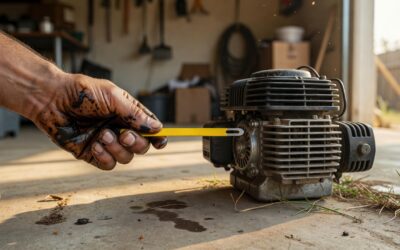
- Remove the oil fill cap and wipe the dipstick clean with a lint-free cloth or paper towel. Reinsert the dipstick fully without threading it in, then withdraw it to read the level.
- Read the dipstick level. Oil should sit between the upper (FULL) and lower (ADD) marks. If oil is at or below the ADD mark, the engine needs oil. If oil is at the FULL mark, no addition is needed.
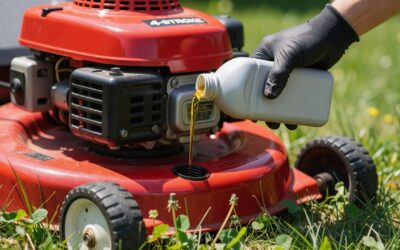
- Add oil in small increments. Pour approximately 1–2 fl oz (30–60 ml) at a time, recheck the dipstick after each addition. Slow incremental filling prevents overfill — there is very little margin between the ADD and FULL marks on small Honda engines.
- Replace the oil fill cap and thread it fully. A loose cap causes oil to spray onto the muffler and deck during operation, creating a fire and smoke hazard.
- Run the engine briefly and recheck. After the first start following an oil change, let the engine run for 30 seconds, shut it off, wait 2 minutes, then recheck the dipstick. Oil circulates through passages and the level may read slightly lower than immediately after filling.
Locating the Oil Drain Bolt (For Full Oil Changes)
For a complete oil change rather than a top-up, the oil drain bolt is located on the underside of the engine crankcase. Tilt the mower with the air filter and carburetor side facing up (not down — tilting the wrong way forces oil into the air filter). Place an oil drain pan beneath the bolt, remove it with the appropriate socket, allow full drainage, replace and torque the bolt, then fill with fresh oil to the FULL dipstick mark.
What Type of Oil Does a Honda Lawn Mower Use?
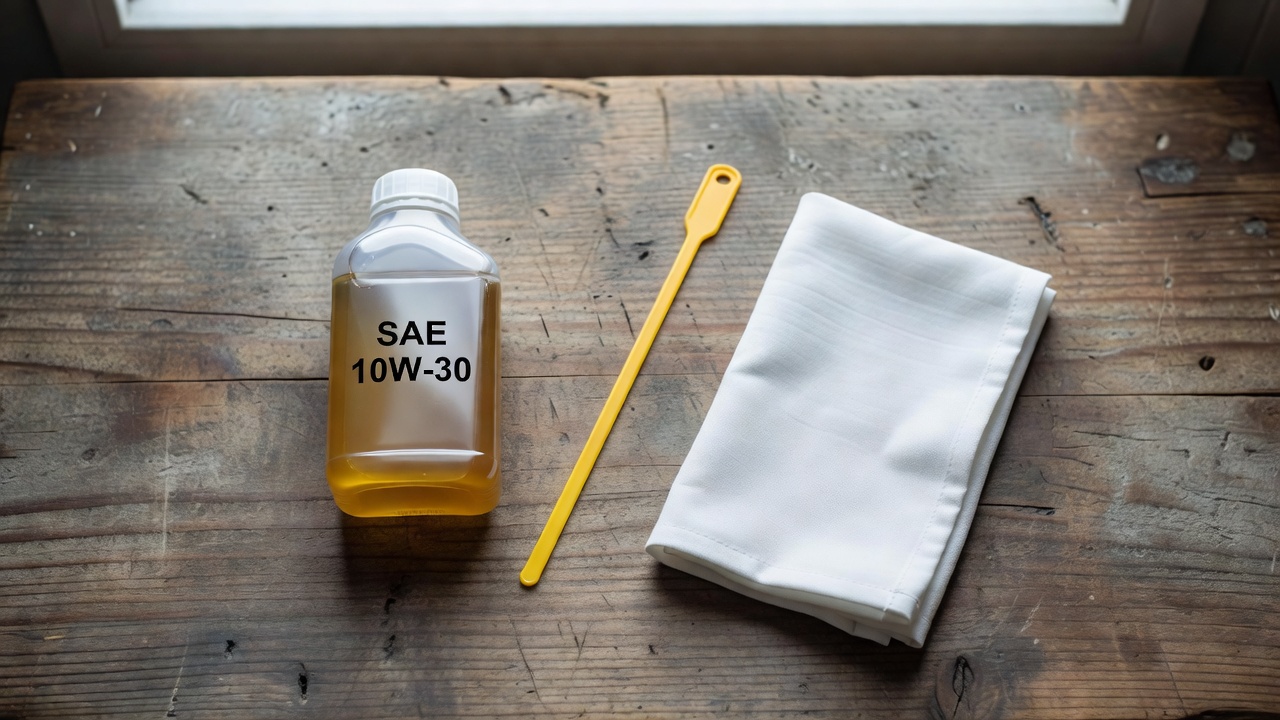
Honda recommends SAE 10W-30 motor oil for most operating temperatures and conditions. This is the correct default choice for the majority of homeowners using GCV160, GCV190, and GX-series engines. The oil must meet API service classification SJ or later — most modern motor oils sold in the US meet this standard, but check the API donut label on the bottle before purchasing.
Temperature-based alternatives per Honda’s guidance:
- SAE 30: Acceptable for sustained operation above 50°F (10°C). Not recommended for cold starts below that threshold — thicker viscosity makes cold starting harder and delays lubrication to engine components on startup.
- SAE 10W-30: Recommended for all-season use, the widest temperature range, and the safest single choice if you operate the mower in varying conditions.
- Synthetic 5W-30: Acceptable per Honda’s maintenance guidance for engines that have already completed their break-in period. Synthetic oil does not void the warranty on Honda small engines, and it offers better cold-weather flow and extended oxidation resistance.
Do not use oil additives, high-mileage oil formulations, or two-stroke oil in a Honda four-stroke mower engine. Honda does not sell pre-mixed oil for these engines — the crankcase uses straight four-stroke motor oil only.
Honda Riding Mower and Commercial Engine Oil Capacities
Riding mowers and commercial Honda equipment use significantly larger engines with proportionally higher oil capacities. Applying a walk-behind engine’s 550 ml capacity to a riding mower engine results in severe underfilling and rapid engine damage.
Commercial GX-Series Engines
- GX160 / GX200: Approximately 600 ml (20.3 fl oz / 0.63 qt)
- GX270: Approximately 1,100 ml (37.2 fl oz / 1.16 qt)
- GX390: Approximately 1,100 ml (37.2 fl oz / 1.16 qt)
- GX630 / GX660 / GX690: Approximately 1,500–1,800 ml — confirm via engine-specific manual
Honda Riding Mower Engines (iGX Series)
- iGX800: Approximately 2,000 ml (67.6 fl oz / 2.11 qt)
- Other iGX models vary — consult the engine plate and corresponding owner’s manual
Engine Oil vs. Hydrostatic Transmission Fluid
Select Honda riding mowers use a hydrostatic transmission that contains its own fluid — separate from and not interchangeable with engine oil. Do not add engine oil to the transmission reservoir. The transmission fluid reservoir has a separate fill cap, typically located at the rear of the mower near the transmission housing. Honda’s hydrostatic transmissions are often factory-sealed and labeled as lifetime-fill units that do not require routine user servicing — check your owner’s manual before attempting to open or service the transmission.
Frequently Asked Questions
How often should I change the oil in my Honda lawn mower?
Honda recommends changing the engine oil after the first month or 5 hours of use on a new mower (break-in interval), then every 50 hours of operation or once per mowing season — whichever comes first. If the mower operates in dusty or high-heat conditions, shortening the interval to every 25 hours extends engine life. The 50-hour or annual interval applies to standard residential use under normal conditions.
What happens if I overfill oil in a Honda mower engine?
Overfilling forces excess oil into the crankcase breather system, from which it travels into the air filter and combustion chamber. Symptoms include white or blue smoke from the exhaust, a fouled or oil-soaked air filter, a wet or oil-fouled spark plug, hard starting, and rough running. In severe cases the engine hydro-locks — oil enters the combustion chamber in sufficient quantity to prevent the piston from compressing, bending a connecting rod. If you overfill, remove the drain bolt and drain oil until the dipstick reads correctly before starting the engine.
Should I warm up my Honda mower before changing the oil?
Running the engine for 2–3 minutes before an oil change warms the oil, lowers its viscosity, and allows it to drain more completely — including suspended combustion byproducts. Allow the engine to cool for 5–10 minutes after the warm-up run before draining. Draining immediately from a fully hot engine risks contact burns from the oil and the drain bolt area. The warm-drain method is preferable to a cold drain for a more complete oil removal.
Where can I dispose of used Honda mower oil?
Used motor oil is classified as hazardous waste and must not be poured down drains, onto soil, or into household trash. Accepted disposal options include: automotive parts retailers (AutoZone, O’Reilly, Advance Auto Parts — most accept used oil at no charge), municipal household hazardous waste (HHW) collection events, and certified recycling centers searchable via Earth911.com. Collect used oil in a sealed, leak-proof container (the original oil bottle works) before transport. Many municipalities also offer curbside hazardous waste pickup on scheduled dates.