

Quick Answer: How Much Oil Does a Lawn Mower Take?
Most walk-behind lawn mowers take 15–18 oz (0.47–0.53 L) of oil. Riding mowers and zero-turn mowers take 48–64 oz (1.4–1.9 L), depending on engine size and brand. These figures apply to four-stroke engines only — two-stroke engines mix oil directly with fuel and have no separate oil reservoir. Always confirm the exact amount using your dipstick or owner’s manual, since capacity varies by engine model.

Pros
- Large-size design named in product title
- Sharpening and balancing functions listed
- Listed as a new upgraded version

Pros
- Adjustable 15-to-45-degree range in title
- Sharpening and balancing functions listed

Pros
- Sharpener and balancer functions in title
- 15-to-45-degree adjustable setting listed
- Built for lawn mower blade maintenance
Pros
- Includes replacement gaskets and a 98079-55846 spark plug
- Matches Honda HRR216 and HRS216 lawn mower models
- Designed around the 16100-Z8B-901 carburetor specification
Cons
- Restricted to select Honda GCV160 mower applications
- Installation requires basic mechanical tools and skills
Quick-Reference Oil Capacity by Mower Type and Engine Brand
Use this table to find a starting estimate for your mower. Confirm the final fill level with the dipstick before running the engine.
| Mower Type | Engine Brand / Model | Oil Capacity (oz) | Oil Capacity (L) |
|---|---|---|---|
| Walk-Behind | Briggs & Stratton 450E / 500E (140–150cc) | 15 oz | 0.44 L |
| Walk-Behind | Briggs & Stratton 675 / 725EXi (190cc) | 18–19 oz | 0.53–0.56 L |
| Walk-Behind | Honda GCV160 | 13.1 oz | 0.39 L |
| Walk-Behind | Honda GCV190 | 18.2 oz | 0.54 L |
| Walk-Behind | Kawasaki FJ180V | 17.6 oz | 0.52 L |
| Riding Mower | Briggs & Stratton Intek V-Twin (17–21 hp) | 48–56 oz | 1.4–1.65 L |
| Riding Mower | Kohler Command Pro V-Twin (18–26 hp) | 56–64 oz | 1.65–1.9 L |
| Riding Mower | Kawasaki FR / FS Series V-Twin (14–25 hp) | 51.2–58 oz | 1.5–1.7 L |
| Zero-Turn | Kohler 7000 Series V-Twin (22–26 hp) | 56–64 oz | 1.65–1.9 L |
| Zero-Turn | Kawasaki FX Series V-Twin (19–27 hp) | 58–64 oz | 1.7–1.9 L |
| Zero-Turn | Briggs & Stratton Commercial V-Twin (20–27 hp) | 56–64 oz | 1.65–1.9 L |
Note: These figures reflect crankcase capacity for a full drain-and-refill oil change. When topping off, add oil in small increments — 1–2 oz at a time — and recheck the dipstick each time. For broader ecosystem context, read through our operational guide on jbl partybox club 120 vs sony srs xv500.
What Type of Oil Does a Lawn Mower Need?
Oil quantity and oil type are separate decisions. Putting the right volume of the wrong oil into your engine causes premature wear. Here is how to choose correctly. For broader ecosystem context, read through our operational guide on jbl partybox club 120 vs sony srs xv500.
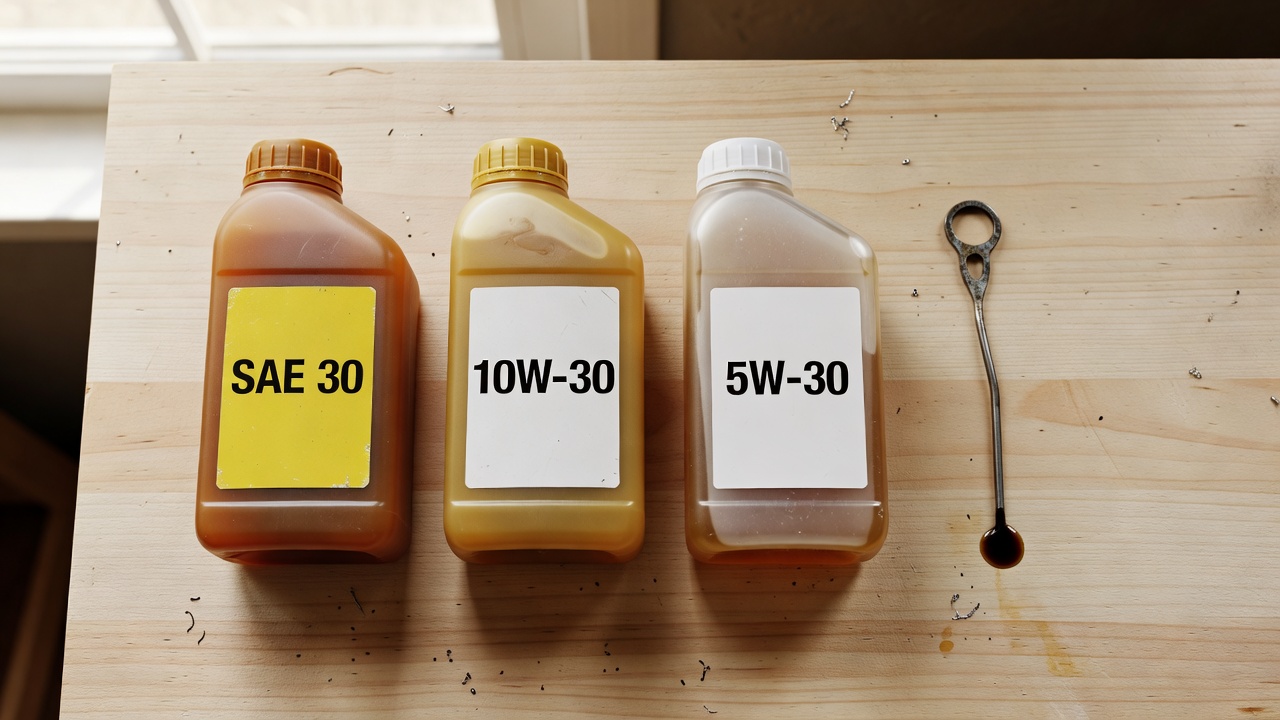
SAE 30 vs. 10W-30 vs. Synthetic
- SAE 30 — The traditional single-grade oil for small engines. Recommended by Briggs & Stratton, Honda, Kohler, and Kawasaki for operation above 40°F (4°C). Suitable for most warm-season mowing across the US.
- 10W-30 — A multi-grade oil that performs across a wider temperature range (0°F to 100°F / −18°C to 38°C). Acceptable as a substitute for SAE 30 above 40°F, and the preferred choice if temperatures fluctuate or if you mow in spring and fall when mornings are cold.
- Full Synthetic 5W-30 — Approved by Briggs & Stratton and Honda for four-stroke engines. Provides better cold-start protection, runs cleaner, and extends oil life. A good choice if you want longer change intervals or operate in climates with wide temperature swings.
- 5W-30 — Recommended for cold-weather operation below 40°F (4°C). If you use equipment in winter or early spring, this grade flows better at low temperatures and reduces cold-start wear.
Temperature Quick-Reference
| Operating Temperature | Recommended Oil Grade |
|---|---|
| Below 0°F (−18°C) | 5W-30 synthetic |
| 0°F to 40°F (−18°C to 4°C) | 5W-30 |
| 40°F to 100°F (4°C to 38°C) | SAE 30 or 10W-30 |
| Wide range / variable climate | 10W-30 or synthetic 5W-30 |
Do not use automotive high-mileage additives or diesel oils in small four-stroke engines. These contain friction modifiers that can damage lawn mower engine seals and clutch components. For troubleshooting and reliability insights, consult our in-depth z890 vs x870e motherboard report.
Two-Stroke vs. Four-Stroke Engines: Why It Changes Everything
Before adding any oil to a reservoir, confirm whether your mower runs a two-stroke or four-stroke engine. Treating them the same way causes serious engine damage.
Four-Stroke Engines (most modern lawn mowers)
Four-stroke engines have a dedicated oil sump (crankcase) that you fill separately from the fuel tank. This is the engine type covered by all capacity figures in this article. You check oil level via a dipstick or sight glass and change it on a scheduled interval. The fuel tank accepts gasoline only. For troubleshooting and reliability insights, consult our in-depth z890 vs x870e motherboard report.
Two-Stroke Engines (older or lightweight equipment)
Two-stroke engines have no separate oil reservoir. Oil is mixed directly with gasoline before it goes into the fuel tank. The most common ratio is 50:1 (2.6 oz of oil per 1 US gallon of gasoline), though some older engines specify 32:1 or 40:1. Always verify the ratio in your engine’s manual — using the wrong ratio causes either oil starvation (too lean) or excessive smoke and fouled spark plugs (too rich).
How to Tell Which Engine You Have
- Look for a dipstick or oil fill cap separate from the fuel cap — four-stroke confirmed.
- Check the fuel cap: if it says “No oil mixing” or shows a gasoline-only symbol — four-stroke confirmed.
- If the manual or engine label specifies a fuel-to-oil ratio — two-stroke confirmed.
- Most walk-behind mowers sold in the US since the 1990s are four-stroke. Handheld equipment (trimmers, chainsaws) is more commonly two-stroke.
How to Check and Verify Oil Level with the Dipstick
The dipstick is the definitive tool for verifying oil level regardless of mower brand, engine size, or whether you just did a full oil change or a top-off. No capacity table replaces this step. Readers comparing setup options can review our technical analysis on marshall stanmore iii vs harman kardon onyx studio 8.
Step-by-Step Dipstick Check
- Park on a level surface. An unlevel surface gives a false reading — the oil pools to one side.
- Let the engine cool for at least 5 minutes after running. Hot oil expands and reads slightly higher.
- Locate the oil fill cap or dipstick. On walk-behind mowers it is typically on the side of the engine block near the base. On riding mowers it is usually accessible from the front engine compartment.
- Remove the dipstick, wipe it clean with a rag, and reinsert it fully without threading it in.
- Remove it again and read the oil level against the MIN and MAX (or ADD and FULL) marks.
- Oil should sit between the two marks — ideally near the upper mark but not above it.
- If low: add oil in 1–2 oz increments, recheck between each addition. Overfilling is as harmful as underfilling.
What Overfilling Does
Oil above the MAX mark foams under engine speed. Foamy oil loses its lubricating properties, causes blue smoke from the exhaust, and can hydrolock the engine if it reaches the combustion chamber. If you overfill, drain the excess using a turkey baster or oil extractor before starting the engine.
How to Change Lawn Mower Oil: Full Drain vs. Top-Off
The two scenarios — full oil change and topping off a low level — use different volumes and procedures. For complementary field maintenance guidelines, examine our breakdown of dyson v8 cyclone vs bissell featherweight stick.
Full Oil Change
Briggs & Stratton recommends changing oil after the first 5 hours of operation on a new engine, then every 50 hours or once per mowing season, whichever comes first. Honda and Kohler specify similar intervals. High-demand conditions (dusty environments, sustained heavy loads) warrant more frequent changes.
- Warm the engine for 2–3 minutes. Warm oil flows faster and carries more suspended contaminants out during the drain.
- Shut off the engine and disconnect the spark plug wire for safety.
- Locate the drain plug on the underside of the engine. Not all walk-behind mowers have a drain plug — some require tilting the mower or using an oil extractor through the fill tube.
- Place a drain pan and remove the drain plug. Allow oil to drain fully (3–5 minutes).
- Reinstall the drain plug and torque it finger-tight plus a quarter turn. Do not overtighten — the housing threads are aluminum on most small engines.
- Refill with fresh oil to the manufacturer’s specified capacity. Use a funnel to avoid spills on hot engine surfaces.
- Check the dipstick before starting. Wipe, insert, remove, read.
- Reconnect the spark plug wire, start the engine, and check for leaks around the drain plug.
- Dispose of used oil at an auto parts store (AutoZone, O’Reilly, Advance Auto Parts) or a municipal recycling center. Do not pour used oil down a drain or onto the ground — it is an environmental hazard and illegal in most states.
Topping Off a Low Level
If the dipstick shows oil below the MIN mark but you are not due for a full change, top off rather than drain and refill. To evaluate matched hardware tolerances, consult our detailed overview of bissell crosswave hydrosteam vs shark stainforce.
- Use the same oil grade currently in the engine — mixing grades is acceptable in an emergency but not ideal.
- Add 1–2 oz at a time. Walk-behind mower crankcases are small; the difference between ADD and FULL is often only 3–4 oz.
- Recheck the dipstick after each addition.
- If the mower is consistently low between changes, inspect for leaks around the drain plug, oil fill cap seal, or valve cover gasket.
How to Find the Exact Oil Capacity for Your Specific Mower
If your engine model does not appear in the table above, use these methods to find the verified spec.
Locate the Engine Model Number
- Briggs & Stratton: The model, type, and code numbers are stamped directly on the engine blower housing (the plastic cover over the flywheel). It is a multi-digit number, e.g., 120000 / 0197E1 / 99011547. Enter these at
briggsandstratton.comunder Parts & Support to retrieve the official spec sheet. - Honda: The engine model (GCV160, GCV190, GX200) is stamped on a label on the engine block near the air filter. Use
hondapowerequipment.comand navigate to your engine model for the owner’s manual and oil specs. - Kawasaki: Model and serial number are on a label on the engine. Use
kawasaki-engines.comto search by model for service manuals and oil capacity. - Kohler: Model and spec numbers are on a silver label on the engine. Use
kohlerengines.comand search Owner’s Manuals by model for crankcase capacity data.
Owner’s Manual
If you do not have a physical copy, all four major engine manufacturers host free PDF downloads by model number. Search: [engine brand] [model number] owner’s manual PDF. The crankcase oil capacity is listed in the Maintenance or Specifications section.
The Dipstick Always Wins
Even with a confirmed capacity spec, fill to the dipstick’s FULL mark — not to the exact ounce. Slight manufacturing tolerances, residual oil in the engine after a drain, and mower angle all affect how much oil the engine actually accepts before reaching FULL. The dipstick is the ground truth.
Common Questions on How Much Oil Do You Put In Lawn Mower Answered
What happens if you put too much oil in a lawn mower?
Oil above the MAX mark on the dipstick foams under operating speeds. Foamy oil cannot lubricate bearing surfaces effectively, causes white or blue exhaust smoke, and can push past seals into the combustion chamber. In severe overfill cases, the engine hydrolocks and stalls. Drain the excess before running the engine. Use an oil extractor syringe or turkey baster if you do not have access to the drain plug easily.
Can I use car oil in my lawn mower?
Standard automotive motor oil in grades like 10W-30 or 5W-30 is acceptable in most four-stroke lawn mower engines, and both Briggs & Stratton and Honda explicitly allow it. Avoid automotive oils labeled as high-mileage formulas or those containing heavy-duty diesel additives — these include friction modifiers that can damage small engine clutch surfaces. Standard conventional or synthetic 10W-30 or SAE 30 from any automotive brand works fine.
How often should I change my lawn mower oil?
Change oil after the first 5 hours on a brand-new engine to flush break-in metal particles, then every 50 operating hours or once per mowing season — whichever comes first. This interval applies to Briggs & Stratton, Honda, Kohler, and Kawasaki engines under normal conditions. Mowing in dusty conditions, on steep terrain, or in high heat accelerates oil degradation; under those conditions, change every 25 hours.
How do I know if my lawn mower is low on oil without a dipstick?
All four-stroke lawn mower engines have a dipstick or oil fill cap with a built-in short dipstick rod — there is no four-stroke engine designed to be checked without one. If the dipstick is missing, order a replacement by engine model number before running the mower. Running without knowing the oil level risks catastrophic bearing failure in minutes if the crankcase is dry. Some newer Briggs & Stratton engines include a low-oil shutdown sensor that stops the engine automatically if oil pressure drops too low — but this is a safety backstop, not a substitute for routine checking.
For more hands-on benchmarks and buying recommendations, consult our guides on heavy-duty chainsaw buyer guide, as well as high-CFM commercial leaf blower guide, as well as durable ride-on lawn tractor guide.
Mechanical safety standards, operational tolerances, and protective gear guidelines align with benchmark specifications established by the American National Standards Institute (ANSI).









