


Pros
- Large-size design named in product title
- Sharpening and balancing functions listed
- Listed as a new upgraded version

Pros
- Adjustable 15-to-45-degree range in title
- Sharpening and balancing functions listed

Pros
- Sharpener and balancer functions in title
- 15-to-45-degree adjustable setting listed
- Built for lawn mower blade maintenance
Pros
- Includes replacement gaskets and a 98079-55846 spark plug
- Matches Honda HRR216 and HRS216 lawn mower models
- Designed around the 16100-Z8B-901 carburetor specification
Cons
- Restricted to select Honda GCV160 mower applications
- Installation requires basic mechanical tools and skills
Quick-Reference: Lawn Mower Oil Capacity by Mower Type
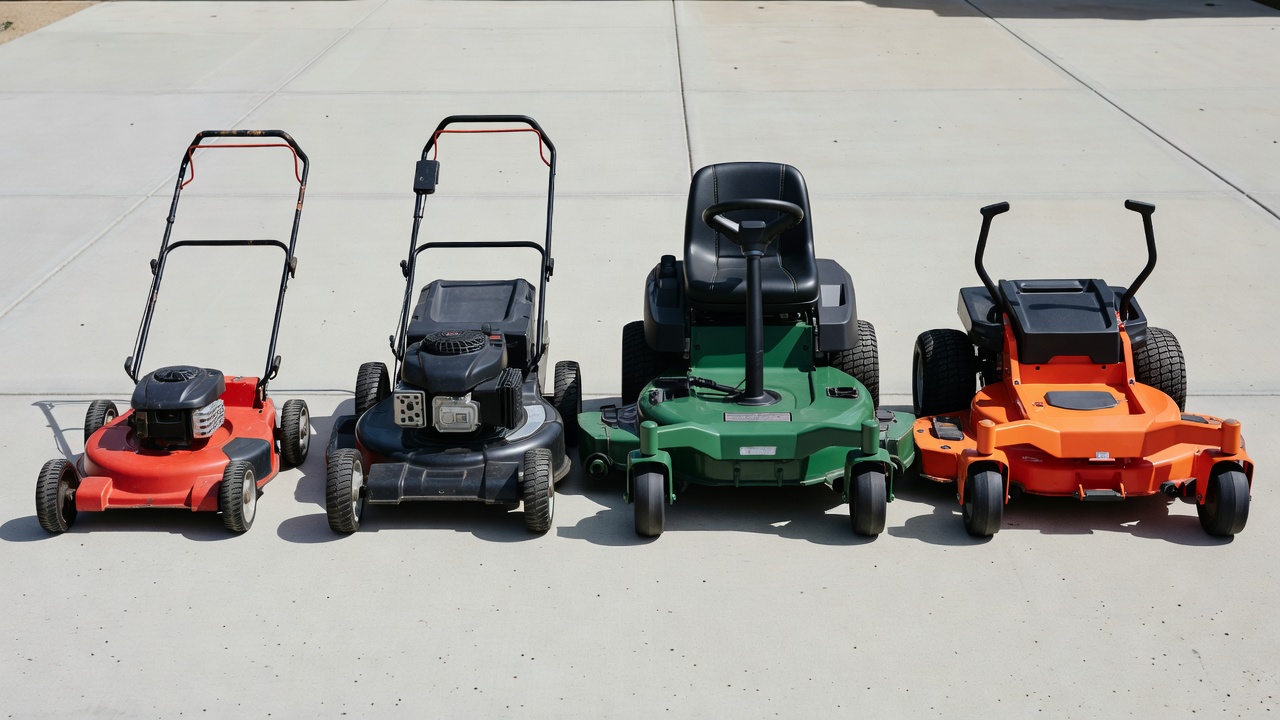
The table below covers the three most common mower categories. Use it to set your expectations before checking your specific engine specs in the next section.
| Mower Type | Typical Oil Capacity (oz) | Typical Oil Capacity (ml) | Common Engine Range |
|---|---|---|---|
| Push / Walk-Behind (small) | 15–18 oz | 450–530 ml | 140cc–163cc |
| Walk-Behind (self-propelled) | 18–20 oz | 530–590 ml | 163cc–190cc |
| Riding Lawn Mower | 48–64 oz | 1,420–1,890 ml | 500cc–700cc |
| Zero-Turn Mower | 56–82 oz | 1,660–2,430 ml | 700cc–999cc |
Key takeaway: Walk-behind capacity and riding/zero-turn capacity differ by a factor of roughly 3–5×. Buying a single quart (32 oz) is sufficient for a walk-behind oil change; plan on two quarts for most riding mowers.
Oil Capacity by Engine Brand and Displacement
Oil capacity is an engine specification, not a mower-brand specification. A Husqvarna riding mower and a Cub Cadet riding mower fitted with the same Kohler engine hold identical amounts of oil. Match your engine nameplate — usually stamped on the engine shroud — to the table below. For troubleshooting and reliability insights, consult our in-depth jbl partybox club 120 vs sony srs xv500 report.
Briggs & Stratton Engines
| Engine Model / Displacement | Oil Capacity (oz) | Oil Capacity (ml) | Typical Mower Application |
|---|---|---|---|
| 140cc (500 Series) | 15 oz | 444 ml | Basic push mower |
| 163cc (550–575 Series) | 15 oz | 444 ml | Push / entry self-propelled |
| 190cc (625–675 Series) | 18–20 oz | 530–590 ml | Self-propelled walk-behind |
| Vanguard 400cc (V-Twin) | 48 oz | 1,420 ml | Entry riding mower |
| Vanguard 810cc (V-Twin) | 64 oz | 1,890 ml | Commercial zero-turn |
Honda Engines
| Engine Model | Oil Capacity (oz) | Oil Capacity (ml) | Typical Mower Application |
|---|---|---|---|
| GCV160 (160cc) | 13.1 oz | 390 ml | Push / walk-behind |
| GCV190 (187cc) | 18.0 oz | 530 ml | Self-propelled walk-behind |
| GXV160 | 13.1 oz | 390 ml | Commercial walk-behind |
Note: Honda GCV160 capacity (13.1 oz / 390 ml) sits below the typical walk-behind range. Overfilling even by a few ounces causes smoke and foaming — measure carefully with a graduated container. For troubleshooting and reliability insights, consult our in-depth jbl partybox club 120 vs sony srs xv500 report.
Kohler Engines
| Engine Model | Oil Capacity (oz) | Oil Capacity (ml) | Typical Mower Application |
|---|---|---|---|
| XT Series 149cc | 15 oz | 444 ml | Walk-behind push mower |
| XT Series 196cc | 20 oz | 591 ml | Self-propelled walk-behind |
| 7000 Series KT715 (725cc) | 56–58 oz | 1,657–1,716 ml | Riding / zero-turn mower |
| 7000 Series KT745 (747cc) | 56–58 oz | 1,657–1,716 ml | Riding / zero-turn mower |
| Command PRO CH680 (674cc) | 64 oz | 1,893 ml | Commercial riding mower |
Kawasaki Engines
| Engine Model | Oil Capacity (oz) | Oil Capacity (ml) | Typical Mower Application |
|---|---|---|---|
| FR600V (603cc) | 55.4 oz | 1,640 ml | Riding / zero-turn mower |
| FR651V (651cc) | 55.4 oz | 1,640 ml | Riding / zero-turn mower |
| FR730V (726cc) | 58.5 oz | 1,730 ml | Riding / zero-turn mower |
| FX850V (852cc) | 82.0 oz | 2,430 ml | Commercial zero-turn mower |
How to Check and Verify Your Mower’s Exact Oil Capacity
Manufacturer tables give the theoretical fill volume from a completely dry engine. In practice, residual oil always remains after draining, so the dipstick — not a measuring cup — is the authoritative final check. Follow this sequence every time. Readers comparing setup options can review our technical analysis on z890 vs x870e motherboard.
- Park on a level surface. An unlevel surface tilts the oil in the crankcase and produces a false dipstick reading.
- Let the engine cool for at least 5 minutes after use. Hot oil expands and reads higher than its true cold level.
- Locate the oil fill cap. On walk-behind mowers it is typically a yellow or black cap on the side of the engine block. On riding mowers it may be under a hood panel near the engine shroud.
- Remove the dipstick, wipe it clean with a lint-free rag, reinsert fully, then withdraw it again. Read the oil level against the two marks (MIN and MAX, or ADD and FULL).
- Add oil in small increments (2–3 oz at a time) if the level is at or below the MIN mark. Recheck after each increment.
- Stop when the oil reaches the MAX / FULL mark. Do not add oil beyond this point — the space between MIN and MAX typically represents only 4–8 oz on a walk-behind engine.
- Confirm with the owner’s manual. The manual lists the exact capacity in the engine specifications or maintenance table. Find it by searching "[engine model] owner’s manual" on the manufacturer’s website if the paper copy is missing.
Dipstick reading tip: On Briggs & Stratton engines the dipstick has a crosshatch zone — any oil film within that zone is acceptable. On Honda GCV engines the dipstick has two distinct dots; fill to the upper dot only.
What Type of Oil Does a Lawn Mower Take?
Oil type is inseparable from capacity — buying the wrong viscosity in the right volume still damages the engine. Most small mower engines run on one of three options. Readers comparing setup options can review our technical analysis on z890 vs x870e motherboard.
SAE 30 (Single-Grade)
- Recommended for air temperatures consistently above 40°F (4°C).
- Standard choice for older Briggs & Stratton and Kohler single-cylinder engines.
- Thickens in cold weather; do not use SAE 30 for cold-morning starts below 40°F.
10W-30 (Multi-Grade)
- Suitable for temperatures ranging from 0°F to 100°F (−18°C to 38°C).
- The most universally accepted option for modern four-stroke mower engines.
- May produce slightly higher oil consumption in older, worn engines compared to SAE 30 — this does not change the fill capacity, but means more frequent dipstick checks.
Synthetic 5W-30
- Provides the widest temperature range and best cold-start protection.
- Approved for Honda GCV160, GCV190, and most current Kawasaki FR-series engines.
- Same fill volume as conventional oil — synthetic does not alter capacity, only service intervals (some manufacturers allow extended drain intervals with full synthetic; consult the manual).
| Oil Type | Temperature Range | Best For |
|---|---|---|
| SAE 30 | Above 40°F (4°C) | Older single-cylinder engines, warm climates |
| 10W-30 | 0°F to 100°F (−18°C to 38°C) | Most modern 4-stroke walk-behind and riding engines |
| Synthetic 5W-30 | −20°F to 120°F (−29°C to 49°C) | Honda, Kawasaki, Kohler — all temperatures |
Do not use motor oil with energy-conserving additives or friction modifiers (marked "Energy Conserving" on the API donut) in air-cooled engines unless the manufacturer explicitly approves it — these additives are designed for automotive wet-clutch systems and can cause slippage in mower transmissions.
How to Change Lawn Mower Oil (Step-by-Step)
Knowing the capacity matters most during an oil change. Change oil after the first 5 hours on a new engine, then every 50 hours of operation or once per season — whichever comes first — per standard OEM maintenance schedules from Briggs & Stratton and equivalent engine manufacturers. For complementary field maintenance guidelines, examine our breakdown of marshall stanmore iii vs harman kardon onyx studio 8.
- Gather supplies: fresh oil (correct type and enough volume for your engine), an oil drain pan, a funnel, rags, and nitrile gloves.
- Warm the engine for 2 minutes. Warm oil flows and drains more completely than cold oil. Shut the engine off and wait 30 seconds before proceeding.
- Disconnect the spark plug wire to prevent accidental engine starts during the procedure.
- Drain the old oil.
- If a drain plug is present: Place the drain pan below, remove the plug with the correct socket, allow oil to drain fully, then reinstall the plug and torque to spec (typically 140–180 in-lb for small engines).
- If no drain plug (most walk-behind mowers): Tilt the mower on its side with the air filter and carburetor facing up — never down — to prevent fuel and oil from flooding those components. Drain from the fill tube into the pan.
- Reinstall or confirm the drain plug is tight before adding new oil.
- Add fresh oil slowly using a funnel. Pour approximately 80% of the rated capacity first, then check the dipstick. Continue adding in 2-oz increments until the dipstick reads at the FULL / MAX mark.
- Replace the oil fill cap, reconnect the spark plug wire, and run the engine for 30 seconds. Shut off, wait 1 minute, recheck the dipstick. Top off if needed.
- Dispose of used oil responsibly. Most auto parts stores (AutoZone, O’Reilly, Advance Auto) accept used motor oil at no charge.
How often to change: Every 50 operating hours or once per season for standard conventional oil. With full-synthetic oil, some manufacturers (Honda, Kawasaki) extend this interval — confirm in the engine’s maintenance schedule, not a generic recommendation.
Signs Your Lawn Mower Has Too Much or Too Little Oil
Getting the oil volume wrong in either direction causes measurable engine damage. Recognize these warning signs early. To evaluate matched hardware tolerances, consult our detailed overview of dyson v8 cyclone vs bissell featherweight stick.
Too Much Oil (Overfilling)
- White or blue smoke from the exhaust — excess oil enters the combustion chamber and burns off as smoke. This is the most common visible sign of overfilling.
- Oil leaking from the air filter or breather tube — overfilled crankcase pressure forces oil through the crankcase ventilation system into the air filter housing.
- Hard starting or misfires — oil contamination on the spark plug tip prevents reliable ignition.
- Seal and gasket damage — chronically elevated crankcase pressure accelerates wear on crankshaft seals, leading to external oil leaks.
Fix: Remove the excess oil using a turkey baster, hand pump, or by briefly tilting the mower (air-filter side up) to drain a small amount from the fill tube. Recheck the dipstick after each extraction until the level reads within the correct range.
Too Little Oil (Underfilling / Running Low)
- Engine running hotter than normal — oil is the secondary cooling medium in air-cooled engines; low level raises operating temperature significantly.
- Knocking or rattling sounds at startup — oil-starved bearings and piston rings produce metallic noise within seconds of startup.
- Low-oil shutoff activation — most modern Briggs & Stratton, Honda, and Kawasaki engines have a low-oil sensor that kills the engine automatically before seizure occurs. If the mower shuts off unexpectedly on level ground, check the oil level immediately.
- Engine seizure — worst-case outcome of running an engine dry. The piston welds itself to the cylinder wall; the engine is typically unrecoverable without a full rebuild or replacement.
Prevention: Check the oil level with the dipstick before every mowing session. It takes under 60 seconds and is the single highest-value maintenance habit for extending engine life. When planning workspace deployment, consider the engineering criteria outlined in our bissell crosswave hydrosteam vs shark stainforce guide.
Everything You Need to Know: How Much Oil Does A Lawn Mower Hold FAQ
How much oil does a Briggs and Stratton 140cc engine hold?
A Briggs & Stratton 140cc engine (500 Series) holds approximately 15 oz (444 ml) of oil. Always verify by filling to the FULL mark on the dipstick rather than pouring in the full theoretical volume at once, since residual oil from the previous fill may remain.
Can I use car motor oil in my lawn mower?
Yes, provided the viscosity grade matches the engine manufacturer’s specification (SAE 30, 10W-30, or 5W-30) and the oil meets API service classification SJ or higher. Avoid oils labeled "Energy Conserving" or those formulated with heavy friction-modifier packages designed for automotive transmissions. A standard conventional or synthetic passenger-car motor oil of the correct grade works correctly in most small mower engines.
How do I know if my lawn mower needs oil?
Remove and wipe the dipstick, reinsert it fully, withdraw it again, and read the level against the MIN and MAX marks. If the oil film sits at or below the MIN mark, the engine needs oil. Also check oil color: oil that is jet black and gritty rather than amber or light brown is past its service life and should be changed regardless of level.
How much oil does a riding lawn mower take for an oil change?
Most riding lawn mowers with Kohler 7000 Series or Kawasaki FR-series engines require 56–64 oz (1.65–1.89 L) for a full drain-and-refill oil change — roughly 1.75 quarts. Purchase two quarts to ensure you have enough; leftover oil stores well sealed. Zero-turn mowers with larger engines (Kawasaki FX850V) may require up to 82 oz (2.43 L) — just over 2.5 quarts.
For more hands-on benchmarks and buying recommendations, consult our guides on heavy-duty chainsaw buyer guide, as well as high-CFM commercial leaf blower guide, as well as durable ride-on lawn tractor guide.
Mechanical safety standards, operational tolerances, and protective gear guidelines align with benchmark specifications established by the American National Standards Institute (ANSI).









