Choosing the right leaf blower depends on three key factors: your yard size, the type of debris you’re clearing, and your physical ability. For small yards under 0.25 acres with light leaves, a handheld electric blower with 150-250 CFM is typically sufficient. Medium yards (0.25-0.5 acres) benefit from backpack or corded electric models with 250-400 CFM, while large properties over 0.5 acres often require walk-behind or gas-powered units with 400+ CFM to handle heavy debris efficiently.
Understanding both the physical form factor and the airpower rating (measured in CFM and MPH) ensures you select a blower that matches your specific cleaning requirements without overspending or underperforming.
Understanding Leaf Blower Size: Form Factor vs. Airpower
When shopping for a leaf blower, “size” refers to two distinct characteristics that work together to determine performance and usability.
Physical Form Factor
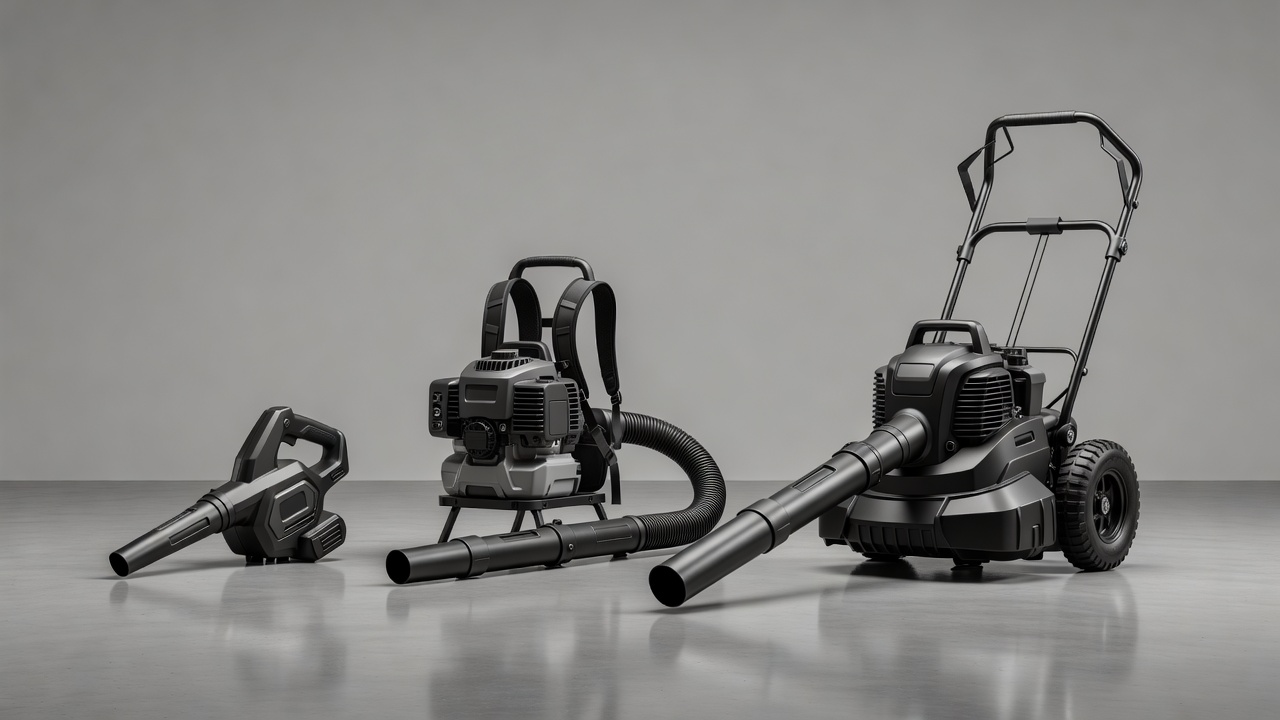
The form factor describes the blower’s design and how you carry or operate it:
- Handheld blowers are lightweight, portable units you carry in one hand, typically weighing 5-10 pounds. They’re ideal for quick cleanup jobs and smaller areas.
- Backpack blowers distribute weight across your shoulders and back, allowing longer use with less fatigue. They generally weigh 10-20 pounds and offer more power than handheld models.
- Walk-behind blowers are wheeled units you push like a lawn mower, weighing 50-100+ pounds. They provide maximum power for large areas and heavy debris without requiring you to carry the equipment.
Airpower Rating: CFM and MPH
Airpower determines how effectively a blower moves debris:
- CFM (cubic feet per minute) measures the volume of air the blower produces. Higher CFM means more air movement, which is crucial for heavy or wet debris.
- MPH (miles per hour) measures air speed. Higher MPH helps dislodge stuck debris and move it quickly over distances.
For most applications, CFM is more important than MPH because moving a larger volume of air is generally more effective than moving air faster. A blower with 400 CFM at 150 MPH will typically outperform one with 200 CFM at 200 MPH for typical yard cleanup tasks.
Step 1: Measure Your Yard Size
Your lot size is the primary factor in determining which blower form factor will serve you best. Here’s how to estimate and categorize your yard:
Estimating Your Yard Size
Measure the length and width of your property in feet, then multiply to get square footage. Divide by 43,560 to convert to acres. Don’t subtract your house footprint—you’ll need to clear around the entire perimeter.
Yard Size Categories
- Small yards (under 0.25 acres / under 10,000 sq ft): Typically suburban lots with minimal landscaping. Handheld blowers are usually sufficient.
- Medium yards (0.25-0.5 acres / 10,000-21,780 sq ft): Larger suburban or small rural properties with more trees and landscaping features. Backpack or corded electric models provide better performance.
- Large yards (0.5+ acres / over 21,780 sq ft): Rural properties, estates, or heavily wooded lots. Walk-behind or powerful gas backpack blowers are often necessary.
Step 2: Assess Your Debris Type and Conditions
The type and condition of debris you’re clearing significantly impacts the CFM requirements for effective cleanup.
Debris Categories and CFM Requirements
- Light debris (150-250 CFM): Dry leaves, grass clippings, and light dust. These materials are easily moved with lower air volume.
- Medium debris (250-400 CFM): Wet leaves, small twigs, pine needles, and mixed yard waste. Requires more air volume to move effectively.
- Heavy debris (400+ CFM): Wet mulch, gravel, compacted leaves, and large branches. Demands maximum air volume and often higher MPH ratings.
Additional Conditions to Consider
-
li>Terrain: Sloped or uneven ground may require more power to move debris uphill or across obstacles.
- Obstacles: Dense landscaping, garden beds, and tight spaces may favor maneuverable handheld models over larger walk-behind units.
- Frequency: Regular maintenance (weekly during fall) may justify investing in more powerful equipment than occasional seasonal use.
Step 3: Choose Your Blower Type by Yard Size
Use this decision matrix to match your yard characteristics with the appropriate blower type:
Small Yards (Under 0.25 Acres)
Recommended: Handheld electric blower (corded or battery-powered)
- CFM range: 150-250 CFM
- Best for: Light to medium debris on flat terrain
- Advantages: Lightweight (5-8 lbs), easy to store, minimal maintenance
- Limitations: Limited runtime for battery models, cord restrictions for corded models
Medium Yards (0.25-0.5 Acres)
Recommended: Backpack blower or powerful corded electric
- CFM range: 250-400 CFM
- Best for: Medium to heavy debris, moderate terrain
- Advantages: Better ergonomics for extended use, more power than handheld models
- Considerations: Heavier weight (10-15 lbs), higher cost than basic handhelds
Large Yards (0.5+ Acres)
Recommended: Walk-behind blower or powerful gas backpack
- CFM range: 400+ CFM
- Best for: Heavy debris, large areas, challenging terrain
- Advantages: Maximum power, reduced fatigue for large jobs
- Considerations: Higher cost, storage requirements, maintenance needs (for gas models)
Power Source Considerations: Electric, Battery, or Gas
Each power source has distinct advantages and limitations that affect your overall satisfaction with the blower.
Corded Electric Blowers
- Advantages: Unlimited runtime, lightweight, no fuel costs, minimal maintenance
- Limitations: Restricted range by cord length, requires nearby outlet, potential cord management issues
- Best for: Small to medium yards with accessible power outlets
Battery-Powered Blowers
- Advantages: Cordless convenience, quiet operation, no emissions, moderate weight
- Limitations: Limited runtime (typically 20-60 minutes), battery recharge time, higher initial cost
- Best for: Small to medium yards where mobility is important
Gas-Powered Blowers
- Advantages: Maximum power, unlimited runtime with fuel, no cord restrictions
- Limitations: Heavier weight, higher noise levels, regular maintenance required, fuel costs
- Best for: Large properties, heavy debris, professional or frequent use
Physical Ability and Weight: Will You Comfortably Operate It?
Your physical capability is a crucial factor that’s often overlooked when selecting a leaf blower. Even the most powerful blower is useless if you can’t comfortably operate it for the duration of your cleanup tasks.
Weight Considerations
- Handheld models (5-10 lbs): Suitable for most adults, but may cause fatigue during extended use or for those with arm or shoulder limitations.
- Backpack models (10-20 lbs): Distribute weight more evenly, reducing arm fatigue but potentially straining the back if not properly fitted.
- Walk-behind models (50-100+ lbs): Eliminate carrying weight entirely but require pushing effort and may be difficult to maneuver in tight spaces.
Ergonomic Factors
-
li>Vibration: Gas models typically produce more vibration than electric, which can cause hand-arm fatigue over time.
- Noise levels: Electric and battery models operate more quietly, reducing hearing protection requirements and neighborhood disturbance.
- Balance: Well-designed blowers distribute weight evenly and include comfortable straps and handles.
Making Your Final Decision
To select the right leaf blower, systematically evaluate your specific situation:
- Measure your yard and categorize it as small, medium, or large.
- Assess your typical debris and note any challenging conditions like wet leaves or gravel.
- Consider your physical limitations and how long you typically spend on yard work.
- Evaluate your power source preferences based on your yard’s layout and your tolerance for maintenance.
- Test if possible—visit a store to hold different models and assess weight and ergonomics.
Remember that investing in a slightly more powerful blower than you think you need often pays off in reduced frustration and time savings. However, oversizing can lead to unnecessary expense and handling difficulties.
FAQ
Can I use a handheld blower for a medium-sized yard?
Yes, but it may require multiple battery charges or extension cord management. For yards at the upper end of the medium category (close to 0.5 acres), a backpack model will likely provide better performance and less fatigue.
How important is MPH compared to CFM?
CFM is generally more important for most residential applications because moving a larger volume of air is more effective for clearing debris. MPH becomes more important for dislodging stuck debris or covering long distances quickly.
Are gas blowers worth the extra maintenance?
For large properties or heavy-duty use, yes. Gas models provide maximum power and unlimited runtime. For smaller yards, the convenience and lower maintenance of electric models often outweigh the power advantage of gas.
What’s the most versatile blower size?
A backpack blower in the 300-400 CFM range offers good versatility for most medium-sized yards with typical debris. It provides enough power for most tasks while remaining portable enough for regular use.
How do I know if I need a walk-behind blower?
Consider a walk-behind if you have more than 0.5 acres of property, regularly deal with heavy or wet debris, have physical limitations that make carrying equipment difficult, or need to clear large areas quickly and efficiently.