Quick Answer: How Does An Edger Work?
A typical lawn or landscape edger drives a vertical metal blade or cutting wheel along the line where grass meets a sidewalk, driveway, or curb. The cutter slices turf and shallow roots, leaving a crisp, narrow groove. Manual models rely on your push; electric and gas models spin the cutter with a motor or small engine. Hair clippers, concrete finishing…

Pros
- Highly versatile multi-head system with support for a wide range of EGO attachments.
- Brushless motor and carbon fiber shaft are built for durability and reduced vibration.
- Edger attachment offers adjustable depth control for more precise curb and driveway edging.
- Works with EGO 56V ARC Lithium batteries, which is convenient for current EGO users.
Cons
- Battery and charger are not listed in the kit details, so they may need to be purchased separately.
- As a multi-head system, it may not be the simplest choice if you only need a basic standalone edger.
- The product data does not provide weight or runtime, making it harder to compare with other cordless edging options.
EGO Power+ ME0820 is a cordless multi-head edging kit that pairs the PH1420 power head with the EA0820 8-inch edger attachment. It is designed for homeowners who want one power unit that can support multiple yard-care tasks over time.
The standout feature is flexibility. The power head works with EGO's Multi-Head System attachments, while the edger itself offers up to 3 inches of depth adjustment for crisp lawn borders. A brushless motor, digital two-speed control, and IPX4 weather-resistant construction add practical value for regular outdoor use.
There are a few limitations to consider. The kit details do not include a battery or charger, so some buyers may need to add those separately. It is also best suited to users already invested in the EGO 56V platform, since the system's value is strongest when paired with other compatible attachments.
Overall, this is a strong option for EGO owners who want a durable, expandable edging system rather than a single-purpose tool. It should appeal most to users who value modularity, cleaner edging control, and compatibility with a larger cordless yard-care lineup.

Pros
- Includes both battery and charger for immediate setup.
- Compatible with RYOBI 18V ONE+ batteries for broader system flexibility.
- Lightweight design improves portability and reduces fatigue during regular yard work.
- Supports both .065 and .080 trimmer line for added line compatibility.
Cons
- 13-inch maximum cutting width is more suited to small and medium yards than large properties.
- No runtime, noise level, or weight spec is provided in the source data.
- The product details do not specify advanced features such as brushless motor technology or telescoping shaft adjustment.
Overview: The RYOBI ONE+ 18V 13 in. Cordless Battery String Trimmer/Edger is a lightweight, battery-powered lawn tool designed for basic trimming and edging tasks. Its 2-in-1 setup makes it a practical option for homeowners who want one tool for routine yard cleanup.
Performance: A pivoting head helps the tool transition into edging mode, while the variable-speed trigger gives the user more control over light trimming and tougher spots. The adjustable 11 in. to 13 in. cutting width adds flexibility, and compatibility with .065 and .080 line makes replacement easier.
Drawbacks: This model is best matched to smaller or medium-size yards because its 13-inch cutting width is modest. The provided data does not list runtime, total weight, or advanced motor details, so buyers should avoid assuming high-end performance beyond the stated features.
Verdict: For homeowners already using the RYOBI ONE+ platform, this trimmer/edger offers convenient cordless operation and broad battery compatibility. It is a sensible pick for straightforward lawn maintenance, especially when included battery and charger value matters.

Pros
- True 2-in-1 design that converts quickly between trimmer and edger modes
- Command feed spool with free spools for life program for ongoing convenience
- Two 20V batteries and charger included for extended use out of the box
- Tilting head plus rubberized wheels improve control on varied terrain
- Full Power Share compatibility with other WORX 20V and 40V tools
Cons
- 12-inch cutting diameter may require extra passes on larger lawns
- 0.065-inch line diameter best suited to light and medium grass rather than heavy brush
- Battery-powered design means runtime depends on charge levels without specified duration
The WORX WG163 is a cordless 20V string trimmer and lawn edger built for residential use. Weighing just 5.5 lbs with a compact design, it features rubberized wheels and an adjustable spacer guard that create a solid first impression of a user-friendly outdoor power tool focused on precision and ease.
In performance the 7600 rpm motor and 12 inch cutting diameter handle standard grass trimming effectively. The innovative command feed allows instant line deployment with a push button while the head tilts up to 90 degrees for slopes and tight spaces. Conversion from trimmer to edger takes only seconds and the two included Power Share batteries support the broader WORX ecosystem for ongoing convenience.
Potential drawbacks include the 12 inch path that can slow progress on expansive lawns and the 0.065 inch line suited mainly to lighter tasks. Battery runtime is not detailed in specs so users may need to plan around recharges for prolonged sessions.
Overall the WORX WG163 delivers strong value for homeowners managing small to medium yards who want a convertible cordless tool with ecosystem compatibility and straightforward operation.
What a lawn edger is for
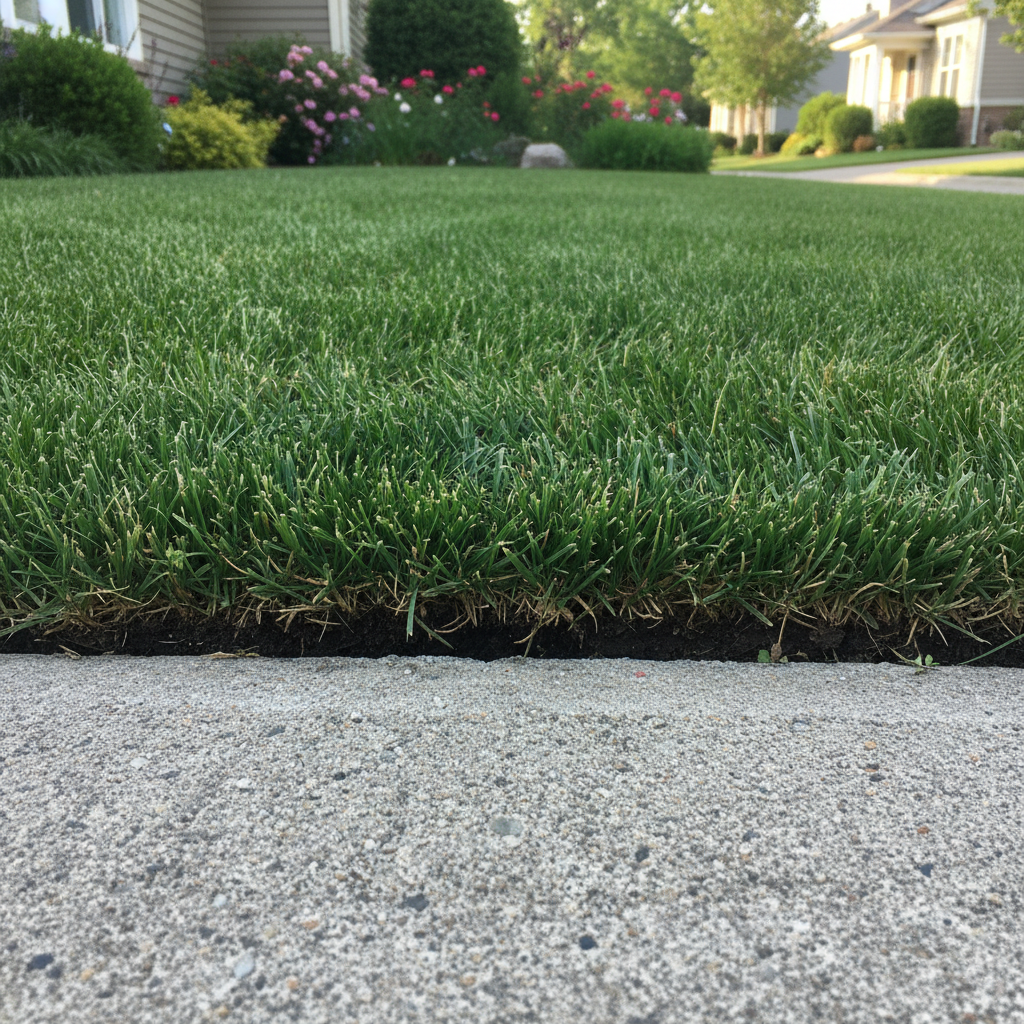
A consumer lawn edger, sometimes called a landscape edger, is built to define a boundary. Mowing shortens the lawn from above. It does not reliably stop grass from leaning over pavement, sending runners onto a walk, or blurring the line between turf and a bed. An edger’s job is that boundary: a narrow, upright cut that separates grass from a hardscape or planting edge so the line is easy to see and easier to keep.
People usually run an edger where turf meets something firm enough to act as a guide. Sidewalks, driveways, and curbs are the classic paths. The same idea applies along patio slabs, stepping-stone walks, and the outer rim of a mowing strip. Some homeowners also recut the outline of a flower bed or path so the grass does not creep inward. In each case the tool is not replacing the mower. It is finishing the outline the mower cannot hold by itself.
A clean turf-to-hardscape edge looks like a thin, nearly vertical wall of soil and cut stems, with the grass standing back from the concrete or stone instead of draping over it. Uncut grass hides the joint and can look ragged even after a careful mow. Grass that has only been knocked back with a string trimmer often lies over or frays, so the line is tidier than before but still soft. A dedicated edge reads as a crisp groove: a dark, narrow trench with a square face on the turf side. For additional operational safety benchmarks, see our published testing notes on jbl partybox club 120 vs sony srs xv500.
That line does not stay put forever. Grass grows, thatch builds, soil slumps into the groove, and runners try to cross the cut. Landscapers and homeowners recut the same path periodically because the first pass is a definition, not a permanent barrier. How often depends on growth, climate, and how sharp you want the outline to stay. Edging can make the lawn look more intentional and can reduce grass that spills onto pavement, but it does not replace mowing, does not stop every weed, and is not a guaranteed fix for every landscape problem. For additional operational safety benchmarks, see our published testing notes on jbl partybox club 120 vs sony srs xv500.
How the vertical cutting mechanism creates a clean line
The distinctive feature of a typical lawn edger is orientation. The cutting part is held in a vertical plane, roughly perpendicular to the ground, instead of spinning parallel to the turf the way a mower blade or a string trimmer head usually does. That vertical attitude is what lets the tool slice downward along a guide edge rather than merely shorten blades of grass from above. To compare alternative configurations, check our hands-on review of z890 vs x870e motherboard.
What the cutter actually severs is a thin sandwich of living stems, thatch, shallow roots, and a sliver of soil. The goal is not to excavate a ditch. It is to cut a neat face so the turf stops at a chosen line. Powered designs usually spin a rigid metal blade. Some use a cutting wheel with a toothed or disc-like rim. Either way, the spinning edge shears material as it travels along the sidewalk, driveway, or curb. Debris—clippings, grit, and small clods—gets thrown or left along the cut because the blade is opening a groove and flinging whatever it loosens.
A manual edger works on the same geometric idea with less machinery. A half-moon edger is a sharp, curved blade on a long handle. You drive it into the soil along the line, then rock or step it forward so each bite continues the groove. A star-wheel or toothed-wheel manual edger is rolled along the same path; your pushing force and body weight press the teeth down so they slice as the wheel turns. There is no high-speed spin, so the cut is slower and more dependent on how firmly and straight you work, but the result is still a vertical slice rather than a horizontal trim. To compare alternative configurations, check our hands-on review of z890 vs x870e motherboard.
The narrow trench or groove is both the product and a temporary guide. It creates the visual line and gives later passes a channel to follow. Depth, blade size, and how aggressively the cutter bites are model-dependent. They are not universal measurements, and a deeper setting is not automatically a better one. Hitting a hidden root, paver lip, or irrigation part can stall the cutter or throw the tool off line. A clean pass is a controlled slice, not a guarantee of a perfectly square wall on every lawn.
Several parts stay above the cut on purpose. The housing and blade guard cover most of the spinning disc so the exposed arc is limited to the working edge. Wheels or a guide shoe ride on the hard surface or on the turf so the operator is not supporting the full weight of the machine and so the blade stays closer to vertical. Those contact points matter as much as the cutter itself. If the guide loses the pavement, the blade can wander into the lawn or chatter against concrete. If the guard is missing or packed with grass, debris control and the operator’s margin of safety both get worse. Users looking for related component recommendations can explore our marshall stanmore iii vs harman kardon onyx studio 8 breakdown.
How power reaches the cutter on manual, electric, and gas edgers
Consumer edgers fall into a few mechanical families. The cutting idea—vertical slicing along a guide—stays the same. What changes is how force arrives at the blade or wheel.
Manual force
A fully manual edger transfers the user’s force directly into the cut. On a half-moon tool, your arms and, often, a foot on the blade’s step drive the edge into the soil. On a wheeled manual edger, forward motion plus downward pressure turns a toothed wheel so each tooth takes a bite. There is no motor, no fuel, and no cord. The limit is how consistently you can keep the cutter upright and how hard the ground is. Packed clay, thick roots, and dry turf take more effort than moist, recently mowed grass. Before finalizing equipment decisions, refer to our comprehensive dyson v8 cyclone vs bissell featherweight stick comparison.
Electric and gasoline power
Corded, battery, and gasoline lawn edgers differ mainly in how they supply energy. An electric motor or a small gasoline engine sits on the tool and turns a shaft, belt, or gear train that ends at the spinning blade. The power source changes runtime, noise character, exhaust, and how you start the machine. The cutting mechanism is still a rigid vertical cutter. Starting, priming, and blade-service steps vary by design and belong in that tool’s manual rather than in a general explanation.
Two form factors show up often. A stick edger looks like a long shaft with the motor or engine near the operator’s hands or along the shaft and the cutter at the far end. The operator walks and steers while the blade hangs beside the pavement. A walk-behind edger puts the cutter in a wheeled chassis. The operator pushes the machine the way one might push a small mower, and the frame is meant to keep the blade vertical while the wheels track the line. Neither layout is inherently “the professional choice” in the abstract; they are different ways to hold a vertical cutter on a path. For broader ecosystem context, read through our operational guide on bissell crosswave hydrosteam vs shark stainforce.
Many designs include a few functional extras. A blade guard limits how much of the disc is exposed and helps direct flying debris. A depth adjustment raises or lowers the cutter relative to the guide wheel or shoe so you can take a shallower or deeper bite. Some powered units use a clutch or a similar engagement so the engine or motor can run without the blade spinning at full effect until you are ready. Those parts exist to control the cut and reduce accidental contact. They are not optional decorations, and defeating them is not part of normal use.
How an edger differs from a string trimmer
The most common mix-up is between a dedicated edger and a string trimmer used on its side. A string trimmer typically spins a flexible line—or, on some heads, a small plastic blade—inside a roughly horizontal cutting path. That path is excellent for shortening grass against a fence, under a deck edge, or in places a mower deck cannot reach. The line whips through stems. It does not hold a rigid plane.
Many trimmers can be rotated so the line cuts more vertically along a sidewalk. That trick can tidy a pavement edge and is often enough when the grass is only slightly overgrown and you want a quick cleanup. The result is usually softer and less trench-like than a dedicated edge. The flexible line can wander, fray thick runners instead of shearing them cleanly, and bounce off concrete. It also throws debris in a wide fan and can scuff the hard surface if the head rides too close.
A dedicated edger holds a rigid cutter in a fixed vertical attitude. A guide wheel or shoe often tracks the hard surface so the blade stays on the joint. That combination is why a lawn edger can leave a straighter, deeper groove than a flexible line. The metal blade or cutting wheel keeps cutting in the same plane even when the turf is dense. It can also catch on buried objects more abruptly than a string, which is one reason kickback and a sudden stop are part of the risk picture.
A trimmer is still the clearer tool when you need to taper grass in irregular spots, work around posts, or do light touch-up after a recent edge. A dedicated edger is the clearer tool when you want a repeated, square turf-to-hardscape line along a long walk or drive. One is not universally faster, safer, or better. They solve overlapping jobs with different cutters and different kinds of control.
Other tools also called edgers
The word “edger” is shared by several tools that do not cut lawns. If the rest of this article does not match the object in your hand, you are probably looking at one of these.
- Hair or beard edger. A small clipper or trimmer used to tidy a hairline, sideburns, or beard outline. It uses fine teeth or a narrow foil on skin and hair, not a landscape blade. This article does not cover grooming technique.
- Concrete or cement edger. A hand trowel or powered finishing tool used on freshly placed concrete. It rounds or defines the slab’s edges while the mix is still plastic so the corner is less likely to chip and the joint looks finished. It is a masonry finishing tool, not a turf cutter.
- Lumber or sawmill edger. A machine that rips bark, wane, or irregular edges from boards so the lumber has straighter sides. The mechanism is a saw, not a lawn blade.
Context usually settles the meaning. If you are standing on a lawn beside a sidewalk, you want a landscape tool. If you are in a bathroom with a clipper, or on a wet slab with a hand tool, or on a mill floor, the lawn mechanism below does not apply. The remainder of this article is about lawn and landscape edgers.
The basic process of making an edge
The exact controls differ by machine, so the sequence below is a conceptual map, not a substitute for the owner’s manual. Depth stops, starting routines, and blade-change steps are design-specific. Treat them that way.
Before the first pass
Walk the line you intend to cut. Clear rocks, toys, hoses, and anything a spinning blade should not meet. Look for irrigation heads, shallow wires, landscape lighting, and the lip of pavers that sit higher or lower than the main slab. On a new bed line with no pavement to follow, a string line or paint mark can stand in for a hard edge. Check that the blade guard is in place, the cutter is secure, and the power source—cord, battery, or fuel system—is in the condition the manufacturer describes as ready for use.
Aligning and walking the cut
Set the guide wheel or shoe against the sidewalk, driveway, or curb so the vertical blade sits on the joint, not out in the lawn and not grinding the face of the concrete. Keep both hands on the tool. Start the cutter only when the working end is in position and bystanders are clear. Walk at a controlled pace. Let the blade slice rather than shoving the machine as if it were a plow. The operator’s job is to keep the cutter vertical and the guide in contact. Leaning the shaft or lifting a walk-behind frame to “help” the blade usually waves the line or lets the disc climb.
If the cutter hits something solid, stop. Do not try to power through a hidden root ball, a buried stake, or a raised paver. Shut the tool down, isolate the power source, and inspect. A shallower first pass is often the safer approach on unknown ground or after a long gap between edgings. A second pass can deepen or clean the groove once you know the path is clear. There is no universal walking speed or trench width that works on every lawn.
After the pass
Sweep or blow clippings and soil off the hard surface so the new line is visible and so grit is not left to grind underfoot. Look at the turf face. A torn, wavy, or incomplete groove may need another light pass, a slower walk, or a stop for a dull or clogged cutter. Leave the area safer than you found it: cord coiled, fuel cap secure, battery removed if you are done for the day, and the blade no longer spinning before you set the tool down.
Safety around blades, debris, fuel, and electricity
An edger is a small yard tool with a serious cutter. The same features that make a clean line—a rigid disc, stored energy, and a narrow working gap beside concrete—create the main hazards. No setup is completely safe, and this is not legal advice. Follow the tool’s manual and label, and use a qualified repair shop when the machine is damaged or unfamiliar.
Spinning blades and kickback
A rotating blade can cut skin, footwear, cords, and irrigation parts in a fraction of a second. Kickback happens when the cutter snags—on a root, a crack, a nail, or a thick clod—and the tool jumps or twists toward the operator or off the line. Even a “small” disc has enough energy to surprise someone who is leaning over the work or holding the shaft with one hand. Keep a balanced stance, both hands on the grips, and the guard in place. Never reach near the cutter while it can still move.
Flying debris, eyes, and feet
The blade throws soil, stones, and clippings. Eye protection is a basic precaution, not an optional extra for dusty days. Closed-toe, sturdy footwear matters because the working end is at ground level and because a slip can put a foot into the path of the disc. Long pants help against grit. Keep children, pets, and bystanders out of the work area and out of the debris fan. A sidewalk is a public-looking space; people can walk into the job without noticing the tool.
Gasoline models
Fuel, exhaust, and hot parts add their own risks. Refuel outdoors, with the engine cool, using an approved container, and in line with the manual and local rules. Spills on a hot muffler or on dry mulch are a fire hazard. Exhaust in a closed garage or shed is dangerous. Do not touch the muffler or other hot surfaces immediately after running. Store fuel as the label and local rules require; there is no single household rule that covers every jurisdiction.
Electric models and batteries
Corded edgers can cut their own cords and can shock an operator who works in standing water or with damaged insulation. Keep the cord behind you and off the cutting line. Wet grass increases slip and electrical risk; if the manual warns against wet conditions, treat that as a stop. Battery packs should be handled as the manufacturer describes: intact housings, dry contacts, and no makeshift charging. A damaged pack or a crushed cord is a reason to stop and replace the part, not a reason to tape things back together.
Before any inspection, clearing a jam, or blade work, isolate the power source. Unplug a corded tool. Remove the battery from a cordless tool. On a gasoline model, stop the engine and disconnect the spark plug lead so an accidental pull cannot start the cutter. Wait for the blade to stop completely. Those steps are ordinary service hygiene, not optional extras.
When the cut looks ragged or the edger struggles
A wavy or torn edge is often an operator issue before it is a broken machine. Walking too fast lets the blade tear instead of shear. Letting the tool lean tilts the groove and can scalp the turf or grind the slab. Setting an overly aggressive depth makes the cutter stall, bounce, or climb. Treating a string trimmer as if it were a rigid edger produces a fuzzy line that no amount of extra passes will square up.
Check the tool next. A dull, bent, or loose cutter leaves a chewed face. Packed grass in the guard can choke the disc and throw debris in odd directions. A guide wheel that is not riding the hardscape lets the blade wander. Wet, overgrown, or debris-filled turf changes the result as well: wet soil smears, tall grass wraps, and hidden trash becomes an impact. None of those conditions has a single universal fix, and sharpening does not restore every damaged blade.
If the machine bogs, kicks, smokes in an unusual way, or makes a new metallic sound, stop and inspect rather than force the cut. Hitting roots, pavers, or hidden wire can stall or damage the cutter. Isolate power first. If the problem is beyond a cleared guard and a visibly intact blade, a qualified service shop is the safer next step. Replacement intervals, torque values, and part numbers are manufacturer-specific; they do not belong in a general how-it-works article.
Mechanical safety standards, operational tolerances, and protective gear guidelines align with benchmark specifications established by the American National Standards Institute (ANSI).
Putting the mechanism back in one picture
A lawn or landscape edger is a boundary tool. A rigid cutter stands vertical, follows a sidewalk, driveway, curb, or marked bed line, and slices a narrow groove through turf and shallow roots. Manual half-moon and star-wheel designs use your force. Stick and walk-behind powered designs use an electric motor or a small gasoline engine to spin a blade or cutting wheel. A string trimmer can tidy the same joint with a flexible line, usually with a softer result. Hair, concrete, and lumber edgers share the name only.
How deep, fast, or clean a given pass looks depends on turf conditions, operator control, and the specific tool. Those details are not universal. What stays consistent is the mechanical idea: keep a guarded vertical cutter on a guide, clear the line of hazards, isolate power before you put a hand near the disc, and recut the same path when growth blurs the edge again.
For more hands-on benchmarks and buying recommendations, consult our guides on residential zero-turn lawn mower guide, as well as heavy-duty chainsaw buyer guide.