Most Craftsman lawn mowers use SAE 30 or 10W-30 oil, though the correct type depends on your specific engine and climate. Check your owner’s manual or the engine manufacturer’s label (Briggs & Stratton, Kohler, etc.) for exact specifications. Use the oil capacity listed in your manual, typically 0.6 to 2 quarts for push mowers and 2 to 4 quarts for riding mowers.
How to Find Your Mower’s Oil Requirements
The most reliable way to determine the correct oil for your Craftsman lawn mower is to consult the owner’s manual that came with your machine. This document contains the manufacturer’s specific recommendations for your exact model, including the recommended viscosity, oil type, and capacity. If you still have the original manual, look for the section on engine maintenance or lubrication.
If you no longer have the physical manual, several alternatives exist. Craftsman provides digital copies of owner’s manuals on their official website, which you can search by model number. You can also contact Craftsman customer support directly and provide your mower’s model number to get the correct information.
Another authoritative source is the engine itself. Craftsman mowers typically use engines manufactured by Briggs & Stratton, Kohler, or Honda. Each of these manufacturers prints or stamps the recommended oil type directly on the engine block or on a decal near the oil fill cap. Look for a label that states the oil viscosity and sometimes the API service classification.
To identify your engine brand, locate the engine’s model and type numbers, which are usually stamped into the metal or printed on a label. For Briggs & Stratton engines, this information is typically found on the side of the engine block. For Kohler engines, look for a similar label near the valve cover. Once you have these numbers, you can look up the engine manufacturer’s specific oil recommendations online.
Common Oil Types for Craftsman Mowers
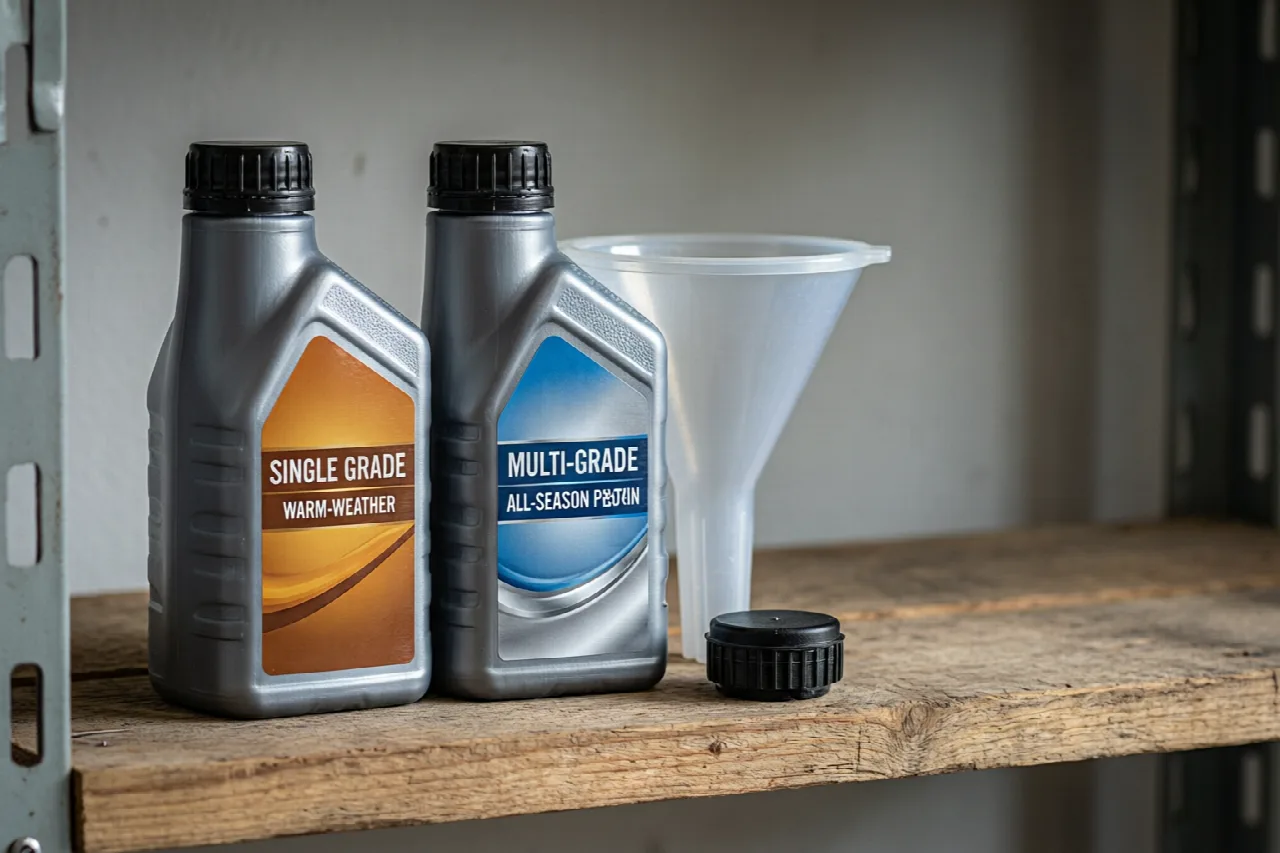
Craftsman lawn mowers generally accept a small range of oil viscosities, with SAE 30 and 10W-30 being the most common. Understanding the difference between these two options helps you choose the right one for your conditions.
SAE 30 is a single-viscosity oil designed for warmer temperatures. It provides excellent lubrication at operating temperatures and is the traditional choice for small air-cooled engines. However, SAE 30 becomes thicker in cold weather, which can make starting more difficult and reduce oil flow during warm-up. This oil is best suited for mowing season in moderate to warm climates where temperatures stay above freezing.
10W-30 is a multi-viscosity oil that performs well across a broader temperature range. The “10W” indicates its cold-weather performance, meaning it flows more easily at low temperatures than SAE 30. The “30” indicates it provides the same high-temperature protection as SAE 30. This makes 10W-30 a more versatile choice, particularly if you store your mower in an unheated space or mow in cooler spring and fall conditions.
Many modern Craftsman mowers, especially those with Briggs & Stratton engines, are now recommended to use 10W-30 for year-round use. Some engine manufacturers have moved away from SAE 30 entirely, citing improved cold-start performance and better protection during warm-up. If your engine label specifies one type, follow that recommendation rather than substituting.
Regarding synthetic versus conventional oil, both are acceptable for most Craftsman mowers. Synthetic oil offers better performance at extreme temperatures, improved resistance to breakdown, and often extends the interval between changes. However, it is more expensive. Conventional oil is perfectly adequate for most residential mowing applications and meets the requirements of most engine manufacturers. If you choose synthetic, ensure it has the same viscosity rating and API service classification recommended for your engine.
Oil Change Intervals and Capacity
Regular oil changes are essential for keeping your Craftsman lawn mower engine running smoothly and extending its lifespan. The frequency depends on your engine manufacturer and how often you mow.
For most Briggs & Stratton engines, the recommended interval is every 50 hours of operation or once per season, whichever comes first. Kohler engines typically follow a similar schedule, with some models recommending changes every 100 hours. If you mow a large property frequently, you may need to change the oil more than once per season. Conversely, if you mow a small yard only occasionally, an annual change is usually sufficient.
Always check your owner’s manual for the specific interval recommended for your engine model. Some newer engines with synthetic oil may have extended intervals, but do not assume this without checking the documentation.
Oil capacity varies significantly between mower types. Push mowers typically hold between 0.6 and 1 quart of oil, while riding mowers and lawn tractors generally hold between 2 and 4 quarts. Zero-turn mowers can hold even more, depending on the engine size. The exact capacity is printed in your owner’s manual and often on the engine label as well.
Overfilling the oil is a common mistake that can cause serious engine damage. When you add too much oil, the crankshaft can churn the oil into a foam, which reduces its lubricating properties and can cause the engine to overheat. Excess oil can also be forced past the piston rings into the combustion chamber, resulting in blue smoke and carbon buildup. If you suspect you have overfilled, drain the excess oil immediately and recheck the level with the dipstick.
When changing the oil, always use the correct capacity and check the level with the dipstick before starting the engine. Warm the engine briefly before draining to help the oil flow more easily, and dispose of used oil at a recycling center or auto parts store that accepts it.
Frequently Asked Questions
Can I use car oil in my Craftsman lawn mower?
You can use car oil if it meets the viscosity and API service classification recommended for your engine. However, many small engine manufacturers recommend against using energy-conserving oils designed for cars, as they may contain friction modifiers that can cause clutch slippage in some mower models.
What happens if I use the wrong viscosity oil?
Using the wrong viscosity can reduce engine performance and potentially cause damage. Oil that is too thick can make starting difficult and reduce flow to critical components. Oil that is too thin may not provide adequate protection at operating temperatures, leading to increased wear.
Do I need to change the oil filter when I change the oil?
Riding mowers and tractors typically have oil filters that should be replaced with each oil change. Push mowers generally do not have replaceable oil filters. Check your owner’s manual to confirm whether your model has a filter.
How do I dispose of used lawn mower oil?
Used oil should never be poured down drains, onto the ground, or into household trash. Collect it in a sealed container and take it to a local recycling center, auto parts store, or hazardous waste collection facility that accepts used motor oil.
Choosing the right oil for your Craftsman lawn mower comes down to following the manufacturer’s specifications for your specific engine. Whether you use SAE 30 or 10W-30, conventional or synthetic, the key is to use the correct viscosity for your climate and to change the oil at the recommended intervals. By checking your owner’s manual or engine label and maintaining proper oil levels, you can keep your mower running reliably for many seasons.