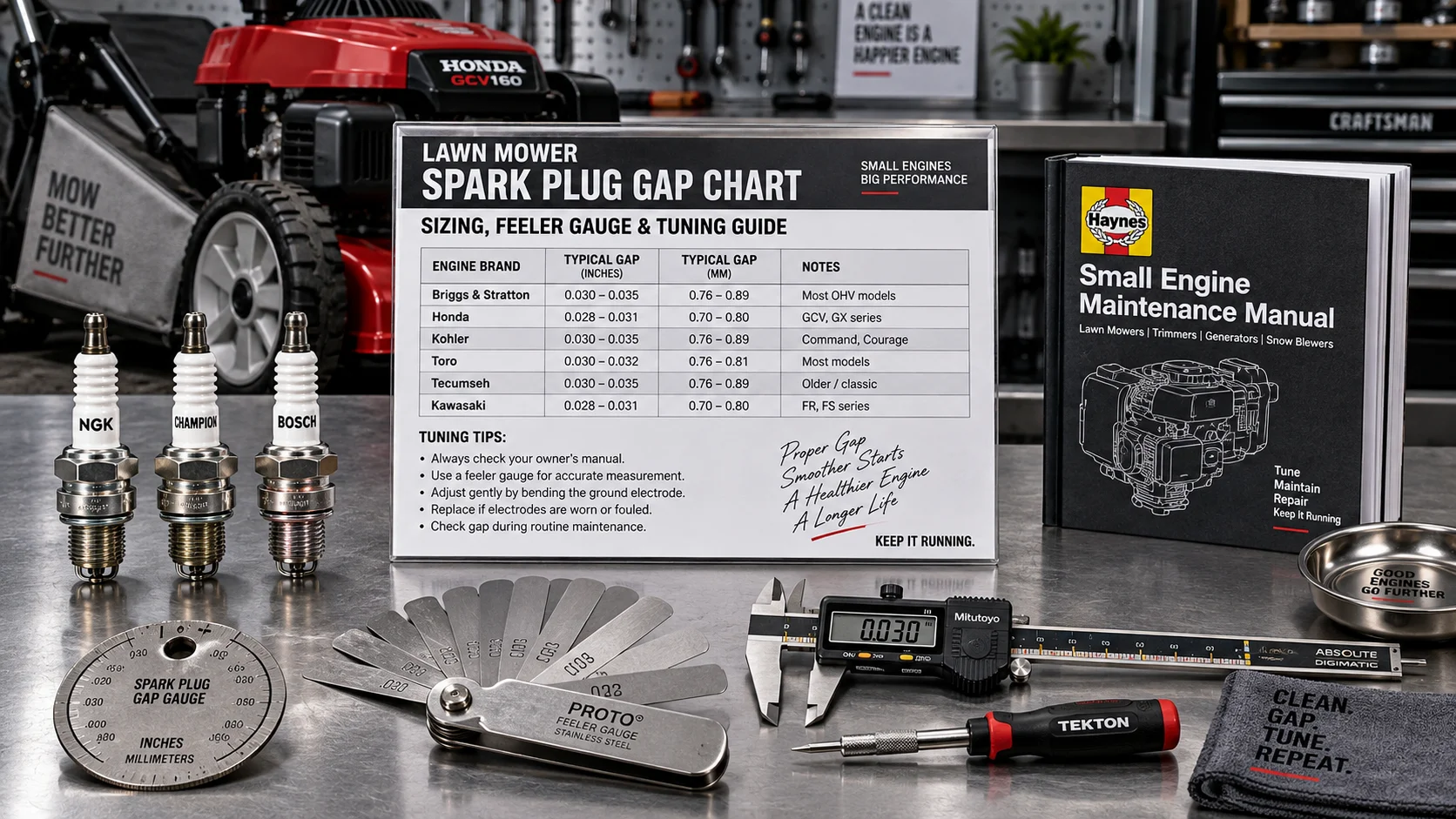
Quick Answer: Most lawn mower engines need a spark plug gap of 0.020 to 0.030 inches (0.50–0.76 mm). Briggs & Stratton small engines typically spec 0.030 in, Kohler engines commonly spec 0.030 in, and many Honda and generic push mowers run 0.028–0.030 in. Always confirm against your engine’s decal or manual, then set the gap with a wire feeler gauge — never a coin or a guess.
Lawn Mower Spark Plug Gap Chart (Quick Reference)
Use this diagnostic matrix as your starting point. Gap is measured cold, between the center electrode and the ground electrode, with the plug threads facing you.

The gap is the air space the ignition coil’s voltage must jump to create the spark. That distance controls two competing things: how much voltage is required, and how large and hot the spark kernel is. A wider gap needs more voltage to fire. A narrower gap fires easily but produces a weaker, smaller flame front that burns fuel less completely.
On a lawn mower, the ignition system is deliberately modest. There is no distributor, no knock sensor, and no computer trimming timing. The gap is your only mechanical tuning lever for ignition quality. Set it wrong and you get hard starting, surging, power loss in tall grass, or a plug that fouls within a season.
What Happens If the Gap Is Too Wide
- Hard starting, especially when hot or damp
- Misfire under load — the engine bogs in thick grass
- Coil stress and eventual coil failure
- Erratic idle and surging
What Happens If the Gap Is Too Narrow
- Weak spark and incomplete combustion
- Rough, lopey idle
- Rapid carbon fouling of the electrode
- Reduced fuel economy and more exhaust odor
How to Measure and Adjust Gap With a Feeler Gauge
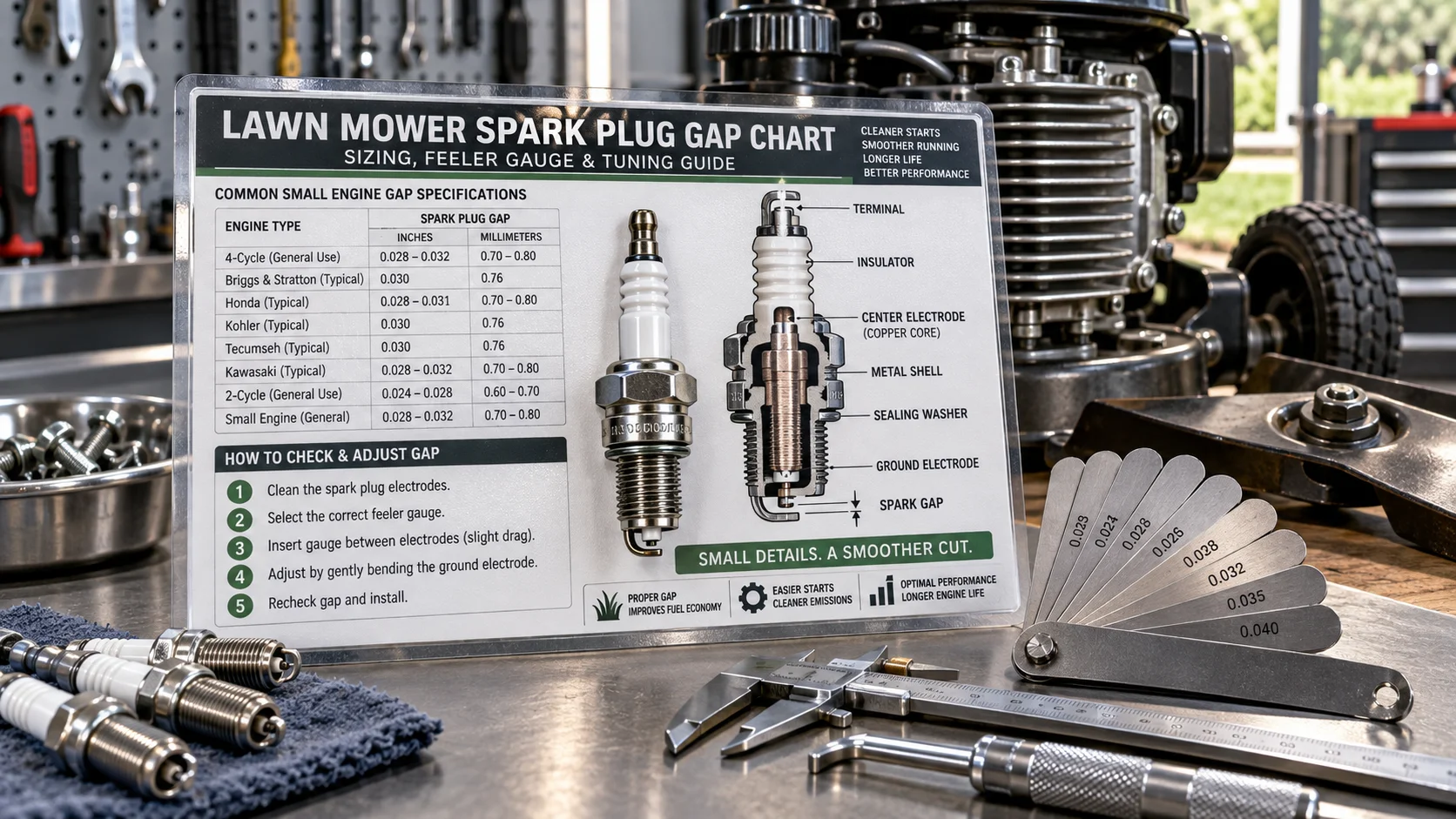
A feeler gauge spark plug adjustment is a two-minute job and the single most reliable DIY ignition tune. You want a wire-type gap gauge, not a flat blade gauge, because the wire slides cleanly between the electrodes and reads the true air gap.
Step-by-Step Adjustment
- Disconnect the spark plug boot and remove the plug with a 13/16 in (21 mm) or 5/8 in (16 mm) spark plug socket. Most mower plugs are 13/16 in.
- Inspect the electrode for wear, oil, or carbon before adjusting. If the center electrode is rounded or the ground electrode is eroded, replace the plug — do not gap a worn plug.
- Select the correct wire on your gauge matching your spec (e.g., 0.030 in).
- Slide the wire between the electrodes. It should drag with light friction. If it drops through freely, the gap is too wide. If it will not enter, the gap is too narrow.
- Adjust by bending only the ground (side) electrode using the gauge’s notch or a small flat tool. Never pry on the center electrode — you will crack the ceramic insulator.
- Re-check with the wire until it drags correctly, then reinstall and torque to roughly 15–20 ft-lb (hand-tight plus a firm snug — do not over-torque into an aluminum head).
Pro tip: gap the plug cold. Metal expands when hot, and a plug gapped hot will read narrow once it cools.
Briggs & Stratton Spark Plug Gap Specifics
Briggs & Stratton is the most common small engine in North America, and the good news is the spec is remarkably consistent: 0.030 in (0.76 mm) for the vast majority of four-stroke engines, from the classic flathead to modern OHV and Intek V-twins. The factory-recommended replacement is typically a Champion RC12YC (or the older RJ19LM / J19LM for flatheads).
Two exceptions worth knowing: some older flathead engines spec 0.020 in, and a few premium V-twin applications call for 0.030–0.040 in. The engine identification decal — usually on the blower housing or valve cover — is the final authority. If the decal is gone, look up the model and type number stamped on the engine.
Kohler Spark Plug Specs
Kohler spark plug specs are slightly more varied because Kohler builds several engine families. As a general guide:
- Command and Courage single-cylinder: 0.030 in (0.76 mm), Champion RC12YC or NGK BKR5E
- Command PRO and twin-cylinder: commonly 0.030 in, but some spec 0.040 in — verify per model
- Older K-series cast iron: often 0.025–0.030 in
Kohler engines are sensitive to plug heat range. Using a plug that is too hot can cause pre-ignition and pinging under load; too cold and it fouls. Match the reference number in your Kohler owner’s manual rather than substituting a random plug.
Champion vs NGK Mower Plugs
The Champion vs NGK mower plugs debate is mostly about brand loyalty, but there are real differences worth understanding.
| Factor | Champion | NGK |
|---|---|---|
| Common in | Briggs & Stratton, Kohler, Tecumseh | Honda, Kawasaki, many imports |
| Typical mower reference | RC12YC, RJ19LM | BPR6ES, BKR5E |
| Heat range feel | Generally matched to OEM spec | Slightly different numbering system |
| Availability | Excellent at big-box stores | Excellent online and at powersports shops |
| Best practice | Use the brand and number your engine maker specifies — cross-reference charts exist but heat ranges do not map 1:1 | |
Both brands make quality copper-core plugs. The mistake is cross-referencing by thread size alone. A Champion RC12YC and an NGK BKR5E are close cousins, but heat range and reach must match your engine. When in doubt, buy the OEM-specified plug.
Black Carbon Fouled Spark Plug Signs
Reading your plug tells you what the engine is doing. Black carbon fouled spark plug signs include a dry, sooty, matte-black coating on the insulator tip and electrodes. This is unburned fuel and carbon, and it points to one of several causes:
- Gap too narrow — weak spark cannot burn the mixture
- Rich fuel mixture — dirty air filter or stuck choke
- Wrong heat range — plug too cold for the engine
- Weak ignition coil — insufficient voltage
- Excessive idling — common on mowers run at low throttle
Contrast this with oil fouling (wet, shiny black — worn rings or valve guides) and ash deposits (tan/gray crusty — oil additives burning). A healthy mower plug reads light tan to gray-brown. If your plug is black and dry, clean or replace it, then fix the root cause — a new plug in a rich-running engine will foul again within hours.
When to Replace vs Re-Gap
Gapping is a maintenance adjustment, not a repair. Replace the plug if:
- The center electrode is rounded, pitted, or eroded
- The ceramic insulator is cracked or chipped
- The plug is oil-fouled or heavily carbon-fouled
- It has run a full season or more (copper plugs wear fast)
- The threads or gasket seat are damaged
For a mower used weekly, a fresh plug each spring is cheap insurance. Re-gapping is fine for a plug with a clean, square electrode that has simply drifted out of spec.
Recommended Hardware & Essential Equipment
Getting the gap right requires the right tools and a correctly specified plug. The verified units below cover the two most common failure points: an accurate wire gap gauge for precise adjustment, and a fresh OEM-spec replacement plug so you are not re-gapping a worn electrode. These solve the hardware problem directly — measure accurately, replace when worn, and your mower starts on the first pull.

Pros
- Fully waterproof and dustproof design means it can handle splashes, spills, and sandy environments.
- Long battery life provides extended playback for camping trips, backyard gatherings, or a full workday.
- Compact and lightweight at 1.21 pounds makes it easy to carry in a bag or clip to a backpack.
- PartyBoost compatibility offers a simple way to expand your sound system with other JBL speakers.
Cons
- As a renewed product, it may show minor cosmetic wear and does not come with the original manufacturer's full warranty.
- The 0 listed customer reviews for this specific renewed listing means there is no user feedback to gauge seller reliability or product condition.
The JBL Flip 6 (Renewed) is best for outdoor enthusiasts and casual listeners who want a proven, waterproof portable speaker at a reduced cost. Its IP67 rating and 12-hour battery are genuine advantages for poolside, hiking, or travel use. However, as a refurbished item, it is not ideal for buyers seeking a brand-new product with full manufacturer support, and the lack of reviews for this specific listing adds uncertainty about the seller's quality control.
Waterproof Rating: IP67 (dustproof and waterproof)
Battery Life: Up to 12 hours per charge
Dimensions: 2.8 x 7 x 2.6 inches
Weight: 1.21 pounds
Connectivity: Bluetooth wireless
Special Feature: PartyBoost for speaker pairing
Product prices and availability are accurate as of the date/time indicated and are subject to change. Any price and availability information displayed on Amazon.com at the time of purchase will apply. As an Amazon Associate we earn from qualifying purchases. Images, product titles, and product highlights from Amazon.
Next Step & Hardware Pairing: For recommended machine configurations and real-world durability tests, see our buyer guide on high-torque riding mowers.
Frequently Asked Questions
What is the spark plug gap for a Briggs & Stratton lawn mower?
Most Briggs & Stratton four-stroke engines spec 0.030 inches (0.76 mm). Some older flatheads call for 0.020 in. Always confirm on the engine decal or in your owner’s manual, since a few V-twin models differ.
Can I set the gap without a feeler gauge?
You can approximate it, but you should not. A wire feeler gauge costs a few dollars and reads the true air gap. Using a coin, a blade, or a visual guess produces an inaccurate gap that causes misfire or fouling. Buy the gauge — it pays for itself in one season.
Why does my mower spark plug keep fouling black?
Dry black carbon fou
For more hands-on benchmarks and buying recommendations, consult our guides on heavy-duty chainsaw buyer guide.