Quick Answer
The best backpack blower depends on property size and how long you work. Gas backpack models usually deliver the strongest airflow for large lots, and a well-balanced harness reduces fatigue during long sessions. Match airflow to yard size, check harness weight distribution and tube comfort, and confirm the noise level meets local rules before buying.

Pros
- High-output clearing power with a rated 88 m/s maximum blowing force
- Efficient Stihl 4-MIX engine designed for large-area clearing
- Integrated Stihl anti-vibration system reduces operator strain
- Adjustable blow tube and soft-grip handle
- Wide, padded shoulder straps enhance comfort during long jobs
Cons
- Substantial total weight of approximately 23.8 pounds
- Requires ongoing small-engine fuel mixing and routine upkeep

Pros
- Equipped with a 64.8cc 4-MIX gas engine
- Engineered for low vibration levels during prolonged wear
- Adjustable blower tube accommodates varied operator heights
- Durable backpack harness supports heavy-duty outdoor cleanups
Cons
- Weighs over 24 pounds before adding fuel
- Requires ongoing gas engine maintenance and fuel mixing
Pros
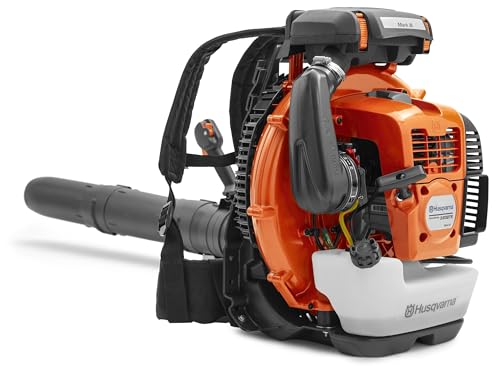
- Strong rated output of 1000 CFM, 220 MPH, and 47 N blow force
- Ventilated ergonomic harness with load-distributing hip belt
- Two-stage intake air filtration protects engine in dusty jobs
- Intuitive tube-mounted throttle control
Cons
- Substantial 34-pound weight can lead to operator fatigue
- Requires ongoing 2-cycle fuel mixing and maintenance
Why Backpack Blowers Outperform Handheld Units for Large Properties
A backpack blower transfers the engine and fuel mass from your arms to a hip-supported harness, allowing sustained operation across acre-scale properties without the forearm fatigue that limits handheld units to 15-20 minute sessions. The engineering advantage is simple: a 70cc-class engine produces 700-900 CFM of sustained airflow, but that output is only useful if the operator can carry it for two hours straight. The harness system is what makes that possible.
For context on how power classes compare across the entire category, our cordless leaf blowers guide covers the battery-powered equivalents, while this guide focuses on the gas-powered units that dominate professional landscaping. If you’re still deciding between platforms, the gas or electric leaf blower comparison breaks down the tradeoffs in detail.
Understanding CFM, MPH, and Newton Force: The Physics That Actually Matters
CFM (Cubic Feet Per Minute): Volume of Air Moved
CFM measures the volume of air the impeller displaces per minute. Higher CFM means more leaves and debris are moved per pass. For residential use, 600-700 CFM handles most half-acre lots with moderate leaf drop. Commercial properties and acre-plus lots with heavy oak or maple coverage require 800+ CFM to avoid multiple passes over the same area. To evaluate matched hardware tolerances, consult our detailed overview of how to choose leaf blower.
MPH (Miles Per Hour): Air Velocity at the Nozzle
MPH measures airspeed at the tube tip, which determines whether wet, matted, or layered debris breaks free. A blower rated at 270 MPH can lift damp leaves that a 150 MPH unit simply pushes around. However, MPH without adequate CFM produces a narrow, high-velocity stream that clears a small strip rather than a wide swath. The practical combination is high CFM paired with 180+ MPH.
Newton Force: The Manufacturer Metric That Predicts Real-World Performance
Newton (N) force is the most honest specification because it combines CFM and MPH into a single thrust measurement. Stihl and Husqvarna publish Newton ratings; many budget brands do not. A blower rated at 23N or higher will move wet leaves and pine straw that lower-rated units cannot. When comparing models across brands, look for Newton ratings first, then verify CFM and MPH as supporting data.
Top Backpack Blower Models: Technical Breakdown
Stihl BR 800 C-E Magnum: The Professional Standard
The BR 800 C-E remains the benchmark for professional-grade backpack blowers. Its 79.9cc engine produces 913 CFM and 238 MPH, with a maximum thrust rating that places it at the top of the class. The Easy2Start system reduces pull force by approximately 30% compared to standard recoil ignition, which matters during extended fall cleanup when cold starts happen multiple times per day. The anti-vibration system uses spring-isolated engine mounts to reduce operator fatigue during multi-hour sessions.
The tradeoff is weight: at approximately 24.3 pounds dry, it is heavier than mid-range units. The harness compensates with a wide hip belt that distributes load across the pelvis rather than the shoulders. Operators who run this unit for full commercial days report that the harness quality justifies the weight penalty.
Husqvarna 360BT: The Value Leader
The 360BT delivers 765 CFM and 270 MPH from a 65.6cc engine, making it one of the highest-velocity residential backpack blowers available. The air purge system primes the carburetor before starting, reducing the number of pulls required on cold mornings. At a lower price point than the Stihl BR 800, it offers comparable performance for homeowners who don’t need commercial-duty durability. The harness is adequate but not as refined as Stihl’s system for all-day use.
Echo PB-9010T: Maximum Raw Power
The PB-9010T uses a 79.7cc engine to produce 1006 CFM and 220 MPH, making it the highest-CFM backpack blower in its class. The tradeoff is tube stiffness: the standard tube is less flexible than Stihl’s, which increases wrist and forearm fatigue during extended use. For operators who prioritize raw moving capacity over ergonomics, this unit is hard to beat. For full-day commercial use, the tube design is a legitimate consideration.
Sizing Matrix: Matching Blower Power to Your Property
| Property Size | Leaf Density | Minimum CFM | Recommended Class | Example Models |
|---|---|---|---|---|
| Under 1/4 acre | Light (few trees) | 450-550 | Handheld or entry backpack | Battery handheld units |
| 1/4 to 1/2 acre | Moderate | 600-700 | Mid-range backpack | Husqvarna 350BT, Echo PB-580T |
| 1/2 to 1 acre | Moderate-heavy | 700-800 | Full-size backpack | Husqvarna 360BT, Stihl BR 600 |
| 1 to 2 acres | Heavy (oak, maple) | 800-900 | Commercial-grade backpack | Stihl BR 800 C-E, Echo PB-770T |
| 2+ acres | Heavy, mixed debris | 900+ | Top-tier commercial | Echo PB-9010T, Stihl BR 800 C-E |
For a deeper comparison of how backpack units stack up against handheld alternatives across these property sizes, see our backpack vs handheld blowers analysis.
Diagnostic Matrix: Troubleshooting Common Backpack Blower Problems
Problem: Blower Starts but Loses Power Under Load
Root cause: Air filter restriction or fuel system contamination. A clogged air filter reduces the air-fuel mixture ratio, causing the engine to run rich and lose top-end power. This is the most common cause of performance degradation in units that have been in service for more than one season.
Diagnostic steps:
- Remove the air filter cover and inspect the filter element. If it is visibly darkened or clogged with debris, replace it immediately.
- Check the fuel filter (in-tank pickup filter) for clogging. Replace annually or every 100 operating hours.
- Inspect the spark arrestor screen on the exhaust port. Carbon buildup here restricts exhaust flow and reduces power.
- If the carburetor has a high-speed adjustment needle, verify it is set to the factory specification (typically 1 to 1.5 turns out from seated).
Problem: Difficult Cold Starts Despite Good Compression
Root cause: Fuel staleness or primer bulb failure. Two-stroke fuel degrades within 30 days if stored without stabilizer. Ethanol-blended fuel absorbs moisture, causing phase separation that blocks the carburetor’s low-speed circuit.
Diagnostic steps:
- Drain the fuel tank completely and inspect the fuel for discoloration or a sour smell. Replace with fresh fuel mixed at the correct ratio (typically 50:1 for most modern two-stroke engines).
- Inspect the primer bulb for cracks or hardening. A compromised bulb fails to draw fuel into the carburetor, requiring excessive priming or choking.
- Verify the choke engages fully. A partially engaged choke provides an overly rich mixture that floods the engine rather than aiding starting.
- Check the spark plug electrode condition. A fouled plug (wet with fuel or covered in carbon) should be replaced with the correct heat range specified by the manufacturer.
Problem: Excessive Vibration During Operation
Root cause: Impeller imbalance or loose engine mounts. A bent or damaged impeller blade creates rotational imbalance that transmits vibration through the frame. Loose anti-vibration spring mounts allow direct engine-to-frame contact.
Diagnostic steps:
- Inspect the impeller through the intake opening for visible damage, debris accumulation, or bent blades. Do not attempt to straighten a damaged impeller; replace it.
- Check all anti-vibration spring mounts for proper seating and tension. Replace any springs that appear compressed or deformed.
- Verify that all housing fasteners are torqued to specification. Loose fasteners create harmonic vibration that compounds over time.
Maintenance Intervals: Protecting Your Investment
| Component | Inspection Interval | Replacement Interval | Failure Mode if Neglected |
|---|---|---|---|
| Air filter | Every use | Every 25-50 hours or when visibly clogged | Power loss, rich running, engine wear |
| Fuel filter (in-tank) | Monthly | Annually | Hard starting, fuel starvation under load |
| Spark plug | Every 25 hours | Every 100 hours | Hard starting, misfires, reduced power |
| Spark arrestor screen | Every 50 hours | When carbon-blocked | Exhaust restriction, power loss, overheating |
| Fuel lines | Every 50 hours | Every 2-3 seasons | Cracks cause air leaks and lean running |
| Impeller | Every 100 hours | When damaged or imbalanced | Vibration, reduced airflow, housing damage |
| Harness straps | Every use | When frayed or hardware fails | Operator fatigue, improper weight distribution |
For general chainsaw and outdoor power equipment maintenance procedures that apply across tool categories, our chainsaw and outdoor tool maintenance guide covers the fundamentals.
Harness Setup: The Step Most Operators Get Wrong
Improper harness adjustment is the leading cause of back and shoulder fatigue during extended blower use. The correct sequence is specific and should be followed every time you put the unit on:
- Loosen all shoulder straps and the hip belt completely before lifting the blower.
- Lift the blower onto your back using your legs, not your back, and settle it so the base sits on your lower back/hip area.
- Tighten the hip belt first until it is snug on your iliac crest (the top of your hip bones). The hip belt should carry 60-70% of the unit’s weight.
- Tighten the shoulder straps until the blower is held firmly against your back without gaps. The straps should not bear the primary load.
- Adjust the throttle tube angle so it points downward at approximately 45 degrees, allowing a neutral wrist position during operation.
Proper harness setup reduces perceived weight by 30-40% compared to a loose or improperly adjusted system. If your unit’s harness does not include a wide hip belt, consider upgrading to an aftermarket padded belt before the fall season.
Noise Regulations and Community Considerations
Backpack blowers typically operate between 95 and 110 dB(A) at the operator’s ear. Many municipalities restrict leaf blower use to specific hours (commonly 8 AM to 6 PM on weekdays) and some ban two-stroke engines entirely in residential zones. Before purchasing, verify local ordinances. Battery-powered units in the 60-75 dB(A) range may be the only compliant option in restricted areas. The OSHA equipment safety regulations provide the federal framework for occupational noise exposure limits that apply to commercial landscaping operations.
Final Recommendation by Use Case
For Homeowners with 1/2 to 1 Acre
The Husqvarna 360BT offers the best balance of power, weight, and price. Its 765 CFM and 270 MPH handle most residential leaf loads without the commercial-grade weight penalty of larger units.
For Commercial Landscapers
The Stihl BR 800 C-E Magnum is the standard for a reason. The Easy2Start system, anti-vibration harness, and 913 CFM output justify the premium price for operators who run the unit daily. The Echo PB-9010T is the alternative when raw CFM output is the priority and tube ergonomics are secondary.
For Noise-Restricted Areas
Battery-powered backpack blowers in the 60-75 dB(A) range are the only viable option where two-stroke engines are banned. Performance has improved significantly, but runtime remains limited compared to gas. Carry multiple batteries for properties over half an acre.
Backpack Blowers and Comfort
Backpack blowers move the weight to your back and hips, which can make long sessions more comfortable on large lots. Look for padded straps and a sensible harness fit. General safety notes for outdoor power equipment are at American National Standards Institute (ANSI).