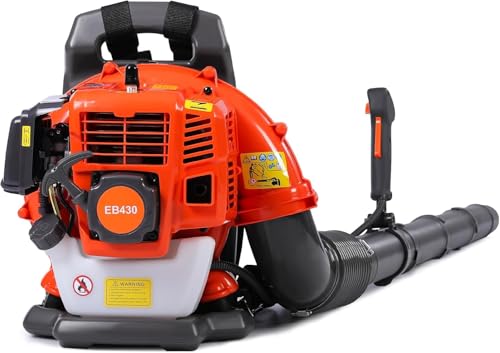
For homeowners and property managers tackling dense leaf accumulation, standard handheld or backpack blowers often lack the continuous volume needed to sweep broad lawns. A wheeled walk behind blower delivers significantly higher airflow—often exceeding 1,200 CFM—though it requires manual pushing effort across uneven ground and takes up considerably more storage space in a garage or shed.

Pros
- Powerful 7HP 212cc 4-stroke OHV gas engine
- Heavy-duty 13.5-inch metal impeller
- 360° front swivel wheel and 10-inch rear wheels
- 90° adjustable airflow output angle
- Rust-resistant powder-coated steel frame
Cons
- Engine oil is not included upon unboxing
- Manual push operation requires physical effort
- Gasoline and oil maintenance required
Pros
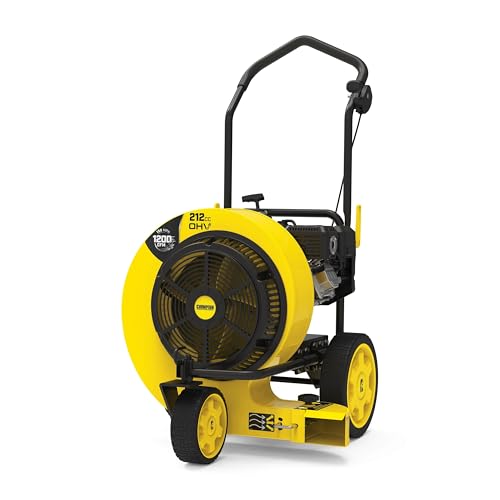
- Rated for up to 1200 CFM of air volume
- 3-position wind vane plus forward air attachment
- Large 12-inch never-flat rear wheels
- Lockable 360-degree front swivel wheel
- Ergonomic handle features height adjustment
Cons
- Weighs 104 pounds without power propulsion
- Gas engine requires fuel and oil upkeep
- Bulky frame requires ample storage space

Pros
- High-volume clearing with a rated 3000 CFM and 207 MPH
- Electric start eliminates manual pulling effort
- Standard clevis pin hitch connects easily to ATVs and tractors
- Adjustable vertical airflow discharge for directed blowing
- Durable steel frame construction with large wheels
Cons
- Requires a towing vehicle like an ATV or lawn tractor
- Weighs 291 pounds and demands significant storage space

Pros
- Produces up to 1270 CFM airflow and 150 MPH wind speed
- Runs on standard unleaded 87-octane gasoline with no oil mixing
- 360-degree front swivel wheel and 12-inch rear wheels for steering
- 90-degree adjustable flow angle directs debris where needed
- Convenient handle-mounted controls for speed adjustment
Cons
- Manual push design requires physical effort on uneven ground
- Bulky footprint requires dedicated garage or shed storage

Pros
- 212cc 4-stroke engine delivers up to 1200 CFM
- Durable 13-inch steel impeller with welded blades
- Adjustable airflow: level, 15° up, or 15° down
- Includes front air deflector and engine oil
- 8-inch 360° swivel wheel with 12-inch rear wheels
Cons
- Manual-push machine weighing 88 pounds
- Requires ongoing 4-stroke engine maintenance
- Large footprint takes up significant garage space

Pros
- 209cc engine rated up to 1200 CFM and 150 MPH
- 7-position air flow angle control lever
- 8-inch front swivel caster and 12-inch rear wheels
- Variable throttle control for speed and volume
- Includes removable forward/side discharge chute
Cons
- Heavy 82-pound unit requires manual pushing
- Listing features conflicting engine cycle specs
- Gasoline engine requires regular maintenance

Pros
- 7HP 209cc 4-stroke engine delivers up to 1270 CFM
- Lightweight 14.2-inch plastic impeller design
- 12-inch rear wheels paired with 8-inch swivel caster
- Rust-resistant powder-coated steel frame
- Adjustable airflow angle for targeted blowing
Cons
- Requires manual propulsion across turf
- Plastic impeller may be vulnerable to hard debris
- Routine gas engine maintenance required
Airflow Volume Versus Velocity: Why 1200+ CFM Matters
Cubic feet per minute (CFM) measures the overall volume of air a machine moves, whereas miles per hour (MPH) indicates how fast that air exits the nozzle. For sweeping large open spaces and deep leaf piles, high CFM is the deciding metric because it pushes broad swaths of debris at once rather than simply carving narrow paths.
Most walk behind units in this category utilize engines ranging from 209cc to 212cc (roughly 7 horsepower), generating advertised airflow between 1,200 and 1,270 CFM alongside wind speeds of 150 MPH. For instance, the Landworks Leaf Blower Wheeled Walk Behind Jet advertises 1270–2000 CFM and 150–200 MPH from its 212cc 4-stroke OHV motor paired with a 13.5-inch metal impeller. The trade-off for this high-volume output is weight; moving an all-steel blower across soft or sloping turf requires physical exertion, making it less practical for intricate garden beds where a small rechargeable leaf blower might suffice.
Push Maneuverability: Wheel Dimensions and Swivel Casters
Maneuvering a heavy walk behind blower depends primarily on rear wheel diameter and front wheel mechanics. Without self-propulsion, larger rear wheels reduce rolling resistance over bumpy lawns, gravel pathways, and thick turf.
Machines like the BILT HARD 212cc Gas Walk Behind Leaf Blower and SuperHandy Walk Behind Leaf Blower utilize 12-inch rear wheels alongside an 8-inch 360-degree front caster wheel. The front swivel wheel lets you pivot effortlessly around trees, fence lines, and curves. However, caster wheels can wander when traversing side slopes; to counteract this, models such as the Champion Power Equipment 212cc 1200 CFM provide the option to lock the front wheel in place, giving you straight-line tracking over rough ground at the cost of quick pivoting.
Chute Adjustment: Directional Deflectors and Flow Angle
Air discharge direction dictates whether you blow debris into neat windrows or scatter it uncontrollably. Having a versatile chute mechanism allows you to switch between lateral clearing and forward sweeping.
The Yardmax Gas Walk-Behind Blower, Orange, (YF1565) features a 7-position handle controlling the outward angle—allowing horizontal, upward, or downward pitches—plus a removable deflector adapter to send air straight ahead. Similarly, the BILT HARD 212cc Gas Walk Behind Leaf Blower offers 15-degree upward and downward tilt plus an included front deflector. Aiming downward helps dislodge wet, matted leaves, while an upward angle lifts dry leaves into a traveling pile. The limitation is that manual chute adjustments require stopping your forward pace to adjust pins or levers, unlike expensive commercial machines with remote fingertip controls.
Champion 212cc Versus BILT HARD 212cc: Air Control and Features
Comparing the Champion Power Equipment 212cc 1200 CFM and the BILT HARD 212cc Gas Walk Behind Leaf Blower reveals two distinct approaches to ergonomics and accessories within the 212cc displacement class.
Both models deliver an advertised 1200 CFM output and feature a 3-position wind vane (level, 15 degrees up, 15 degrees down) alongside forward-flow attachments. The Champion blower emphasizes operator comfort with a soft-grip, height-adjustable handle to reduce back fatigue, paired with a lockable front caster wheel and a 2-year limited warranty. On the other hand, BILT HARD focuses on out-of-the-box readiness, including engine oil, mounting hardware, a spark plug wrench, and a 13-inch steel impeller featuring four welded blades. Buyers prioritizing warranty support and handlebar customization may favor Champion, while those seeking a complete package with supplied maintenance essentials may prefer BILT HARD.
Walk-Behind Versus Tow-Behind: Sizing Up Your Acreage
Property size determines whether a manual walk behind unit is practical or whether a tow-behind model is a necessary upgrade. If your yard spans multiple acres, pushing a heavy machine can quickly lead to exhaustion.
For expansive properties, the SuperHandy Tow-Behind Leaf Blower bypasses foot propulsion entirely by utilizing a standard clevis pin hitch that connects to ATVs, lawn tractors, or utility carts. Equipped with a massive 15HP engine, electric start, and an 18-inch metal impeller, it advertises up to 3000 CFM and 207 MPH. The downside is clear: weighing in at 291 lbs and commanding a higher price tag ($1,535.94), it is impractical for standard suburban yards or tight residential boundaries. Homeowners with typical half-acre to one-acre properties will find standard walk behind blowers much more nimble and economical for routine leaf blower for driveway and turf clearing.
Frequently Asked Questions About Walk Behind Blowers
What kind of fuel do walk behind gas blowers require?
Most 4-stroke walk-behind blowers in this class, such as models from Landworks and SuperHandy, run on standard unleaded 87-octane gasoline with 10% or less ethanol. Four-stroke engines require separate crankcase oil, which must be added before initial startup.
How does an adjustable front wheel improve handling on uneven ground?
A 360-degree front caster wheel allows tight pivoting around garden beds and trees on flat surfaces. Some models let you lock the front wheel straight, which helps maintain a steady line across sloped or rough turf without veering off course.
Are walk behind blowers self-propelled?
The standard walk behind models listed here are push-propelled, relying on large 10-inch to 12-inch rear wheels to roll smoothly across lawns. True self-propelled drive is not included, though tow-behind options attach directly to lawn tractors or ATVs for larger properties.
Which Walk Behind Blower Should You Choose?
When selecting the right model, consider your yard size, terrain slope, and how much manual pushing you are willing to do. If you have flat to gently rolling residential acreage, the Champion Power Equipment 212cc 1200 CFM stands out as a reliable choice thanks to its lockable front wheel, adjustable ergonomic handle, and robust warranty backing. Its primary limitation is that pushing a 1200 CFM gas-powered frame requires sustained physical effort across thick grass. For property owners maintaining multi-acre parcels, farms, or commercial grounds who want to avoid manual pushing altogether, the tow-behind SuperHandy Tow-Behind Leaf Blower serves as the heavy-duty alternative, trading tight maneuverability and low cost for tractor-pulled 3000 CFM clearing power.