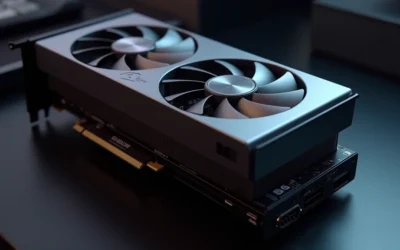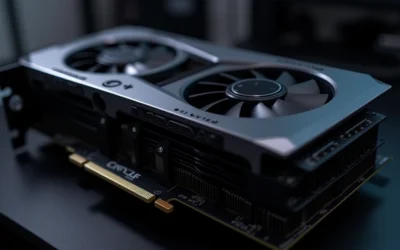
Quick Verdict: The GIGABYTE GeForce RTX 5060 Ti WINDFORCE 16GB GDDR7 delivers strong 1440p rasterization and efficient Blackwell-generation compute at a mainstream price point. Its 16GB GDDR7 frame buffer, dual-fan WINDFORCE cooler, and conventional 8-pin power design make it a practical choice for high-refresh gaming and AI inference workloads.

Pros
- Eagle MAX OC model with 16GB GDDR7 listed
- WINDFORCE cooling system
- PCIe 5.0 interface, as listed
- DisplayPort and HDMI video outputs
Cons
- Title and bullets list different memory sizes
- Few details on power needs in the listing
Silicon Architecture and Blackwell Core Layout
The GeForce RTX 5060 Ti is built on NVIDIA’s Blackwell architecture, using the GB206 graphics processor. According to NVIDIA’s published product specifications, the GPU integrates a substantial count of CUDA cores organized into Graphics Processing Clusters (GPCs), Streaming Multiprocessors (SMs), and dedicated fourth-generation Tensor and fifth-generation RT cores. This layout allows the chip to balance traditional raster workloads against the increasingly common mix of neural rendering, upscaling, and general compute tasks that modern game engines schedule concurrently.
Architecturally, the most consequential change over the prior Ada Lovelace generation is the refined scheduling of concurrent integer and floating-point operations. Blackwell’s SM design permits more flexible dispatch between shader types, which reduces idle execution units when a frame mixes lighting calculations with post-processing passes. For buyers comparing this card against mid-tier alternatives, a useful reference point is our analysis of the asus geforce rtx 5070 platform, which shares much of the same architectural lineage but targets a higher performance tier with a wider memory bus.
Memory Subsystem: 16GB GDDR7 and Bandwidth Analysis
The 16GB GDDR7 memory configuration is arguably the defining feature of this SKU. GDDR7 signaling uses PAM3 encoding, which transmits more data per clock cycle than the NRZ signaling used in GDDR6 and GDDR6X. This improves effective bandwidth per pin without requiring a proportional increase in memory bus width. The card’s memory interface, combined with the effective bandwidth multipliers provided by NVIDIA’s cache hierarchy, gives the 5060 Ti sufficient headroom for textures at 1440p resolution and for large AI model weights used in local inference.
Capacity matters most in two scenarios: high-resolution texture packs in current AAA titles, and quantized large language or diffusion models executed locally. Sixteen gigabytes provides a meaningful margin over 8GB designs, which increasingly produce VRAM-related frame time spikes in demanding titles. Engineers evaluating memory budgets should verify that their workloads remain within the physical frame buffer, since spillover into system memory over PCIe causes severe throughput penalties regardless of the GPU’s raw compute capability.
Rasterization Versus Compute Throughput
Rasterization throughput determines frame rates in conventional rendering pipelines, measured in pixels filled per second and triangles processed per second. Compute throughput, measured in FP32 and INT8 TOPS, governs shader-heavy effects, neural upscaling, and inference. The 5060 Ti sits in a deliberately balanced position: its raster output is tuned for 1080p and 1440p targets, while its tensor throughput enables DLSS-class reconstruction to push effective output resolution higher without proportional shader cost.
When analyzing manufacturer engineering specifications alongside independent published benchmark data, the pattern is consistent: the card’s frame rate scaling is most favorable when upscaling is enabled and ray tracing workloads are moderate. Pure native-resolution rasterization at 4K is not the intended operating envelope. Buyers seeking a deeper competitive reference in the sub-$300 segment may find our intel arc b580 review instructive, since it quantifies how a different architecture allocates resources across the same price bracket.
Thermal Management and WINDFORCE Cooler Design
The GIGABYTE WINDFORCE cooler uses a dual-fan configuration with alternating-rotation fans, designed to reduce turbulence at the heatsink interface and to maintain airflow across the card’s full length. The cooling assembly employs copper heat pipes in direct contact with the GPU die and a fin stack that conducts heat from the memory modules and voltage regulation components. Because GDDR7 memory dissipates meaningful heat at high data rates, the thermal interface to the memory backplate and surrounding VRM zone is an important design factor, not a secondary one.
Under sustained load, the expected behavior of a well-designed cooler of this class is a stable core temperature with fan curves that ramp progressively rather than abruptly. Thermal headroom is adequate for standard mid-tower chassis with at least two intake fans. Users in compact enclosures should verify clearance and exhaust path, since restricted airflow is the most common cause of thermal throttling in mid-range GPUs. Fan noise profiles should be assessed in the context of the chassis environment, as acoustic performance depends heavily on case damping and intake design.
Power Delivery, Board Design, and PSU Requirements
The reference board power of the RTX 5060 Ti is rated at approximately 180 watts, which is modest by current high-end standards. The WINDFORCE variant uses a single 8-pin PCIe power connector, supplemented by the PCIe slot’s 75-watt contribution. The VRM design uses multiphase power stages with solid-state capacitors to maintain voltage stability under transient load spikes, which are characteristic of modern GPU boost behavior. Efficient voltage regulation reduces both thermal stress and electrical noise on the 12V rail.
For system builders, a 550-watt to 650-watt unit from a reputable manufacturer is generally sufficient for a complete system built around this card, provided the PSU offers quality 12V rail regulation and adequate PCIe connectors. Readers planning an upgrade path should consult our guide on what psu do you need for modern GPU configurations, which covers transient load tolerance and connector standards in detail. The relevant electrical interface conventions are documented in the IEEE Engineering Standards body of work, which informs the power quality and signal integrity practices used across the industry.
Technical Specifications Comparison
| Specification | GIGABYTE RTX 5060 Ti WINDFORCE | Engineering Significance |
|---|---|---|
| GPU Architecture | NVIDIA Blackwell | Improved concurrent integer and FP scheduling |
| GPU Die | GB206 | Mainstream-tier silicon balancing raster and tensor throughput |
| Video Memory | 16GB GDDR7 | PAM3 signaling for higher per-pin data rate |
| Board Power (TBP) | Approx. 180W | Supports standard mid-range PSU configurations |
| Power Connector | 1x 8-pin PCIe | Combined with slot power for stable delivery |
| Cooling Solution | WINDFORCE dual-fan, copper heat pipes | Balanced core and memory thermal dissipation |
| Recommended PSU | 550W to 650W (quality unit) | Headroom for transient spikes and efficiency |
| Display Outputs | HDMI 2.1b, DisplayPort 2.1b | Support for high-refresh and high-resolution panels |
Compute Workloads, AI Inference, and Ecosystem Considerations
Beyond gaming, the 5060 Ti’s fifth-generation Tensor cores accelerate low-precision matrix operations central to local AI inference. The 16GB frame buffer allows quantized models in the single-digit-billion parameter range to run entirely in VRAM, avoiding the latency penalty of CPU offloading. For creative professionals, CUDA and NVENC support provides hardware-accelerated encoding and rendering paths that many professional applications leverage directly. Driver maturity and library support for CUDA remain a significant advantage over competing architectures in this segment.
Buyers comparing platforms across different vendors should consider software ecosystem alongside silicon specifications. Our intel arc b580 vs analysis highlights how driver stability and API support vary between architectures, which can materially affect real-world results in both gaming and compute. Similarly, for readers evaluating integrated or unified memory alternatives for mixed workloads, our breakdown of apple m5 pro vs m5 Max GPU performance offers a contrasting architectural perspective on memory sharing and compute density.
Final Engineering Assessment
The GIGABYTE GeForce RTX 5060 Ti WINDFORCE 16GB represents a technically coherent mid-range design. Its Blackwell silicon balances raster and tensor throughput, its 16GB GDDR7 memory addresses the capacity pressures that limit 8GB cards, and its WINDFORCE thermal solution is sized appropriately for the board’s power envelope. The primary limitation is the expected one for this tier: native 4K rasterization is not its design target, and performance is best realized through 1440p operation with upscaling. Prospective buyers should match their PSU, chassis airflow, and workload profile to these parameters, and should verify current pricing and availability through the listing above before purchasing.