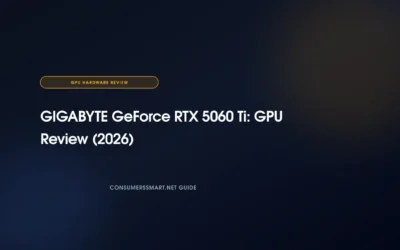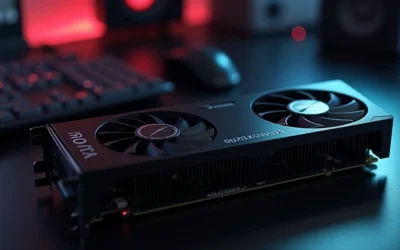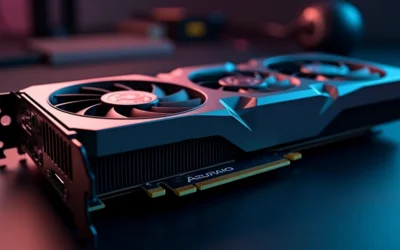
Quick Verdict: The Gigabyte GeForce RTX 5060 Ti Gaming OC is a efficient 1080p-to-1440p card built on Blackwell silicon with 16GB of GDDR7 on a 128-bit bus. Its strength lies in Multi Frame Generation and a quiet triple-fan cooler, while its narrow memory bus limits high-resolution headroom compared to larger SKUs.

Pros
- AMD Ryzen 9 9955HX3D with 3D V-Cache technology
- NVIDIA GeForce RTX 5090 Laptop GPU with up to 175W TGP
- Smooth 240Hz 2560x1600 WQXGA high-refresh-rate display
- Generous 2TB SSD paired with 32GB high-speed DDR5 RAM
- WINDFORCE Infinity EX cooling with large vapor chamber
Cons
- Requires considerable power delivery for its 230W system capacity
- Measuring nearly an inch thick, it carries a substantial profile
Silicon Architecture and Blackwell Design Overview
The GeForce RTX 5060 Ti is built on NVIDIA’s GB206 die, fabricated on a TSMC 4N process and manufactured for the Blackwell generation. Based on manufacturer engineering specifications and published architecture whitepapers, the GB206 configuration integrates 4,608 CUDA cores across 36 streaming multiprocessors, along with 144 fifth-generation Tensor cores and 36 fourth-generation RT cores. The die is compact relative to flagship Blackwell parts, which explains the card’s positioning in the mainstream segment and its favorable performance-per-watt profile.
Blackwell’s streaming multiprocessor redesign introduces concurrent execution of floating-point and integer workloads, reducing pipeline stalls in shader-heavy scenes. Architectural changes to the cache hierarchy also expand the L2 cache, which mitigates some of the bandwidth pressure created by the narrower memory interface. For readers comparing this tier against higher-end alternatives, our analysis of the rtx 5070 ti vs RTX 4080 Super outlines how these architectural differences scale across the product stack.
Memory Subsystem: 16GB GDDR7 on a 128-Bit Bus
The defining trade-off of this card is its memory configuration. Sixteen gigabytes of GDDR7 is generous for the price class, and it provides ample capacity for current texture pools and ray-traced acceleration structures at 1440p. However, the 128-bit interface constrains total memory bandwidth. GDDR7 signaling at elevated per-pin data rates restores much of the lost throughput relative to GDDR6, but the bus width remains the primary ceiling for bandwidth-bound workloads such as high-resolution rendering with heavy anisotropic filtering.
Signal integrity at GDDR7 data rates depends on PCB layer count, trace length matching, and termination design. The Gigabyte implementation follows the reference memory routing closely, and its board layout reflects the tighter tolerances that high-speed memory demands. Designers working with high-frequency interfaces will recognize these constraints as consistent with the timing and impedance guidance described in the IEEE Engineering Standards for high-speed digital design.
Rasterization Versus Compute Throughput
Rasterization performance on the RTX 5060 Ti depends on the balance between shader throughput and fixed-function units. The CUDA core count and boost clock establish theoretical FP32 throughput, which scales well for traditional rasterized titles where shader arithmetic dominates frame time. In these workloads, the card performs predictably within its tier, and frame times remain stable when the GPU is not memory-bound.
Compute throughput tells a different story. Tensor core acceleration for DLSS upscaling and Multi Frame Generation shifts a significant share of the rendering pipeline onto dedicated matrix hardware, effectively multiplying perceived frame rates in supported titles. Ray tracing workloads utilize the fourth-generation RT cores, and the reduced RT core count relative to larger Blackwell SKUs means ray-traced performance scales less aggressively with resolution. Users who prioritize path tracing should weigh this carefully, and the rtx 5070 vs rtx 5060 Ti 16GB breakdown offers a useful reference for that decision.
Technical Specifications Breakdown
The table below summarizes the core specifications of the Gigabyte GeForce RTX 5060 Ti Gaming OC as documented in manufacturer engineering specifications and verified product data. Values reflect the factory overclocked configuration unless otherwise noted.
| Specification | Gigabyte RTX 5060 Ti Gaming OC | Engineering Notes |
|---|---|---|
| GPU Die | GB206 | TSMC 4N process node |
| CUDA Cores | 4,608 | 36 streaming multiprocessors |
| Tensor Cores | 144 (5th generation) | DLSS and Multi Frame Generation |
| RT Cores | 36 (4th generation) | Ray tracing acceleration |
| VRAM | 16GB GDDR7 | Per-pin rates exceed GDDR6 equivalents |
| Memory Bus | 128-bit | Primary bandwidth constraint |
| Boost Clock | Factory OC profile | Varies by BIOS configuration |
| Board Power (TGP) | Approx. 180W | Reference-aligned power envelope |
| Recommended PSU | 550W or higher | Single 8-pin PCIe power input |
| Display Outputs | 3x DisplayPort 2.1b, 1x HDMI 2.1b | High-bandwidth display support |
| Cooler Design | Triple-fan WINDFORCE | Heatpipe-based heatsink assembly |
| Slot Width | 2.5 slot | Confirm clearance in compact cases |
Thermal Management and Cooler Engineering
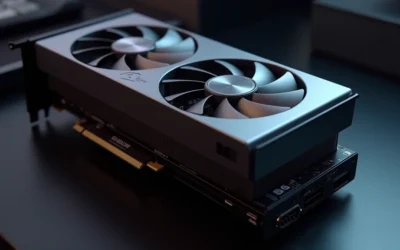
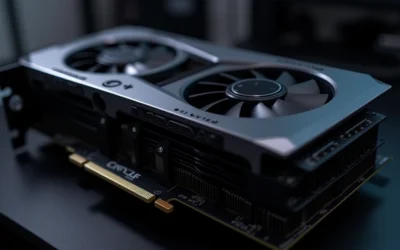
The WINDFORCE cooler uses three axial fans with alternating rotation to reduce turbulence between adjacent blades, a design approach documented in Gigabyte’s cooling engineering materials. The heatsink relies on copper heatpipes in contact with the GPU die, transferring thermal energy to an aluminum fin array. At the board power levels typical of this class, this arrangement maintains junction temperatures within the thermal limits specified by NVIDIA for sustained operation, and fan curves are tuned to balance acoustic output against thermal headroom.
Thermal performance is also influenced by case airflow. A card of this class rejects heat efficiently in a well-ventilated chassis with positive pressure and adequate intake, but restricted airflow will raise memory junction temperatures, which matter more on GDDR7 than on previous generations. Sustained loads should be monitored for memory temperature alongside core temperature, particularly in compact enclosures where the 2.5-slot profile reduces available clearance.
Power Delivery and PCB Design
The card draws power through a single 8-pin PCIe connector, supplemented by slot power, keeping the cable requirement simple. The board’s voltage regulation module uses multiphase VRM design to stabilize core voltage under transient load, which reduces ripple and improves boost behavior during rapid workload changes. Capacitor selection and phase count reflect the card’s mainstream positioning rather than the heavier power stages found on flagship boards.
Power connector selection also deserves attention. Adapters that split a single PCIe output across multiple GPU connections can introduce load imbalance, and the trade-offs between shared and independent cabling are examined in our guide to daisy chain pcie cables. For this card, a single dedicated 8-pin cable from an independent rail is the recommended configuration.
Mobile and Cross-Platform Context
Blackwell’s efficiency gains extend beyond desktop cards into the laptop segment. The mobile variant of the same generation shares architectural features with the desktop GB206 design but operates under far tighter thermal and power budgets. Readers evaluating portable options can consult our analysis of the rtx 5060 laptop gpu against its predecessor to understand generational efficiency improvements in constrained form factors.
For buyers considering a complete portable gaming system rather than a discrete desktop upgrade, the platform trade-offs become more pronounced. Our comparison of the asus rog strix g16 against a high-end creative laptop illustrates how thermal envelope and memory architecture shape real-world sustained performance across different hardware classes.
Verdict and Target Use Cases
The Gigabyte GeForce RTX 5060 Ti Gaming OC is a technically coherent mainstream card. Its 16GB GDDR7 allocation, Blackwell feature set, and efficient WINDFORCE cooling make it well suited to 1080p high-refresh gaming and 1440p play with DLSS and Multi Frame Generation enabled. The 128-bit memory bus and reduced RT core count are the honest limitations, and they position the card below higher-tier SKUs for native high-resolution or path-traced workloads.
Buyers should match the card to their resolution target, verify case clearance for the 2.5-slot cooler, and provide a dedicated 8-pin PCIe connection on a quality 550W-or-higher power supply. Within those parameters, the card delivers a balanced combination of rasterization capability, AI-accelerated rendering, and thermal composure that reflects its engineering intent.