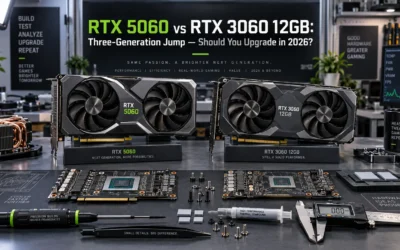
Quick Answer: RTX 5060 Laptop GPU vs RTX 4060 Laptop GPU — Which Should You Buy in 2026?
Choose the RTX 5060 Laptop GPU for the better overall gaming experience, especially if you are buying new, using ray tracing, or want DLSS 4 and Multi Frame Generation. It is typically 15–20% faster than the RTX 4060 Laptop GPU, although both have 8GB of VRAM. Choose the RTX 4060 only when the laptop is at least roughly 15–20% cheaper or has clearly better cooling, CPU, display, memory, or build quality.
Winner by Category
| Category | Winner | Margin / Evidence |
|---|---|---|
| 1080p | RTX 5060 Laptop GPU | Usually 15–20% faster; one 25-game comparison measured 84.8 FPS versus 78.0 FPS, an 8.7% lead. |
| 1440p | RTX 5060 Laptop GPU | Generally 10–20% faster; a comparison recorded 62.3 FPS versus 56.4 FPS, or 10.4%. |
| 4K | RTX 5060 Laptop GPU | Typically 10–25% ahead, but both GPUs have only 8GB of VRAM and are not ideal native-4K laptop solutions. |
| Ray tracing | RTX 5060 Laptop GPU | Usually 10–25% faster because of newer RT and Tensor hardware; Cyberpunk 2077 RT Ultra showed a narrower 32.03 versus 29.45 FPS lead. |
| Upscaling | RTX 5060 Laptop GPU | Supports DLSS 4, including Multi Frame Generation; the RTX 4060 supports DLSS 3/3.5 Frame Generation. |
| VRAM | Tie | Both provide 8GB and use a 128-bit memory bus. The 5060 uses GDDR7; the 4060 uses GDDR6. |
| Power | Depends on laptop | RTX 5060 implementations are approximately 40–100W, with some near 115W; RTX 4060 models span 35–115W. |
| Value | RTX 4060 Laptop GPU | Better only when it is roughly 15–20% cheaper than an otherwise comparable RTX 5060 laptop. |

Pros
- Very large 32GB VRAM pool for AI and creative workloads.
- Includes a GPU holder to help reduce sag and improve build stability.
- Wide range of modern display outputs for flexible workstation or gaming setups.
- Strong feature set for both gaming and content creation in one card.
Cons
- Its ultra-high-end specification makes it overkill for many mainstream gaming builds.
- The triple-fan design may be difficult to fit in compact cases.
- Advanced features such as AI acceleration and DLSS 4 depend on supported software and games.
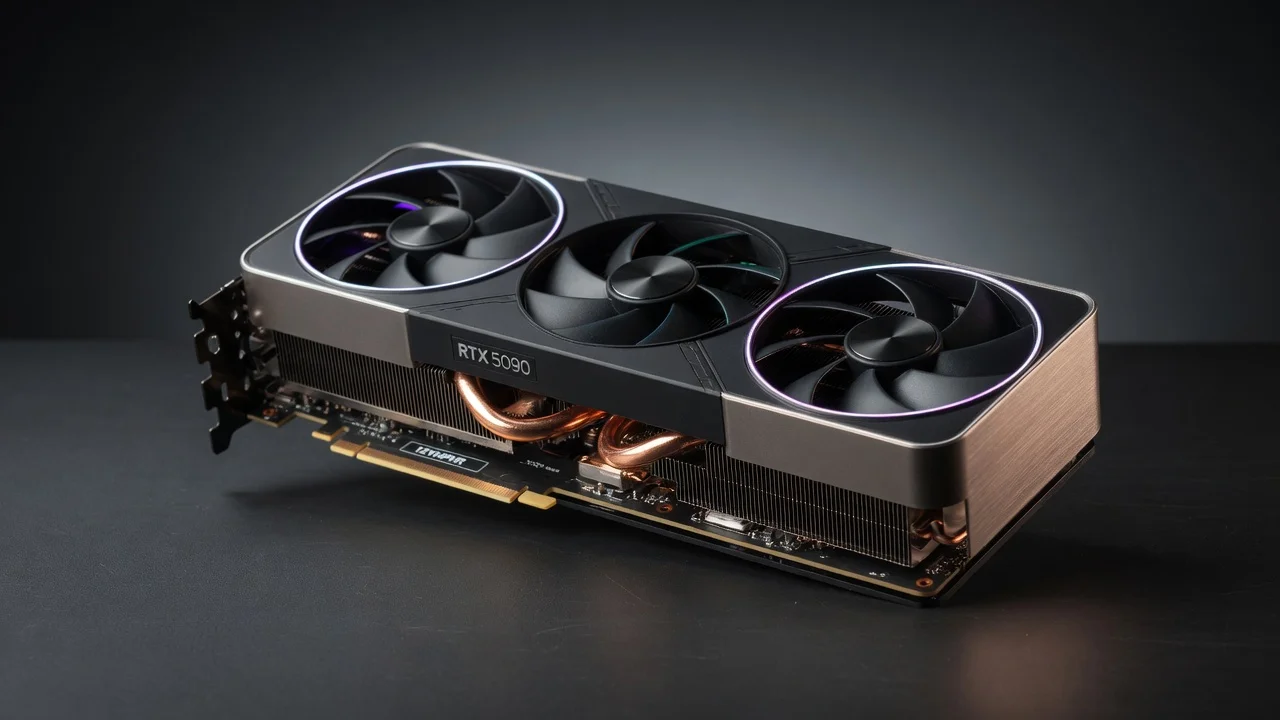
Overview: The ASUS TUF Gaming GeForce RTX 5090 is a flagship-class graphics card built for users who need extreme GPU performance for gaming, AI work, and professional content creation. The triple-fan cooler and included GPU holder suggest a focus on physical support and long-term build stability.
Performance & Features: With 32GB of GDDR7 VRAM, 28 Gbps memory, 21760 CUDA cores, and 3352 AI TOPS, this card is designed for demanding workloads such as AI-assisted editing, local LLM inference, 8K assets, and heavy multitasking. It also supports DLSS 4, ray tracing, and up to four displays through DP 2.1b and HDMI 2.1b outputs.
Drawbacks & Considerations: This is an extremely specialized product, so many gamers and casual users will not need this much power or memory. The large triple-fan form factor may also be a challenge in smaller cases, and the most advanced features only matter in supported applications and titles.
Verdict: The RTX 5090 TUF is best suited to enthusiasts, AI developers, and creators who want maximum headroom for modern GPU workloads. If your projects or games can use its top-tier feature set, it offers a highly capable all-in-one solution.

Pros
- Large 32GB VRAM capacity is well suited to AI and creator workloads.
- Advanced cooling hardware is designed for sustained performance under heavy load.
- Strong display connectivity supports flexible multi-monitor builds.
- Included GPU holder helps reduce sag and improve installation stability.
Cons
- Ultra-premium positioning makes it excessive for many mainstream gaming or basic productivity users.
- The quad-fan design may require generous case clearance and careful system planning.
- The listing does not provide dimensions or power requirements, so compatibility should be checked separately.
Overview: The ASUS ROG Astral GeForce RTX 5090 White OC Edition is a premium white graphics card with 32GB GDDR7 memory, built for high-end gaming, AI creation, and professional content work. Its quad-fan design and included GPU holder point to a focus on physical stability and sustained performance.
Performance: The card lists 3352 AI TOPS, 5th Gen Tensor Cores, a 28 Gbps memory speed, a 512-bit memory bus, and a factory OC boost clock of 2610 MHz. Those specs are aimed at faster AI-assisted editing, local LLM inference, large scene rendering, and other GPU-heavy workloads.
Considerations: This is an ultra-premium part with capabilities that will be excessive for many users. The large cooling solution can also make fitment more demanding, so buyers should verify case space, cooling layout, and overall platform compatibility before purchase.
Verdict: It makes the most sense for creators, AI enthusiasts, and high-end PC builders who want maximum VRAM, strong cooling, and multi-display support in a single card. If you only need standard gaming performance, a more modest GPU may be easier to justify.

Pros
- 24GB GDDR6X memory handles heavy 4K/8K workloads
- DLSS 3 and ray tracing boost performance in supported titles
- Advanced vapor chamber and milled heatspreader lower GPU temperatures
- Axial-tech fans provide 23% more airflow
- 3-year warranty adds long-term assurance
Cons
- Large 14.1 x 5.9 x 2.8-inch footprint needs a spacious case
- 8.05-pound weight requires sturdy case support

Pros
- Very large 24GB frame buffer for demanding workloads and future-facing gaming setups.
- Strong ray tracing and AI acceleration from 2nd Gen RT Cores and 3rd Gen Tensor Cores.
- Durable TUF build with military-grade components and dual ball fan bearings.
- Includes HDMI 2.1 and DisplayPort 1.4a for modern high-resolution displays.
Cons
- This is a high-end, premium-class GPU that will be excessive for casual or 1080p-only gaming.
- The product data does not list dimensions, power requirements, or included accessories, so build planning may require extra checking.
- Tuning software is included, but the card may still demand a capable cooling and power setup in a well-prepared system.
Overview & Design: The ASUS TUF Gaming NVIDIA GeForce RTX 3090 is a flagship-class graphics card built around NVIDIA Ampere architecture. It is positioned for users who want a high-end GPU with a focus on durability, cooling design, and long-term stability.
Performance & Key Features: With 24GB of GDDR6X memory, 2nd Generation RT Cores, and 3rd Generation Tensor Cores, this card is designed for demanding gaming and creative workloads. It is well suited to 4K and 8K output, ray tracing, and AI-assisted features such as DLSS, while HDMI 2.1 and DisplayPort 1.4a support modern display setups.
Drawbacks & Considerations: Based on the product data, this is clearly a premium, high-performance GPU, which makes it more card than many users need for everyday gaming. The listing also does not provide dimensions, power draw, or accessory details, so buyers should confirm system compatibility before purchase.
Verdict: The TUF RTX 3090 is best for enthusiasts, creators, and power users who want top-tier GPU memory capacity and strong cooling-focused construction. If you need a durable high-end card for heavy workloads or high-resolution gaming, it is a compelling option.

Pros
- Massive 24GB GDDR6X memory capacity for demanding games and professional workloads.
- Triple-fan cooling design is suited to a high-performance enthusiast GPU.
- Includes both DisplayPort and HDMI connectivity for flexible display setups.
- GeForce Experience support adds practical software features for gamers and creators.
Cons
- This is a premium-class graphics card, so it may be overkill for casual gaming or basic desktop use.
- The product data does not list size, power requirements, or noise levels, which makes system fitment harder to judge.
- A triple-fan design may require a roomy PC case and strong airflow, depending on the rest of the build.
Overview: The PNY GeForce RTX 3090 24GB XLR8 Gaming Uprising is a high-end graphics card built around NVIDIA Ampere architecture. It is positioned for users who need serious graphics performance, with a triple-fan cooling design and a large 24GB memory buffer.
Performance and Features: Key specifications include 5248 CUDA cores, a 1395MHz core clock, a 1695MHz boost clock, and 24GB of GDDR6X memory on a 384-bit bus. That combination is well suited to 4K gaming, content creation, and other GPU-heavy workloads where memory capacity and bandwidth matter. PCI Express 4.0 support and DisplayPort plus HDMI outputs add modern connectivity options.
Considerations: The available product data does not list dimensions, power draw, or acoustic performance, so buyers should verify compatibility with their case and power supply before purchase. As with most flagship-class graphics cards, this model is likely more capable than what many everyday users require.
Verdict: If you want a powerful GPU with large memory capacity for demanding gaming or creator workflows, this card offers the right feature set. It is best suited to enthusiasts who can fully use its performance and have a system built to support a top-tier graphics card.
- 24GB GDDR6X for heavy workloads
- Triple-fan cooling for enthusiast builds
- DisplayPort and HDMI for versatile monitor support
- NVIDIA GeForce Experience for driver and capture tools

Pros
- Large 24GB VRAM capacity is ideal for texture-heavy games and professional content creation.
- Strong Ampere-based core count supports demanding GPU workloads.
- WINDFORCE 3X cooling and alternate spinning fans help manage thermals under load.
- Includes DisplayPort and HDMI outputs for modern display compatibility.
Cons
- Requires a 750W power supply, which may not fit lower-wattage systems.
- ATX form factor can be a challenge in compact PC cases.
- Its high-end capability may be more than many casual 1080p gaming setups need.
Overview: The GIGABYTE GeForce RTX 3090 Gaming OC 24G is a full-size ATX graphics card built around NVIDIA's GeForce RTX 3090 and GIGABYTE's WINDFORCE 3X cooling design. The metal back plate adds rigidity, while RGB Fusion 2.0 provides a customizable visual accent.
Performance: With 24GB of GDDR6X memory on a 384-bit bus, 10,496 CUDA cores, and 936 GB/s memory bandwidth, this card is built for demanding gaming, 3D work, and GPU-accelerated creative tasks. The 2nd Generation RT Cores and 3rd Generation Tensor Cores support ray tracing and AI-driven workloads, and the card lists a maximum digital resolution of 7680x4320.
Considerations: This model requires a 750W power supply and uses an ATX form factor, so it is best suited to larger desktop builds. Its premium specifications also make it more capable than many users need for everyday use or standard 1080p play.
Verdict: If you want a high-capacity RTX GPU with strong cooling and advanced features for enthusiast gaming or creative work, this card is a solid fit for users who can support its size and power requirements.

Pros
- High-end RTX 5080 performance platform with 16GB GDDR7 memory.
- Quad-fan cooling and vapor chamber design focus on stronger thermal control.
- Protective PCB coating adds practical durability benefits.
- Factory OC profile reaches up to 2790 MHz in OC mode.
- Backed by a 3-year warranty.
Cons
- The quad-fan cooler may be less suitable for compact cases, so fitment should be checked carefully.
- As a flagship-class GPU, it is most appropriate for users who truly need top-tier performance.
- The listing does not provide full compatibility details such as dimensions, power requirements, or display outputs.
Overview: The ASUS ROG Astral NVIDIA GeForce RTX 5080 16GB GDDR7 White OC Edition is a premium graphics card aimed at enthusiast gaming and advanced PC builds. Its white finish and quad-fan cooling solution give it a distinctive look while signaling a focus on thermal performance.
Performance: Built on NVIDIA Blackwell and supporting DLSS 4, this model is positioned for demanding gaming and GPU-heavy workloads. ASUS lists a boost of up to 2790 MHz in OC mode, 1899 AI TOPS, and 16GB of GDDR7 memory, while the quad-fan design is intended to improve airflow and pressure by up to 20%.
Considerations: This is a large, high-end card, so buyers should confirm case space and overall system compatibility before purchase. The raw listing does not include full details such as dimensions, power draw, or port layout, so those specifications should be checked separately.
Verdict: For users building a premium gaming or creator system that can benefit from strong cooling, modern memory, and RTX 5080-class performance, this ASUS ROG Astral model is a strong candidate. It is best suited to enthusiasts who want a feature-rich card with a focus on sustained thermal control.

Pros
- Uses NVIDIA's Blackwell Architecture for a modern high-end GPU platform
- Includes AI-focused features such as Tensor Cores and FP4 support
- Supports advanced gaming technologies including DLSS 4 and Reflex 2
- Backed by full ray tracing and neural rendering capabilities
Cons
- The listing does not provide key compatibility details such as dimensions, power requirements, or display outputs
- Its high-end feature set may be excessive for casual users or basic PC builds
- No customer review text is included in the source data, so real-world user feedback is limited here
Overview: The NVIDIA GeForce RTX 5080 Founders Edition is a premium graphics card built on NVIDIA Blackwell Architecture. As a Founders Edition model, it represents NVIDIA's own official take on a flagship-level GPU for gaming and creator-focused systems.
Performance: Its feature set includes Tensor Cores with FP4 support, DLSS 4, NVIDIA Reflex 2 with Frame Warp, and full ray tracing with neural rendering. In practical terms, that points to strong support for modern games, AI-accelerated workloads, and visually intensive creative applications.
Considerations: The supplied listing does not include practical specs such as size, power draw, or connector information, so buyers still need a full spec sheet before planning a build. There is also no customer review content in the source data, which limits insight into long-term user experience.
Verdict: This card is best suited to enthusiasts, gamers, and creators who want NVIDIA's latest high-end feature set. It is less compelling for users who only need basic graphics performance or a simpler upgrade path.
Specifications Side-by-Side
These are laptop GPU specifications rather than fixed desktop-card specifications. Laptop manufacturers can set different power limits, cooling solutions, firmware behavior, and graphics-switching configurations, so two notebooks carrying the same GPU name may not perform identically.
| Specification | RTX 5060 Laptop GPU | RTX 4060 Laptop GPU |
|---|---|---|
| Architecture | NVIDIA Blackwell | NVIDIA Ada Lovelace |
| GPU designation | GB206/GN22-X4 | AD107/GN21-X4 |
| CUDA cores | 3,328 | 3,072 |
| Streaming multiprocessors | 26 SMs | 24 SMs |
| Video memory | 8GB GDDR7 | 8GB GDDR6 |
| Memory bus | 128-bit | 128-bit |
| Approximate memory bandwidth | 448GB/s at 28Gbps; some lower-power versions are listed around 384GB/s | 256GB/s at 16Gbps |
| Approximate base clock | 952–1,455MHz, depending on firmware and power limit | Approximately 1,470MHz |
| Maximum listed boost clock | Up to approximately 2,497MHz | Up to approximately 2,370MHz |
| Typical listed TBP/TGP range | Approximately 40–100W; some configurations reach roughly 115W | 35–115W officially; 100–115W is common in gaming laptops |
| NVENC encoder | Ninth-generation NVENC | Eighth-generation NVENC |
| Video encoding | AV1 encode and decode | AV1 encode and decode |
| Upscaling and frame generation | DLSS 4, including Super Resolution, Frame Generation, Ray Reconstruction, and Multi Frame Generation | DLSS 3/3.5, including Super Resolution and Frame Generation |
| Launch laptop positioning | Laptops announced from $1,099 | Generally launched around the $999–$1,099 laptop class |
Gaming Performance
1080p
The RTX 5060 Laptop GPU is the faster 1080p option when the two systems have comparable power limits, processors, memory, and cooling. Aggregate results put its advantage around 15–20%, although laptop differences can make the practical gap smaller. In one 25-game comparison, the RTX 5060 averaged 84.8 FPS while the RTX 4060 averaged 78.0 FPS, a more modest 8.7% difference. The named Red Dead Redemption 2 result was more representative of the broader trend: 69.21 FPS versus 60.15 FPS at 1080p Medium, giving the 5060 a 15.1% lead.
1440p
At 1440p, the RTX 5060 generally retains an advantage of approximately 10–20%. The same comparison measured 62.3 FPS on the RTX 5060 Laptop GPU and 56.4 FPS on the RTX 4060 Laptop GPU, or 10.4% faster performance. Red Dead Redemption 2 at 1440p Medium produced 42.32 FPS versus 36.38 FPS, which is a 16.3% advantage for the newer GPU. The result is useful for high-refresh 1440p panels, but the laptop’s TGP and cooling remain important. Standard operational and maintenance protocols can be consulted via AMD official chipset architecture and support resources.
4K
The RTX 5060 leads in available 4K averages by roughly 10–25%, but neither GPU should be selected as an ideal native-4K laptop solution. Both have 8GB of VRAM, so demanding games can run into memory-capacity limits at higher texture settings and resolutions. Laptop power limits also make 4K results less consistent than 1080p or 1440p results. For a notebook with a 4K display, DLSS and sensible texture settings are important for both GPUs. For broader ecosystem context, read through our operational guide on how to clean gpu dust.
Ray Tracing & Upscaling
The RTX 5060 is normally the stronger ray-tracing choice, with a typical lead of about 10–25% in comparable laptop tests. Its newer RT and Tensor hardware help in supported games, but the advantage is not guaranteed in every title. In Cyberpunk 2077 at 1080p RT Ultra, the RTX 5060 reached 32.03 FPS compared with 29.45 FPS for the RTX 4060, an 8.8% gain; at 1440p, the RTX 4060 was slightly ahead in that particular comparison. DLSS can make both cards more practical, while DLSS 4 gives the RTX 5060 access to Multi Frame Generation.
Features & Ecosystem
The most important feature difference is NVIDIA’s upscaling and frame-generation support. The RTX 5060 Laptop GPU supports DLSS 4 with Super Resolution, Frame Generation, Ray Reconstruction, and Multi Frame Generation. The RTX 4060 Laptop GPU supports DLSS 3/3.5 with Super Resolution and Frame Generation. Both can use AMD FSR in games that implement it, but FSR does not provide the RTX 5060’s DLSS 4 Multi Frame Generation features. For troubleshooting and reliability insights, consult our in-depth vertical gpu mount airflow report.
Both GPUs support NVIDIA Reflex, Broadcast, Studio applications, CUDA-based software, and AV1 encode and decode. The RTX 5060 moves to a ninth-generation NVENC encoder, while the RTX 4060 uses an eighth-generation NVENC encoder. Both remain suitable for high-quality streaming and video export, so the 5060’s encoder advantage is a newer-generation benefit rather than a reason to dismiss the 4060 for ordinary creator work.
For productivity, both GPUs support CUDA, TensorRT, OptiX, Blender, Adobe applications, AI inference, and other GPU-accelerated software. NVIDIA’s current comparison data lists CUDA capability 12.0 for the RTX 5060 and 8.9 for the RTX 4060. Both receive Game Ready and Studio drivers, and the RTX 4060 continues to have active driver support. Neither is a native AMD ROCm GPU; buyers choosing a laptop for compute should focus on CUDA, TensorRT, and OptiX compatibility. Readers comparing setup options can review our technical analysis on weak psu cause gpu stutter.
Power, Thermals & Build Compatibility
There is no single power level for either mobile GPU. RTX 5060 Laptop implementations are listed at approximately 40–100W, with some manufacturer configurations reaching roughly 115W. RTX 4060 Laptop versions officially range from 35–115W, while 100–115W designs are common in gaming notebooks. A high-power RTX 4060 can therefore approach or occasionally exceed a low-power RTX 5060.
For laptop shopping, evaluate the complete system rather than the GPU label alone. A thicker RTX 4060 laptop with stronger cooling may sustain its performance better than a thin RTX 5060 model running at a lower power limit. The display resolution, CPU, installed memory, MUX or Advanced Optimus implementation, and manufacturer firmware can all materially affect frame rates and responsiveness. For complementary field maintenance guidelines, examine our breakdown of black screen gpu drivers.
- Check the GPU power limit: Compare the listed TGP or TGP range before comparing model names.
- Check cooling: Look for a design that can sustain gaming loads without severe thermal or power throttling.
- Check the display: Match the panel to the GPU; 1080p and 1440p are more appropriate targets than native 4K.
- Check graphics switching: MUX and Advanced Optimus behavior can affect performance and battery-oriented operation.
- Check the whole configuration: CPU, RAM, storage, chassis quality, and firmware can make a larger buying difference than a modest GPU advantage.
Price & Value Analysis
In 2026, mainstream RTX 5060 laptops typically sell for approximately $1,100–$1,500, with examples around $1,099–$1,299 and premium models reaching higher prices. NVIDIA announced RTX 5060 laptops starting at $1,099. RTX 4060 laptops with remaining new stock generally sit around $900–$1,100, with $999 representing a typical current listing.
The RTX 5060 is the better performance purchase when prices are close. Its usual 15–20% gaming lead, higher memory bandwidth, newer ray-tracing and Tensor hardware, DLSS 4 support, and ninth-generation NVENC give it more headroom for a new laptop. However, the RTX 4060 becomes the value winner when it is at least roughly 15–20% cheaper than an otherwise comparable RTX 5060 model. At that discount, the older GPU can deliver a better price-to-performance ratio. To evaluate matched hardware tolerances, consult our detailed overview of daisy chain pcie cables.
Do not compare prices without comparing the rest of the laptop. A discounted RTX 4060 system with better cooling, a stronger CPU, more suitable memory, or a better-built chassis may be the smarter purchase even if its GPU is slower. Conversely, paying near-RTX 5060 pricing for an RTX 4060 laptop removes its main advantage.
Which Should You Buy?
Choose RTX 5060 Laptop GPU if…
- You are buying a new gaming laptop and want the faster GPU in typical comparable configurations.
- You play at 1080p or 1440p and want approximately 10–20% more raster performance in many games.
- You use ray tracing and want the benefit of the newer RT and Tensor hardware.
- You want DLSS 4, including Multi Frame Generation in supported games.
- You stream or export video and prefer the newer ninth-generation NVENC encoder.
- You plan to keep the laptop for several years and value newer architecture and features.
Choose RTX 4060 Laptop GPU if…
- You find a model around $900–$1,100 that is at least roughly 15–20% cheaper than a similar RTX 5060 laptop.
- You prioritize price-to-performance over the newest architecture and DLSS 4 features.
- The RTX 4060 laptop has materially better cooling, CPU performance, display quality, RAM, or build quality.
- You are comfortable with DLSS 3/3.5 and do not need Multi Frame Generation.
- You want capable 1080p gaming, CUDA applications, Blender, Adobe software, AV1 encoding, and NVIDIA Studio support without paying for the newer generation.
Consider a different card if…
Consider a higher-tier laptop GPU if native 4K gaming, demanding ray tracing, or substantially more VRAM headroom is a priority, because both cards in this comparison provide only 8GB. If your budget is tight, also consider a lower-priced laptop tier rather than paying near-RTX 5060 pricing for an RTX 4060; the right alternative depends on the specific laptop deal and the performance target.
Common Questions on Rtx 5060 Laptop Gpu Vs Rtx 4060 Laptop Gpu Answered
Is the RTX 5060 Laptop GPU much faster than the RTX 4060 Laptop GPU?
It is faster, but it is not a massive generational jump. Available aggregate comparisons place the RTX 5060 approximately 15–20% ahead overall. A separate 25-game result measured an 8.7% advantage at 1080p and 10.4% at 1440p, showing why the laptop’s TGP, CPU, cooling, and memory configuration matter.
Does the RTX 5060 Laptop GPU have more VRAM?
No. Both the RTX 5060 Laptop GPU and RTX 4060 Laptop GPU have 8GB of video memory on a 128-bit bus. The important memory upgrade is the RTX 5060’s GDDR7 technology and higher bandwidth, approximately 448GB/s in a 28Gbps implementation compared with approximately 256GB/s for the RTX 4060’s GDDR6. Neither provides substantially greater VRAM capacity.
Is DLSS 4 available on the RTX 4060 Laptop GPU?
The RTX 4060 Laptop GPU supports DLSS 3/3.5 features, including Super Resolution and Frame Generation. The RTX 5060 Laptop GPU supports DLSS 4, including newer features such as Multi Frame Generation and Ray Reconstruction. Both can use FSR when supported by a game, but FSR does not add the RTX 5060’s DLSS 4 Multi Frame Generation capability.
Can a high-power RTX 4060 laptop beat a low-power RTX 5060 laptop?
Yes, it can approach or occasionally exceed it. RTX 5060 Laptop GPU configurations range from approximately 40–100W, with some reaching roughly 115W, while RTX 4060 Laptop GPU configurations range from 35–115W. Because TGP, cooling, firmware, MUX or Advanced Optimus, CPU, and memory all influence performance, compare the complete laptop configuration rather than relying on the GPU name alone.
Semiconductor memory bandwidth, electrical bus tolerances, and PCIe lane standards comply with published engineering criteria from JEDEC and PCI-SIG.
Related Posts
- Explore more in our GPU Reviews category.
- See how it compares to laptop options in our RTX 5070 Ti vs RTX 4080 Laptop guide.
Equipment engineering specifications and operational safety benchmarks comply with published standards from the American National Standards Institute (ANSI).