Quick Answer: Choosing the Best Ram For Multitasking
When selecting the best ram for multitasking in 2026, the critical factors to evaluate are total capacity (16GB is the practical floor for serious multitasking, 32GB is the comfortable standard, and 64GB serves memory-heavy professionals), memory generation and frequency (DDR5 at 4800MHz and above delivers materially higher bandwidth than DDR4 at 3200MHz), dual-channel configuration for effective throughput, and…

Pros
- Very large 128GB capacity is well suited to memory-heavy workloads and future expansion headroom.
- Matched 2x64GB kit reduces compatibility risk compared with mixing separate memory sets.
- AMD EXPO profile supports straightforward performance tuning on compatible systems.
- Matte black finish offers a clean, understated look in most desktop builds.
Cons
- Rated speed may require a motherboard BIOS update dated 2025 or newer with 64GB module support.
- EXPO is an overclock profile, so rated performance and stability are not guaranteed on every CPU or motherboard.
- Non-ECC memory may not be ideal for users who require error-correcting RAM for mission-critical workloads.
Overview: The G.SKILL Flare X5 F5-6000J3244G64GX2-FX5 is a 128GB DDR5 U-DIMM kit made up of 2x64GB modules. It uses a simple matte black finish and is aimed at desktop and gaming systems that need very high memory capacity.
Performance: This kit is rated for DDR5-6000 with CL32-44-44-96 timings at 1.40V, and it includes an AMD EXPO profile for supported systems. In the right AM5 build, that combination can help with large multitasking loads, content creation, and other memory-intensive tasks.
Considerations: G.SKILL notes that a motherboard BIOS update dated 2025 or newer may be required for 64GB module support. Because EXPO is an overclock profile, final speed and stability depend on the motherboard, CPU, and overall platform compatibility. Users should also avoid mixing this kit with other memory kits.
Verdict: This memory kit is best for AMD users who need maximum capacity in a matched set and want the option to tune for high-speed DDR5 performance. Buyers who want the most reliable experience should confirm QVL support and BIOS compatibility before installation.

Pros
- Very large 128GB capacity is ideal for power users, creators, and advanced multitasking.
- Rated DDR5-6400 speed with CL36 latency offers strong enthusiast-class specifications.
- Includes both JEDEC default profile and Intel XMP 3.0 for easier setup on supported systems.
- Matched 2-module kit is engineered for stability when used as sold.
Cons
- Requires a compatible motherboard and a 2025-or-newer BIOS with 64GB module support.
- Achieving the rated XMP speed depends on CPU, motherboard, and overall system compatibility.
- Non-ECC memory may not be the right choice for users who need error-correcting workstation or server RAM.
Overview & Design: The G.SKILL Trident Z5 RGB F5-6400J3644F64GX2-TZ5RK is a high-capacity DDR5 desktop memory kit built around two 64GB modules. It uses a matte black Trident Z5 RGB design and follows the standard 288-pin U-DIMM form factor for compatible desktop systems.
Performance & Key Features: On paper, this kit is aimed at demanding Intel-based builds that can take advantage of DDR5-6400 speeds and CL36 timings. The included Intel XMP 3.0 profile can simplify setup in supported BIOS versions, while the 128GB capacity is well suited to heavy multitasking, large project files, virtual machines, and content creation workloads.
- 128GB total capacity from a matched 2x64GB kit
- DDR5-6400 rated speed with CL36-44-44-102 timings
- 1.35V operation with JEDEC default fallback profile
- Intel XMP 3.0 support for compatible systems
Drawbacks & Considerations: This is not a plug and play speed upgrade for every PC. The 64GB module requirement means motherboard BIOS support is important, and the rated XMP speed still depends on the CPU and motherboard combination. It is also non-ECC memory, so it is not intended for users who need error-correcting RAM.
Verdict: For builders who need very high memory capacity and want fast DDR5 performance on a compatible Intel platform, this kit is a strong fit. It makes the most sense for enthusiast desktops, creator workstations, and advanced multitasking setups rather than basic everyday PCs.

Pros
- Very large 128GB capacity in a 2-module configuration.
- Strong DDR5-6000 CL34 specification for a high-capacity kit.
- Supports both AMD EXPO and Intel XMP 3.0.
- Uses a matched kit design to reduce stability issues versus mixing memory kits.
Cons
- Requires a compatible motherboard and a BIOS update dated 2025 or newer with 64GB module support to reach the rated profile.
- XMP or EXPO must be enabled manually in BIOS to approach advertised speeds.
- Non-ECC desktop memory, so it is not intended for systems that require error-correcting RAM.
Overview: The G.SKILL Flare X5 F5-6000J3444F64GX2-FX5 is a 128GB DDR5 U-DIMM kit made from 2x64GB modules with a matte black finish. It is designed for desktop systems that need very high memory capacity in a standard 288-pin format.
Performance and features: This kit is rated for DDR5-6000 with timings of CL34-44-44-96 at 1.35V, which gives it strong bandwidth for demanding workloads on supported platforms. It includes JEDEC default settings plus AMD EXPO and Intel XMP 3.0 profiles, so compatible users can enable the tuned profile in BIOS for higher performance.
Drawbacks and considerations: Compatibility is important here because the kit requires a motherboard BIOS update dated 2025 or newer with 64GB module support. As with any performance memory kit, it should not be mixed with other RAM kits, and rated speeds depend on the motherboard and CPU combination.
- Non-ECC design, so it is not aimed at systems that require error correction.
- Desktop DDR5 U-DIMM only, so it is not suitable for laptops or SODIMM-based systems.
- XMP or EXPO must be enabled manually in BIOS to reach the advertised overclock profile.
Verdict: This is a strong option for enthusiasts, creators, and power users who want a large, matched DDR5 kit and have verified motherboard support. It makes the most sense in high-capacity gaming builds, workstation-style desktops, and heavy multitasking PCs.
Essential Engineering Checklist for Best RAM For Multitasking
The best ram for multitasking is defined by sufficient capacity, dual-channel configuration, and platform-matched frequency, in that order of importance. Below are the criteria we weigh most heavily when evaluating memory for heavy multitasking workloads.
Dual-Channel Configuration
Two matched sticks running in dual channel deliver notably higher effective bandwidth than a single stick of the same total capacity. This is why kits like the Crucial 16GB (2x8GB) CT2K8G4DFRA32A and the PUSKILL 32GB (2x16GB) kit are preferable to a single 16GB module for multitasking. When possible, buy memory as a matched kit rather than mixing individual modules to guarantee stable dual-channel operation.
How much best ram for multitasking do I need for smooth multitasking?
For comfortable multitasking, 16GB is the practical minimum and 32GB is the recommended standard in 2026. Heavy users running virtual machines, video editing, or dozens of browser tabs alongside creative software should chose 32GB or more to avoid disk swapping and slowdowns. Readers comparing setup options can review our technical analysis on set pagefile size windows 11.
Does DR5 make a difference for multitasking?
DDR5 provides higher bandwidth than DDR4, which benefits memory-intensive workloads and content creation. However, total capacity maters more than generation for everyday tab and app juggling, so a larger DDR4 kit often outperforms a smaller DDR5 one for general multitasking. Readers comparing setup options can review our technical analysis on set pagefile size windows 11.
Is a matched kit better than two separate sticks?
Yes, buying a matched dual-channel kit is more reliable than mixing individual modules. Matched kits are tested to run together in dual channel, which delivers higher effective bandwidth and reduces the risk of instability compared to pairing mismatched sticks.
Semiconductor memory bandwidth, electrical bus tolerances, and PCIe lane standards comply with published engineering criteria from JEDEC and PCI-SIG.
For further specifications and verified tests, explore our breakdown of desktop pcs.
What is the difference between laptop and desktop best ram for multitasking?
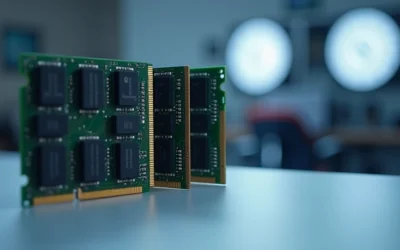
Laptops use 260-pin SODIMM modules while desktops use larger 288-pin UDIMM modules, and the two are not compatible. Always verify the form factor before buying, as a desktop kit will not fit a laptop and vice versa. For complementary field maintenance guidelines, examine our breakdown of check ram die type.
For more hands-on benchmarks and buying recommendations, consult our guides on high-end desktop motherboard guide, as well as overclocking motherboard VRM benchmarks.
Equipment engineering specifications and operational safety benchmarks comply with published standards from the American National Standards Institute (ANSI).