Quick Answer: Riding Mowers How To Choose Diagnostic & Solution
The best riding mower depends on yard size, terrain, and budget. For most homeowners with 1–2 acres, a rear-engine riding mower or standard lawn tractor with a 42–46 inch cutting deck and 18–24 HP engine covers the core need. For 2+ acres or complex layouts, a zero-turn mower with a tight turning radius reduces mowing time significantly. For flat, smaller…

Pros
- Commercial-grade electric performance with instant torque and no gas engine maintenance.
- Large included battery package and fast charger improve runtime and turnaround time.
- Heavy-duty 54-inch fabricated deck is built for durability and wider coverage per pass.
- Comfort-focused operator features are better than many basic riding mowers in this class.
- Backed by a 4-year limited warranty for added purchase confidence.
Cons
- At 848.78 pounds, it is very heavy and will be difficult to move manually or transport without proper equipment.
- The large footprint, with dimensions of 76.77 x 73.23 x 56.3 inches, requires substantial storage space.
- The premium feature set and battery system may be more than many small-yard owners need.
Overview & Design: The Greenworks 80V 54" MaximusZ Zero Turn Riding Lawn Mower is a commercial-style electric mower built for large residential properties. Its 54-inch 10-gauge fabricated steel deck, zero-turn layout, and premium operator seat give it a serious, heavy-duty feel right away.
Performance & Key Features: This model is positioned as a 41HP gas-equivalent machine with instant torque, a constant 17,900 FPM blade speed, and SmartCut technology that adapts to changing grass conditions. The included battery kit with (2) 16.0Ah and (4) 6.0Ah batteries is designed to support up to 4+ acres per charge, while the 1.5kW fast charger helps reduce downtime.
Drawbacks & Considerations: The mower is extremely heavy at 848.78 pounds, so it is not easy to move or store in tight spaces. It is also a major investment and may be excessive for smaller yards or users who do not need the runtime and power of a large battery-electric zero-turn.
Verdict: This is a strong fit for homeowners with large lawns who want powerful, low-maintenance mowing performance and premium comfort features. Buyers who need a wide cutting deck, long runtime, and electric operation will likely get the most value from it.

Pros
- Brushless motor system delivers gas-equivalent power without emissions or excessive noise
- High-capacity battery kit enables cutting coverage of up to 4.4 acres per charge set
- Durable 10-gauge steel deck and constant high blade tip speed handle dense grass effectively
- Premium seating and lighting features support comfortable extended operation
- 4-year warranty provides strong protection for the investment
Cons
- Runtime tops out around 4.4 acres depending on conditions, requiring recharges for bigger properties
- Electric design depends on charging infrastructure and battery management rather than simple refueling
- Height adjustment is noted only basically without extensive position details in available specs
The Greenworks 60V MaximusZ Zero Turn Riding Lawn Mower is a commercial-grade electric machine built for large lawns. Its primary construction centers on a heavy-duty 60-inch 10-gauge fabricated steel deck that prioritizes durability and airflow, paired with premium comfort elements including an adjustable suspension seat with lumbar support and foldable armrests for a solid first impression of quality and user focus.
Performance shines through an intelligent brushless motor system offering power equivalent to a 31HP gas engine with zero emissions. Three high-torque brushless hub motors sustain a constant 17,900 FPM blade speed, while SmartCut Technology auto-adapts to prevent bogging in thick or wet grass. The complete kit supplies (2) 20.0Ah suitcase batteries plus (4) 8.0Ah batteries and a 1.5kW fast charger for up to 4.4 acres of cutting. Additional capabilities include a 4-in-1 deck for mulching, bagging, rear and side discharge, 300 lb towing capacity with front/rear hitch, dual LED headlights, and an LCD display.
Drawbacks and considerations include the practical need to recharge the battery set after maximum runtime, which can interrupt work on properties exceeding 4.4 acres. Being fully electric means reliance on power sources for recharging instead of fuel, and height adjustment is referenced only in basic terms without more granular position data in the specifications.
In verdict, the Greenworks 60V MaximusZ delivers the most value to homeowners and professionals managing medium-to-large properties who want quiet, emission-free commercial power, versatile cutting options, and the security of a 4-year warranty in a comfortable zero-turn package.

Pros
- Strong stated cutting capacity for large properties, with up to 4 acres per charge.
- Zero-turn design supports fast, precise mowing around obstacles.
- Uses battery power instead of gas, reducing maintenance-related chores and emissions.
- Includes six high-capacity batteries and a charger, so it is ready for use out of the box.
Cons
- Heavy at 720 pounds, which may make transport, storage, or maneuvering by hand difficult.
- Large dimensions require substantial garage or shed space.
- The high upfront cost may put it out of reach for buyers with smaller lawns or limited budgets.
Overview & Design: The EGO Power+ ZT5207L is a 52-inch electric riding lawn mower with a zero-turn radius, built for users who need efficient coverage on larger properties. Its black finish, substantial frame, and 720-pound weight reflect a serious, full-size riding mower designed for demanding residential mowing.
Performance & Key Features: EGO says Peak Power+ technology combines up to six 56V ARC Lithium batteries, and the mower is rated at a 25 HP-equivalent output. The 52-inch deck and zero-turn steering should help reduce mowing time and improve control around landscaping, while the included six 56V 12.0Ah batteries are stated to support up to 4 acres per charge.
Drawbacks & Considerations: This model is large and heavy, so it will not suit every storage space or every user. Its premium positioning also means buyers should be confident they need this much capacity, since smaller yards may not justify the size, weight, or cost.
Verdict: The ZT5207L is best for homeowners with expansive lawns who want battery-powered convenience and zero-turn efficiency in one machine. It is a compelling option if you value gas-like performance, broad deck coverage, and compatibility with EGO's 56V battery ecosystem.

Pros
- Offers quiet, emission-free electric operation with power matching traditional 22 HP gas mowers.
- Includes four high-capacity 56V 10.0Ah batteries for up to 2 acres of runtime right out of the box.
- Customizable LCD interface and multiple driving modes enhance user control and ride comfort.
- Versatile 10-position cutting height and 3-in-1 deck options provide flexible lawn finishing.
- Fast two-hour full recharge capability supports productive multi-session mowing days.
Cons
- Maximum single-charge coverage is limited to about 2 acres without purchasing additional batteries for bigger properties.
- Requires access to a power outlet for recharging, which may interrupt workflow on very large or remote lawns.
- Battery management and storage add extra steps compared to simple gas-powered alternatives.
The EGO Power+ ZT4204L is a premium electric zero-turn riding lawn mower built for homeowners seeking a clean alternative to gas models. It features a robust 42-inch stamped steel deck and includes four 56V 10.0Ah ARC Lithium batteries plus a charger, delivering an immediate impression of high-quality engineering focused on power and convenience.
In real-world use, this mower matches the performance of a 22 horsepower gas unit while reaching speeds up to 8 MPH. The zero-turn radius combined with three selectable driving modes via the LCD interface allows smooth navigation and efficient cutting of up to 2 acres per charge. Users can fine-tune the cut across 10 height positions from 1.5 to 4.5 inches and choose between mulching, bagging, or side discharge for complete lawn care flexibility. Full recharges take roughly two hours with the included Z6 charger.
Potential drawbacks include the 2-acre limit on the stock battery set, meaning larger properties will need extra batteries for uninterrupted operation. As a fully electric system, it also depends on regular charging access rather than quick refueling, and battery handling requires more attention than traditional gas mowers.
Overall, the EGO Power+ ZT4204L is an excellent choice for environmentally conscious homeowners with lawns up to a few acres who value quiet operation, low maintenance, and precise control. Those with extensive grounds should plan for additional battery capacity to maximize its benefits.

Pros
- Gas-equivalent power from electric Peak Power system with no emissions or fuel needs
- Long runtime covering up to 3 acres per charge with included high-capacity batteries
- Highly maneuverable 52-inch zero-turn deck with customizable blade speeds from 2300 to 3200 RPM
- User-friendly digital interface and app integration for real-time customization and monitoring
- Strong warranty coverage up to 5 years on mower and batteries with registration
Cons
- Runtime limited to approximately 3 acres per full charge, requiring recharges for larger properties
- Depends on multiple large 56V batteries which must be managed and recharged using the included charger
- No independent customer reviews available yet to confirm long-term real-world reliability
The EGO POWER+ Z6 Zero Turn Riding Lawn Mower model ZT5216L is a premium electric zero-turn rider built for efficient large-area mowing. It features a robust 52-inch 10-gauge fabricated steel deck, wide frame for slope stability, and durable IPX5-rated weather-resistant construction that creates an immediate impression of professional-grade quality without the noise or fumes of gas models.
In performance, Peak Power technology draws from up to six included 56V 10.0Ah ARC Lithium batteries to deliver power equal to a 27-horsepower gas engine while covering up to 3.0 acres per charge. The dual-blade system offers adjustable speeds from 2300 to 3200 RPM and 10 cutting heights between 1.5 and 4.5 inches. Three driving modes support speeds up to 8 MPH, and the color digital screen plus EGO Connect app allow full customization of speed, cruise control, and battery monitoring for real-world efficiency on varied terrain.
Considerations include the finite runtime of about 3 acres before recharging is needed, reliance on managing six batteries with the 880W charger, and the absence of extensive user feedback at launch that leaves long-term durability still to be proven in the field.
Overall, the EGO POWER+ Z6 ZT5216L delivers the most value to homeowners with mid-to-large lawns seeking quiet, powerful electric zero-turn performance, advanced controls, and reduced maintenance. Those with properties exceeding 3 acres or preferring simpler traditional mowers may want to evaluate battery logistics carefully.

Pros
- Massive 60-inch reinforced 10-gauge steel deck enables wide efficient passes on large lawns
- 41 HP gas-equivalent power maintains full blade speed for superior cut quality
- Unique rear dump bed with hydraulic assist simplifies debris handling
- Extremely quiet operation plus LED headlights and premium padded seat enhance comfort and usability
- High total battery capacity of 5,120 Wh supports extended runtime on big properties
Cons
- Battery-only power requires planned recharging downtime unlike continuous-run gas mowers
- Large 60-inch deck and overall size may prove less maneuverable in tight spaces or heavily obstructed yards
- Slope capability limited to 15 degrees which may restrict use on steeper terrain
The Greenworks 80V 60 Inch Riding Lawn Mower stands as a robust electric alternative in the riding lawn mowers and tractors category. Built around a reinforced 10-gauge steel cutting deck and equipped with a premium high-back padded seat featuring back support and foldable armrests, it presents a durable and comfortable design aimed at serious property owners. High-intensity LED headlights further improve visibility for dawn or dusk sessions, creating an immediate impression of thoughtful engineering for extended outdoor use.
Performance centers on the 41 horsepower gas-equivalent system that maintains a constant 17,000 FPM blade tip speed through Cyclone Cut Technology, ensuring the blades never slow under load. The mower reaches up to 4 MPH while handling slopes up to 15 degrees and offers single-lever 13-position deck height adjustment from 1.5 to 4.5 inches. Included batteries totaling 5,120 Wh enable cutting up to 5.12 acres, and the industry-only rear dump bed supports a 200 lb payload with hydraulic assist for practical debris management. Operation remains 4 times quieter than gas counterparts, adding real-world neighborhood-friendly value.
Considerations include reliance on battery power, which necessitates recharging rather than continuous refueling. The substantial 60-inch deck and overall scale may reduce agility in confined or obstacle-dense areas, and the maximum 15-degree slope rating limits suitability for steeper hills.
This Greenworks 80V model delivers the strongest value for owners of expansive properties seeking gas-like power without noise, emissions, or fuel hassles. Those with multi-acre lawns who already use or plan to expand a Greenworks 80V ecosystem will appreciate the runtime, dump-bed convenience, and consistent cutting performance most.
Pros
- Zero-emission brushless system delivers gas-equivalent power with far less maintenance and quieter operation
- Included high-capacity battery set enables substantial runtime of up to 3.5 acres depending on conditions
- Constant high blade speed and SmartCut Technology ensure consistent cutting performance in challenging grass
- Heavy-duty 54-inch steel deck with multi-function discharge options and 300 lb towing capacity
- Premium adjustable suspension seat, LED lights, LCD, and 4-year warranty enhance comfort and reliability
Cons
- Full runtime requires managing and swapping multiple batteries from the included kit
- Best suited to expansive properties and may feel oversized or impractical for smaller residential lawns
- Actual cutting area can vary based on grass conditions, thickness, and terrain as noted in the specifications
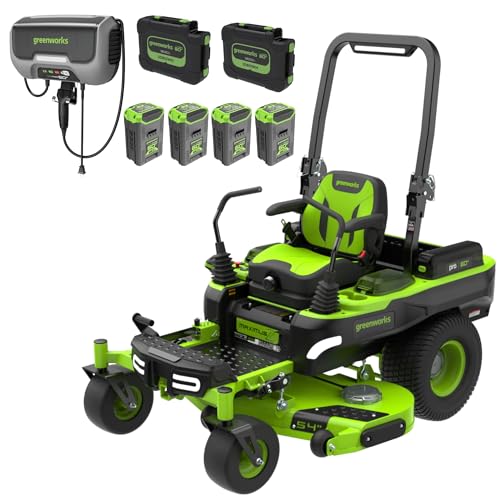
The Greenworks 60V MaximusZ Zero Turn Riding Lawn Mower is a commercial-grade electric rider built to handle large lawns with modern efficiency. It features a sturdy 10-gauge fabricated steel 54-inch deck and an intelligent brushless motor system that creates an immediate sense of durable, low-maintenance design aimed at serious yard work.
Performance centers on power equivalent to a 31HP gas engine delivered through zero-emission brushless motors that provide instant torque and quiet running. Three high-torque hub motors hold a constant 17900 FPM blade tip speed while SmartCut Technology adapts to grass density so the mower does not bog down in thick or wet conditions. The supplied battery pack of two 20.0Ah and four 8.0Ah units supports mowing up to 3.5 acres, and the deck offers 4-in-1 mulching, bagging, and discharge modes along with 300 lb towing capacity and hitch points for added utility.
Considerations include the need to manage several batteries to achieve maximum runtime, with recharging handled by the 1.5kW wall charger. As a full-size zero-turn model optimized for multi-acre properties, it may be less ideal for compact lots, and real-world coverage will depend on grass conditions and terrain as indicated in the product details.
Overall the Greenworks MaximusZ delivers strong value for homeowners or professionals who need emission-free power, consistent cutting performance, and comfort features on large properties while benefiting from a solid 4-year warranty and reduced ongoing maintenance.
What Is a Riding Mower and How Does It Differ from a Lawn Tractor or Zero-Turn?
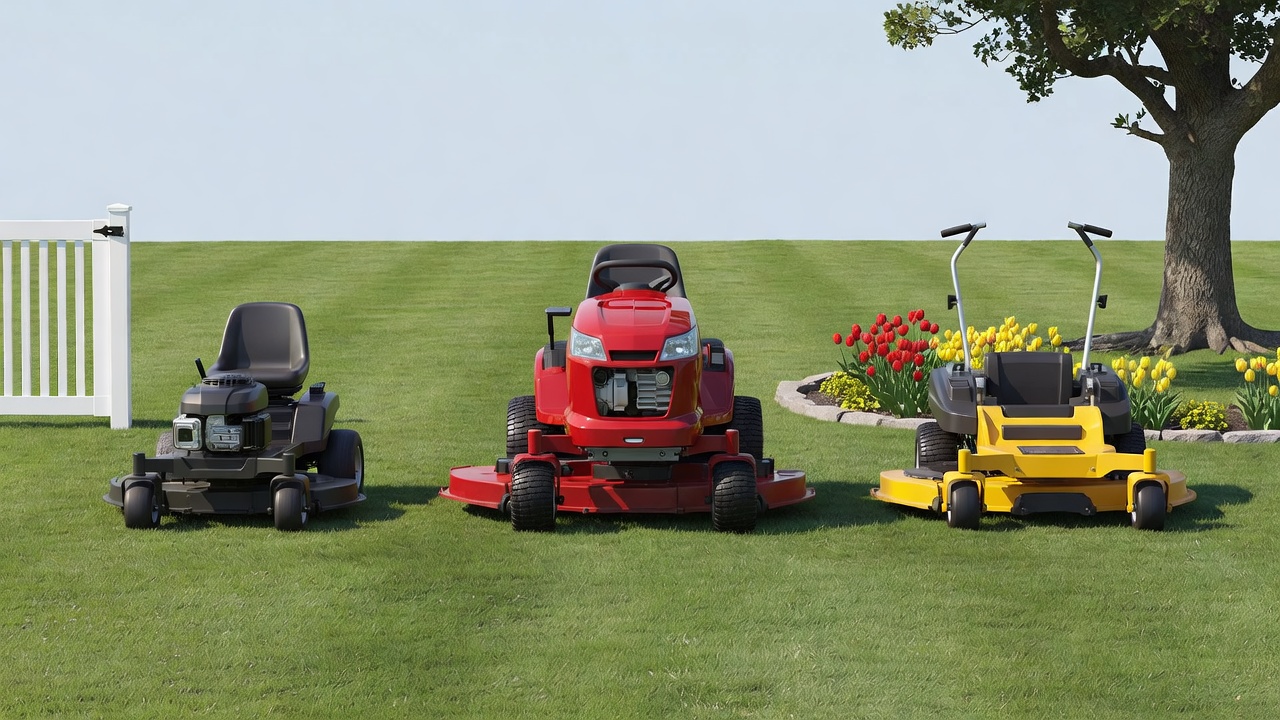
“Riding mower” is the umbrella term for any self-propelled mower you sit on while operating. Within that category, three main types serve different needs:
- Rear-engine riding mowers place the engine behind the seat. They typically have 30–38 inch decks and suit flat yards under 1 acre where storage space is limited.
- Front-engine lawn tractors look like small farm tractors. They accept a wider range of attachments (carts, snow blades, aerators) and usually offer 42–54 inch decks with 18–26 HP engines. These handle 1–3 acres and moderate slopes.
- Zero-turn mowers use dual hydrostatic transmissions controlled by lap bars instead of a steering wheel. Each drive wheel operates independently, allowing a near-zero turning radius. Decks run 42–60+ inches with 20–30+ HP engines. They excel on 2+ acres with many obstacles but perform poorly on slopes above 10–15 degrees.
Matching the type to your property prevents buying more machine than you need — or one that cannot handle your terrain. For broader ecosystem context, read through our operational guide on jbl partybox club 120 vs sony srs xv500.
What Factors Determine Which Riding Mower Is Best for Your Yard?
Five variables define the right mower for your situation: For broader ecosystem context, read through our operational guide on jbl partybox club 120 vs sony srs xv500.
- Yard acreage drives deck width and engine power. Under 1 acre: 30–42 inches. 1–2 acres: 42–48 inches. 2+ acres: 48–60 inches.
- Terrain slope limits zero-turn use. Most manufacturers rate zero-turns safe up to 10–15 degrees. Lawn tractors with locking differentials handle steeper grades.
- Obstacle density (trees, beds, fences) favors zero-turn maneuverability or a compact rear-engine mower.
- Storage space matters. Measure your shed or garage door width before choosing a 54- or 60-inch deck.
- Budget sets the feature floor. Entry-level tractors start near $1,500; premium zero-turns exceed $5,000.
Write down your acreage, steepest slope (in degrees or percent grade), obstacle count, storage dimensions, and maximum spend before comparing models. For troubleshooting and reliability insights, consult our in-depth z890 vs x870e motherboard report.
How Do You Choose the Right Cutting Deck Size for Your Property?
Deck width is the single spec that most affects mowing time. Wider decks cut more grass per pass but reduce maneuverability in tight areas.
- Under 1 acre: 30–42 inches. A 38-inch deck on a rear-engine mower navigates gates and narrow passages.
- 1–2 acres: 42–48 inches. This range balances speed and agility for typical suburban lots.
- 2+ acres: 48–60 inches. Larger decks shave hours off seasonal mowing time on open ground.
A wider deck does not always mean a better mower. On properties with many trees or narrow gates, a 42-inch deck may finish faster than a 54-inch deck that requires constant backing and turning. Match deck width to the narrowest passage you must mow through. For troubleshooting and reliability insights, consult our in-depth z890 vs x870e motherboard report.
What Engine Horsepower Do You Need in a Riding Mower?
Horsepower should match workload, not just acreage. General guidelines:
- 14–18 HP (single-cylinder): Flat yards under 1 acre, light mowing only.
- 18–24 HP (twin-cylinder preferred): 1–3 acres, moderate slopes, occasional towing of a cart or spreader.
- 24+ HP (twin-cylinder, commercial-grade): 3+ acres, steep terrain, heavy attachments (bagger, snow blade, aerator), or frequent tall-grass cutting.
Twin-cylinder engines run smoother, last longer, and handle load changes better than single-cylinder engines at the same rated HP. If you plan to pull a loaded yard cart up a grade, the extra torque of a twin-cylinder 22 HP engine outperforms a single-cylinder 24 HP unit. Readers comparing setup options can review our technical analysis on marshall stanmore iii vs harman kardon onyx studio 8.
Are Zero-Turn Mowers Worth It, and Who Should Buy One?
Zero-turn mowers reduce mowing time on large, obstacle-rich properties by eliminating the wide turning arcs of steering-wheel tractors. Advantages include:
- Turning radius near zero — pivot around trees and beds without backing up
- Higher ground speeds (often 7–10 mph vs. 5–7 mph for tractors)
- Better visibility of the cutting path
Disadvantages: For complementary field maintenance guidelines, examine our breakdown of dyson v8 cyclone vs bissell featherweight stick.
- Poor traction on slopes above 10–15 degrees; risk of rollover
- Steeper learning curve for lap-bar controls
- Larger storage footprint
- Higher purchase price for comparable deck size
Zero-turn becomes cost-effective around 2 acres with multiple obstacles. On open, flat 3+ acre lots, the time savings compound. On small or hilly yards, a lawn tractor is safer and more practical.
What Is the Best Riding Mower for Large Yards (2 Acres or More)?
For properties of 2 acres and up, prioritize these specifications: To evaluate matched hardware tolerances, consult our detailed overview of bissell crosswave hydrosteam vs shark stainforce.
- Deck width: 48 inches minimum; 54–60 inches for 3+ acres
- Engine: 22+ HP twin-cylinder (Kawasaki, Kohler, Briggs V-twin series)
- Transmission: Commercial-grade hydrostatic (e.g., Hydro-Gear ZT-3100 or ZT-3400) for durability under extended use
- Fuel capacity: 4+ gallons to minimize refill stops
- Frame: Welded steel with reinforced deck mounting points
- Bagger compatibility: High-capacity (6+ bushel) or powered bagger option
Between zero-turn and lawn tractor for large acreage: zero-turn wins on speed and maneuverability; lawn tractor wins on slope capability, attachment versatility, and operator comfort for long sessions. Some owners keep one of each.
What Is the Best Budget Riding Mower, and What Do You Sacrifice Under $1,500?
New riding mowers under $1,500 typically offer:
- 14–18 HP single-cylinder engine
- 30–42 inch stamped-steel deck
- Gear-drive or entry-level hydrostatic transmission
- Basic seat, no cruise control, limited warranty (often 2-year limited)
What you give up:
- Twin-cylinder engine smoothness and longevity
- Fabricated (welded) deck — stamped decks dent and rust faster
- Commercial-grade hydrostatic transmission — shorter service life under heavy use
- Dealer network depth — some budget brands sell only through big-box stores with limited service support
A used mid-grade mower (3–5 years old, dealer-maintained) often delivers better value than a new budget model, provided you verify hour-meter reading, maintenance records, and deck spindle condition.
Should You Buy a Gas or Electric Riding Mower?
Gas mowers remain the default for acreage over 1, slopes, and attachment work. They refuel in minutes, run indefinitely, and deliver consistent torque for towing.
Battery-electric mowers suit flat lots under 1 acre where noise, emissions, and fuel costs are concerns. Current models typically deliver 45–60 minutes of run time per charge under normal conditions — enough for 0.5–1 acre depending on grass density. Charge times range from 2–4 hours. They lack the sustained power for heavy bagging or towing on grades.
Long-term cost favors electric on small properties: no fuel, oil changes, spark plugs, or belt replacements. On 2+ acres, battery swap logistics and limited run time make gas more practical today.
What Riding Mower Brands Are Most Reliable, and How Do You Evaluate Quality?
Reliability stems from dealer network, parts availability, warranty terms, and engine supplier — not brand name alone. Consistently strong performers in consumer reliability surveys and technician feedback include:
- John Deere: Extensive dealer network, 4–5 year warranties on select series, proprietary engines on upper tiers, strong resale value.
- Husqvarna: Broad dealer presence, uses Kawasaki/Kohler/Briggs commercial engines, 3–5 year warranties.
- Cub Cadet: Strong MTD-backed dealer network, fabricated decks on mid-tier up, 3–5 year warranties.
- Toro: Dealer-focused distribution, Toro-branded engines on some lines, 3–5 year warranties.
Brands sold primarily through mass retailers (Troy-Bilt, Craftsman) use similar components but often have shorter warranties (2–3 years), thinner dealer service networks, and lighter-duty frames. For any brand, confirm a servicing dealer within 20 miles before buying.
What Should You Know Before Buying a Riding Mower? (Checklist and Common Mistakes)
Before purchasing, complete this checklist:
- Measure your mowable acreage (subtract house, driveway, gardens). Use a measuring wheel or satellite tool.
- Check maximum slope with a phone inclinometer app. Note any area exceeding 15 degrees.
- Measure your storage door width and interior clearance.
- Identify the nearest authorized service dealer for your target brand.
- Read the warranty: years covered, what’s excluded (deck spindle, transmission, battery), labor inclusion.
Common mistakes:
- Buying by price alone — underpowered mowers wear out fast on large yards.
- Choosing zero-turn for hilly property — safety hazard and poor traction.
- Ignoring deck width vs. gate width — mower won’t reach back yard.
- Skipping test drive — seat comfort, control reach, and vibration vary widely.
- Overlooking maintenance schedule — oil every 50 hours, blade sharpening 2–3×/season, belt inspection annually.
Plan for seasonal maintenance: oil change, filter replacement, blade sharpening or replacement, tire pressure check, battery tender over winter. A well-maintained mid-grade mower lasts 15–20 years; a neglected premium unit fails in half that time.
For more hands-on benchmarks and buying recommendations, consult our guides on high-CFM commercial leaf blower guide.
Mechanical safety standards, operational tolerances, and protective gear guidelines align with benchmark specifications established by the American National Standards Institute (ANSI).