Quick Answer: Choosing the Best Dyson Robotic Vacuum
When choosing a dyson robotic vacuum in 2026, the four factors that most reliably predict satisfaction are suction power measured in Pascals, navigation system type (LiDAR versus camera-based), the presence and quality of a self-cleaning mop system, and dust-bin or bag capacity at the base station. The top-rated models reviewed here span $297.99 to $297.99 and represent a range…

Pros
- Industry-leading suction power for deep carpet cleaning
- Unique extending side duct solves the common robot vacuum edge-cleaning problem
- Comprehensive HEPA filtration is excellent for allergy sufferers
- Low-profile design with built-in LED light ring navigates under furniture easily
Cons
- Lower average user rating suggests occasional software or connectivity bugs
- Run time of up to 65 minutes may require multiple recharging breaks for larger homes
- Higher price point compared to entry-level robotic vacuums
The Dyson 360 Vis Nav Robot Vacuum represents a bold step forward in automated home maintenance, combining Dyson's legendary suction engineering with advanced visual mapping. Designed for homeowners who refuse to compromise on cleanliness, this premium robotic vacuum is engineered to tackle everything from fine dust on hardwood floors to deeply embedded pet hair in thick carpets. If you want a hands-off cleaning solution that actually matches the power of a traditional upright vacuum, this device is built for you.
Unrivaled Suction and Edge Cleaning
What sets this robot vacuum apart is its raw cleaning performance. Sporting twice the suction power of traditional robotic vacuums, it utilizes a triple-action brush bar that blends carbon fiber filaments, stiff nylon bristles, and woven nylon to sweep up debris of all sizes. Furthermore, Dyson has solved the classic edge-cleaning issue with an innovative extending side duct. Instead of using spinning side brushes that scatter dirt, the vacuum automatically redirects suction directly to the wall's edge, ensuring no corner is left untouched.
Intelligent 360 Navigation and App Control
Equipped with 26 onboard sensors and a unique 360-degree vision system, the vacuum continuously analyzes its surroundings to build a highly detailed map of your home. Through the MyDyson app, users can customize their cleaning routines, define restricted zones, and analyze deep clean reports that show dust hotspots. The low-profile chassis allows it to slide under low furniture, while an integrated LED light ring ensures it can navigate and clean effectively even in pitch-black rooms.
Considerations and Room for Improvement
While the mechanical engineering is top-tier, real-world feedback highlights a few areas of caution. The battery life caps out at around 65 minutes in quiet mode, meaning the unit will need to return to its dock to recharge frequently during large-house cleanups. Additionally, some users have reported minor software optimization issues with the mapping interface, which can occasionally require patience during the initial setup phase.
The Verdict
The Dyson 360 Vis Nav Robot Vacuum is a powerhouse that redefines expectations for automated floor care. While it comes with a premium price tag and a slightly shorter battery run time, its unmatched suction, edge-to-edge cleaning capability, and medical-grade HEPA filtration make it an outstanding investment for allergy sufferers and pet owners looking for a truly deep clean.
Suction Power and Floor Type Compatibility
Suction power, expressed in Pascals (Pa), is the single most cited specification in robotic vacuum marketing, but raw numbers only tell part of the story. The Dreame L40 Ultra Gen 2 leads the reviewed field at 25,000 Pa across five adjustable levels, while the eufy Robot Vacuum E25 delivers 20,000 Pa paired with a 1 kg downward-pressure HydroJet roller mop. The roborock Qrevo S Pro reaches 18,500 Pa and the Qrevo S5V 12,000 Pa, both via brushless motors optimized for airflow efficiency. Higher Pa ratings matter most on medium-pile carpet where embedded pet hair and fine particulates require genuine lift force. On hard floors, suction levels above 10,000 Pa typically provide diminishing returns, so models with automatic floor-detection and adjustable modes offer a practical advantage by conserving battery while still clearing debris from grout lines and tile gaps.
Brush bar design is equally important. The Dyson 360 Vis Nav uses an 11.8-inch wide brush bar combining three cleaning actions and an extending side duct that redirects suction directly to wall edges, eliminating the side-sweeper flick that scatters fine debris. The roborock Qrevo S Pro and S5V both use all-rubber main brushes with SGS-certified zero-tangle side brushes, a meaningful design choice for households with long hair or heavy pet shedding. When comparing models for carpet use, look for at least 10 mm of automatic mop lift to prevent wetting carpet fibers during combined vacuum-and-mop cycles.
Navigation System and Mapping Accuracy
LiDAR (Light Detection and Ranging) navigation is now the standard for mid-range and premium dyson robotic vacuum models, providing 360-degree room scanning that generates accurate floor maps for efficient, methodical cleaning paths. The Shark AV2501AE and Shark Matrix Clean (AV2511AE) both use 360-degree LiDAR combined with Matrix Clean grid-pattern logic that takes multiple overlapping passes over soiled areas, reducing missed spots on large open-plan floors. The Dyson 360 Vis Nav relies on 26 sensors including a 360-degree vision system for navigation and dual-link suspension to handle low-clearance furniture at its 3.8-inch profile. For broader ecosystem context, read through our operational guide on why robot vacuum keeps getting lost lidar fix.
Multi-floor mapping capability is a practical necessity for two-story homes. The roborock Qrevo S5V supports up to four floor plans with automatic detection on switching, while the eufy E25 stores up to five floor plans. The Dreame L40 Ultra Gen 2 uses Smart Pathfinder and 3DAdapt obstacle avoidance to navigate around shoes, cables, and furniture legs without requiring manual no-go zone setup. For homes with cluttered floors or frequent rearrangement of furniture, reactive obstacle avoidance using structured light or camera sensors reduces stuck-robot incidents significantly compared to purely LiDAR-based systems. For more on navigation tiers, our overview of robot vacuums with mapping covers the technology in depth.
Mop System Quality and Self-Cleaning Hygiene
Not all mopping systems are equivalent. Spinning pad mops, roller mops, and oscillating pads each handle stain removal differently. The Dyson Spot+Scrub Ai uses an HD camera with green illumination and AI processing to identify spills and stains, returning to stubborn marks up to 15 times. Its microfiber wet roller refreshes with clean water on every rotation, meaning only clean water contacts floors throughout the cycle. This contrasts with passive spinning pad systems that can spread dirty water across the floor if the mop is not cleaned between passes. The eufy E25 addresses this with its HydroJet system that refreshes the roller mop twice per second using a dual-tank design separating clean and dirty water. For broader ecosystem context, read through our operational guide on why is my robot vacuum not dispensing water.
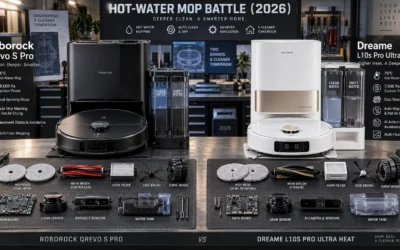
Self-cleaning dock temperature is a hygiene indicator that is often overlooked. The roborock Qrevo S Pro heats wash water to 167 degrees Fahrenheit for mop self-cleaning and uses 113-degree warm air drying to prevent mildew odor between cycles. The roborock Qrevo S5V uses hot-air drying in its all-in-one dock as well. The Dreame L40 Ultra Gen 2 dock handles mop washing and drying alongside self-emptying. Models that only air-dry mops at ambient temperature are more susceptible to odor buildup in humid environments, a factor worth weighing in kitchens or homes with multiple pets. For troubleshooting and reliability insights, consult our in-depth roborock qrevo s pro vs dreame l10s pro ultra heat report.
Base Station Capacity and Hands-Free Duration
The dust collection capacity of the base station determines how long the system runs without any manual intervention. The Dyson Spot+Scrub Ai uses a bagless cyclonic bin rated for up to 100 days of dry debris storage, the highest figure among reviewed models. The Shark AV2501AE and Shark Matrix Clean use bagless 60-day self-empty bases with true HEPA filtration capturing 99.97 percent of particles at 0.3 microns. The roborock Qrevo S Pro uses a sealed 2.7-liter bag lasting 7 to 9 weeks, while the eufy E25 uses a 3-liter bag lasting approximately 75 days. Bagged systems offer an advantage for allergy sufferers because dust is contained during removal, whereas bagless designs require careful handling to avoid releasing captured allergens.
Battery Runtime and Recharge Behavior
Runtime directly determines whether a single charge covers an entire home in one session. The Dreame L40 Ultra Gen 2 leads the reviewed group at 231 minutes in Quiet Mode using a 5,200 mAh battery, covering up to 1,679 square feet per cycle. The Bissell FlexClean FurForce reaches 180 minutes, the Shark AV2501AE up to 120 minutes, and the Shark Matrix Clean up to 90 minutes. The Dyson 360 Vis Nav offers up to 65 minutes but compensates with automatic recharge and resume behavior. The eufy E25 provides 125 minutes in standard vacuum-and-mop mode. For homes over 2,000 square feet, prioritize models with recharge-and-resume functionality and runtime above 120 minutes to avoid multiple interrupted cycles.
| Model | Suction (Pa) | Runtime (min) | Base Capacity | Mop Self-Clean | Navigation |
|---|---|---|---|---|---|
| Dreame L40 Ultra Gen 2 | 25,000 | 231 | Not Specified | Yes | LiDAR + 3DAdapt |
| Dyson 360 Vis Nav | Highest (2x claimed) | 65 | Not Specified | No | 360 Vision (26 sensors) |
| Dyson Spot+Scrub Ai | Not Specified | Not Specified | 100-day bagless | Yes (self-cleaning roller) | LiDAR + HD Camera AI |
| roborock Qrevo S Pro | 18,500 | Not Specified | 2.7L bag, 7-9 weeks | Yes (167F wash, 113F dry) | LiDAR |
| roborock Qrevo S5V | 12,000 | Not Specified | 10-week bin | Yes (hot-air dry) | LiDAR + structured light |
| eufy Robot Vacuum E25 | 20,000 | 125 | 3L bag, ~75 days | Yes (HydroJet roller) | LiDAR |
| Shark AV2501AE | Not Specified | 120 | 60-day bagless HEPA | No | 360 LiDAR |
| Shark Matrix Clean | Not Specified | 90 | 60-day bagless | No | 360 LiDAR |
Our methodology for comparing top-rated dyson robotic vacuum options centers on a structured analysis of verifiable manufacturer specifications, third-party certification data where available, and aggregated user satisfaction signals from verified purchasers. We do not accept manufacturer samples or compensation, and brand relationships have no influence on rankings. Each model is assessed across six primary dimensions: suction power and brush engineering, navigation system type and mapping capability, mop hygiene and self-cleaning temperature, base station capacity and filter type, battery runtime and recharge behavior, and app ecosystem quality including voice assistant compatibility. Secondary factors include noise output (decibel ratings where disclosed), WiFi frequency requirements, obstacle avoidance technology tier, and warranty terms. This multi-axis scoring approach surfaces models that perform consistently across real household conditions rather than excelling in a single benchmark specification.
Price-to-feature ratio is evaluated within each tier separately. A model priced at the lower end of the entry-level to premium range is not penalized for lacking features standard in flagships, but is assessed on whether its included features are implemented reliably. User review patterns are cross-referenced for recurring complaints such as navigation failures, mop odor, connectivity drops, or brush tangling, which may not appear in specification sheets but significantly affect long-term ownership satisfaction. Models with SGS or third-party certifications for tangle-resistance, HEPA filtration rated to 0.1 or 0.3 microns, and independently verified suction figures are weighted more favorably than those relying solely on unverified manufacturer claims.
Final Verdict: Choosing the Right Robot Vacuum Mop
Best Overall Dyson Robotic Vacuum: Dreame L40 Ultra Gen 2. At 25,000 Pa with five suction levels, an extendable brush and mop arm that reaches corners most robots miss, 231 minutes of runtime in Quiet Mode, and an all-in-one dock handling self-emptying, mop washing, and drying, the L40 Ultra Gen 2 delivers the most comprehensive feature set relative to its price point in the reviewed group. The Smart Pathfinder and 3DAdapt obstacle avoidance reduce manual intervention in cluttered spaces, and off-peak charging support adds a practical energy-cost benefit. For households with mixed flooring, pets, and large square footage, it represents the strongest balance of cleaning power, autonomy, and maintenance convenience among the top-rated models evaluated.
Best Value Choice: Shark AV2501AE. At the lower end of the entry-level to premium range, the Shark AV2501AE combines 360-degree LiDAR navigation, Matrix Clean grid-pattern coverage, a 60-day bagless self-empty base with true HEPA filtration at 99.97 percent efficiency, and up to 120 minutes of runtime with recharge-and-resume. It lacks a mop system and self-cleaning dock, but for buyers whose primary need is thorough vacuuming with minimal intervention, it delivers reliable performance at a price that is significantly below the flagship tier. The Shark Matrix Clean (AV2511AE) is a close alternative at the same price with a self-cleaning brush roll and voice control, making it worth considering for pet-heavy households. For additional options in this segment, see our comparison of Shark robotic vacuum models and parts.
Best for AI-Driven Stain Removal: Dyson Spot+Scrub Ai. The Spot+Scrub Ai occupies the top of the price range and targets a specific problem that standard spinning-pad mops handle poorly: persistent, localized stains. Its HD camera with green illumination and AI processing identifies spills and returns to them up to 15 times, while the hygienic roller design ensures only clean water contacts the floor on every pass. The bagless 100-day cyclonic bin eliminates bag replacement entirely, and faster LiDAR-based auto-zoning reduces initial setup time. For households with young children, frequent cooking spills, or light-colored hard flooring where stain visibility is high, the Spot+Scrub Ai addresses a gap that general-purpose robot vacuums leave open. Buyers interested in the full Dyson robotic vacuum lineup can also review our dedicated Dyson vacuum robot guide for detailed model comparisons.
What suction power do I need in a dyson robotic vacuum for carpets?
For low-pile carpets, a minimum of 10,000 Pa with a rubber brush roll provides adequate embedded-dirt extraction. Medium-pile carpets benefit from 18,000 Pa or higher with automatic suction boost on carpet detection, as seen in the roborock Qrevo S Pro at 18,500 Pa and the Dreame L40 Ultra Gen 2 at 25,000 Pa. Models with mop-lift functionality of at least 10 mm are essential if you run combined vacuum-and-mop cycles to avoid wetting carpet fibers.
Is a dyson robotic vacuum worth buying if I already own a cordless stick vacuum?
A dyson robotic vacuum adds value primarily through scheduled, unsupervised cleaning that maintains baseline cleanliness between manual deep-clean sessions. Cordless stick vacuums, including the Dyson V11 Origin in the reviewed group, offer superior spot-cleaning power and attachment versatility but require active use. The two categories are complementary rather than substitutes, with robotic units handling daily maintenance and stick vacuums addressing targeted messes or high-traffic areas. For most households, running a dyson robotic vacuum on a daily or every-other-day schedule reduces the frequency and duration of manual vacuuming sessions measurably.
How often do dyson robotic vacuum base stations need maintenance?
Dust bag or bagless bin emptying frequency depends on collection capacity: the Dyson Spot+Scrub Ai is rated for 100 days, the eufy E25 approximately 75 days, and the Shark models 60 days. Mop water tanks on self-refilling docks like the roborock Qrevo S5V need refilling based on floor area cleaned per session. Filters should be rinsed or replaced per manufacturer guidance, typically every 2 to 3 months for HEPA-rated units, to maintain filtration efficiency and prevent suction loss. For maintenance parts availability across brands, our guide on compact robot vacuum models includes sourcing tips applicable to most major brands.
Do dyson robotic vacuum models work reliably on dark or black floors?
LiDAR-based navigation systems, used by the majority of models reviewed here, operate independently of floor color and function normally on dark surfaces. Camera-only or infrared cliff-sensor systems can occasionally misread very dark floors as drop-offs, causing the robot to stop or avoid those areas. If your home has dark hardwood or slate tile, prioritize LiDAR navigation models such as the Shark AV2501AE, roborock Qrevo S Pro, or Dreame L40 Ultra Gen 2 to avoid navigation errors. Most current flagship units include redundant sensors that mitigate this issue.
What WiFi setup do dyson robotic vacuum models require?
All dyson robotic vacuum models reviewed here require a 2.4 GHz WiFi network for app connectivity and voice assistant integration. None support 5 GHz-only networks, which is a common point of confusion during setup. Dual-band routers broadcasting both 2.4 GHz and 5 GHz simultaneously are compatible as long as the robot is connected to the 2.4 GHz band specifically. Voice assistant support spans Amazon Alexa, Google Assistant, and in some models Apple Siri, with the Dreame L40 Ultra Gen 2 and eufy E25 supporting all three. Stable 2.4 GHz signal strength at the robot’s operating area is more important than total router speed for reliable scheduling and remote control performance.
Dyson Charging and Power Notes
Dyson robotic machines use compact batteries and docks that connect to household power, so basic safe charging habits apply. Readers can find electrical guidance for household equipment through the International Electrotechnical Commission (IEC).