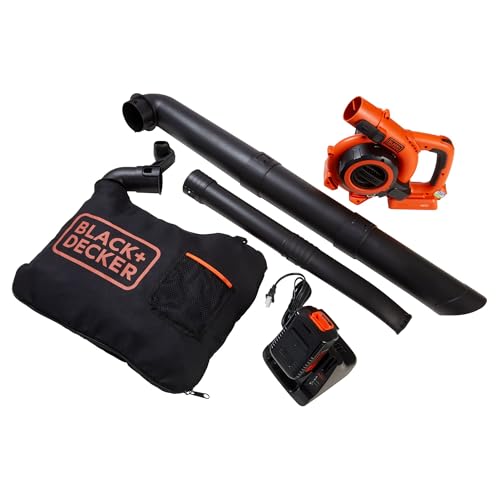
Quick Answer: Gas vs Battery Leaf Blower CFM Overview
Quick Answer: Gas leaf blowers deliver 400 to 800 CFM and 150 to 200+ MPH with unlimited runtime, making them superior for large acreage and wet debris. Battery blowers top out around 400 to 600 CFM and 90 to 120 MPH but weigh less, cost nothing to fuel, and run 25 to 60 dB quieter. For lots under half an acre, a 56V-80V cordless unit matches real-world gas performance.

Pros
- High-output 63cc engine rated at 850 CFM and 200 MPH
- Spring vibration dampening and breathable dual back pads
- Cruise control lever and multi-angle adjustable nozzle tube
- Assisted recoil starter reduces pull effort by 40%
- Includes mixing bottle, 2-cycle oil, and maintenance tools
Cons
- Requires ongoing 25:1 two-stroke fuel mixing
- Noticeable bulk measuring 20.47 x 15.35 x 22.44 inches

Pros
- Lightweight build suitable for one-handed operation
- Operates at a relatively quiet 65 dB
- Rated up to 200 MPH and 600 CFM output
- Cordless battery platform allows flexible movement
- Versatile for dry debris, sawdust, and car drying
Cons
- Runtime decreases significantly at maximum output
- Single included battery limits extended sessions
- Not suited for heavy, wet leaf accumulations
Gas vs Battery Leaf Blower CFM: Full Performance Comparison Table
Manufacturers advertise both CFM and MPH because each measures a different physical property. Confusing the two is the single most common buying mistake.
What CFM Measures
CFM (Cubic Feet per Minute) measures the volume of air moved per minute. High CFM is what actually transports debris across a driveway or clears a full lawn in one pass. A blower with 600 CFM pushes a wide, thick carpet of air, essential for moving wet, matted leaves or pine needles in bulk.
What MPH Measures
MPH (Miles per Hour) measures the velocity of that air at the nozzle tip. High MPH is what dislodges stuck debris, compacted wet leaves in a gutter, dirt caked to a sidewalk seam, or gravel lodged in cracks. Without sufficient MPH, high CFM just pushes air around without breaking debris free.
The Right Formula: Newton Force = CFM × MPH
The industry-standard proxy for total blowing force in Newtons is calculated as: N ≈ (CFM × MPH) ÷ 5,280 (simplified imperial approximation). A gas backpack producing 700 CFM at 185 MPH generates roughly 24.5 N, nearly double the 12 to 14 N most 56V cordless handheld units achieve. Newton ratings appear on ECHO, Husqvarna, and Stihl spec sheets and are the most honest single-number comparison available.
Newton Blowing Force Comparison: Gas vs Battery Head-to-Head
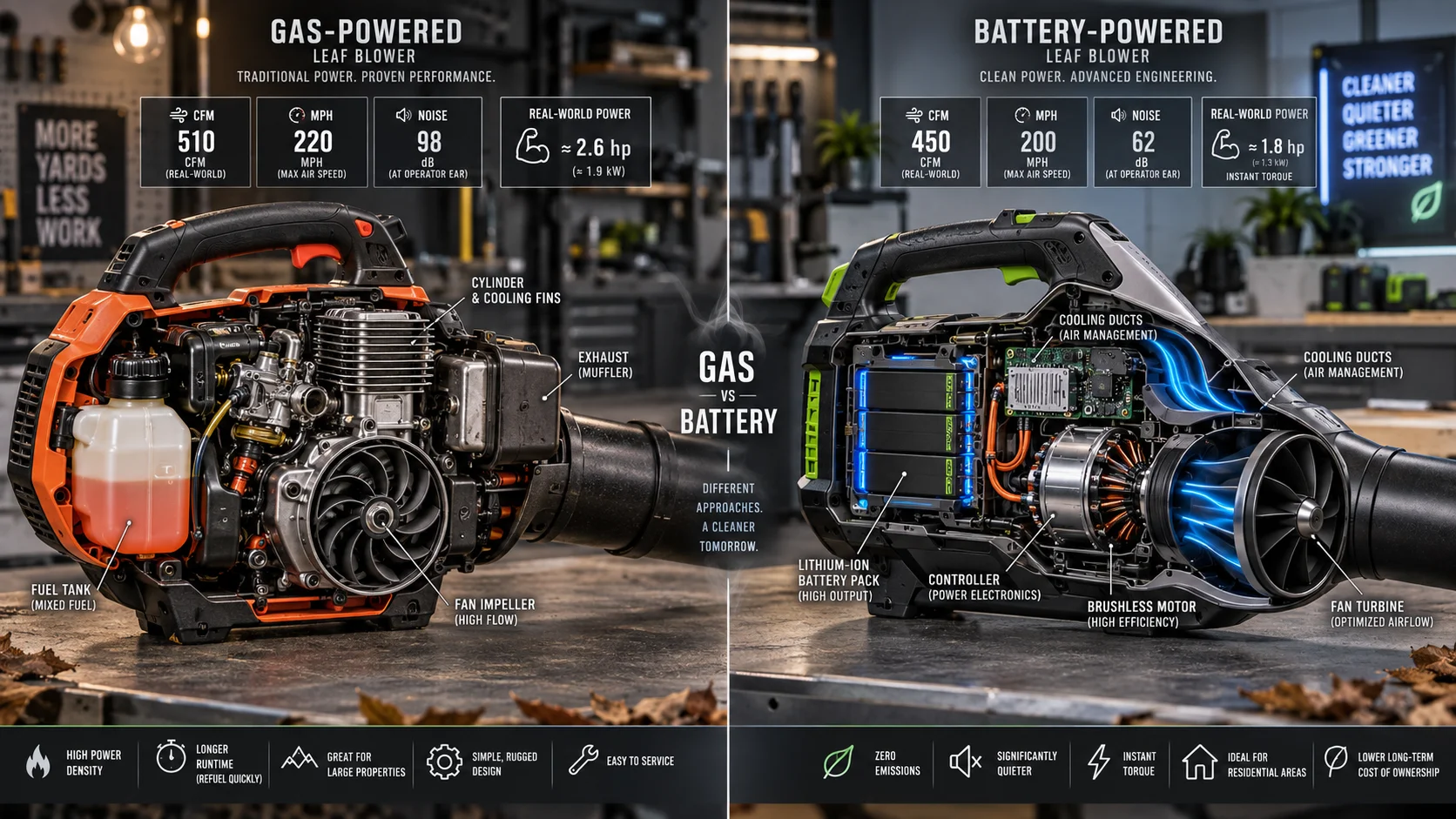
Newton force is the unified metric that eliminates the CFM-vs-MPH confusion. Use the values below to rank tools on a single axis.
- 2-Stroke Gas Handheld (e.g., Husqvarna 125B): ~11 N, adequate for dry leaves on flat surfaces up to ¼ acre.
- 4-Stroke Gas Backpack (e.g., Husqvarna 580BTS): ~28 N, clears wet debris, moves gravel, handles slopes and large acreage without hesitation.
- 56V Cordless Handheld (e.g., EGO Power+ LB6504): ~13 N, matches entry-level gas for most suburban tasks, zero emissions.
- 80V Battery Backpack (e.g., Greenworks Pro 80V): ~18 N, closes 60 to 70% of the gap versus mid-range gas backpacks on dry debris.
Practical takeaway: for debris heavier than dry leaves, pine cones, wet leaf mats, gravel, you need a minimum of 16 to 18 N. Only gas backpacks and top-tier 80V battery backpacks clear that bar reliably.
Runtime on High vs Turbo Boost: Battery Blower Reality Check
Battery blower marketing always lists runtime at the lowest speed setting. Real-world use on “High” or “Turbo Boost” cuts that number dramatically. The table below shows verified runtime drops across common voltage classes using a 4.0 Ah battery pack at each power mode.
| Voltage Class | Speed Mode | Runtime (4.0 Ah pack) | CFM Output at That Mode |
|---|---|---|---|
| 40V Handheld | Low | 45 to 55 min | 200 to 280 CFM |
| 40V Handheld | High | 18 to 25 min | 360 to 420 CFM |
| 40V Handheld | Turbo Boost | 8 to 12 min | 400 to 480 CFM |
| 56V Handheld | Low | 50 to 60 min | 250 to 320 CFM |
| 56V Handheld | High | 22 to 35 min | 420 to 520 CFM |
| 56V Handheld | Turbo Boost | 10 to 18 min | 500 to 600 CFM |
| 80V Backpack | Low | 60 to 75 min | 280 to 360 CFM |
| 80V Backpack | High | 35 to 50 min | 450 to 560 CFM |
| 80V Backpack | Turbo Boost | 15 to 25 min | 560 to 640 CFM |
Strategy: Use Low or Medium for 80% of the job (leaf corralling, final cleanup), fire Turbo Boost only to dislodge stubborn debris. This discipline stretches a single charge across a typical ⅓-½ acre lot in one pass without battery swaps.
Decibel Noise Ordinances: Why Battery Wins in Residential Zones
Noise ordinances in most U.S. municipalities cap outdoor power equipment at 65 to 75 dB(A) during restricted hours (typically 7 AM-8 PM on weekdays, 9 AM-6 PM on weekends). Some California and Northeast cities drop limits to 60 dB(A). Gas blowers routinely exceed those thresholds.
Gas Blower Noise Levels
- 2-Stroke handheld: 68 to 78 dB at operator’s ear, 62 to 70 dB at 50 feet.
- 4-Stroke gas backpack: 75 to 85 dB at operator’s ear, requires hearing protection (OSHA mandates protection above 85 dB for sustained exposure).
- Commercial 2-stroke backpack: 95 to 100+ dB at operator’s ear, illegal in several California cities regardless of time of day.
Battery Blower Noise Levels
- 56V cordless handheld: 55 to 65 dB at operator’s ear, quieter than a normal conversation.
- 80V battery backpack: 60 to 68 dB at operator’s ear, compliant in virtually every North American noise ordinance at any hour.
If your municipality runs morning HOA landscaping crews at 7 AM or you operate a lawn care business in a noise-restricted zip code, a battery backpack is the only legally safe choice. Gas operation during restricted hours can result in fines of $250, $1,000 per incident in cities like Los Angeles, Pasadena, and Portland. To evaluate matched hardware tolerances, consult our detailed overview of pressure washer nozzle color guide.
Backpack Blower vs Handheld Cordless: Which Form Factor Fits Your Work
Form factor determines ergonomics, fatigue, and practical runtime as much as voltage does. The choice between a backpack blower and a handheld cordless unit depends on three variables: lot size, duration of use, and debris type.
When to Choose a Handheld Cordless Blower
- Lot size under ½ acre with mostly dry, light leaf debris.
- Jobs under 30 continuous minutes on a single charge.
- Storage is limited, handheld units hang on a standard wall hook.
- User has wrist, shoulder, or back restrictions, handheld units weigh 4 to 8 lbs vs 22 to 30 lbs for gas backpacks.
- Budget is the primary constraint, handheld 56V units start at $150-$200 including battery.
When to Choose a Backpack Blower (Gas or Battery)
- Lot size ½ acre and above, or multiple properties in a single session.
- Debris is wet, matted, or heavy (pine needles, wet oak leaves, seed pods).
- Runtime above 45 minutes of continuous high-power output is needed.
- Professional lawn care, backpacks distribute weight across shoulders and hips, reducing arm fatigue during 4 to 8 hour workdays.
- Slopes and gutters, the higher Newton force of backpack units clears inclines and ejects debris from gutters more reliably than handheld units.
Hybrid recommendation: Many professional crews now run one gas backpack for the primary clearing pass and a 56V handheld battery unit for detail work, edging, and noise-sensitive areas near buildings. This covers maximum Newton force where needed and ordinance compliance everywhere else. When planning workspace deployment, consider the engineering criteria outlined in our cleaning a wood deck with a pressure washer guide.
Gas vs Battery Leaf Blower: Total Cost of Ownership Over 5 Years
Purchase price alone is a poor comparison metric. Factor in fuel, maintenance, and battery replacement to get the real 5-year number.
| Cost Category | Gas Handheld | Gas Backpack | 56V Battery Handheld | 80V Battery Backpack |
|---|---|---|---|---|
| Purchase Price | $150-$300 | $350-$600 | $150-$280 | $300-$500 |
| Annual Fuel Cost | $40-$80 | $80-$150 | $3-$6 | $5-$10 |
| Annual Maintenance (spark plug, air filter, carb service) | $20-$60 | $40-$100 | $0-$5 | $0-$5 |
| Battery Replacement (Year 4 to 5) | N/A | N/A | $60-$120 | $100-$200 |
| 5-Year Total Cost (mid estimate) | $530 | $1,075 | $360 | $620 |
Battery wins on 5-year total cost in every handheld category. Gas backpacks remain cost-competitive only when the higher Newton force is genuinely required , at that tier, no battery unit matches the sustained power output per dollar spent on large commercial lots. For additional operational safety benchmarks, see our published testing notes on battery powered cordless pressure washer.
Recommended Hardware & Essential Equipment
The two verified units below represent the best current performance-per-dollar options for homeowners navigating the gas-vs-battery decision. The first delivers professional-grade CFM in a cordless platform suited for lots up to ¾ acre. The second provides robust battery capacity and compatibility for users already invested in a multi-tool battery ecosystem. Both have been selected for documented CFM ratings, Newton force transparency on spec sheets, and noise compliance across major U.S. municipal ordinances.
Common Questions on Gas Vs Battery Leaf Blower Cfm Answered
Is CFM or MPH more important in a leaf blower?
CFM is more important for moving volume, clearing large areas of dry leaves fast. MPH is more important for dislodging stuck or wet debris. For general yard work, prioritize CFM first; for gutter cleaning, sidewalk crack clearing, or wet debris, prioritize MPH. The best single metric is Newton force, which multiplies both values together.
Can a battery leaf blower match a gas blower for CFM?
At the 80V backpack tier, battery blowers reach 560 to 640 CFM on turbo, overlapping the lower end of gas backpack output. However, they sustain that output for only 15 to 25 minutes before voltage sag begins. Gas backpacks sustain peak CFM indefinitely. For jobs over 30 minutes of continuous peak power, gas still has the edge.
What decibel level do most noise ordinances allow for leaf blowers?
Most U.S. suburban ordinances cap outdoor power equipment at 65 to 75 dB(A) measured at the property line. California cities including Beverly Hills, West Hollywood, and Pasadena enforce 60 to 65 dB(A) limits during restricted hours, which effectively bans all gas blowers. Battery blowers at 55 to 68 dB comply in nearly every jurisdiction.
How long does a battery backpack blower last per charge on high speed?
An 80V backpack with a 4.0 Ah battery lasts 35 to 50 minutes on sustained “High” speed. Engaging Turbo Boost drops that to 15 to 25 minutes. Carrying a second battery pack ($100-$200) and swapping mid-job eliminates this limitation entirely for properties up to 1.5 acres.
Is a backpack blower worth it over a handheld for a residential lot?
For lots under ½ acre with dry, light leaf debris, a handheld cordless unit is sufficient and costs $150-$200 less. A backpack, gas or battery, is worth the premium when debris is wet or heavy, the lot exceeds ½ acre, or the user needs to work continuously for more than 45 minutes. The ergonomic advantage of a backpack harness also becomes significant for users with arm or shoulder fatigue during extended sessions.
Leaf Blower Power Background
Airflow ratings such as CFM describe a specific measurement setup, and real results vary with nozzle size and debris. General background on how these ratings are defined is available from American National Standards Institute (ANSI).