

Direct Answer: A snow blower works by rotating a helical auger at ground level to scoop snow and channel it toward a discharge chute or impeller fan, which then throws the snow away from the cleared path. Single-stage models rely on the auger alone; two-stage models add a separate high-speed impeller fan for heavier volumes; three-stage models insert an accelerator between the auger and impeller for maximum throughput on wet or packed snow. The engine or motor drives all moving parts through a transmission and drive system controlled by the operator.
Pros
- Produces up to a rated 765 CFM of blowing power
- Variable-speed trigger offers customizable air delivery
- Includes a 56V 5.0Ah battery and matching charger
Cons
- High-output operation can significantly reduce runtime per charge
- 5.0Ah battery adds noticeable weight for single-handed work
Pros
- M18 FUEL system utilizes dual battery power for high output
- Cordless design offers unrestricted portability across large areas
- Integrates with the Milwaukee M18 tool ecosystem
Cons
- Tool only; requires two M18 batteries and a charger sold separately
- Dual batteries increase overall handheld carrying weight
Pros
- Offers up to a manufacturer-rated 700 CFM air volume
- Brushless motor ensures efficient power delivery
- Includes a 4.0Ah battery and rapid charger
Cons
- The 60V battery pack adds weight during extended handheld use
The Basic Principle: Auger, Impeller, and Discharge
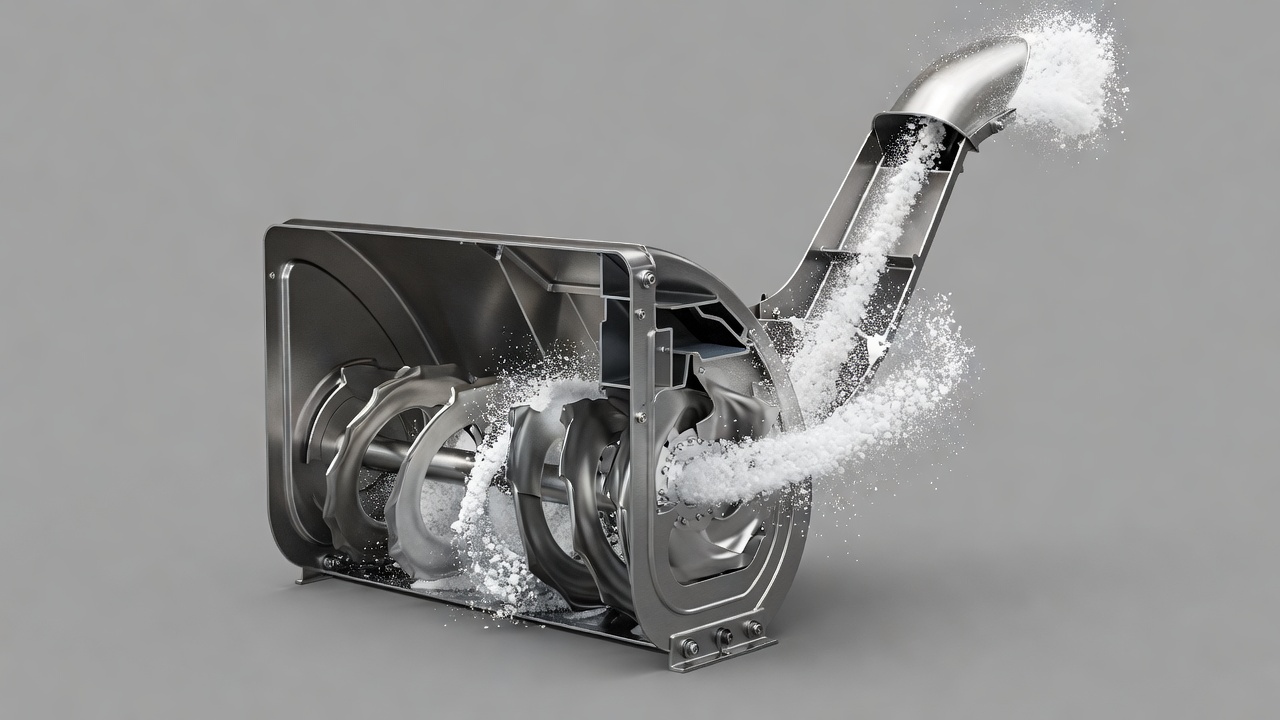
Every snow blower — regardless of stage count or power source — shares one fundamental sequence: collect, move, eject. Understanding these three steps explains the entire machine.
The Auger
The auger is a rotating, spiral-shaped blade (resembling a large drill bit or corkscrew) mounted horizontally at the front of the machine inside the intake housing. As the auger spins, its curved blades bite into the snow pack at ground level, break it up, and pull it inward toward the center of the housing. The auger rotates at roughly 100–200 RPM in most residential models. The blades are typically made from hardened steel or a steel-and-rubber composite on single-stage machines, allowing them to skim paved surfaces without major damage.
The Impeller
In two-stage and three-stage machines, once the auger delivers broken snow to the center of the housing, an impeller fan — a high-speed paddle-style fan spinning at 3,000 RPM or more — accelerates the snow upward and outward through the discharge chute. The impeller never contacts the ground; it handles only the pre-broken snow fed to it by the auger. This division of labor lets each component be optimized independently: the auger for torque and cutting, the impeller for throwing distance.
The Discharge Chute
The discharge chute is a curved tube mounted on top of the housing. Snow exits through it and lands in whatever direction the operator aims. Most chutes rotate 180–200 degrees left or right via a crank or electric chute control. A hinged deflector at the chute’s opening adjusts the ejection angle — lower to throw snow close, higher to throw it farther. Throw distances range from 15 feet on small single-stage electrics to 50+ feet on large three-stage gas models. To evaluate matched hardware tolerances, consult our detailed overview of jbl partybox club 120 vs sony srs xv500.
Single-Stage Snow Blowers: Simplicity and Limitations
A single-stage snow blower uses only the auger to both collect and eject snow. The auger spins fast enough (and its rubber-edged blades contact the pavement closely enough) to fling snow directly up into the chute without a separate impeller. Because there is no second mechanical stage, the entire machine is lighter, narrower, and less expensive than two-stage alternatives. To evaluate matched hardware tolerances, consult our detailed overview of jbl partybox club 120 vs sony srs xv500.
- Best conditions: Light, dry snow under 6 inches on flat, paved driveways and sidewalks.
- Limitations: The auger must contact the ground to function, so single-stage blowers cannot be used safely on gravel. They also struggle with wet, dense, or packed snow because the auger cannot generate enough velocity to throw heavy material effectively.
- Self-propulsion: Single-stage models are not self-propelled; the auger’s contact with the pavement pulls the machine forward. On ice or very smooth surfaces, traction is reduced.
- Width and weight: Clearing widths typically range from 11–22 inches; total weight is usually 30–90 lbs, making them easy to store and maneuver.
Single-stage blowers are effective for light snow (under 6 inches) on paved surfaces — conditions where a simpler, faster machine is sufficient and cost matters. When planning workspace deployment, consider the engineering criteria outlined in our z890 vs x870e motherboard guide.
Two-Stage Snow Blowers: The Standard Residential Approach
The two-stage design separates collection and ejection into distinct mechanical stages, which is why two-stage blowers handle deeper, wetter, and denser snow far more effectively than single-stage units.
Stage 1 — Auger Collection
The auger rotates at lower speed than a single-stage unit, prioritizing torque over velocity. Its steel blades (no rubber edge) do not contact the ground — a small gap of roughly ½ inch is maintained — making two-stage machines safe on gravel and uneven terrain. The auger breaks up the snow and drives it to the center of the intake housing. When planning workspace deployment, consider the engineering criteria outlined in our z890 vs x870e motherboard guide.
Stage 2 — Impeller Ejection
A separate, high-speed impeller fan receives the collected snow and accelerates it through the discharge chute. Because the impeller runs at its own optimized speed, it can throw snow 25–50 feet even when the snow is heavy or wet. The mechanical separation also protects the drivetrain: if the auger jams on a rock or ice chunk, a shear pin breaks before damage reaches the transmission (see Key Components below).
Drive System
Two-stage blowers are self-propelled. A friction-disc transmission or hydrostatic drive system transfers engine power to the rear wheels independently of the auger drive. Operators select forward speed (typically 3–6 forward speeds plus 1–2 reverse) using a gear selector, while separate engagement levers independently activate the wheel drive and the auger/impeller. This split control lets the operator stop forward motion while keeping the auger running, or vice versa. For additional operational safety benchmarks, see our published testing notes on marshall stanmore iii vs harman kardon onyx studio 8.
- Clearing width: Typically 20–30 inches.
- Intake height: Typically 12–23 inches, handling snowfall well over 12 inches with multiple passes.
- Weight: 150–300 lbs, requiring self-propulsion to be manageable.
Three-Stage Snow Blowers: Maximum Power and Speed
Three-stage snow blowers add a third mechanical element between the auger and the impeller: an accelerator (also called a center auger or secondary auger). This accelerator is a serrated or paddle-style rotor mounted at the center of the intake housing, perpendicular to the main auger.
What the Accelerator Does
The main outer augers break up and move snow inward as in a two-stage machine. The accelerator then chops the snow further, compresses it, and feeds it into the impeller at significantly higher speed and volume than a two-stage system can achieve. The result is faster intake clearing and longer throw distances. Three-stage models discharge snow approximately 20–50% farther than comparable two-stage models due to the increased velocity generated at the impeller inlet. To compare alternative configurations, check our hands-on review of dyson v8 cyclone vs bissell featherweight stick.
When Three-Stage Makes Sense
- Regions with frequent heavy, wet, or lake-effect snowfall exceeding 18 inches per event.
- Commercial properties or large residential lots with long driveways where clearing speed is critical.
- Operators who regularly encounter packed or compacted snow from plows blocking the end of the driveway.
Three-stage blowers carry a significant price and weight premium over two-stage equivalents. For most residential users with moderate snowfall, a two-stage machine is sufficient.
Power Sources: Gas, Electric, and Battery Systems
The engine or motor drives the auger, impeller, and (on self-propelled models) the wheels through a shared mechanical system. The power source changes starting behavior, runtime, maintenance, and — to a degree — available torque, but it does not fundamentally alter the auger-to-chute mechanics described above. Users looking for related component recommendations can explore our bissell crosswave hydrosteam vs shark stainforce breakdown.
Gas-Powered Snow Blowers
Gas engines deliver the highest sustained power output. Residential gas snow blowers typically produce 4–13 horsepower (the exact figure depends on engine displacement and the manufacturer’s rating method). Gas models start via recoil pull-start or electric start, run indefinitely as long as fuel is available, and are not tethered to an outlet. Trade-offs include cold-weather starting difficulty, annual carburetor maintenance, oil changes, and fuel stabilization if stored for the season.
Corded Electric Snow Blowers
Electric motors on corded models are rated in amps rather than horsepower; typical corded single-stage units draw 12–15 amps, roughly equivalent to 1.5–2 hp. They start instantly, require no fuel, and produce no direct emissions. The primary limitation is the power cord, which restricts range to the length of a heavy-duty outdoor extension cord and creates a trip and tangling hazard during operation.
Cordless Battery-Powered Snow Blowers
Brushless DC motors in battery-powered models offer the convenience of cordless operation with near-instant start. Most residential battery snow blowers use 40V, 56V, or 80V lithium-ion platforms. Cordless battery-powered snow blowers have a runtime of approximately 30–60 minutes per charge under typical conditions, though runtime drops in very cold temperatures or heavy, wet snow. Dual-battery systems extend runtime and are now common in mid-range and premium cordless models. Mechanically, the motor drives the auger (and impeller, on two-stage battery models) through the same drive train architecture as gas machines.
| Power Source | Typical Power Output | Runtime | Maintenance Level | Best For |
|---|---|---|---|---|
| Gas | 4–13 HP | Unlimited (with fuel) | High | Heavy snowfall, large areas, two/three-stage use |
| Corded Electric | 1.5–2 HP equivalent | Unlimited (with cord) | Low | Light snow, small driveways near outlet |
| Battery (Cordless) | 1–3 HP equivalent | 30–60 min per charge | Low | Light-to-moderate snow, noise-sensitive areas |
Key Components and How They Work Together
Understanding individual parts clarifies why snow blowers behave the way they do under stress or when maintenance is needed.
Engine and Motor
The engine or motor is the prime mover. On gas models, a single-cylinder four-stroke engine connects via a belt-and-pulley system to both the auger gearbox and the transmission. Belt tension is controlled by engagement levers (often called bail levers or clutch handles) on the handlebar — releasing the lever slackens the belt and disengages the component.
Transmission and Friction Drive
The friction-disc transmission is the most common drive system on mid-range two-stage gas blowers. A rubber-edged friction disc contacts a steel drive plate; the point of contact determines forward or reverse speed. Shifting gears physically moves the friction disc across the drive plate. Hydrostatic transmissions (found on premium models) replace mechanical gears with hydraulic fluid pressure, offering infinitely variable speed control and smoother operation. The transmission drives the axle and wheels independently of the auger system.
Auger Gearbox
A dedicated gearbox steps down the engine speed to the lower, higher-torque RPM required to spin the auger. The gearbox is lubricated with gear oil and is a long-service component when maintained correctly. On single-stage electric models, the motor may drive the auger directly or through a simple gear reduction without a separate gearbox housing.
Shear Pins
Shear pins are deliberately weak bolts or pins that connect the auger blade to the auger shaft. When the auger strikes a rock, frozen newspaper, or dense ice chunk, the shear pin breaks at a set torque threshold — protecting the auger gearbox and transmission from catastrophic damage. Shear pins are inexpensive consumable parts (typically sold in multipacks) and can be replaced in minutes with a wrench. They are not a design flaw; they are an intentional mechanical fuse.
Chute Control and Deflector
The discharge chute rotates horizontally via a crank handle (manual control) or an electric chute rotator (powered control). The deflector flap at the chute opening is adjusted independently to control ejection arc. On premium models, both controls are mounted at the handlebars and can be operated without stopping or releasing the engagement levers.
Skid Shoes
Adjustable skid shoes on the underside of the intake housing set the clearance between the auger housing and the ground. Raising the skid shoes leaves a thin layer of snow on the surface (useful for gravel driveways to prevent stone pickup); lowering them allows the housing to skim bare pavement for a cleaner result.
Choosing the Right Snow Blower for Your Needs
Matching the machine’s stage type, power source, and clearing width to actual conditions produces better results and longer equipment life than buying on price alone.
- Snowfall depth: Under 6 inches of dry snow on a flat paved surface → single-stage electric or battery. Regular snowfall of 6–12 inches → two-stage gas or battery two-stage. Frequent heavy snowfall over 12 inches or wet/packed conditions → two-stage or three-stage gas.
- Surface type: Gravel driveways require a two-stage or three-stage model with raised skid shoes. Single-stage models should only be used on paved surfaces.
- Driveway width and length: A 24-inch clearing width handles a standard two-car driveway in reasonable time. Longer driveways benefit from wider models (28–30 inches) to reduce pass count.
- Physical capability: Battery and single-stage electric models weigh significantly less and require less physical effort. Operators managing weight or mobility limitations benefit from self-propelled two-stage models despite their size.
- Storage and noise: Battery and electric models produce significantly less noise — important in dense residential areas with early-morning snow events.
For deeper comparison of specific models by stage type, see our dedicated guides on single-stage snow blowers and gas vs. electric snow blower trade-offs linked in the navigation.
Common Questions on How Does Snow Blower Work Answered
Does a snow blower work on wet, heavy snow?
Two-stage and three-stage models handle wet, heavy snow effectively because the impeller generates enough velocity to throw dense material clear. Single-stage models struggle with heavy snow — the auger cannot spin material fast enough to eject it properly, and the machine may clog repeatedly. For regions with frequent wet snowfall, a two-stage gas model is the minimum practical choice.
What causes a snow blower auger to stop spinning?
The most common cause is a broken shear pin. When the auger hits a hard object, the shear pin snaps to protect the gearbox. The engine continues running but the auger stops. Replacing the shear pin — typically a 2–5 minute task with the correct replacement pin and a wrench — restores function. On belt-driven models, a worn or broken auger drive belt is the second most common cause.
How far does a snow blower throw snow?
Throw distance depends on stage type, snow density, and chute deflector angle. Single-stage electric models typically throw 15–25 feet. Two-stage gas models reach 25–40 feet under normal conditions. Three-stage models can exceed 50 feet on light, dry snow. Wet, heavy snow always reduces throw distance regardless of machine type.
Can a snow blower damage a gravel driveway?
A single-stage snow blower will pick up and throw gravel because the auger contacts the surface directly — this damages the machine, the gravel, and anything in the throw path. Two-stage and three-stage models with properly adjusted skid shoes maintain ground clearance and can be used safely on gravel by raising the housing slightly to leave a thin snow buffer between the auger and the stones.
For more hands-on benchmarks and buying recommendations, consult our guides on residential zero-turn lawn mower guide, as well as heavy-duty chainsaw buyer guide, as well as durable ride-on lawn tractor guide.
Mechanical safety standards, operational tolerances, and protective gear guidelines align with benchmark specifications established by the American National Standards Institute (ANSI).


