As an Amazon Associate we earn from qualifying purchases. When you buy through our links, we may earn a commission at no extra cost to you. Prices and availability are subject to change on Amazon. Affiliate disclosure ›
How Much Do Riding Lawn Mowers Weigh?
Riding lawn mowers typically weigh between 300-600 lbs for residential models, with zero-turn radius mowers reaching 500-800+ lbs and commercial models exceeding 1,000 lbs. Learn what affects mower weight and why it matters for transport, storage, and performance.
Quick Answer: How Much Do Riding Lawn Mowers Weigh?
Direct Answer: Riding lawn mowers typically weigh between 300 to 600 lbs (136 to 272 kg) for residential models. Most common seated mowers range from 400 to 500 lbs, while zero-turn radius mowers tend to be heavier at 500 to 800+ lbs. Commercial and garden tractor models can exceed 1,000 lbs. Weight varies based on deck size, engine displacement, construction materials, and integrated features like mulching systems or cabs.
The Flagship Score evaluates build engineering, verified performance signals, and long-term owner satisfaction.
Updated: Oct 3, 2026
Last update on Oct 3, 2026. Product prices and availability are accurate as of that date/time and are subject to change. Any price and availability information displayed on Amazon.com at the time of purchase will apply. Affiliate links / Images, product titles, and product highlights from Amazon.
The Greenworks 80V 42" CrossoverT Cordless Riding Lawn Tractor is a zero-emission riding mower for large-yard homeowners, delivering 32HP gas-equivalent brushless power, SmartCut technology, and four included batteries for up to 1.5 acres of runtime.
Pros & Cons
Pros
Powerful 80V brushless motor delivers 32HP gas-equivalent performance with quiet fume-free operation and no engine maintenance.
Complete kit includes four 6.0Ah batteries and 600W charger for substantial runtime up to 1.5 acres.
SmartCut technology and 42-inch heavy-duty steel deck ensure consistent cuts without bogging in tough conditions.
Versatile towing up to 350 lbs and optional cargo hauling plus comfort features like high-back seat and LED lights.
Strong 4-year limited warranty and full compatibility with the Greenworks 80V tool ecosystem.
Cons
Rear utility cargo bed for 200 lb hauling is sold separately and not included in the kit.
Runtime of up to 1.5 acres varies with conditions and may require recharging or battery swaps on larger properties.
As a fully cordless model continuous operation depends on battery levels unlike gas engines with unlimited runtime.
Detailed Review
The Greenworks 80V 42" CrossoverT Cordless Riding Lawn Tractor is a ready-to-mow zero-emission tractor designed for homeowners managing medium to large lawns. It features a reinforced 42-inch stamped steel deck of 12-gauge construction along with premium comfort elements such as a high-back padded seat with foldable armrests. The overall build emphasizes durability and user convenience right out of the box with the included battery and charger set.
Performance centers on the 80V TruBrushless motor that provides 32HP gas-equivalent power with instant torque and quiet fume-free operation. SmartCut technology senses grass conditions and automatically adjusts power to maintain a consistent cut even in tall thick or wet areas. The four 6.0Ah batteries support runtime for up to 1.5 acres depending on conditions while dual LED headlights and a 7-position deck height range from 1.5" to 4.5" add practicality. Front and rear attachments further allow towing up to 350 lbs for added yard utility.
Key considerations include that the rear utility storage bin capable of hauling 200 lbs is sold separately so full cargo functionality requires an extra purchase. Runtime remains condition-dependent and may fall short for properties significantly larger than 1.5 acres without using the 600W charger or swapping batteries. The cordless design prioritizes ease and low maintenance but trades off the continuous runtime of traditional gas models.
This tractor delivers strong value for eco-conscious owners of residential properties who want gas-like power without the emissions noise or upkeep. It suits those who already use or plan to expand into the Greenworks 80V family of tools and who appreciate the 4-year limited warranty. Users with exceptionally large or commercial-scale lawns should evaluate battery logistics carefully before purchase.
The Flagship Score evaluates build engineering, verified performance signals, and long-term owner satisfaction.
Updated: Oct 3, 2026
Last update on Oct 3, 2026. Product prices and availability are accurate as of that date/time and are subject to change. Any price and availability information displayed on Amazon.com at the time of purchase will apply. Affiliate links / Images, product titles, and product highlights from Amazon.
The EGO Power+ TR4204 is a cordless electric riding lawn mower designed for medium to large lawns, delivering 21 horsepower equivalent power and cutting up to 1.5 acres per charge with six included 56V batteries.
Pros & Cons
Pros
Delivers strong 21 horsepower equivalent power comparable to gas riding mowers.
Provides up to 1.5 acres of runtime on a full charge with the six included batteries.
Features low-maintenance dual brushless motors without belts for greater durability.
Offers versatile 12-position cutting height adjustment from 1.5 to 4.5 inches.
Includes digital controls for blade settings, drive speeds, and cruise control.
Cons
Limited to 1.5 acres of cutting per charge without purchasing additional batteries for bigger lawns.
Requires recharging time for the six 56V batteries after each use session.
Relies solely on battery power with no hybrid or gas backup option for extended operation.
Detailed Review
The EGO Power+ TR4204 is a cordless electric riding lawn mower built as a modern tractor alternative for residential use. It features a robust 42-inch stamped steel deck and arrives ready to go with six 56V 6.0Ah batteries plus a charger, creating an immediate impression of convenience and solid construction free from gas engine complexity.
Performance shines through its equivalent 21 horsepower output and top speed of 6 MPH, allowing efficient coverage of up to 1.5 acres on a single charge. Dual brushless cutting motors operate without belts for added durability and less upkeep, while the digital display lets users select three blade settings, three drive speeds, and cruise control. The 12 adjustable heights ranging from 1.5 to 4.5 inches combined with anti-scalp wheels deliver precise results across varied terrain.
Drawbacks center on battery dependency, as larger properties beyond 1.5 acres require extra batteries and recharging intervals can interrupt workflow. The fully electric design eliminates fuel storage needs but demands access to power sources between sessions.
This mower suits homeowners with medium to large yards who value quiet, emission-free operation and reduced maintenance. Those seeking expandable battery capacity for bigger areas will find the EGO Power+ TR4204 a strong long-term investment in cordless lawn care.
The Flagship Score evaluates build engineering, verified performance signals, and long-term owner satisfaction.
Updated: Oct 3, 2026
Last update on Oct 3, 2026. Product prices and availability are accurate as of that date/time and are subject to change. Any price and availability information displayed on Amazon.com at the time of purchase will apply. Affiliate links / Images, product titles, and product highlights from Amazon.
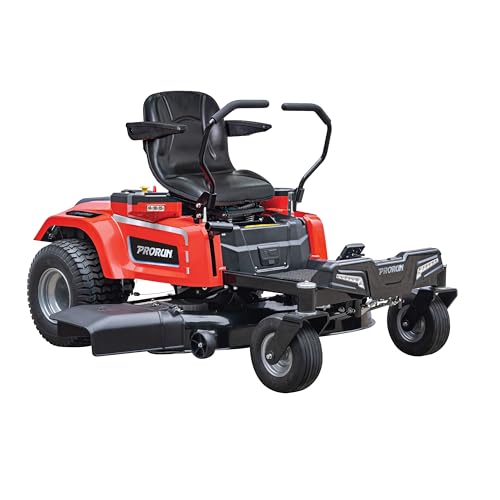
The PRORUN PZT60V42 is a fully electric 60V zero-turn riding lawn mower designed for homeowners seeking zero-emission power equivalent to a 20 HP gas engine, offering up to 2 acres runtime with four brushless motors and a 42-inch steel deck.
Pros & Cons
Pros
High-efficiency brushless motors maximize power output and durability over traditional motors
Up to 2 acres runtime with three included 10.0 Ah batteries supports substantial mowing sessions
Zero-emission operation with gas-equivalent 20 HP power for quieter environmentally friendly use
Six-port auto-switchover battery system provides flexible extended runtime options
Durable 42-inch steel deck plus included mulch and towing kits add immediate functionality
Cons
Runtime is limited to approximately 70 minutes or 2 acres which may require recharging for larger properties
Fully battery-dependent design means performance relies on charge levels and spare battery availability
42-inch deck size may require more passes on expansive lawns compared to wider commercial models
Detailed Review
The PRORUN PZT60V42 is a fully electric 60V zero-turn riding lawn mower built for residential and light commercial use. Its primary design centers on a robust 42-inch 14-gauge stamped steel twin blade deck powered by direct-drive brushless motors, giving an immediate impression of solid construction and modern battery-focused engineering. The mower arrives complete with three 10.0 Ah batteries, a charger, mulch kit, and towing kit for ready-to-work versatility.
In performance terms, four high-efficiency brushless motors deliver power equivalent to a 20 HP gas engine while producing zero emissions. The system supports up to 2.0 acres or 70 minutes of runtime, and six battery ports with auto switchover intelligently manage all PRORUN 60V battery sizes for continuous operation. A washout port on the steel deck further simplifies post-mow maintenance during real-world sessions.
Potential drawbacks include the finite 70-minute runtime window which can limit coverage on larger properties without spare batteries or recharge breaks. As a fully electric model, it also depends entirely on battery charge levels rather than continuous fuel refills, and the 42-inch deck width may demand extra passes compared with wider traditional options.
Overall the PRORUN PZT60V42 offers strong value for homeowners and small-property managers who want gas-like cutting power without emissions or noise. Those with medium-sized lawns seeking quiet efficient zero-turn performance and included accessories will benefit most from this electric mower.
The Flagship Score evaluates build engineering, verified performance signals, and long-term owner satisfaction.
Updated: Oct 3, 2026
Last update on Oct 3, 2026. Product prices and availability are accurate as of that date/time and are subject to change. Any price and availability information displayed on Amazon.com at the time of purchase will apply. Affiliate links / Images, product titles, and product highlights from Amazon.
The Husqvarna Z254F is a zero turn riding mower designed for large residential lawns, offering a 24HP 726cc FR730 engine and 54-inch FAB deck as its standout power and cutting strengths.
Pros & Cons
Pros
Strong 24HP FR730 engine power for demanding cutting conditions
Wide 54-inch FAB deck reduces total mowing time
Zero turn design delivers excellent maneuverability
Sparse details beyond engine and deck leave other features unspecified
Gas-powered FR730 engine needs regular fuel and maintenance
Large 54-inch deck size may feel oversized on compact properties
Detailed Review
The Husqvarna Z254F is a zero turn mower from the established Husqvarna brand in the riding lawn mowers category. It centers on a solid build that pairs a 24HP 726cc FR730 engine with a 54-inch FAB deck for straightforward residential grass care.
Performance stems directly from the listed specifications. The FR730 engine delivers the horsepower needed for steady operation across typical lawns while the wide FAB deck completes passes efficiently. Zero turn handling improves control in real yard layouts based on the model design.
Considerations arise from the limited data available. Secondary elements such as comfort features fuel capacity or extras receive no mention and the gas engine format involves routine upkeep. The large deck suits open areas better than confined spaces.
The Husqvarna Z254F provides the most value for owners of medium or large properties who want reliable engine power and a broad cutting width. Users with smaller lots or those seeking extensive accessory options should weigh the core specs carefully before purchase.
Why Riding Lawn Mower Weight Matters
Understanding riding lawn mower weight is more important than many homeowners realize. Weight directly impacts maneuverability, fuel efficiency, terrain capability, and practical concerns like transportation and storage. A mower that’s too heavy for your terrain may cause soil compaction and reduce traction, while one that’s too light might lack stability on slopes.
Weight also determines what equipment you’ll need to move and store your mower. A 600-lb mower requires a substantial trailer with appropriate weight capacity, while lighter models (300 to 400 lbs) can sometimes be transported on smaller trailers or even in truck beds. Additionally, heavier mowers place greater stress on driveways, decks, and garage flooring, making weight a practical consideration for your property.
For commercial operators, mower weight affects fuel consumption, wear on components, and the physical demands of operation over extended hours. Understanding these relationships helps you choose a mower suited to your specific needs rather than purchasing based on brand or aesthetics alone.
Typical Weight Ranges by Riding Mower Type
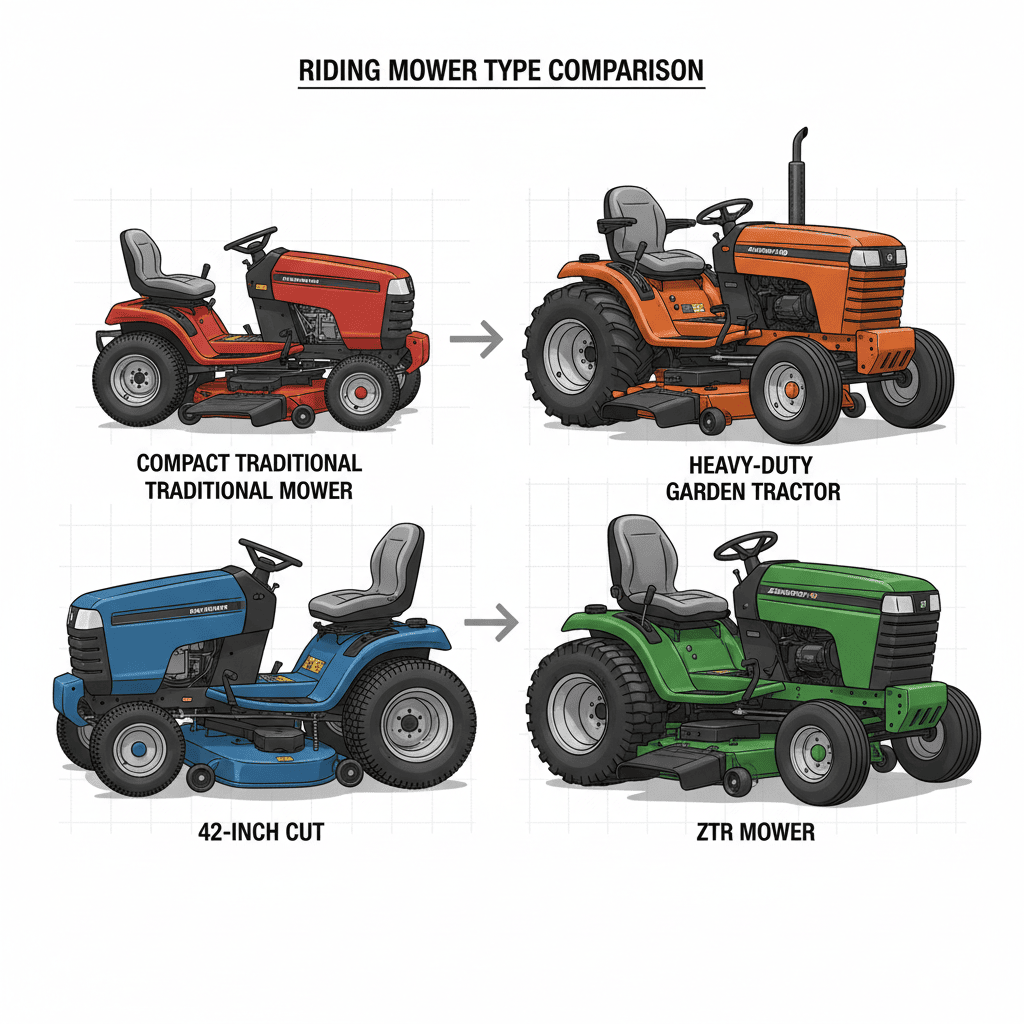
Riding lawn mower weight varies significantly by type and size. Here’s a breakdown of the major categories:
Traditional Seated Riding Mowers (42 to 54″ Deck)
The most common residential riding mowers fall into this category and typically weigh 400 to 550 lbs. A standard 42-inch deck mower usually weighs around 400 to 450 lbs, while 48-inch and 54-inch models range from 480 to 550 lbs. These mowers balance cutting width, power, and transportability, making them the default choice for residential properties of 1 to 3 acres.
Lighter models in this range (300 to 400 lbs) exist but are usually entry-level or designed for smaller yards. These tend to have smaller engines (16 to 19 hp) and less robust construction, which can limit durability and performance on thicker grass or uneven terrain.
Zero-Turn Radius Mowers (42 to 60″ Deck)
Zero-turn mowers are engineered differently than traditional riding mowers, featuring dual hydraulic motors and reinforced frames for improved maneuverability. This design comes at a weight penalty: most zero-turn models weigh 500 to 800+ lbs. A 42-inch zero-turn typically weighs 500 to 600 lbs, while 52 to 60-inch models often exceed 700 to 800 lbs.
The added weight comes from hydraulic systems, heavier frames, and more powerful engines (20 to 30 hp). While heavier, zero-turn mowers provide superior control and efficiency on larger properties (2 to 5 acres), as the reduced mowing time and improved maneuverability often justify the additional weight and cost.
Garden Tractors (42 to 60″ Deck)
Garden tractors are multi-purpose machines designed for mowing, tilling, and pulling attachments. These robust machines weigh 600, 1,000+ lbs depending on size and engine displacement. Smaller garden tractors (16, 20 hp, 42-inch deck) typically start around 600, 700 lbs, while larger models (24, 30 hp, 60-inch deck) can weigh 900, 1,000 lbs or more. For troubleshooting and reliability insights, consult our in-depth marshall stanmore iii vs harman kardon onyx studio 8 report.
Garden tractors feature reinforced frames, larger fuel tanks, and integrated three-point hitch systems, accounting for the substantial weight increase. They’re ideal for properties with varied terrain and the need for multiple attachments.
Commercial-Grade Lawn Mowers (48 to 72″ Deck)
Commercial mowers used by landscapers and grounds maintenance companies weigh 1,000, 2,000+ lbs. These machines feature commercial-grade engines (40, 60+ hp), heavy-duty frames, and enhanced durability for daily use. A 48-inch commercial walk-behind or riding mower typically weighs 1,000, 1,200 lbs, while 60, 72-inch commercial zero-turn models can exceed 1,500, 2,000 lbs. Readers comparing setup options can review our technical analysis on dyson v8 cyclone vs bissell featherweight stick.
The extreme weight reflects professional-grade construction, larger fuel capacity (for all-day operation), and reinforced components designed to withstand constant use and rough conditions.
Key Factors That Affect Riding Mower Weight
Deck Size
Cutting deck size is the primary driver of mower weight. Each additional 6 inches of deck width typically adds 30, 60 lbs. A 42-inch deck mower is roughly 100, 150 lbs lighter than a 54-inch deck model, even from the same manufacturer. Larger decks require stronger frames, more robust blade assemblies, and heavier structural components to handle the mechanical stress of wider cutting passes. For complementary field maintenance guidelines, examine our breakdown of bissell crosswave hydrosteam vs shark stainforce.
Engine Displacement and Power
More powerful engines weigh more. A 16-hp engine weighs roughly 100 to 130 lbs, while a 25-hp engine can weigh 150 to 180 lbs or more. Additionally, larger engines require stronger crankshafts, more substantial engine blocks, and heavier transmission housings. This is why entry-level mowers with modest 16 to 18 hp engines often weigh 100 to 150 lbs less than premium models with 25 to 30 hp engines.
Transmission Type
Transmission type significantly impacts weight. Hydrostatic transmissions (infinitely variable) weigh more than belt-driven or gear-driven systems due to their hydraulic pumps and motor assemblies. Zero-turn mowers with dual hydrostatic systems are consequently heavier than equivalent traditional riding mowers with simpler transmissions.
Frame and Construction Materials
Steel frames weigh more than aluminum or reinforced plastic components, but offer greater durability. Commercial-grade mowers prioritize durability over weight, using heavier steel throughout. Residential mowers often employ lighter materials or hybrid construction (steel frame with plastic decks) to reduce weight and improve maneuverability.
Integrated Features
Added features increase weight:
Mulching kits: Add 20 to 40 lbs
Bagging systems: Add 15 to 30 lbs
Cabs (commercial models): Add 200 to 400 lbs
Roll-over protection systems (ROPS): Add 50 to 100 lbs
Steering controls and upgraded seats: Add 20 to 50 lbs
Deck Material (Steel vs. Reinforced Plastic)
Steel decks are heavier but more durable and easier to repair. Reinforced plastic or composite decks reduce weight by 15 to 30 lbs but may be less durable for heavy-duty use. This trade-off is why commercial mowers almost always feature steel decks.
Dry Weight vs. Operating Weight: Understanding the Difference
Manufacturers typically list dry weight, which is the mower’s weight without fuel, oil, or coolant. Operating weight includes a full fuel tank and other fluids. The difference can be significant:
A typical 10 to 15 gallon fuel tank adds 60 to 90 lbs when full (gasoline weighs ~6.3 lbs/gallon)
Oil and coolant add another 10 to 15 lbs
Operator weight (150 to 250 lbs) further increases total machine weight on the ground
For transport and storage planning, factor operating weight, not just dry weight. A 500-lb (dry) mower becomes 560 to 600+ lbs with a full tank, plus additional weight from the operator during transport or towing.
How to Determine Your Mower’s Exact Weight
Check the Owner’s Manual
The owner’s manual always lists the dry weight and often specifies operating weight. This is the most reliable source and typically appears in the specifications section.
Review the Manufacturer’s Website
Most manufacturers publish detailed specifications online. Search for your model number and look for the specs sheet or product page, which lists dry weight, deck size, engine displacement, fuel capacity, and other critical data.
Contact the Manufacturer or Dealer
If you can’t locate specifications, contact the manufacturer’s customer service or your local dealer. They can provide exact weight and advise on transport requirements for your specific model.
Weigh It Directly
For existing mowers, weigh them at a local scale (truck scales, agricultural co-ops, or recycling facilities often offer this service for free or a small fee). Weigh the mower both empty and with a full fuel tank to establish both dry and operating weights.
Weight Considerations for Transport and Storage
Trailer Requirements
Choosing the correct trailer depends on mower weight. Follow these guidelines:
300 to 400 lbs: Standard 4×8-foot utility trailer (rated for 2,000 lbs total capacity) works well
400 to 600 lbs: 5×10-foot trailer with 3,500 to 5,000 lbs capacity recommended
600 to 1,000 lbs: Heavy-duty 6×12-foot or 7×14-foot trailer rated for 7,000 to 10,000 lbs capacity
1,000+ lbs: Commercial-grade trailer rated for 15,000+ lbs or dedicated mower transport trailers
Always verify the trailer’s actual weight capacity and don’t exceed 80% of the rated capacity. Overloaded trailers affect braking, handling, and vehicle stability.
Loading and Securing
Heavier mowers require proper securing to prevent shifting during transport. Use:
Heavy-duty tie-down straps (rated for at least the mower’s weight)
Multiple attachment points on the mower frame
Ramps with sufficient load capacity (most mower ramps are rated 1,500 to 3,000 lbs)
A spotter or helper for safe loading of mowers over 600 lbs
Storage Space and Foundation
Weight affects storage requirements. A 500 to 600 lb mower concentrated on a small contact patch can damage wood decking, asphalt, or concrete if stored in the same spot long-term. Consider:
Storing on concrete or compacted gravel rather than wood decks
Using weight distribution platforms (plywood under wheels) for deck storage
Ensuring garage or shed flooring can support the mower’s weight, especially for commercial models (1,000+ lbs)
Protecting the storage area from moisture, which adds weight to mowers left outside
Weight Impact on Performance and Efficiency
Fuel Consumption
Heavier mowers require more engine power to move, resulting in higher fuel consumption. A lightweight 400-lb mower might achieve 2 to 3 hours of runtime per tank, while a 700-lb zero-turn might achieve 4 to 6 hours on the same tank size due to its more powerful engine, despite the weight penalty. Balance weight and engine size when evaluating fuel efficiency.
Traction and Terrain Performance
Moderate weight (400 to 600 lbs) improves traction on slopes and uneven terrain by increasing tire contact pressure. However, excessive weight can cause soil compaction and rut formation, especially on wet or soft ground. For delicate lawns or wet conditions, lighter mowers (300 to 400 lbs) cause less damage.
Maneuverability
Lighter mowers are easier to steer and maneuver in tight spaces, gardens, and around obstacles. Heavier mowers require more operator effort and larger turning radiuses, making them less suitable for complex landscaping. This is why homeowners with small to medium lawns typically prefer lighter mowers (400 to 500 lbs), while those with open, large properties benefit from heavier, more powerful models.
Frequently Asked Questions About How Much Do Riding Lawn Mowers Weigh
What is the average weight of a residential riding lawn mower?
The average residential riding lawn mower weighs between 400 to 500 lbs. This range represents the most common category: 42 to 48-inch deck mowers with 18 to 22 hp engines. These machines balance cutting capacity, power, and transportability for typical residential properties of 1 to 3 acres. Entry-level models may weigh as little as 300 to 350 lbs, while premium residential mowers approach 550 to 600 lbs.
Do zero-turn mowers weigh significantly more than traditional riding mowers?
Yes. Zero-turn mowers typically weigh 100 to 300 lbs more than equivalent traditional riding mowers due to their dual hydrostatic transmission systems, reinforced frames, and heavier construction. A 48-inch traditional riding mower might weigh 450 lbs, while a 48-inch zero-turn weighs 550 to 650 lbs. Despite the weight increase, many operators prefer zero-turns for the superior maneuverability and time savings on larger properties.
How much does a full fuel tank add to a mower’s weight?
A full fuel tank typically adds 60 to 90 lbs to a mower’s weight, depending on tank size. Most residential mowers have 10 to 15 gallon tanks. Since gasoline weighs approximately 6.3 lbs per gallon, a 12-gallon tank adds about 75 lbs when full. Always account for operating weight (including fuel) when calculating trailer capacity or storage requirements, not just the dry weight listed in specifications.
Can I transport a 600-lb riding mower on a standard pickup truck?
It depends on your truck’s payload capacity. Most half-ton pickup trucks have a payload capacity of 1,000 to 1,200 lbs, which is sufficient for a 600-lb mower plus the operator. However, verify your specific truck’s payload in the owner’s manual. If payload is limited or uncertain, use a trailer instead. Also consider that mowers in truck beds reduce traction and braking ability, so many operators prefer dedicated trailers for safety and convenience.
Related Maintenance and Operating Guides
To keep your equipment running at peak operating efficiency, explore our related technical walkthroughs and maintenance tutorials:
Riding mower weight varies by deck size, engine, and frame design, which affects trailer loading and ramp use. Readers can find general safety guidance for ride-on equipment transport at American National Standards Institute (ANSI).