Inspect the lawn and mower, set a cutting height that will not scalp high spots, then start the machine and walk a steady overlapping pattern. Handle clippings and edges as you go, keep control around slopes and obstacles, and shut the mower down fully before you clean and store it. The same sequence applies to a typical walk-behind rotary or reel mower, whether it runs on gas, a battery, or a cord—only starting, power, and a few safety details change.
Know Which Kind of Push Mower You Have
In this article, a push mower is a walk-behind mower you propel with your own walking pace. It is not a riding mower, a zero-turn machine, or commercial equipment. Most home lawns are cut with one of two cutting systems and one of three common power sources. Knowing which combination you have keeps the rest of the job accurate without turning setup into a product comparison.
A rotary mower uses a spinning blade under a deck. The blade shears grass as it turns and usually throws clippings out a side discharge chute, into a bag, or back under the deck if you are mulching. A reel mower uses a spinning cylinder of helical blades that scissor grass against a fixed bedknife. Reel machines tend to need grass that is already reasonably short and even; they do not fling debris the same way a rotary deck does, but they still have moving blades that can cut skin and they still need a clear path.
Power changes how you start, how noisy the job is, and which extra hazards you manage:
- A gas mower needs fuel, produces exhaust, and has hot surfaces after it has been running. Starting usually involves the machine’s own primer, choke, or starter control plus a blade-control bar on the handle. Never disable that bar or any shield.
- A battery mower starts with a key, button, or handle control after the pack is seated. It is typically quieter than a gas engine, but the blade is still a cutting hazard and the battery should be charged and stored as the owner’s manual describes.
- A corded electric mower adds a power cord you must keep behind you and out from under the deck. Do not use a damaged cord, and do not mow in standing water.
Follow your own owner’s manual for the exact start switch, fuel, oil check, charging, and storage steps. Those details vary by machine and are not interchangeable. The technique below—clear the yard, set height, walk an overlapping pattern, then shut down before you touch the deck—applies to all of them.
Check the Lawn, the Mower, and Your Gear
Do the safety and setup work before the blade moves. A few minutes of walking the yard and glancing at the machine prevent most thrown-object injuries and many ragged first passes.
What to wear
Wear sturdy closed-toe shoes with decent traction. Sandals, bare feet, and thin slip-ons leave toes exposed if you slip or if debris comes out from under the deck. Eye protection is ordinary caution because rotary mowers can throw stones, wire, and sticks. Hearing protection is reasonable for a loud gas mower. Long pants help against flying grit. Tie back loose clothing and hair so nothing can catch on the handle or controls. Keep both hands free for the handle; do not mow with earbuds so loud that you cannot hear the engine change pitch or someone calling out.
Walk the yard first
Walk the lawn and pick up stones, sticks, wire, toys, pet waste, hoses, and anything else that can become a projectile or wrap the blade. Check under shrubs and along fences, where debris hides. Note sprinkler heads, shallow roots, low branches, hidden holes, and wet spots. Mark or remember high lumps, tree roots, and the crowns of buried objects so you can raise the deck or go around them. If the grass hides the ground, slow down even more on the first pass.
Keep children, bystanders, and pets out of the yard while the mower is running. A rotary discharge chute can throw debris farther than it looks. Do not assume a fence or hedge will stop a stone. If someone must cross the lawn, stop the blade and wait until they are clear.
Glance at the mower
Before you start, look at the machine the way a careful owner would, not as a substitute for the manufacturer’s checklist:
- Confirm the discharge guard, bag, or mulch plug is fitted the way the design intends. Never run a rotary mower with the chute unguarded.
- Check that the blade-control bar and any kill switch or key work. Never tape, wire, or wedge a safety control so the blade stays engaged without your hands on the handle.
- Look under the deck only after you are sure the blade is stopped and the power source is off. Clumps of old grass can hide damage; a bent blade, missing fasteners, or a cracked deck is a reason to stop and get the machine serviced rather than force a cut.
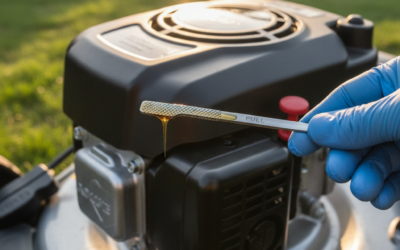
- On a gas mower, check fuel and oil in a well-ventilated place, with the engine cold, following the manual. Wipe spills. Do not add fuel with the engine running or hot.
- On a battery mower, seat the pack fully and confirm the handle controls feel normal.
- On a corded mower, inspect the cord and any outdoor-rated extension for cuts or crushed insulation. Keep connections off wet ground when you can.
If the blade is nicked, bent, or badly worn, do not mow as if that is acceptable. A damaged blade can vibrate, tear grass, and throw pieces. Sharpening or replacement is a shop task if you are not equipped to do it safely with the machine fully disabled.
Set Cutting Height and Avoid Scalping
Cutting height is a judgment call, not a single universal number. On most walk-behind rotary mowers you change it with levers at the wheels or a single deck-height control. Reel mowers usually have a roller or bedknife adjustment described in their manual. Set all wheels or sides to the same height unless the manual describes a specific exception. An uneven deck will leave a step in the grass.
A somewhat higher cut is often kinder to the lawn than a very short one. Taller grass shades the soil, helps the plant keep more leaf, and is less likely to brown after a hot or dry stretch. A common guideline is to avoid removing most of the grass blade in one mowing—often summarized as not taking more than about one-third of the height at a time. Treat that as a rule of thumb, not a measured law. Species, season, and how long the lawn has been neglected all change what is reasonable. If you need an exact target in inches or centimeters for a named grass, use local extension guidance or a turf source you trust rather than a single article.
Scalping is cutting so low that the mower peels turf off high spots, leaving brown soil, crowns, or bare patches. You can often spot ground that will scalp before you start: humps, the high side of a slope, the crown over tree roots, the lip of a sidewalk, and any ridge left by previous wheel tracks. Raise the deck on rough or neglected turf. If the lawn has not been cut in a while, take more than one pass. Cut high first, then lower the deck a notch and go over it again after the grass has had a chance to stand back up, or at least after you have cleared the bulk of the growth. Forcing a very low cut through tall, wet, or lumpy grass buries the deck, tears turf, and leaves a chewed look.
Start the Mower and Push With an Even Overlap
Start on level ground with a clear blade path. Stand so you are not in line with the discharge chute. Keep feet away from the deck. Use the machine’s own controls—blade-control bar, primer or choke if it has them, starter rope or electric start, battery button, or corded switch—exactly as the manual shows. There is no single choke, primer, or battery sequence that fits every model. If the engine or motor does not start after a few normal attempts, stop and check the manual rather than flooding a gas engine or cycling a battery pack endlessly.
Hold the handle with both hands and walk at a steady, comfortable pace. Let the mower do the cutting. Rushing leaves waves of uncut tips and can stall a rotary blade in thick grass. Crawling so slowly that you dwell in one spot can scalp a soft patch or leave a burnished track. You will feel the right pace after a few lengths: the machine sounds loaded but not strained, and the cut behind you looks even.
Overlap each pass by a modest strip so you do not leave ribbons of taller grass between rows. The overlap only needs to cover the uncut edge and any wheel track from the previous pass. A huge overlap wastes time; no overlap leaves stripes you will see from the porch. Watch the line of already-cut grass and keep the deck overlapping it slightly rather than aiming for a measured percentage.
At the end of a row, ease off rather than yanking the handle. For a typical rotary walk-behind, a small U-turn or a two-step pivot works: slow down, lift slightly if the design allows you to take weight off the front without tipping the machine toward your feet, and swing into the next row so the wheels do not grind a hole in soft turf. Do not jerk a running mower backward toward your feet. If you must pull it toward you, stop the blade first unless the manual describes a specific reverse procedure for that model. Reel mowers are often easier to turn in a gentle arc; avoid twisting the reel sideways across the turf.
On a corded mower, start with the cord laid out to the side you will finish last, then keep it behind you on already-cut grass. Never step over a live cord toward the deck, and never let the cord run under the housing. If the cord gets ahead of you, stop, shut the mower off, and reset the cord. Do not mow in standing water.
Use a Simple Pattern and Change Direction Next Time
A simple pattern is enough for an ordinary residential lawn. The goal is even coverage, not a show stripe.
On a rectangular lawn, mow the longest direction in straight, slightly overlapping rows. Many people cut a perimeter pass first to create a turning lane, then fill in the interior. Others mow the interior first and tidy the edges last. Either order works if you stay consistent and do not leave islands of uncut grass. A perimeter-first approach is handy when beds, fences, and sidewalks give you a clean frame to work inside. Doing the perimeter last can help you blow or throw remaining clippings onto the lawn instead of into a flower bed, depending on which way the chute faces.
Around beds, trees, and irregular edges, slow down and treat the obstacle as a separate loop. Mow a careful ring or a series of short passes that follow the curve, then return to your main rows. Do not scrape the deck against trunks, landscape timber, or stone; that chips bark and can throw chips back at you. Leave a small buffer if you cannot see the ground at the base of a plant. You can tidy that strip later with the mower’s edge, a trimmer, or hand shears.
Gentle curves are fine on kidney-shaped lawns or along a driveway. Force-fitting a rigid grid onto a curved space usually leaves awkward leftover patches. Keep the overlap honest on curves; the inside of a turn covers less ground than it looks.
Change direction on later mowing sessions. If you always push the same way, wheels can mat the same paths and the grass can lean in one direction, which makes the next cut look uneven even when the height is right. Alternating direction—north–south one time, east–west the next, or a diagonal on a later visit—reduces wheel tracks and matting. That is a practical habit, not a promise that striping or a special pattern will improve turf health by a measured amount. You do not need a striping kit to mow well.
Manage Clippings, Edges, Wet Grass, and Tall Grass
How you handle clippings depends on how much you cut and how dry the grass is. Short, dry clippings can often be left on the lawn. They sift down and break down. That is ordinary mulching practice, whether you use a mulch plug or simply discharge lightly over the turf. Thick wet clumps are different: they can smother the grass underneath, leave yellow patches, and clog the deck. If you see ropes or piles of wet clippings, stop and rake or bag them rather than driving them into the lawn.
Bag or rake when the grass is long, when you made a heavy cut, when the lawn is already thatchy and matted, or when clippings would wash onto a walk or into a storm drain. Local rules about dumping clippings vary; follow whatever your city or homeowners’ association requires. Do not invent a disposal method that ignores those rules.
Finish along fences, walks, and beds with the tools you have. A side-discharge rotary mower can often make a close pass with the chute aimed onto the lawn, not toward the street, a window, or gravel. A bagging setup keeps the edge cleaner. A reel mower can usually run quite close to a hard edge if the ground is even. You may still need a second tool for the last strip against a wall or under a low fence. Take that last strip slowly so the deck does not climb the hard surface and scalp the turf beside it.
Soaked grass is a poor time to mow. The cut is usually ragged, the wheels rut soft ground, clippings clump, and footing is worse. Skip a soaked lawn when you can. Light dew is not the same as saturated soil, but if the mower is smearing grass instead of cutting it, stop and wait. Do not treat standing water as an acceptable mowing surface, especially with a corded machine.
For overgrown grass, raise the cutting height and plan more than one pass. Knock the lawn down high, let the remaining blades spring up, then lower the deck a step and cut again. Trying to bury the mower in a single low pass stalls rotary blades, leaves a mashed mat, and is hard on you and the machine. Work in smaller zones if the growth is very heavy so you can clear the discharge path as you go. If the grass is so tall that you cannot see hazards, walk it again and consider a trimmer or a higher first cut before you commit the mower to hidden holes and debris.
Stay in Control on Slopes and Around People
Mow only slopes you can walk and control with firm footing. If the hill feels steep enough that you might slip, or if the mower starts to feel heavier than you can steer, stop. There is no single degree or percent grade that is safe for every person and every walk-behind mower. Wet grass, loose soil, and hidden holes make a moderate slope behave like a steep one.
On a moderate slope you can handle, many walk-behind users prefer to mow across the face rather than straight up and down, because pushing a heavy gas mower uphill is exhausting and pulling it downhill can get away from you. Across-the-slope mowing is not automatically safe: a slip can send you toward the downhill side of the deck. Choose the direction that keeps the machine below your hands and your feet out from under it, and shorten your passes so you are never committed to a long run you cannot stop. Do not mow a slope that requires you to hold the handle with one hand or lean over the deck.
If the mower starts to slip or pull, release the blade-control bar, get your feet clear, and let the machine stop. Do not try to catch a sliding mower from the downhill side. Do not leave a running mower unattended on any grade.
Treat gravel, roads, windows, parked cars, and bystanders as no-discharge zones. Point the chute toward the lawn. Slow down near gravel driveways; stones under the deck become missiles. Near a street, watch for traffic if you must step off the grass. Keep people and pets away until the blade has stopped. Never reach under the deck to clear a clog while the machine is running, and never disable a safety interlock to “make it easier.”
Gas mowers add fuel, fire, and exhaust hazards. Refuel outdoors, engine off and cool, away from sparks. Do not run a gas mower in an enclosed garage. Corded mowers add trip and shock hazards if the cord is damaged or used in standing water. Battery packs should stay dry and undamaged. None of these power sources changes the basic rule: if you lose control or cannot see the ground, stop.
Stop, Clean, and Store the Mower
When the last pass is done, release the blade-control bar or use the machine’s stop control so the blade and power source shut down. On a gas mower, wait until the engine has fully stopped. On electric models, remove the key or battery if the design uses one, and unplug a corded mower at the outlet end when you are finished. Do not walk away from a machine that is still spinning down.
The blade must be fully stopped before anyone approaches the deck. Do not put hands or feet under the housing to pull out clippings while there is any chance the blade can move. If you need to tip the mower to clean the underside, follow the manual for which way to tip it. A common concern on gas models is avoiding fuel or oil spills from the tank and carburetor; the safe tilt direction is model-specific. Wait until hot surfaces have cooled enough to handle. Cleaning means scraping or brushing off clippings after shutdown, not spraying a hot engine or muffler with a hose as a shortcut. Water in the wrong place can damage an engine or create a shock hazard on an electric machine. Use only the cleaning method your manual allows.
Clear the discharge chute and bag so damp grass does not sit and rot in place. Empty clippings onto a compost pile, garden, or disposal stream that is allowed where you live. Wipe the deck exterior so you can see damage next time. Coil a cord without kinking it. For leftover fuel, a battery, or long-term storage, follow the owner’s manual and local fire rules. Fuel shelf life, stabilizer use, and battery storage temperatures are not the same for every product, and inventing a number here would be guesswork. Store the mower where children cannot start it, on a stable surface, with the blade stopped and the power source disabled.
Fix an Uneven or Ragged Cut
If the lawn looks worse than it should, check technique and a few visible parts of the machine before you assume the turf is failing.
Strips of taller grass usually mean you did not overlap enough, you drifted off the previous line, or one side of the deck is set lower than the other. Slow down, match the height levers, and overlap a bit more on the next pass. Wheel tracks that look like uncut ribbons often disappear if you change direction next time and keep the deck level.
A mower that bogs down or leaves clumps is often working through grass that is too tall, too wet, or both. Raise the height, wait for the lawn to dry, and take a second pass. A packed discharge chute or a full bag will also make a rotary mower choke and dump wet piles. Stop the blade fully, then clear the chute with a stick, not your hand.
Grass that looks shredded or gray-brown at the tips is often the sign of a dull or damaged blade. A sharp blade shears; a dull one tears. Hitting a hidden object can nick the edge or bend the blade so it no longer cuts cleanly and may vibrate. Do not keep mowing with a blade that is bent or missing pieces. Have it sharpened or replaced by someone who can do that work with the machine safely disabled. Do not treat a single adjustment as a guarantee that the lawn will recover overnight; torn tips usually grow out with the next healthy mowings if you stop tearing them.
If the mower will not start, stay with first checks rather than dismantling the engine or motor. Confirm fuel, a charged battery, a fully seated pack, a plugged-in cord, the presence of a required key, and that safety bars and interlocks are actually engaged. Look for an obvious loose spark-plug boot on a gas model only after the engine is cool and you know how that machine is meant to be inspected. Anything beyond those basics belongs in the manual or with a qualified repair shop. Guessing at torque specs, oil types, or internal failures is how small problems become unsafe ones.
Mowing well with a push mower is mostly judgment: a clear yard, a height that respects the ground, a steady overlapping walk, and a full shutdown before you clean up. Do that consistently, change direction on later visits, and skip the soaked or out-of-control situations, and a typical residential lawn will look even without special equipment or invented settings.