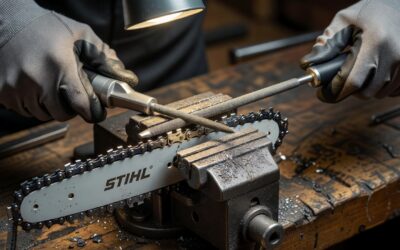
To sharpen a chainsaw chain, first stop the saw and disconnect its power source, then secure the bar with the chain brake engaged. Use a round file sized to your chain’s pitch and a file guide to file each cutter tooth with smooth, one-directional strokes at the angle marked on the cutter, giving every tooth the same number of strokes. Check the depth gauges periodically and file them down with a flat file when needed. A sharp chain produces square chips, pulls itself through the wood, and requires little pressure.
Sharpening a chainsaw chain is a routine maintenance task that most owners can learn to do at home. A sharp chain cuts faster, safer, and with less strain on the saw’s engine. While there are electric sharpeners and bench grinders available, hand-filing with a round file is the most common and accessible method for keeping your chain in top condition between more intensive maintenance sessions.
What You Need Before You Start: Safety Gear and Tools
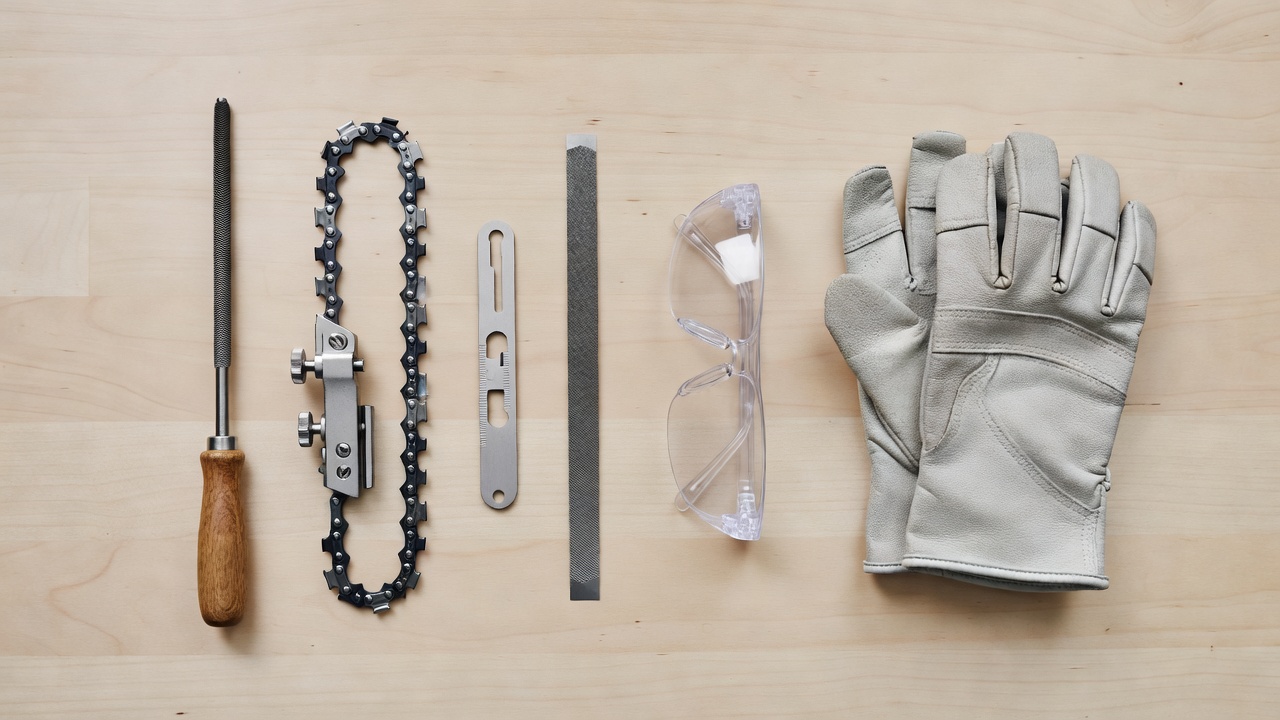
Before you touch the chain, proper preparation prevents injury and ensures you can work effectively. Always stop the saw and disconnect its power source. For a gas-powered saw, this means removing the spark plug lead. For a battery-powered saw, remove the battery. Engage the chain brake and, if possible, secure the guide bar in a vise or clamp so the chain cannot move while you work.
Wear appropriate safety gear: eye protection to guard against metal filings, work gloves to protect your hands from the sharp cutters, and hearing protection if you’re in a noisy environment.
The essential tools for manual sharpening include:
- A round file: This is the primary tool for sharpening the cutter teeth. Its diameter must match the pitch of your chain. You can find the correct size by checking the markings on the chain itself, the chain’s packaging, or the saw’s documentation.
- A file guide: This accessory fits over the round file and rests on the chain, helping you maintain the correct filing angle and depth. It is highly recommended for beginners to ensure consistency.
- A depth gauge tool and a flat file: These are used to check and adjust the height of the depth gauges (also called rakers), which is a critical but often overlooked part of sharpening.
You should also determine if your chain is still serviceable. If the cutter teeth are cracked, broken, or worn down to the point where they cannot be reshaped, or if the drive links are damaged, the chain should be replaced rather than sharpened.
Understanding the Chain: Cutters, Depth Gauges, and Pitch
To file correctly, it helps to understand the basic anatomy of the chain you’re working on. The chain is made of several key components:
- Cutter teeth: These are the sharp, angled pieces that do the actual cutting. Each cutter has a top plate (the angled surface on top) and a side plate (the vertical cutting edge). The gullet is the curved space behind the cutter that clears wood chips.
- Depth gauges (rakers): These sit just in front of each cutter tooth. Their job is to control how deep the cutter bites into the wood. If they are too high, the chain won’t cut aggressively enough. If they are filed too low, the chain will grab too much wood, which is inefficient and increases the risk of dangerous kickback.
- Chain pitch: This refers to the spacing between the drive links on the chain. The pitch determines which size round file you need. Using the wrong file size will round off the cutter’s edges instead of sharpening them properly.
Most chains have the filing angle marked directly on the cutter or listed in the manufacturer’s documentation. This angle is crucial for restoring the cutter’s original cutting geometry.
How to Sharpen the Cutters, Step by Step
With the saw secured and the correct tools in hand, you can begin filing. The goal is to restore the sharp edges of each cutter tooth with identical precision.
- Position the file: Place the file guide on the chain so the round file rests in the gullet of a cutter tooth. The guide should sit flat on the top plate of the cutter and the adjacent depth gauge.
- Set the angle: Align the file guide with the angle mark on the cutter. Most guides have lines that correspond to common filing angles. Ensure the file is level horizontally.
- File with smooth strokes: Push the file forward across the cutter with steady, moderate pressure. This is the cutting stroke. On the return stroke, lift the file slightly so it does not drag against the metal and dull the edge you just created. This one-directional filing is key to a sharp edge.
- Count your strokes: Give each cutter tooth the same number of forward strokes. This ensures all teeth are the same length, which is essential for a balanced, smooth cut. A common practice is to use the same number of strokes you started with, or until the cutter’s edge is bright and sharp along its entire length.
- Work systematically: Start with one cutter on the top of the chain. File it, then rotate the chain to bring the next cutter of the same orientation (e.g., all left-hand cutters) into position. Once all cutters of one orientation are done, repeat the process for the opposite set (e.g., all right-hand cutters).
The correct filing motion is a smooth push forward, not a back-and-forth sawing action. Let the file do the work; excessive pressure can damage the file and the cutter.
Checking and Adjusting the Depth Gauges
After sharpening the cutters, you must check the depth gauges. As the cutters are filed back, the depth gauges can become relatively too high, preventing the chain from cutting effectively.
To check them, place the depth gauge tool over a cutter. The tool has a slot that exposes the tip of the depth gauge. If the gauge protrudes above the tool’s surface, it needs to be filed down.
Using a flat file, file the depth gauge in the direction of the cutter’s motion (forward). File it down until it is flush with the surface of the depth gauge tool. Repeat this for every depth gauge on the chain. Be cautious: filing depth gauges too low is a common mistake that creates an aggressive, unsafe chain with increased kickback potential.
How to Know the Chain Is Sharp
Before returning to work, verify your results with these observable signs:
- Chip shape: A sharp chain produces square, chunky wood chips. A dull chain creates fine, powdery sawdust.
- Cutting feel: The saw should pull itself into the cut with minimal pressure from you. If you have to force the saw, the chain may still be dull.
- Visual inspection: The cutting edges of the top and side plates should appear bright, smooth, and free of nicks or rounded edges.
If the chain cuts crookedly, it often means one side of the chain (either the left or right cutters) was filed more than the other, creating an imbalance.
When to Replace the Chain Instead of Sharpening
Sharpening has its limits. You should replace the chain if:
- Cutter teeth are cracked, broken, or chipped beyond repair.
- Drive links are damaged or worn.
- The chain shows significant rust or wear that extends beyond the cutting edges.
- The chain will not stay properly tensioned on the bar, even after adjustment.
- The cutters have been filed back so many times that they are dangerously small.
Attempting to sharpen a chain that is physically damaged or excessively worn is unsafe and ineffective.
Common Mistakes and Quick Troubleshooting
Avoid these errors to maintain a safe and effective chain:
- Using the wrong file size: A file that is too large will round off the cutter’s edge instead of sharpening it.
- Filing at the wrong angle: This alters the cutter’s geometry, reducing cutting efficiency.
- Uneven strokes: Giving some teeth more strokes than others creates an imbalanced chain that cuts poorly and wears unevenly.
- Filing on the return stroke: This dulls the fresh edge you just created.
- Over-filing depth gauges: This is a serious safety hazard that makes the chain grab aggressively.
If the chain still cuts poorly after sharpening, recheck your filing angle, ensure you used the correct file size, and verify that all cutters received an equal number of strokes. If it cuts crooked, compare the length and sharpness of the left and right cutters.
Other Sharpening Methods at a Glance
While hand-filing is the most common method for routine maintenance, alternatives exist. Electric chain sharpeners and bench grinders can sharpen a chain quickly, but they require careful setup and alignment to avoid damaging the chain. They are often used by professionals or for restoring very dull chains. Hand-filing remains a reliable, portable, and cost-effective skill for most chainsaw owners to learn and use regularly.