How to Start a Lawn Mowing Business: The Direct Answer
Starting a lawn mowing business requires six foundational steps: (1) choose a business structure (sole proprietorship, LLC, or S-corp), (2) register your business and obtain required licenses and permits in your jurisdiction, (3) secure liability insurance (typically $300-$1,000+ annually for solo operators), (4) invest in core equipment (mower, string trimmer, leaf blower; $1,500-$5,000 minimum), (5) develop competitive pricing based on local market rates and service scope, and (6) acquire initial customers through local referrals, door-to-door canvassing, and digital presence. Solo operators can launch profitably with minimal overhead; scaling to hire employees introduces payroll taxes, workers’ compensation insurance, and additional regulatory compliance.
Understanding Your Lawn Mowing Business Model
Before diving into administrative setup, clarify the scope and scale of your operation. This decision determines your regulatory burden, startup capital, and growth trajectory.
Solo Operator vs. Multi-Employee Service
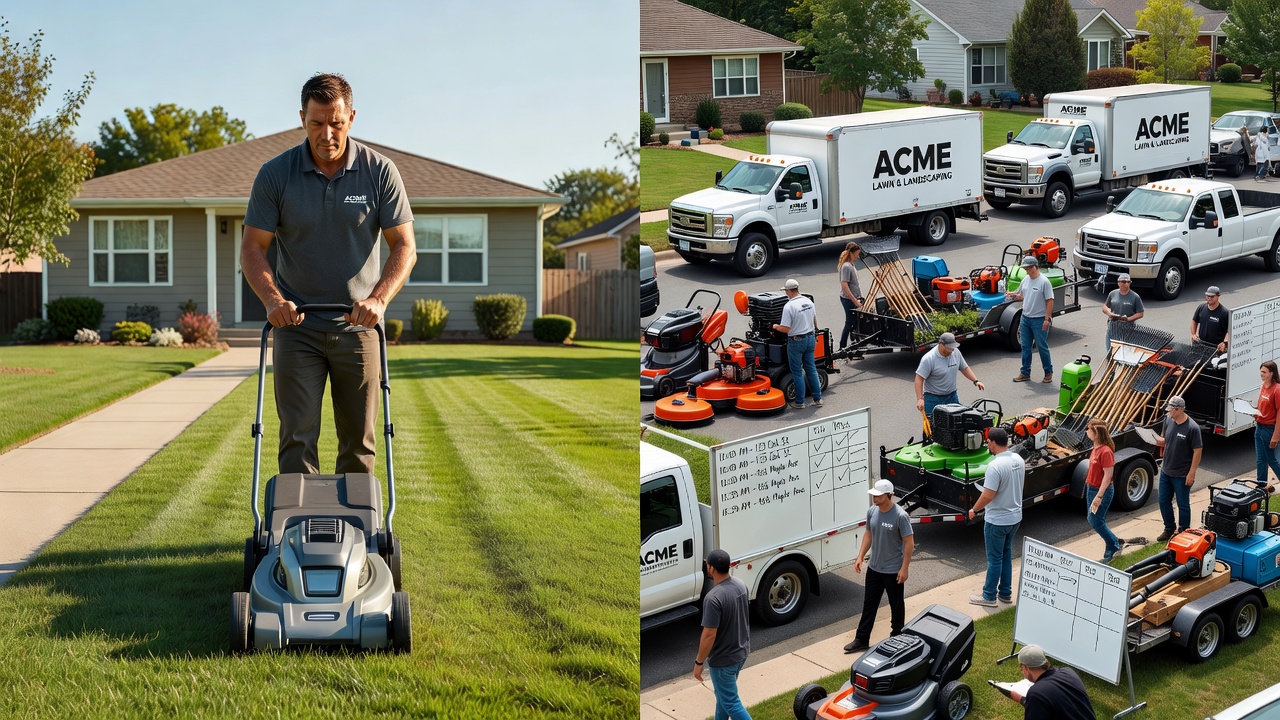
A solo operator is the simplest entry point: you handle all mowing, scheduling, and client communication yourself. Startup overhead is minimal, tax filing is straightforward, and you retain all revenue after expenses. The trade-off is limited income growth without adding team members and capped service capacity (typically 8 to 12 lawns per day, depending on lot size and travel distance).
A multi-person lawn care service allows you to scale revenue and service more customers simultaneously. However, this model introduces payroll taxes, workers’ compensation insurance (mandatory in most states once you hire even one employee), employment liability, and scheduling complexity. Most lawn care business owners start solo and hire crew members only after reaching capacity or revenue benchmarks.
Service Scope: Mowing Only vs. Bundled Services
Launching with lawn mowing only keeps startup simple: one core service, straightforward pricing, and minimal equipment diversity. Many successful operators start here.
Bundled landscaping services (mowing, trimming, mulching, seasonal cleanup, fertilization) command higher margins and improve customer retention but require expanded equipment investment and skills. Defer bundled services until you’ve stabilized mowing revenue.
Business Registration and Legal Structure
Formalizing your business protects personal assets, establishes tax efficiency, and ensures you meet local compliance requirements.
Choose a Business Structure
Three common structures serve lawn mowing startups:
- Sole Proprietorship: Simplest to establish, lowest administrative overhead, and minimal filing fees ($0-$200 depending on state). You and the business are legally one entity, so personal liability is not separated from business liability. Suitable for solo operators with low risk appetite or minimal assets to protect.
- Limited Liability Company (LLC): Separates personal assets from business liability, protecting your home and savings if a client sues. Setup typically costs $50-$500 (state filing fees), and annual renewal fees range from $0-$200. Most small lawn care operators choose this structure for liability protection with minimal complexity.
- S-Corporation: Offers liability protection and potential tax savings on self-employment taxes but requires more complex accounting, quarterly tax filings, and higher formation costs ($500-$1,500). Generally not necessary until revenue exceeds $60,000-$80,000 annually; consult a tax professional before choosing this route.
Recommendation for startups: Most solo operators and small teams benefit from an LLC. It balances liability protection, tax simplicity, and minimal setup cost.
Register Your Business and Obtain Licenses/Permits
Requirements vary significantly by state and locality. Follow this checklist: Users looking for related component recommendations can explore our marshall stanmore iii vs harman kardon onyx studio 8 breakdown.
- State Business Registration: Register your business name with your state’s Secretary of State office (typically online). Filing fee is usually $25-$150. This step is mandatory before opening a business bank account or hiring employees.
- Local Business License: Most cities and counties require a local business license or permit. Cost ranges from $50-$300 annually. Contact your city or county clerk’s office for requirements.
- Landscaping/Contractor License: Some states require a landscaping or general contractor license, especially if you plan to offer fertilization or pesticide application. Licensing typically involves passing an exam and may cost $200-$1,000. Check your state’s Department of Consumer Affairs or equivalent agency.
- Sales Tax Permit: If your state collects sales tax, apply for a sales tax permit from your state’s Department of Revenue. This is usually free and required before collecting client payments.
- EIN (Employer Identification Number): Apply for a federal EIN from the IRS (free, online at irs.gov). You need this to open a business bank account and hire employees. Even sole proprietors benefit from an EIN to separate business and personal finances.
Timeline: Budget 2 to 4 weeks to complete all registrations, longer if your state requires licensing exams.
Insurance and Risk Management
Liability insurance is non-negotiable for lawn care businesses. A single accident, property damage to a client’s home, injury to a bystander, or damage to a vehicle, can bankrupt an uninsured operator. Before finalizing equipment decisions, refer to our comprehensive dyson v8 cyclone vs bissell featherweight stick comparison.
Types of Insurance You Need
- General Liability Insurance: Covers bodily injury (client or bystander injured by your mower or negligence) and property damage (mower thrown object damages client’s window, fence, or vehicle). Annual cost: $300-$800 for solo operators. Typical coverage: $1 million per occurrence, $2 million aggregate. Many clients require proof of this coverage before allowing you on their property.
- Equipment and Tools Coverage: Protects your mower, trimmer, blower, and other equipment against theft, fire, or damage. Often bundled with general liability or purchased separately. Cost: $100-$300 annually, depending on equipment value.
- Workers’ Compensation Insurance: Mandatory in most states if you hire employees (even one part-time worker). Covers employee injuries sustained on the job. Cost varies by state and payroll, typically $1,000-$5,000+ annually for a small crew. Check your state’s workers’ compensation board for minimum requirements and approved insurers.
- Commercial Auto Insurance: If you use a personal vehicle to transport equipment or visit client sites, verify your personal auto policy covers commercial use. Many personal policies exclude business activity. Commercial auto coverage costs $500-$1,500 annually.
Insurance Shopping Tips
Contact multiple insurers specializing in lawn care and landscaping (e.g., State Farm, Nationwide, specialty providers like Insureon). Request quotes for identical coverage limits to compare accurately. Bundling general liability, equipment, and auto coverage often yields discounts. Many insurers now offer streamlined online applications for small operators; you can obtain quotes and bind coverage in 24 to 48 hours.
Equipment Investment and Startup Capital
Quality equipment is the foundation of a reliable service. Underinvesting in tools leads to breakdowns, missed appointments, and lost clients. For broader ecosystem context, read through our operational guide on bissell crosswave hydrosteam vs shark stainforce.
Essential Equipment for a Solo Operator
| Equipment | Typical Cost Range | Notes |
|---|---|---|
| Lawn Mower | $500-$2,000 | Walk-behind mowers (gas or electric) are standard for residential lawns. New mid-range models ($800-$1,200) offer reliability; used commercial-grade mowers ($500-$1,000) are durable but require maintenance inspection. |
| String Trimmer/Weed Whacker | $150-$400 | Gas-powered trimmers are most common for professional use. Lightweight models reduce fatigue on high-volume days. |
| Leaf Blower | $200-$600 | Backpack blowers offer efficiency and comfort. Gas-powered models are more powerful than battery-operated versions. |
| Safety Gear | $100-$250 | Hearing protection, eye protection, work gloves, long pants, and steel-toed boots are essential and required by most jurisdictions. |
| Tool Storage/Transport | $200-$800 | Trailer, truck bed organizer, or storage shed to secure and transport equipment safely. |
| Fuel and Maintenance Supplies | $50-$150 (initial) | Gas, oil, spark plugs, air filters, trimmer line. Budget recurring monthly costs after launch. |
Total Minimum Startup Investment: $1,500-$5,000
A bare-bones launch (used mower, basic trimmer, blower, safety gear, and transport) costs approximately $1,500-$2,500. A more comfortable entry point with newer, more reliable equipment runs $3,500-$5,000. Once operational, ongoing costs include fuel ($200-$400/month), maintenance ($100-$300/month), and insurance ($50-$100/month).
New vs. Used Equipment
Used Equipment: Saves money upfront but carries risk of hidden mechanical issues, limited warranty, and unpredictable repair costs. Suitable if you have mechanical knowledge or access to a trusted technician.
New Equipment: Higher initial cost but includes warranty coverage, reliability assurance, and manufacturer support. Recommended for first-time operators to minimize downtime.
Hybrid Approach: Purchase a new, mid-range mower as your core tool; source a used trimmer and blower to balance cost and reliability.
Pricing Strategy and Setting Service Rates
Underpricing is a common mistake that erodes profitability. Overpricing loses customers to competitors. Research your local market and build pricing around your actual costs.
Research Local Market Rates
Market rates vary dramatically by geography, lawn size, and service scope. A typical range for residential lawn mowing:
- Urban/High-Cost Areas: $40-$80 per lawn
- Suburban Areas: $30-$60 per lawn
- Rural/Lower-Cost Areas: $25-$45 per lawn
Investigate competitors in your area: call 5 to 10 established lawn care services and request quotes for a sample lawn size. Visit Facebook groups or Nextdoor to see what residents are discussing locally. This research takes 2 to 3 hours but yields invaluable market intelligence.
Calculate Your Cost per Lawn
Build a simple spreadsheet to understand profitability:
- Labor Time: Average lawn mowing takes 45 minutes to 1.5 hours (including travel, setup, and cleanup). Calculate your target hourly rate (e.g., $50/hour). A 1-hour lawn = $50 in labor.
- Fuel and Oil: Approximately $5-$10 per lawn (mower, trimmer, blower fuel and maintenance).
- Equipment Depreciation: If your mower costs $1,500 and lasts 5 years (1,000+ operating hours), depreciation is roughly $1.50 per lawn. Spread across a growing customer base, depreciation per lawn decreases.
- Insurance and Overhead: Annual insurance ($500), business registration ($100), licensing ($200), and miscellaneous costs ($200) = $1,000 annually. Divided across 200 lawns/year = $5 per lawn.
- Total Cost per Lawn: $50 (labor) + $7.50 (fuel/maintenance) + $1.50 (depreciation) + $5 (overhead) = ~$64 per lawn.
If local market rates are $40-$60 per lawn and your cost is $64, you face a profitability challenge. Options: (1) improve efficiency (mow faster, reduce travel time between lawns), (2) raise prices slightly ($45-$50), or (3) relocate to a higher-rate market. Most sustainable: improve efficiency through route optimization and skill development.
Pricing Models
- Flat Rate per Lawn: Simplest model. Charge a fixed price regardless of lawn size (e.g., $50 per lawn). Works well for uniform residential neighborhoods. Risk: larger-than-expected lawns reduce profit on specific jobs.
- Tiered by Lawn Size: Charge different rates for small (e.g., $35), medium (e.g., $50), and large (e.g., $70) lawns. More equitable but requires accurate size assessment upfront.
- Hourly Rate: Charge per hour (e.g., $60/hour) with a 1-hour minimum. Transparent for clients but harder to predict final cost. Best used for irregular or specialty jobs, not routine mowing.
- Package/Subscription: Offer recurring service (e.g., weekly mowing for $50/week or $180/month). Generates predictable revenue and improves client retention. Incentivize with 10% discount vs. per-visit rate.
Customer Acquisition and Initial Marketing
Most new lawn care operators fail due to lack of customers, not lack of skill. Proactive, low-cost marketing is essential from day one.
Most Effective Channels for Startups
- Local Referrals and Word-of-Mouth: Tell friends, family, neighbors, and coworkers you’ve launched. Word-of-mouth is the highest-converting channel for service businesses. Offer a $20 referral bonus for each new customer referred by an existing client.
- Door-to-Door Canvassing: Identify target neighborhoods (residential areas within 10 miles of home base to minimize travel time). Knock on doors, introduce your service, leave a simple flyer with your name, phone, and rates. Aim to hand out 50 to 100 flyers weekly. Conversion rates are modest (1 to 3%), but cost is zero except your time.
- Google Business Profile: Create a free Google Business Profile (formerly Google My Business) with your business name, service area, phone, website (even a simple landing page), hours, and photos. Optimize for local search (“lawn mowing near me”). Encourage satisfied customers to leave reviews; Google’s algorithm rewards profiles with positive reviews.
- Social Media: Post before-and-after photos of lawns you’ve mowed on Facebook, Instagram, and TikTok. Use local hashtags (#LawnCare[YourCity], #LandscapeServices[YourCity]). Focus on visual content; the work speaks for itself. Budget: 15 minutes per day posting 2 to 3 photos/updates.
- Nextdoor and Facebook Groups: Join neighborhood-specific Nextdoor and Facebook groups. Introduce your service without hard selling. Answer questions about lawn care (position yourself as knowledgeable). Many successful operators generate 20 to 40% of customers from community groups.
- Craigslist and Local Classifieds: Post a simple ad on Craigslist Services section. Cost: free to $5 per posting. Response rates vary, but posting weekly takes minimal time.
- Partnerships with Related Businesses: Build relationships with local real estate agents, property managers, and home repair contractors. They often receive requests for lawn care recommendations. A simple referral arrangement can generate steady customers.
Building a Basic Online Presence
You don’t need a complex website to launch. A simple one-page site (Wix, Squarespace, or free Google Sites) with the following elements is sufficient:
- Your business name and logo (even a simple text-based logo works)
- Services offered (lawn mowing, trimming, optional add-ons)
- Service area (neighborhoods or radius you cover)
- Pricing (approximate range or sample prices)
- Photos of your work (before-and-after lawn photos)
- Contact info (phone, email, Google Business Profile link)
- Brief customer testimonials (ask first customers for a quick review)
Cost: Free to $10/month for a basic site. Time investment: 3 to 5 hours to set up initially, minimal maintenance afterward.
Promotional Tactics for Bootstrap Startups
- First-Time Customer Discount: Offer 20% off the first mowing to reduce purchase friction (e.g., $40 instead of $50). This softens price objection and builds a trial base.
- Referral Program: Offer $20-$30 credit or cash for each referred customer who books a service. Existing customers become your salesforce with minimal cost.
- Seasonal Promotions: Spring launch promotion (“New to the area, 15% off first three mowings”). Fall cleanup specials (bundled mowing + leaf removal). These create urgency.
- Free Estimates: Offer free in-person quotes. Walking a potential client’s lawn builds confidence and increases conversion vs. phone quotes.
Scaling and Hiring Considerations
After stabilizing as a solo operator (typically 15 to 25 regular customers generating $3,000-$6,000/month), you may consider hiring employees to grow revenue.
When to Hire Your First Employee
Hire when:
- You’re consistently turning away customers due to capacity limits.
- You have 25+ regular customers generating steady revenue ($6,000+/month).
- You’ve operated solo for at least one full season and understand your business rhythms.
Regulatory Changes When Hiring
- Workers’ Compensation Insurance: Mandatory in most states once you hire one employee. Cost: $1,500-$5,000+ annually depending on state and payroll.
- Payroll Taxes: Withhold federal income tax, FICA (Social Security and Medicare), and state taxes. Use a payroll service (QuickBooks Payroll, Gusto, ADP) to automate this; cost is $40-$100/month.
- Employer Identification: You likely already have an EIN from solo operation; confirm it’s in place.
- Background Checks: Conduct criminal background checks on employees (cost: $25-$50 per person). Protects clients and your liability exposure.
Hiring and Team Structure
Start with one part-time employee (e.g., 15 to 20 hours/week) working alongside you before moving to full-time hires. This setup:
- Reduces payroll risk if business slows.
- Allows you to train and evaluate fit without major commitment.
- Generates revenue from 2 to 3 additional crews on busy days.
Typical structure: you manage operations and high-touch client relationships; employees focus on execution (mowing, trimming). Pay part-time crew members $18-$25/hour depending on region and skill. Offer bonuses or profit-sharing once the business reaches $50,000+ annual revenue to improve retention.
Common Questions on How Do You Start A Lawn Mowing Business Answered
Q: Can I start a lawn mowing business with no experience?
A: Yes. Lawn mowing has low technical barriers to entry. Most operators learn through YouTube tutorials, discussions with competitors, and on-the-job practice. Start with friends’ or family members’ lawns to build confidence and a portfolio of before-and-after photos. By your 10th lawn, most operators develop proficiency with equipment and time management. Prioritize customer service and reliability early; skill improvement follows naturally.
Q: What is the most common mistake new lawn mowing operators make?
A: Underpricing is the leading mistake. New operators often charge $25-$30 per lawn to undercut competitors, not accounting for fuel, depreciation, and overhead. This leaves no profit margin and builds unsustainable business economics. Research your market, calculate your actual cost per lawn, and price competitively but profitably. A $40-$60 price range is standard in most U.S. markets; if you’re below $35, you’re likely pricing yourself into failure.
Q: How many customers do I need to make a full-time income?
A: Assuming $50 per lawn and 1 lawn per hour (45 min to 1.5 hours typical), you need approximately 40 lawns per week to earn $2,000/week ($8,000/month before taxes and expenses). Most operators work 4 to 5 days weekly, mowing 8 to 10 lawns per day, which translates to 32 to 50 lawns per week. After fuel, insurance, and equipment costs (~$1,500-$2,000/month), net income is $6,000-$7,000/month for a solo operator. This takes 6 to 12 months to build through customer acquisition and referrals.
Q: Do I need a website or business card to get started?
A: Not immediately. A Google Business Profile, Facebook page, and simple printed business cards (50 cards cost $10-$20 online) are sufficient to launch. Many successful operators generated their first 10 customers through referrals and door-to-door canvassing before investing in a website. Prioritize Google Business Profile first (it’s free and improves local search visibility), then add a simple website once you have 10+ satisfied customers and can feature testimonials and photos.
Conclusion
Starting a lawn mowing business is accessible, low-risk, and capital-efficient. The path is clear: register your business, secure liability insurance, invest in core equipment, research local pricing, and acquire your first customers through referrals and direct marketing. Most operators launch successfully within 4 to 8 weeks for under $3,000 total investment. Growth from solo operator to a multi-person service is optional; many profitable lawn care operators remain solo indefinitely, earning $50,000-$80,000 annually with minimal overhead and flexible schedules. The key is execution: start now, refine pricing and service delivery based on feedback, and scale only when capacity constraints force the decision.
Related Maintenance and Operating Guides
To keep your equipment running at peak operating efficiency, explore our related technical walkthroughs and maintenance tutorials:
- Consult our detailed breakdown on residential zero-turn lawn mower guide.
Safety Planning for Mowing Crews
A mowing business brings traffic, flying debris, and long hours on machines that can throw objects. Crews benefit from written routines for pre-job checks and scheduled breaks.
Employers can review general safety resources for outdoor power equipment at American National Standards Institute (ANSI).