Quick Answer: Leaf Blower Cfm Chart
CFM measures air volume moved per minute: 200 to 350 suits balconies and patios, 350 to 500 handles small residential yards, 500 to 650 clears medium suburban properties, and 650 to 1000+ moves wet, matted leaves on large or commercial sites. Prioritize CFM over MPH for volume clearing; use narrow nozzles to boost MPH for heavy debris.
Pros
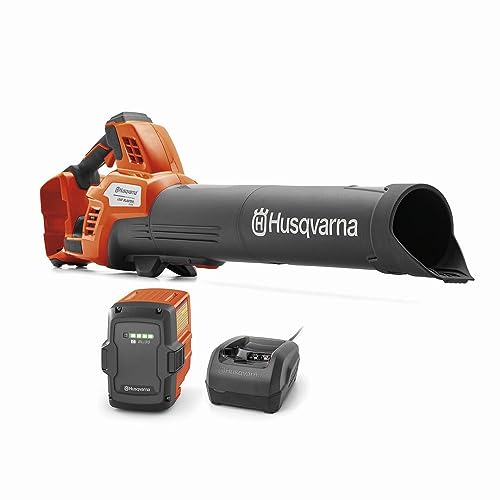
- Produces up to a rated 765 CFM of blowing power
- Variable-speed trigger offers customizable air delivery
- Includes a 56V 5.0Ah battery and matching charger
Cons
- High-output operation can significantly reduce runtime per charge
- 5.0Ah battery adds noticeable weight for single-handed work
Pros
- M18 FUEL system utilizes dual battery power for high output
- Cordless design offers unrestricted portability across large areas
- Integrates with the Milwaukee M18 tool ecosystem
Cons
- Tool only; requires two M18 batteries and a charger sold separately
- Dual batteries increase overall handheld carrying weight
Pros
- Offers up to a manufacturer-rated 700 CFM air volume
- Brushless motor ensures efficient power delivery
- Includes a 4.0Ah battery and rapid charger
Cons
- The 60V battery pack adds weight during extended handheld use
What Is CFM, Exactly: The Physics Behind the Number
CFM stands for cubic feet per minute. It is a volumetric flow rate: the amount of air a blower moves through its outlet in sixty seconds, measured in cubic feet. A blower rated at 500 CFM moves 500 cubic feet of air every minute, roughly the volume of a 10 ft × 10 ft × 5 ft room.
The physics is straightforward. An impeller (a fan wheel) spins inside a housing, drawing air in axially and discharging it tangentially through the nozzle. The volume of air displaced per revolution is fixed by the impeller’s swept volume and housing geometry; multiply by RPM and you get CFM. Air velocity at the nozzle , the MPH rating , is a separate variable: the same volume forced through a narrower opening exits faster, which is why a small round nozzle concentrates force while a wide floor nozzle spreads it. For broader ecosystem context, read through our operational guide on how to choose leaf blower.
Two practical consequences follow. First, CFM and MPH are not interchangeable, and manufacturers rarely test both at the same nozzle configuration. Second, CFM ratings are measured at the outlet with no back-pressure; real-world airflow drops when you attach tubes, bend the nozzle toward the ground, or push into a deep leaf pile.
How to Read a Leaf Blower CFM Chart
A CFM chart maps airflow ratings to yard conditions and debris types. Use the table below as a sizing reference, then cross-check against your property’s actual square footage and typical debris load.
| CFM Range | Typical Use Case | Debris Handled | Best Blower Type |
|---|---|---|---|
| 150 to 250 | Balconies, patios, decks, garage aprons | Dry leaves, pine needles, grass clippings | Handheld cordless |
| 250 to 400 | Small urban/suburban yards under 2,000 sq ft | Dry to slightly damp leaves, light litter | Handheld cordless or electric |
| 400 to 550 | Medium residential yards, 2,000 to 5,000 sq ft | Mixed leaves, wet clippings, acorns | Handheld gas or high-output cordless |
| 550 to 700 | Large residential lots, 5,000 to 10,000 sq ft | Heavy leaf fall, wet matted debris, small twigs | Backpack gas or backpack battery |
| 700 to 1,000+ | Commercial properties, acreage, storm cleanup | Deep piles, wet heavy leaves, mixed yard waste | Professional backpack gas |
For context, most consumer cordless leaf blowers land in the 350 to 650 CFM band, with premium 60V and 80V models pushing past 700 CFM on turbo settings. Turbo or boost modes typically sustain maximum CFM for only 10 to 20 seconds before thermal or battery limits kick in, check the manufacturer’s sustained rating, not just the peak.
CFM vs. MPH: Which Number Actually Matters
CFM determines how much debris you can move per pass; MPH determines how hard the air hits it. For bulk leaf clearing, CFM is the dominant factor, you are moving volume, not launching projectiles. MPH matters when you need to break the surface tension of wet, matted leaves or dislodge debris stuck in turf.
A useful rule of thumb: prioritize CFM, then use nozzle geometry to trade volume for velocity when needed. Swapping a wide floor nozzle for a narrow concentrator tube can raise effective airspeed substantially without changing the motor’s output. If you are choosing between two models and can only optimize one metric, keep CFM high, velocity can be recovered at the nozzle, but volume cannot be manufactured by the motor.
For a deeper side-by-side breakdown of how these two metrics interact across gas and electric platforms, see our gas or electric leaf blower comparison.
Step-by-Step: Sizing a Blower to Your Yard
Step 1: Measure Your Clearing Area
Walk the perimeter of the area you clear regularly and multiply length by width. Include driveways, walkways, and under-deck zones, these often double the effective clearing area compared to lawn alone.
Step 2: Classify Your Debris Load
Dry oak and maple leaves move easily at lower CFM. Wet leaves, pine straw mats, and grass clippings cling to surfaces and require higher sustained airflow plus a velocity-focused nozzle. Heavy acorn and nut drops add weight that pure MPH cannot compensate for, you need volume.
Step 3: Match CFM to the Chart Above
Cross-reference your area and debris class against the CFM chart. If you fall between two bands, choose the higher rating, underpowered blowers force multiple passes, which erodes any battery-life or cost savings.
Step 4: Decide Handheld vs. Backpack
Handheld units are lighter and adequate under roughly 550 CFM for short sessions. Above that threshold, or for clearing sessions longer than 20 to 30 minutes, a backpack configuration distributes weight across your shoulders and reduces fatigue. Our backpack vs handheld blowers guide covers the ergonomic trade-offs in detail.
Diagnostic Matrix: Why Your Blower Underperforms Its CFM Rating
If your blower moves less air than the chart suggests it should, work through this matrix before assuming the motor has failed.
| Symptom | Likely Cause | Diagnostic Check | Fix |
|---|---|---|---|
| Airflow drops noticeably after a few minutes | Thermal throttle or low battery voltage | Check if turbo mode cuts out on a timer; test with a fully charged battery | Use sustained (non-turbo) mode for bulk clearing; carry a spare battery |
| Weaker output with tube attached vs. bare outlet | Tube restriction, kink, or improper seating | Remove tube and compare airflow by hand; inspect for cracks or blockages | Reseat tube, clear debris from the housing, replace damaged sections |
| High-pitched whine, low volume | Impeller imbalance or debris lodged in the housing | Unplug, open housing per manual, inspect impeller for bent blades or packed leaves | Clean housing; replace impeller if blades are damaged |
| Airflow fine at nozzle but leaves won’t lift | Wrong nozzle for debris type | Test with a narrow concentrator tube on wet leaves | Swap to a velocity nozzle for wet/matted debris; use wide nozzle for dry bulk |
| Gas blower bogs down under load | Carburetor, air filter, or fuel issue, not CFM | Check air filter cleanliness, fuel freshness, spark arrestor screen | Clean/replace air filter, drain old fuel, clear spark arrestor |
| Gradual power loss over weeks | Dirty air filter or clogged intake screen | Inspect intake vents for packed dust and lawn debris | Clean intake screen and air filter at every session in dusty conditions |
For gas-powered units, most “low CFM” complaints trace back to maintenance rather than design. A clogged air filter alone can cut airflow by a significant margin. Our chainsaw and outdoor tool maintenance resource covers the same filter, fuel, and spark-plug service intervals that apply to small two-stroke blower engines.
Maintenance Intervals to Protect Rated CFM
A blower that is maintained to spec will hold its rated airflow for years. Follow this schedule:
| Component | Interval | Action |
|---|---|---|
| Air filter (gas) | Every 10 to 15 hours of use, or more often in dusty conditions | Clean with compressed air or replace if torn/oil-soaked |
| Intake screen (all types) | Every session | Brush off leaves, grass, and dust before storage |
| Impeller housing | Monthly during leaf season | Open housing, clear packed debris, inspect blades |
| Fuel system (gas) | Before storage and at season start | Drain stale fuel, run stabilizer, replace fuel filter annually |
| Battery contacts (cordless) | Monthly | Wipe with a dry cloth; store at ~50% charge in cool conditions |
| Nozzles and tubes | As needed | Check for cracks, warping, or loose fit that leaks pressure |
Safety and Regulatory Notes
High-CFM blowers generate significant noise and can propel debris at dangerous velocities. Always wear eye protection and closed-toe shoes, and never point the nozzle at people, pets, or windows. Many municipalities restrict blower use by decibel level and time of day, check local ordinances before operating commercial-grade units in residential neighborhoods. For workplace and jobsite requirements, consult OSHA equipment safety regulations.
Key Takeaways
CFM is the primary metric for leaf blower selection because it directly determines how much debris you can move per pass. Match your CFM rating to your yard size and debris type using the chart above, prioritize sustained airflow over peak turbo numbers, and maintain filters and impellers on a regular schedule to keep your blower performing at its rated output. When in doubt, size up, an underpowered blower costs you more in time and repeated passes than the price difference on a higher-CFM model.
Reading an Airflow Comparison Chart
A CFM chart helps line up models side by side, but its value depends on the conditions behind each figure. Check whether the numbers come from the manufacturer or an independent source, and note which nozzle was used. General safety context for garden machines is also listed at American National Standards Institute (ANSI).